

Buying smoking accessories online works best when you start with the retailer, not the product page. A legitimate online headshop verifies age at checkout, names the materials on every listing, ships in plain packaging, and publishes a real return policy. Look for borosilicate glass, platinum-cured silicone, and authorized vaporizer dealers, then verify each item with the manufacturer before you pay.
How Can You Tell if an Online Headshop Is Legitimate?
A legitimate online headshop makes its rules and business details easy to find. Check the footer, contact page, checkout page, and policy pages before you place an order. You should be able to find a working email address, a clear way to contact support, shipping details, return terms, and the legal name or address connected to the business.
Age checks are another useful signal when the retailer sells covered tobacco products. Federal law sets 21 as the minimum age for tobacco sales. Since September 30, 2024, retailers must check photo identification for customers younger than 30 who try to buy covered tobacco products. [1] The exact checkout process can differ by product and seller, but a retailer should not hide its age policy.
The PACT Act adds rules for remote sales of cigarettes, smokeless tobacco, and electronic nicotine delivery systems. Covered sellers must register, follow state and local requirements, verify age at delivery, and meet labeling, recordkeeping, and packaging rules. [2] These rules do not apply to every accessory in the same way, so read what the store says about the product you are buying.
Look at how the site handles basic questions. A dependable seller should answer questions about dimensions, replacement parts, materials, warranties, and order problems. A store with copied descriptions, no support channel, and policies that contradict one another is not worth the gamble, even when the price looks tempting.
- Find a working support email, business address, and clear contact page.
- Read the age, shipping, privacy, return, and warranty policies before checkout.
- Check that product pages name the maker, materials, dimensions, and included parts.
- Look for secure checkout and a normal payment process with an order confirmation.
- Leave if the seller hides its identity, copies listings, or promises prices that make no sense.
Which Materials Should You Look for and Which Should You Avoid?
Material details tell you more than a product photo. A good listing names the exact material used in the main body, bowl, stem, mouthpiece, seals, and electronic housing when those parts apply. It should not make you guess whether a piece is glass, coated metal, plastic, or silicone.
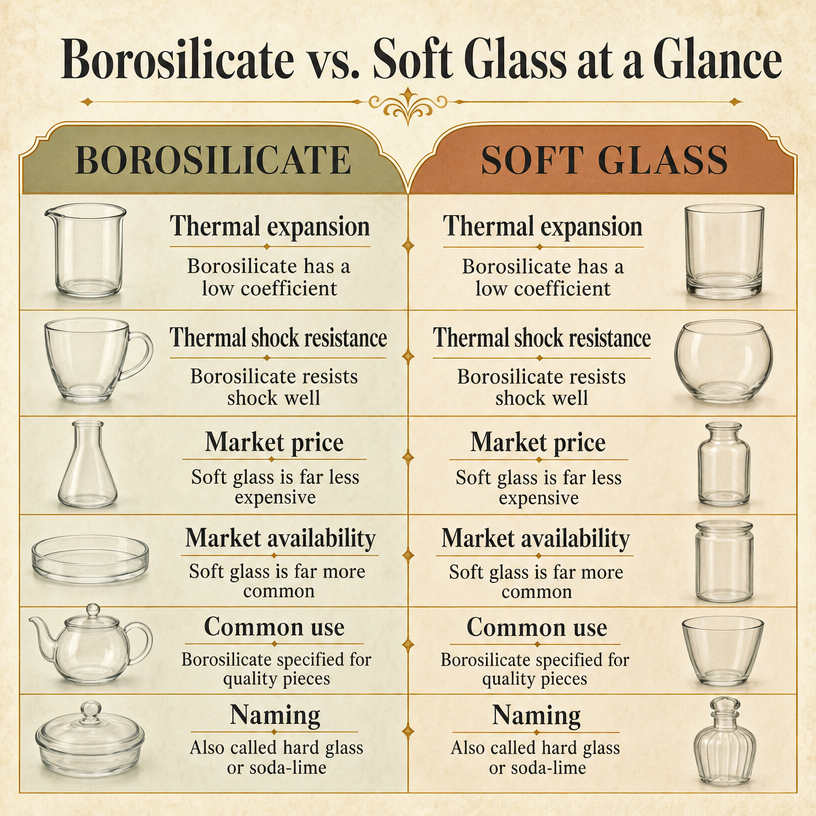
For glass accessories, borosilicate is a useful term to look for. It has a lower rate of thermal expansion than soda-lime glass and is more resistant to sudden temperature changes. [7] A listing that says only thick glass or premium glass does not tell you the glass type, no matter how polished the photos appear.
For silicone, ask whether it is platinum-cured or peroxide-cured. Seller terminology varies, and labels such as food-grade do not always explain the curing process. [6] For metal parts, look for a named metal or alloy instead of a broad term that omits the material. For electronics, check the maker, model, battery information, warranty, replacement parts, and charging instructions.
Also check whether materials are named consistently across the title, description, specifications, and package photo. If one part says borosilicate while another says glass, ask the seller to confirm. A careful product page should make comparison easy, not send you on a scavenger hunt.
- Prefer exact terms such as borosilicate glass, platinum-cured silicone, or a named metal alloy.
- Question vague labels such as premium glass or quality silicone that omit the material.
- Check every part that touches heat or needs regular cleaning, not just the main body.
- Compare the written specifications with the package photos and maker information.
- Skip mystery materials when the retailer cannot provide a direct answer.
How Can You Tell if a Glass Piece Is Borosilicate Instead of Soft Glass?
You usually cannot confirm a glass formula from a photo alone. Color, shine, wall thickness, and weight are not proof. The best starting point is a product page that states borosilicate glass in the specifications and identifies the maker. If the wording is missing, ask the retailer for confirmation in writing.
Borosilicate glass has a lower coefficient of thermal expansion than soda-lime, often called soft glass. That gives borosilicate greater resistance to thermal shock. Soft glass is common across the wider glass market and usually costs less. [7] This difference is useful for judging a listing, but it does not mean every thick or expensive piece is borosilicate.
Price can be a clue, not proof. An unusually cheap and complex piece described as hand-blown borosilicate deserves a closer look. Check whether the artist, studio, or manufacturer is named. Search the maker’s official site for the same model, dimensions, logo placement, and packaging. If the seller uses only stock photos, ask for current product photos.
Read reviews for facts rather than excitement. Useful reviews mention fit, dimensions, joint size, packaging, and whether the received item matched the listing. A handful of short reviews that repeat the product description add little value. A clear return policy matters because even a well-packed glass order can arrive with damage.
- Read the material field and look for the full words borosilicate glass.
- Confirm the maker and compare the model with its official listing.
- Ask the retailer to state the glass type when the page is vague.
- Check dimensions, joint size, wall details, and included parts across all page sections.
- Save the listing and written answer in case the received item differs.
| Attribute | Borosilicate (hard glass) | Soft (soda-lime) glass |
|---|---|---|
| Thermal expansion | Low coefficient of expansion | High coefficient of expansion |
| Thermal shock resistance | Resists sudden temperature changes | Susceptible to shock from temperature changes |
| Market price | More expensive to produce and ship | Far less expensive across the wider glass market |
| Market availability | Specified for quality pipes and water pipes | Far more common in the broader glass market |
| Identification on listings | Usually named as borosilicate or hard glass | Often unnamed; described as glass or thick glass |
| Why it matters online | Better signal of quality at a higher price | Lower price is not proof of glass type |
How Do You Verify a Premium Vaporizer Is Authentic Online?
Start with the manufacturer’s website. Many premium brands publish an authorized-dealer list or offer a dealer search tool. If the retailer is not listed, ask the manufacturer before buying. Marketplace sellers and third-party storefronts can change often, so verify the exact seller name rather than relying on the marketplace name alone.
Next, check the serial-number process. Storz & Bickel, for example, directs customers to register a device using the serial number on its type plate. [5] Registration gives you a direct way to compare the device with the manufacturer’s records. Do not post a full serial number in a public review or photo.
Manufacturer quality systems can also help you compare brands. Storz & Bickel says its devices are made under an ISO 13485-certified quality management system and receive documented inspection. [4] That statement applies to the named manufacturer; it should not be copied onto an unrelated product simply because both are vaporizers.
Before opening or using the device, compare the box, seal, model name, charger, manual, serial label, and included parts with the manufacturer’s official product page. If anything does not match, take photos and contact both the seller and maker. Keep the shipping box until registration and inspection are complete.
- Find the exact retailer on the manufacturer’s authorized-dealer list.
- Compare the listing, model number, price, color, and package contents with the official page.
- Inspect the sealed box, labels, serial number, charger, manual, and included parts after delivery.
- Register the serial number directly with the manufacturer when registration is offered.
- Stop and contact the seller if registration fails or package details do not match.
How Do You Read Food-Grade and Other Silicone Claims?
Silicone listings often use broad grade labels, but those words may not tell you how the item was made. Seller terminology can vary, so the more useful question is whether the silicone is platinum-cured or peroxide-cured. The answer should come from the maker or retailer, not from a guess based on color or flexibility.
Platinum-cured silicone is described by multiple manufacturers as a different curing method than the more common peroxide-cured silicone, and curing process is a more useful comparison point than any single grade label. [6] Because the supplied source is an industry discussion rather than a regulator, use it as a prompt for better questions, not as a universal rule for every product.
A good listing should name the maker, curing process, temperature limits supplied by the maker, care instructions, and any removable parts. If the page says only premium silicone, ask for the missing details. Also check whether replacement glass bowls, downstems, seals, or lids are available for the exact model.
Strong smells, oily surfaces, unsupported temperature promises, and missing maker details are reasons to pause. Do not try to prove a material claim with a home flame or heat test. Instead, request documentation, compare the maker’s page, and use the return window if the received product does not match the listing.
- Ask whether the silicone is platinum-cured or peroxide-cured.
- Look for maker-provided care directions and temperature limits.
- Check that removable glass and silicone parts are named separately.
- Confirm that replacement parts fit the exact model and size.
- Avoid listings that offer only broad grade labels with no maker details.
What Should You Look for in Shipping, Packaging, and Returns?
Read shipping and return policies before adding a product to your cart. Check processing time, carrier options, tracking, delivery estimates, signature rules, shipping cost, and the address used for returns. A delivery estimate should separate order processing from carrier travel time, especially during holidays.
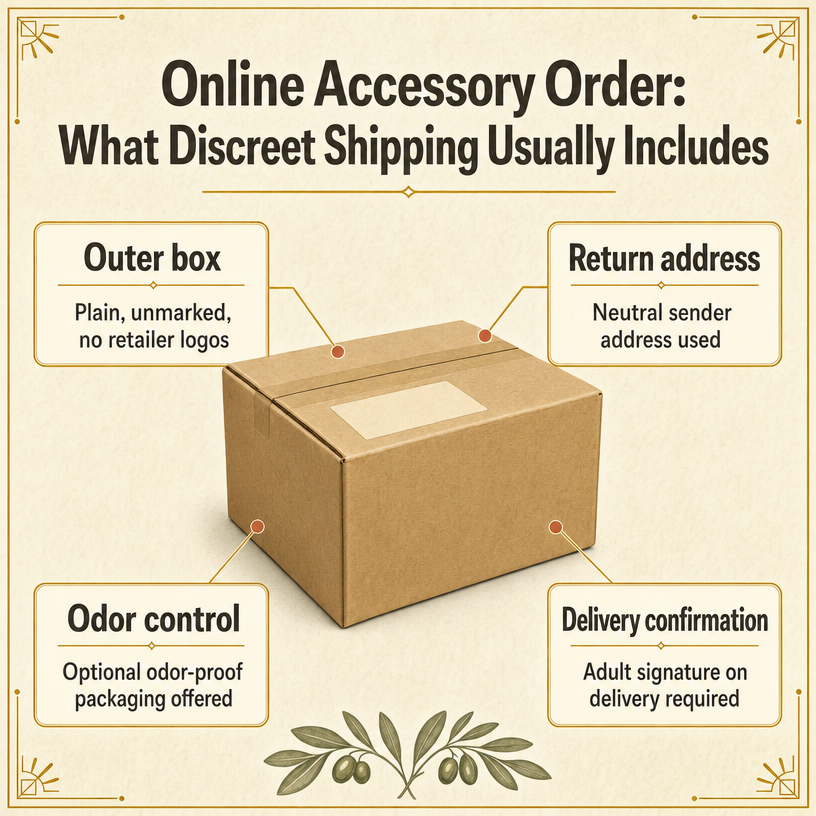
Many accessory retailers describe plain boxes, neutral return addresses, and limited branding as privacy practices. Some may also offer special liners or require an adult signature, but those features vary by retailer and order type. [8] Do not assume discreet means no age check or no signature. Read the exact policy for your cart.
Glass and electronics need clear damage procedures. Find out how quickly you must report a broken or missing item, what photos are required, and whether you must keep the outer box. Some stores will not accept a used item, and some manufacturer warranties cover defects while the retailer handles shipping damage. Know which party to contact first.
Returns can become expensive when a store charges restocking fees or makes the buyer pay return shipping. Look for exclusions covering opened electronics, used accessories, clearance items, and damaged packaging. Take screenshots of the policy and product page because terms can change after an order is placed.
- Read processing times, carrier choices, tracking rules, and delivery estimates.
- Confirm whether the package is plain and whether an adult signature is required.
- Check the deadline and photo requirements for reporting damage.
- Read return exclusions, restocking fees, and return-shipping costs.
- Save the listing, policies, receipt, tracking number, and delivery photos until the order is settled.
How Can You Spot Misleading Made in USA and Origin Claims?
Country-of-origin language can be precise or slippery. An unqualified Made in USA statement means the product should meet the Federal Trade Commission’s all-or-virtually-all standard. The FTC rule covers claims made in online listings and catalogs, and marketers can face civil penalties for claims that do not meet the standard. [3]
Qualified phrases tell a different story. Made in USA with imported parts, assembled in USA, designed in USA, and finished in USA do not all mean the same thing. Read the complete phrase instead of focusing on a flag graphic or a large USA headline. The smaller words may carry the important limit.
Check whether the claim applies to the whole item or only one part. A glass body might be made in one country while a bowl, case, charger, or packaging comes from another. A retailer should repeat the manufacturer’s exact claim rather than rewriting it into something broader.
Origin alone does not tell you whether an accessory is a good fit. Use it as one fact alongside materials, dimensions, maker reputation, warranty, replacement parts, price, and return terms. If origin is central to your buying choice, ask for a direct answer and keep it with your order records.
- An unqualified Made in USA claim is subject to the Federal Trade Commission’s all-or-virtually-all standard.
- Qualified phrases such as ‘with imported parts,’ ‘assembled in,’ and ‘designed in’ describe a different scope and change the claim’s meaning.
- Check whether the wording applies to the whole item or only one part such as the glass, bowl, case, charger, or packaging.
- A flag graphic, city name, or American-themed logo is not the same as a clear origin statement.
- Compare the retailer’s claim with the manufacturer’s exact wording before you handle it as fact.
Where Should You Shop for Smoking Accessories Online?
Shop with a retailer that gives you enough information to make a calm comparison. The best choice is not always the store with the biggest catalog or lowest price. It is the store that names products accurately, answers questions, posts workable policies, and supports the order when something goes wrong.
Compare two or three retailers before checkout. Use the same checklist for each one: seller identity, product materials, maker details, price, stock status, dimensions, included parts, warranty, shipping, and returns. Put the results in a simple note so a flashy sale banner does not distract from missing information.
Treehouse Lifestyle offers a broad online selection of accessories, and qualifying carts receive free shipping on orders $150+. Use the standards in this guide while browsing any retailer, including Treehouse Lifestyle. A product should earn your attention through useful details rather than vague promises.
Give yourself time to read before ordering. If the product page leaves one important question unanswered, contact support. A clear answer can confirm your choice; a vague or missing answer can save you from an order you would regret.
- Confirm the seller’s identity, contact details, age rules, and checkout process.
- Verify the material, maker, dimensions, included parts, and stock status.
- Authenticate brand-name electronics through the manufacturer when possible.
- Read shipping, damage, warranty, and return terms before paying.
- Keep screenshots and order records until you have inspected the delivery.
Frequently Asked Questions
Can you buy smoking accessories online with confidence?
Yes, if you verify the retailer and product before paying. Look for clear contact details, exact material information, age rules where required, shipping terms, and a return policy. For a brand-name electronic device, check the manufacturer’s authorized sellers and serial-number process.
How do you know whether a glass piece is borosilicate?
Look for borosilicate glass in the written specifications and confirm the maker. Photos, thickness, color, and price are not proof by themselves. If the listing is vague, ask the retailer to state the glass type in writing before you order.
What does food-grade silicone tell you?
It is a seller or industry label that may not explain the curing process. Ask whether the item is platinum-cured or peroxide-cured, then check the maker’s care directions, listed limits, and replacement-part details.
How do you check whether a vaporizer is genuine?
Buy from a seller listed by the manufacturer, compare the model and package contents with the official page, and register the serial number directly with the manufacturer when that option is offered. Keep the box and receipt until the check is complete.
Will an online headshop use plain packaging?
Many retailers say they use plain boxes and neutral return addresses, but details vary. Check the seller’s policy for branding, signature requirements, tracking, and any special packaging before placing the order.
What Is the Smartest Way to Buy Smoking Accessories Online?
The smartest approach is simple: check the seller, verify the product details, and read the order policies before you pay. Exact materials, a named maker, useful specifications, and direct answers matter more than broad claims or dramatic discounts.
Use the eight section checklists every time you compare a glass piece, silicone accessory, vaporizer, or full setup. A few extra minutes of checking can help you choose the right size, understand what will arrive, and know what to do if the order does not match the listing.
Sources
- U.S. Food and Drug Administration: Tobacco 21
- Bureau of Alcohol, Tobacco, Firearms and Explosives: Prevent All Cigarette Trafficking (PACT) Act
- U.S. Federal Trade Commission: Complying with the Made in USA Standard
- Storz & Bickel GmbH: About Us / Quality and Responsibility
- Storz & Bickel GmbH: Device Registration
- Reddit / r/cookware community discussion: Silicone Cookware Needs to be Platinum Cured
- Museum of Glass: Borosilicate Glass vs. Soft Glass — What’s the Difference?
- Zaleaf: Discreet Cannabis Shipping: Worry-Free 2025