
This smoking accessories checklist starts with four basics: a grinder, one way to use flower, a reliable lighter, and an airtight storage container. Choose a hand pipe, water pipe, rolling papers, or pre-rolled cones as your one starting method. Add trays, tips, cleaning supplies, and cases later when they solve a real problem. [1] [2] [3]
What are the four core items in a beginner cannabis kit?
The best smoking accessories checklist starts small. A useful first kit covers preparation, use, ignition, and storage. Most beginners can meet those needs with four items instead of a drawer full of gadgets.
First, a grinder breaks flower into a more even texture. Second, you need one device or rolling option. Third, you need a dependable heat source. Fourth, you need a container that closes tightly between sessions. Beginner guides from several retailers use this same basic framework. [1] [2] [3]
Choose the device based on how and where you plan to use it. A small hand pipe takes little setup. A water pipe needs water, a steady surface, and more care. Papers take practice, while cones arrive already shaped. Buying one path first gives you time to learn before spending more.
The storage container matters even if the rest of the kit is simple. An airtight glass jar limits air exchange and helps keep flower organized. A smell-proof bag can hold the jar, grinder, lighter, and small tools together, especially in a shared space. [1] [2] [4]
Think of these items as a working system. The grinder prepares the flower, the device holds it, the lighter provides heat, and the container stores what remains. If an item does not help one of those jobs yet, it can probably wait.
- Grinder: Breaks flower into a consistent texture for packing or rolling.
- One consumption option: Choose a hand pipe, water pipe, rolling papers, or pre-rolled cones.
- Reliable lighter: Keep one working lighter with the kit and consider a spare.
- Airtight storage: Use a jar or sealed container that fits the amount you normally keep.
Which grinder should a beginner buy first?
A grinder is one of the most useful first purchases because it does one simple job again and again. It breaks flower into smaller, more even pieces, making it easier to place in a bowl or spread across paper. A consistent texture also helps prevent large pieces from blocking airflow or creating an uneven roll. [1] [2] [4]
For most beginners, a medium manual grinder is the easiest choice. It is large enough to hold a practical amount but still easy to store. A very small grinder may need several loads, while a large model takes more room and may be more than one person needs.
Material affects feel and durability. Metal grinders are common because their teeth stay firm and their threads can last with basic care. Other materials may cost less or weigh less, but the teeth, lid fit, and turning action matter more than a fancy finish.
A two-piece grinder has a top and bottom chamber. It is simple and compact. A three- or four-piece model adds a collection chamber, a screen, or both. Multi-piece models often include a lower chamber for kief, which is the fine material that passes through the screen. [1] [4]
Before buying, turn the lid if possible and check that it moves without grinding against the body. Look for teeth that meet without touching, a magnet or secure closure, and threads that line up easily. A small cleaning brush or soft dry brush can help remove material from corners.
Do not overfill the chamber. Leave enough room for the teeth to move, then use a few short turns instead of forcing the lid. Empty the grinder after use if you want less material left in the teeth and threads.
- Size: Pick a medium grinder for a balance of capacity and easy storage.
- Material: Compare the strength of the teeth, the lid fit, and the turning action.
- Chambers: Choose two pieces for simplicity or more pieces for separation and collection.
- Kief chamber: Consider one if you want fine material collected below a screen.
- Care: Look for easy-to-reach corners and threads that can be brushed clean.
Pipe, bong, or rolling papers—which one should a beginner start with?
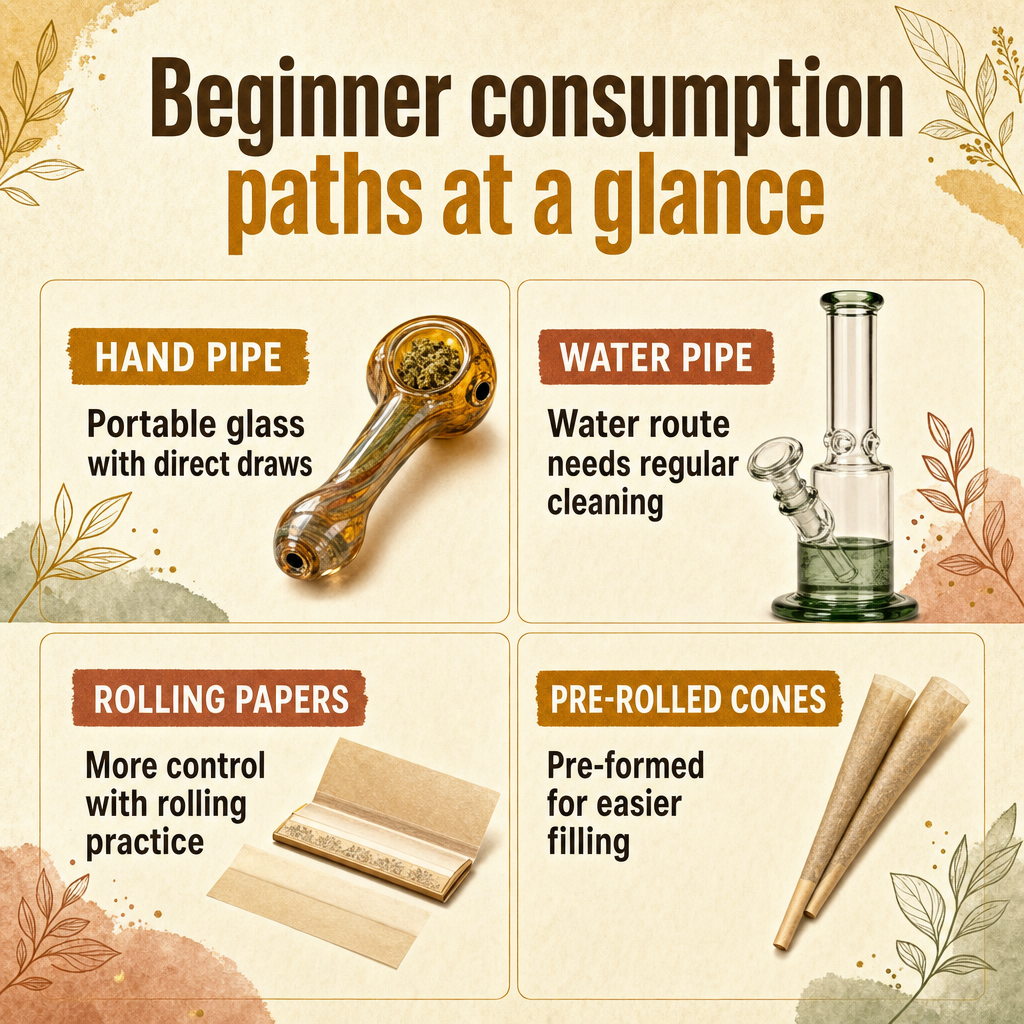
A beginner should start with one method, not all of them. Hand pipes, water pipes, papers, and cones each have a different setup and care routine. Your best choice depends on space, portability, patience, and how much cleanup you want.
A hand pipe is compact and has only a few parts. Spoon pipes are common, while chillums and one-hitters have a straighter shape. A glass hand pipe offers direct use and is easy to carry in a padded case, but it needs regular cleaning and can break if dropped. [2] [3]
A water pipe, often called a bong, routes smoke through water before it reaches the mouthpiece. It usually stays at home because it needs a level surface, fresh water, and more cleaning than a small pipe. Change the water often and keep the base where it cannot be bumped. [2]
Flat rolling papers provide the most control over size and shape, but hand rolling takes practice. New users may waste a few papers while learning how tightly to roll and how much flower to add. Filter tips can give the end more structure and help keep loose material in place.
Pre-rolled cones remove the shaping step. You fill the open end, pack the contents gently, and twist the top closed. They are a practical choice for someone who wants the paper format without learning to form a roll right away. [3] [4]
Cost also matters. A basic pipe is a one-time purchase but needs cleaning supplies. Papers and cones cost less at first, yet they must be replaced. A water pipe can cost more and needs a safe storage spot. Compare the full routine, not just the price tag.
If you want the fewest steps, begin with a small hand pipe. If you prefer the paper format but not the learning curve, choose cones. Pick flat papers when learning to roll is part of the goal. Choose a water pipe when you have a stable home setup and do not mind the added upkeep.
- Hand pipe: Compact, reusable, direct, and easy to set up, but breakable and in need of routine cleaning.
- Water pipe: Better suited to a stable home surface and requires water changes plus regular cleaning.
- Rolling papers: Offer control over the finished roll but require practice and replacement supplies.
- Pre-rolled cones: Arrive shaped and are easier to fill, making them a simple paper-based starting point.
| Option | Best fit | Main upkeep |
|---|---|---|
| Hand pipe | Portable, quick setup | Brush and deep-clean residue |
| Water pipe | Home use with a stable surface | Change water and clean several parts |
| Rolling papers | People who want control and practice | Restock papers and tips |
| Pre-rolled cones | People who want easy filling | Restock cones |
How do rolling papers, cones, and filter tips actually differ?
Rolling papers are flat sheets that you shape by hand. Cones use similar paper but come formed with an open end for filling and a narrow end that usually includes a tip. Beginners often find cones easier because there is no need to build the shape first. [3] [4]
Paper material changes thickness, feel, and how easy the sheet is to handle. Hemp paper is often forgiving and slower burning. Rice paper is very thin and can be harder for new hands to manage. Flax and wood-pulp papers are widely available and often inexpensive. [5]
The strip along one edge is the adhesive. Gum arabic is common, while some papers use sugar gum or tree sap. Lightly moisten only the strip; soaking it can make the paper wrinkle or tear. Adhesive type usually matters less to a beginner than paper thickness, size, and ease of handling. [5]
Filter tips, also called rolling tips, are small pieces of firm paper or card placed at one end. They do not work like an air filter. Their main jobs are to give the roll structure, improve airflow through the open end, and help stop loose flower from reaching the mouth. [2] [3] [4]
Choose a size that matches how much you plan to roll. Standard or one-and-one-quarter-size papers are easier to manage than oversized sheets for many beginners. Some booklets include tips, which reduces the number of separate supplies in the kit.
Store papers and cones in a dry case where they will not bend or become damp. Keep tips in the same case so the pieces stay together. If you are still deciding, buy one small pack of papers and one small pack of cones rather than a bulk box.
- Hemp papers: Often forgiving to handle and known for a slower burn.
- Rice papers: Very thin with low ash, but they can be harder to roll.
- Flax or wood-pulp papers: Common, thin options that are often budget friendly.
- Pre-rolled cones: Best when you want to fill a ready-made shape instead of rolling one.
- Filter tips: Add structure, support airflow, and help contain loose material.
What else should a beginner add beyond the core accessories?
Once the core kit works, add accessories in the order that removes daily frustration. This keeps your first purchase focused and prevents small tools from becoming clutter. A useful extra should save material, improve organization, or make care easier.
A rolling tray is often the first worthwhile addition. It gives you a contained surface for grinding, filling, and packing. Raised edges catch loose material that might otherwise end up on the floor. Trays range from pocket-size metal models to larger wooden designs with room for a jar, grinder, papers, and lighter. [1] [2] [4]
Tips come next if you use papers. They support the end of a roll and help keep its shape. A simple packing tool is helpful with cones, narrow bowls, and small chambers, but it does not need to be fancy. A clean wooden tool or a purpose-made tamper can do the job.
An ashtray provides a dedicated resting and disposal spot. Choose one with a wide, steady base and place it on a hard surface. A small case or stash bag can then keep the lighter, papers, tips, and tools together instead of scattered through drawers.
Cleaning supplies should be purchased before a reusable piece becomes difficult to maintain. Keep them separate from flower and papers, with caps closed and labels intact. The basic set includes isopropyl alcohol, coarse salt for suitable glass pieces, cotton swabs, and pipe cleaners. [2] [4]
Some add-ons are mostly about convenience. A spare lighter prevents an annoying interruption. A paper case prevents bent papers. Humidity-control products may help with a larger storage routine, but they are not required for a small first kit.
Treehouse Lifestyle offers free shipping on orders $150+, but do not build a larger order just to reach the threshold. Buy the core items and the extras you will actually use. A smaller, well-organized kit beats a large pile of tools with no clear purpose.
- Add a rolling tray when you need a clean, contained work surface.
- Add filter tips or a cone-packing tool when your chosen method calls for them.
- Add an ashtray with a steady base for a dedicated resting and disposal spot.
- Add a case or smell-proof bag when small tools are becoming scattered.
- Add cleaning supplies before residue becomes difficult to remove.
- Add a spare lighter and paper case only if they improve your routine.
What cleaning supplies belong in a beginner cannabis kit?
A basic cleaning kit for reusable glass can be small: isopropyl alcohol at ninety percent or higher, coarse salt, pipe cleaners, cotton swabs, sealable bags or plugs, and clean water for rinsing. Premixed glass cleaners are another option. Always follow the maker’s care directions because wood, painted parts, electronics, acrylic, and soft materials may need different methods. [2] [4]
For removable parts, begin only after the piece is cool and empty. Take apart the components that are designed to come off. Place small glass parts in a sealed bag so they do not disappear down a drain or strike a hard sink.
For plain glass, alcohol loosens residue while coarse salt acts as a gentle abrasive when moved inside the piece. Add enough liquid to reach the coated areas, add some salt, close the openings, and shake with control. Pipe cleaners and cotton swabs help reach narrow spots. [2] [4]
Do not mix cleaning products. Keep alcohol away from flame and heat, use it in a ventilated space, and follow the warning label. Store cleaning supplies in their original containers, away from the cannabis kit and out of reach of children and pets.
Rinse the glass with clean water after the residue is gone. Check corners, joints, and narrow channels for remaining salt or cleaner. Let every part dry fully before putting the piece back together or returning it to storage.
A regular schedule makes the job easier. Empty used water after a session, wipe easy-to-reach spots before buildup hardens, and perform a deeper cleaning when residue is visible. Clean tools also keep the kit from becoming sticky and difficult to organize.
- Let the piece cool, empty it, and remove only parts meant to detach.
- Place small glass parts in a sealable bag and add isopropyl alcohol.
- Add coarse salt to suitable plain glass as a gentle scrubbing material.
- Close the openings and shake carefully without striking nearby surfaces.
- Use pipe cleaners or cotton swabs on narrow areas and stubborn spots.
- Rinse with clean water, inspect every channel, and let all parts dry.
How should beginners store flower and smoking accessories at home?
Good storage has four jobs: limit air exchange, control odor, keep small tools together, and restrict access. An airtight glass jar is a common choice for flower. Use a container sized close to what you keep so there is not a large amount of empty space. [1] [2] [4]
Smell-proof containers and bags can help limit odor in shared spaces or during lawful travel. A padded bag can also hold a grinder, lighter, and small glass piece. Keep breakable items separated so they do not strike each other when the bag moves. [2] [4]
Labeling matters. Keep cannabis in clearly marked, resealable, child-resistant packaging rather than a food container. Do not place it near snacks, medicine, or anything a child could mistake for an ordinary household item.
In homes with children, a high shelf alone is not enough. State guidance recommends a locked cabinet or lockbox that is out of sight and reach. The container should remain closed after every use, and the key or code should not be accessible to a child. [7]
Pets also need to be considered. Keep products in sealed containers inside an elevated locked cabinet. Do not leave flower, ash, used papers, or cleaning materials on low tables or floors. Keep pets in another well-ventilated room when smoke is present. [7]
Create one return spot for the whole kit. After use, count the important parts, close the jar, clean up loose material, return the lighter and tools to their case, and lock everything away. A short routine reduces forgotten items and makes the next setup easier.
For accidental ingestion by a child, the cited state guidance lists Poison Control at 1-800-222-1222. For a pet, contact a veterinarian promptly; the same guidance lists ASPCA Animal Poison Control at 888-426-4435. [7]
- Place flower in a clearly labeled, airtight or smell-proof container.
- Put grinders, papers, lighters, and tools in a case or organized bag.
- Separate breakable glass parts and close every zipper, lid, and latch.
- Move the complete kit into an elevated locked cabinet or lockbox.
- Keep the key or access code away from children and other unauthorized users.
- Check the room for loose material, used papers, ash, and cleaning supplies before leaving.
Frequently Asked Questions
What is the cheapest way to build a beginner smoking kit?
Buy only the four core items: a small grinder, one simple consumption option, a reliable lighter, and an airtight container. Add a tray, tips, tools, and cleaning supplies only when they solve a real problem.
Do beginners really need a grinder?
A grinder is strongly recommended because it creates a more consistent texture for easier packing or rolling. A simple two-piece model works, while multi-piece grinders add collection chambers.
Should a beginner start with rolling papers or pre-rolled cones?
Pre-rolled cones are easier to fill because the shape is already formed. Flat papers provide more control over size and shape but require practice, so cones are usually the simpler first choice.
What kind of lighter belongs in a beginner kit?
A dependable standard lighter is the normal choice for flower. Keep it in the kit and consider a spare. Torch-style lighters are generally associated with concentrates and dab rigs, not a basic flower kit.
What supplies are used to clean a pipe or bong?
For suitable plain glass, the common kit includes ninety-percent-or-higher isopropyl alcohol, coarse salt, pipe cleaners, cotton swabs, and clean rinse water. Follow the maker’s directions for other materials.
Where should beginners keep their kit at home?
Keep flower sealed and accessories organized in a case or bag. In homes with children or pets, place the complete kit in an elevated locked cabinet or lockbox, out of sight and reach.
What should you buy first for a simple beginner kit?
Buy a grinder, one consumption option, a reliable lighter, and an airtight storage container first. That is enough to create a practical beginner kit without paying for tools you may never use.
After a few sessions, add accessories in response to real needs. Choose a tray if you are losing flower, tips if your rolls lack structure, a case if tools are scattered, and cleaning supplies for reusable pieces. Store the whole kit sealed, organized, and locked away from children and pets.
Sources
- Curio Wellness: Build Your First Smoke Session Kit: The Essentials Checklist
- Stoops NYC: Your Cannabis Accessories Starter Pack: Trays, Pipes and Papers
- Monteverde: Best Cannabis Accessories for Beginners: What to Buy First
- Ivy Hall Dispensary: Must-Have Cannabis Stash Essentials and Accessories
- Azarius: Rolling Papers Compared: RAW vs OCB vs Elements vs Rizla vs Smoking
- Wikipedia: RAW (rolling papers)
- New Mexico Regulation and Licensing Department, Cannabis Control Division: Safe Storage of Cannabis
- Harm Reduction Journal (Springer Nature): Not all screens are created equal: examination of surface features and other physical properties of commonly used screen materials for smoking drugs