

Choose an Eyce silicone pipe by format: Shorty and Spoon are dry hand pipes, Hammer is a water bubbler, and Mini Beaker and Beaker are water pipes. Then compare removable glass parts, cleaning access, and storage space. A silicone body does not make every component unbreakable, so check replacement fit and warranty terms before buying. [1]
How do Eyce pipes, bubblers, and bongs differ?
Eyce is not a single pipe shape. Its manufacturer guides cover dry hand pipes, a water bubbler, Beaker-style water pipes, and concentrate-oriented products. Start by sorting those groups before comparing extras. A model that looks appealing may still be the wrong format for your needs. [1]
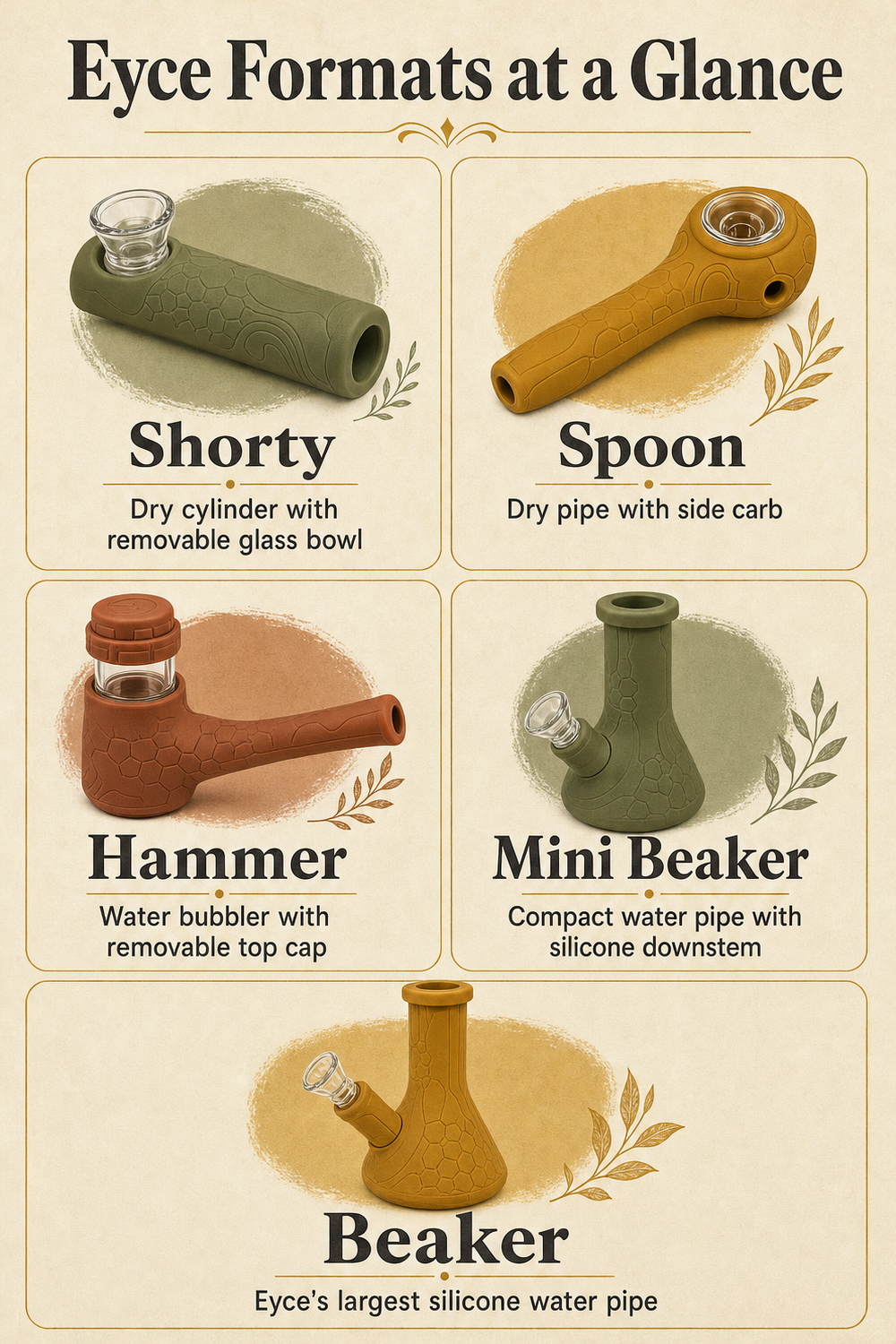
A dry hand pipe does not need a water chamber as part of its layout. The Shorty and Spoon belong in that group, but their shapes differ. The Shorty has a straight cylinder layout, while the Spoon has a bowl, stem, mouthpiece, and side carb. The carb is a separate opening in the pipe body. [1] [3]
The Hammer belongs between a dry hand pipe and a larger water pipe. Eyce describes a bubbler as a hybrid of those formats. The Hammer has a water chamber and an elongated mouthpiece; it should not be confused with the dry Spoon just because both have hand-pipe-style shapes. [1]
For wider category browsing, compare Hand Pipes with Bongs. Those pages help separate layouts, but a category name alone does not tell you a model’s materials, included parts, or replacement fit. Read the exact listing before treating two pieces as equivalent.
A listing such as SILICONE BEAKER BONG WITH REMOVABLE GLASS BOWL is another place to compare body-and-bowl construction. Do not assume it is an Eyce model based on its generic name. Brand, exact model, and included components still need their own checks.
Water-pipe formats also add filling and emptying to your routine. That matters when choosing where to keep the piece and how much maintenance you want. Choose the layout you will actually manage, not the largest model simply because it has more room.
- Shorty and Spoon: dry hand-pipe formats with different bowl and body layouts.
- Hammer: a bubbler with a water chamber and elongated mouthpiece.
- Mini Beaker and Beaker: water-pipe formats with a chamber, slide or bowl, downstem, and mouthpiece.
- Collector, Rig II, and Sidecar: concentrate-oriented products in Eyce’s guide lineup, not interchangeable substitutes for its dry pipes. [1]
| Eyce model | Format | Detail to compare |
|---|---|---|
| Shorty | Dry hand pipe | Straight cylinder; removable glass bowl |
| Spoon | Dry hand pipe | Side carb; removable glass bowl |
| Hammer | Water bubbler | Removable top cap for chamber access |
| Mini Beaker | Compact water pipe | Glass slide and silicone downstem |
| Beaker | Larger water pipe | Eyce’s largest silicone water-pipe format |
Should you choose an Eyce Shorty or Spoon?
Choose between the Shorty and Spoon by looking at their layouts, not by expecting a promised result. The Shorty is a straight silicone cylinder with a bowl at one end and a mouthpiece at the other. Its product page lists a keychain loop and a removable, snap-in 13 mm borosilicate glass bowl. The body is described as platinum-cured silicone. [2]
The Spoon takes a different shape. Its guide identifies a glass bowl, side carb, stem, and mouthpiece, along with an accompanying steel poker. That makes it a separate dry-pipe design, not a Shorty with a different name. Decide which arrangement you prefer to hold, store, and take apart. [3]
The keychain loop is a documented carrying feature on the Shorty. It does not mean you should leave exposed glass loose against other items. Think about where the bowl will sit in your bag and whether you can keep it away from keys or other hard objects.
Both models make glass-part access worth checking. The Spoon guide tells you to remove the glass bowl and clean it separately from the silicone body. The Shorty’s bowl also comes out for cleaning. Before buying, look at the removal instructions rather than guessing how much force the fit needs. [2] [3]
Do not extend the Shorty’s 13 mm bowl specification to the Spoon or the rest of the Eyce range. A stated size on one model is not a promise of universal fit. A replacement listing should name the model it fits.
If your real question is about materials rather than shape, read Glass vs Silicone Smoking Accessories: Which Should You Choose? alongside this model comparison. If you are still considering a glass water pipe instead of either dry format, Is Diamond Glass a good choice for an affordable everyday bong? explores a different buying route. Neither related guide replaces the exact Eyce model’s parts and care instructions.
- Shorty layout: straight cylinder, end bowl, and mouthpiece.
- Shorty components: listed platinum-cured silicone body, removable 13 mm glass bowl, and keychain loop.
- Spoon layout: glass bowl, side carb, stem, and mouthpiece.
- Spoon maintenance: removable glass bowl for separate cleaning, with a steel poker identified in its guide.
- Fit check: confirm replacement compatibility for the named model rather than sharing bowls by guesswork.
Should you buy an Eyce Hammer, Mini Beaker, or Beaker?
Start with the Hammer if you want to compare a bubbler layout against Beaker-style water pipes. The Hammer has a water chamber and an elongated mouthpiece. Its product listing names a removable borosilicate glass bowl, platinum-cured silicone body, removable top cap, stainless steel poker, and integrated storage container. [1] [4]
The top cap is more than a detail in a product photo. Eyce says it provides access for filling, emptying, and cleaning. When you compare models, ask how you will reach the chamber and how many pieces need to come off. Easy-to-understand access may matter more to your routine than an extra compartment. [4]
The Beaker family uses a water-pipe layout. Eyce presents the Beaker as its largest silicone water pipe and the Mini Beaker as its compact counterpart. Their guides identify a slide or bowl, downstem, mouthpiece, and chamber. Compare them by storage space, layout, and access to the parts you will clean. [1] [5] [6]
The Mini Beaker guide specifically identifies a glass slide and a silicone downstem. The Beaker guide discusses separate glass components. Do not copy the Mini’s downstem material into a description of the larger Beaker; check each model’s own information. Shared family names do not mean every part is the same. [5] [6]
Use the Eyce Mini Silicone Beaker Bong listing to inspect the compact option’s current details. Check the included pieces and care information, and compare them with the manufacturer guide. A product photo can help you picture the format, but it cannot establish an unstated part size.
Before choosing the larger format, think through storage and cleanup. Is there room to set the piece down without crowding it? Can you reach the removable parts at your sink? A compact counterpart may suit limited space, while someone with a fixed storage spot may prefer the larger layout.
- Hammer: bubbler format with an elongated mouthpiece and removable top cap for chamber access.
- Hammer extras: documented glass bowl, steel poker, and integrated storage container.
- Mini Beaker: compact water-pipe counterpart with a glass slide and silicone downstem identified in its guide.
- Beaker: the manufacturer’s largest silicone water pipe, with its own component and cleaning instructions.
- Decision point: compare the space you have and the parts you will remove, rather than assuming bigger is better.
Can an Eyce silicone pipe still break?
Yes. A silicone body does not make an Eyce assembly impossible to break. The Shorty and Hammer listings identify removable glass bowls, and the Beaker-family guides also describe glass components. Those parts need their own care even when the outer body feels flexible. [2] [4] [5] [6]
Eyce uses the word unbreakable in its marketing. Read that as a claim about the product’s design, not a guarantee that every part will survive every accident. Its formal warranty discusses damaged glass, metal, and silicone parts. That is a useful reminder that the complete product is more than its outer shell. [8]
No measured drop-test result was verified for this guide. Do not assume a model will survive a certain fall height or repeated drops onto a hard surface. Nor should a buyer assume a glass bowl is covered forever because the body is marketed as durable.
Separate two questions: how the body is built, and what you would do if a smaller component were damaged. Being able to name the bowl or slide is helpful, but you must still confirm that a matching replacement can be obtained. A removable part is not the same thing as a universally available part.
You can browse Accessories while planning spare parts, but check the exact product’s fit before ordering. Keep the model name and purchase details together so you do not have to identify a loose bowl from memory later.
- Silicone body: assess it separately from the pieces attached to it.
- Glass bowl or slide: identify the removable component and its model-specific fit.
- Other parts: check the documented downstem, cap, or metal accessory for your model.
- Replacement route: verify compatibility and current availability rather than relying on an unbreakable slogan.
- Warranty route: read the formal limits before assuming accidental damage qualifies.
What do Eyce silicone and glass labels actually tell you?
Material labels tell you what a manufacturer says a product contains. The Shorty and Hammer listings describe platinum-cured silicone and borosilicate glass. Those are construction details. They are not, by themselves, proof about emissions from a complete smoking device. [2] [4]
If you are asking whether silicone is safe to smoke from, a food-contact label alone cannot settle the question. Federal rule 21 CFR 177.2600 covers rubber articles intended for repeated food contact under specified conditions. Its stated scope concerns food production, preparation, packaging, transport, and holding. It is not a product-specific smoking-device test. [10]
That distinction matters because a familiar label can sound broader than the evidence behind it. A food-contact rule does not establish FDA approval for smoking. Likewise, the phrase platinum-cured does not provide a test result for every part of an assembled pipe.
No Eyce-specific inhalation-emissions study was verified for this guide. Construction details remain descriptions of parts and materials, not test results for the complete device. Ask for product-specific evidence if a listing makes a broader claim.
When reviewing the Eyce Silicone Beaker Bong listing, use the same approach: identify its documented parts and check the exact guide. Do not borrow the Shorty’s or Hammer’s material details just because the products share a brand name.
- Identify the exact model so you are not reading a different product’s specifications.
- Read the listed construction materials and note which material belongs to which part.
- Check the scope of any cited standard; food-contact conditions are not smoking-device testing.
- Look for evidence about the actual assembled product before drawing a broader conclusion.
- Keep unanswered questions open rather than treating a marketing label as a test report.
How do you clean an Eyce pipe and its glass parts?
Use the instructions for your exact model, and separate glass care from silicone-body care. Eyce’s dedicated silicone-cleaner guide says to remove glass parts before applying cleaner to the silicone piece. The Spoon and Beaker-family guides also describe separate cleaning of their glass components. Do not assume one cleaning bath suits every part. [3] [5] [6] [7]
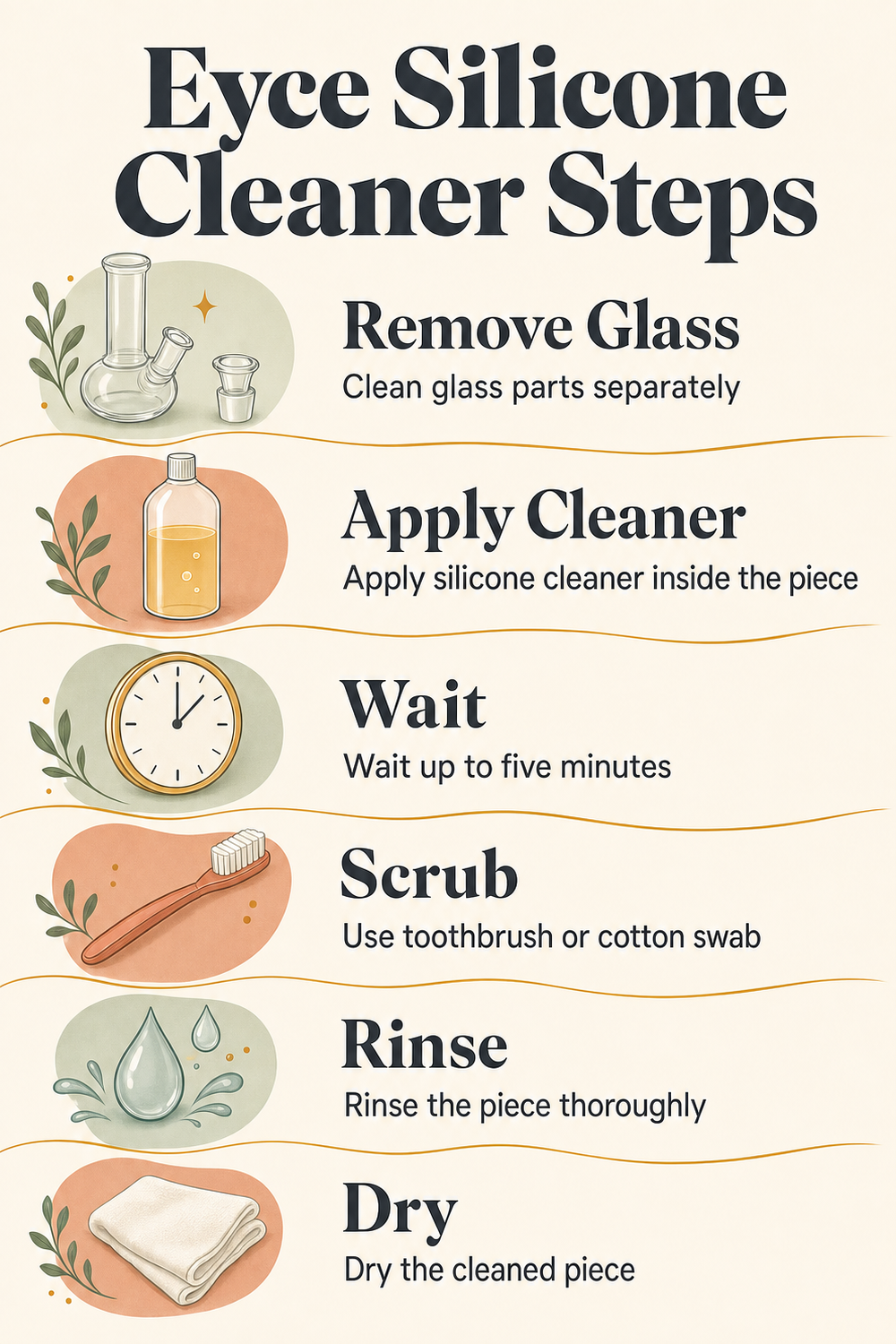
The dedicated cleaner routine has a clear sequence: remove the glass, apply the specified silicone cleaner, wait up to five minutes, scrub, rinse thoroughly, and dry. The guide names a toothbrush or cotton swab for scrubbing. Follow the cleaner’s directions rather than increasing the waiting time on the theory that more must work better. [7]
Glass parts still need their own care instructions. This guide does not add an unverified solvent recipe for them. Set the removed pieces aside where they cannot roll away, and check their instructions before deciding how to clean them. Keep track of small parts during the process so reassembly is straightforward.
The Hammer product page gives another model-specific option: warm, soapy water for all its parts, followed by complete rinsing and drying. That option belongs to the Hammer’s published maintenance guidance. It is not a reason to invent a water temperature or extend the instructions to every accessory. [4]
There is a real difference between Eyce’s published cleaning pages. Its general article discusses isopropyl alcohol, freeze-and-flex, and dishwasher methods, while the dedicated cleaner and model guides describe other routines. Do not turn the general article into a universal alcohol-soaking or dishwasher recommendation. [7] [9]
If two pages disagree for your model, ask Eyce to confirm compatibility before choosing a method. Give the model name, the parts involved, and the cleaner or appliance method you are considering. That is a more useful question than asking whether all silicone pieces can be cleaned alike.
- Remove the glass parts and plan to clean them separately using their applicable instructions.
- Apply the specified silicone cleaner inside the silicone piece.
- Wait as directed; Eyce’s dedicated guide says up to five minutes.
- Scrub accessible areas with the toothbrush or cotton swab described in the guide.
- Rinse the silicone piece thoroughly to remove the cleaner and loosened residue.
- Dry the cleaned piece, then follow the model’s directions for reassembly. [7]
What does the Eyce limited lifetime warranty cover?
Eyce’s limited lifetime warranty is not unlimited lifetime accidental-breakage coverage. Eyce’s formal policy describes a one-time replacement for damaged glass, metal, and silicone parts within the first 365 days, subject to its terms. After that period, coverage is limited to silicone material or workmanship defects under normal intended use. [8]
The later coverage excludes normal wear and accidental damage. That distinction matters if you are buying a silicone-bodied piece mainly because you sometimes drop things. A first-year replacement provision and later defect coverage are two different promises, not one open-ended replacement plan.
Seller eligibility also matters. The policy applies to authentic products bought from authorized retailers and excludes purchases from non-authorized resellers. Treehouse’s authorized-retailer status was not verified for this guide, so confirm eligibility with Eyce before counting on coverage. Keep the receipt even if the product looks identical to one shown on Eyce’s site. [8]
For authorized-retailer purchases, the policy requires separate product registration with proof of purchase within 30 calendar days. Direct purchases are described as automatically registered. Registering a retailer purchase is therefore a separate step, not something to leave until a part is damaged. [8]
Before sending a claim, obtain preauthorization. The policy says customers pay shipping and handling fees, and it excludes claims outside the United States. It also excludes loss, theft, intentional damage, and incompatible third-party components. Read those conditions before buying a replacement part or mailing the original piece. [8]
The policy page states a revision date of May 16, 2024 and says the terms may be amended. Check the live policy when buying and again when making a claim. A short replacement slogan on a product page should not override the formal coverage limits. [8]
- Before purchase, verify the seller’s authorized-retailer eligibility under the current policy.
- Retain proof of purchase and the exact product details.
- For an eligible retailer purchase, register separately with proof of purchase within 30 calendar days.
- When damage occurs, check whether it falls within the first 365 days or the later silicone-defect coverage.
- Review exclusions, United States eligibility, and shipping or handling costs.
- Request preauthorization before shipping anything for a warranty claim.
What should you check before buying an Eyce pipe or replacement bowl?
Choose the format before shopping for a replacement part or comparing small extras. A dry-pipe buyer should start with the Shorty and Spoon layouts. A buyer who wants a water chamber should compare the Hammer and Beaker family. The right decision begins with that basic difference, not the number of features in a listing. [1]
Next, identify the pieces that come out. Check what you will remove to clean the bowl, slide, downstem, or chamber. You do not need every model to disassemble the same way, but you do need instructions you can follow. Consider cleaning access before the purchase rather than leaving it as an issue to solve after delivery.
For replacement bowls, match the exact model. The Shorty’s listing gives a 13 mm bowl specification, but that fact does not establish Spoon, Hammer, or Beaker compatibility. No other replacement-fit sizes were verified for this guide. If a listing only says Eyce bowl without naming your model, ask for confirmation. [2]
A useful question to send the seller is: does this replacement fit my exact Eyce model, and which component does it replace? Include the model name and any identifying details from your purchase. This avoids treating a glass bowl, slide, and downstem as different names for the same item.
Finally, review cleaning instructions and warranty requirements before checkout. Keep your receipt, check seller eligibility, and note any registration deadline. Do not count on a warranty to make an uncertain part fit or cover an incompatible third-party component. [8]
- Choose dry hand pipe, bubbler, or Beaker-style water pipe based on the layout you want.
- Inspect the listed components and the access points used for cleaning.
- Confirm a replacement part’s fit for the exact model, not just the brand.
- Read the model-specific care routine and resolve conflicting instructions before using another method.
- Check seller eligibility, retain the receipt, and complete any required registration on time.
Frequently Asked Questions
Is the Eyce Spoon a bubbler?
Does the Eyce Mini Beaker have a glass downstem?
Can you soak every Eyce silicone pipe in alcohol?
Do not use alcohol soaking as a universal routine. Eyce’s general cleaning article and its dedicated or model-specific instructions differ. Follow the exact model’s guidance, separate glass from silicone when directed, and ask Eyce to confirm the proposed method if two pages conflict. No appliance settings or universal soaking time are established here. [4] [7] [9]
Does Eyce replace broken glass for life?
Eyce’s formal policy describes a one-time replacement for damaged parts within the first 365 days, subject to its terms. Later coverage is limited to qualifying silicone defects, not unlimited accidental glass replacement. Check the current policy for eligibility, exclusions, preauthorization, and shipping or handling costs rather than relying on a product-page slogan. [8]
Do you need to register an Eyce pipe bought from a retailer?
Eyce’s policy requires separate registration with proof of purchase within 30 calendar days for authorized-retailer purchases. Direct purchases are described as automatically registered. Verify that the seller qualifies, keep the receipt, and do not assume the retailer completes registration for you. The formal policy may change, so check its current instructions. [8]
Which Eyce format fits your needs?
Choose a Shorty or Spoon when you want a dry hand-pipe layout. Compare the Hammer when you want a bubbler with access through a removable top cap. Look at the Mini Beaker and Beaker when you want a compact or larger water-pipe format. Start with the layout you want, then check how it fits your storage and cleaning routine.
Then narrow the choice by removable parts, cleaning instructions, storage space, and exact-model replacement fit. Keep glass components in mind even when the outer body is silicone. Before purchase, check seller eligibility and the current warranty terms, and keep the receipt afterward. A well-informed choice is the model whose layout and upkeep match your needs, with clear expectations about what its materials and warranty do—and do not—establish.
Sources
- Eyce: Eyce Product User Guides – How To Smoke – Using A Silicone Water Pipe
- Eyce: Eyce Shorty: Silicone One Hitter w/ Free Shipping
- Eyce: How To Use The Eyce Spoon
- Eyce: Eyce Hammer Bubbler – Silicone Bubbler – Silicone Hammer Bubbler
- Eyce: How To Use The Eyce Beaker
- Eyce: How To Smoke An Eyce Mini Beaker
- Eyce: How To Clean Silicone Pipes
- Eyce: Lifetime Warranty Policy
- Eyce: How to Clean a Silicone Pipe: 3 Methods That Actually Work
- U.S. Food and Drug Administration regulation, reproduced by Cornell Legal Information Institute: 21 CFR § 177.2600 – Rubber articles intended for repeated use.