
The best way to protect glass accessories during travel is to clean and fully dry each piece, remove and wrap detachable parts, place everything in a snug padded case, fill empty space so nothing shifts, and keep the case away from hard objects. For shipping or a long move, add several layers of wrapping and a sturdy outer box with cushioning on every side.
Glass is hard but brittle, and most travel damage comes from movement and pressure, not from heat. Even short drives on bumpy roads can crack a piece if it bounces inside a soft bag or sits next to keys and bottles. The fix is simple: clean, dry, separate, wrap, fill, and test before you leave.
Why Does Glass Break During Travel?
Most glass accessories used for legal dry-herb and tobacco contexts are made from borosilicate glass, which has a low coefficient of thermal expansion and stronger thermal and chemical resistance than ordinary soda-lime glass [2]. Borosilicate handles normal temperature swings in a car trunk or a checked bag quite well. Heat by itself is rarely what breaks a piece in transit.
What does break glass on the road is mechanical stress from movement, pressure, and contact. When a bag shifts, slides, or gets set down hard, every glass surface inside takes a small hit. Glass-to-glass contact is the worst kind, because two hard surfaces meeting at the same point can crack even a strong piece [3].
Glass breaks when stress reaches a weak point, and most breakage in transit is driven by stress from impacts or pressure on contact areas rather than heat exposure alone [5]. Once you understand this, the answer is simple: keep the piece still, keep it cushioned, and keep it away from other hard items. A snug case that does not let the piece shift matters more than the brand of the case or the type of glass.
Think of packing glass the same way you would pack a phone with a glass screen. The case is there to absorb the hits the piece would otherwise take on its own.
- Movement inside a bag is the leading cause of travel breakage, since even small shifts add up over a long drive or flight.
- Hard-item contact (keys, chargers, bottles, lighters) creates pressure points that chip rims and crack thin glass.
- Glass-on-glass contact is the most damaging, because two hard surfaces pressing against each other concentrate force on a single point.
- Exposed edges and thin necks are the most fragile parts and tend to chip first when the piece hits something.
- Temperature change alone rarely breaks borosilicate glass, but rapid swings can still stress vulnerable pieces.
What Should You Do Before Packing a Glass Piece?
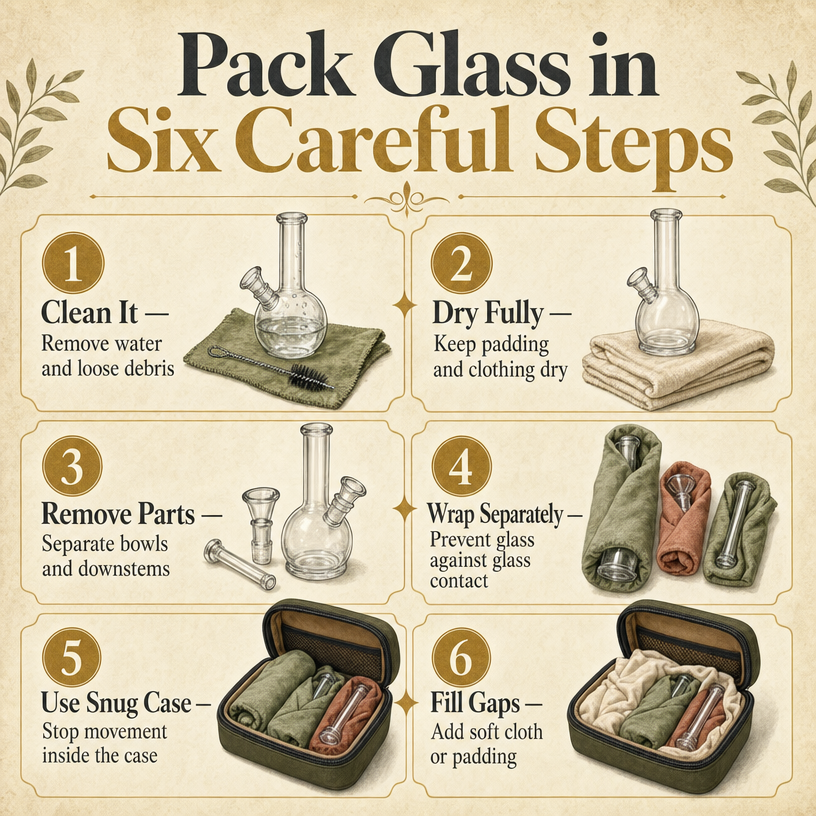
The work you do before packing matters as much as the case you choose. A piece that is wet, dirty, or carrying loose debris will cause problems no matter how nice the bag is. Take ten or fifteen minutes to go through a simple checklist before the trip.
Water trapped inside a sealed bag can soak padding and clothing and leave odor, and loose debris in a grinder or pipe can spill into the bag [1]. Even small amounts of leftover material can stain fabric and ruin clothes. A clean, dry piece travels much more safely than a freshly used one.
It also helps to inspect the piece for any chips or cracks before packing. A small chip on the rim or neck is a weak point that is far more likely to spread into a full break during travel. Set aside any piece that shows visible damage until it can be repaired.
Removable parts such as downstems and bowls should be separated from the main body before packing so glass does not knock against glass inside the case [3]. Each separate piece gets its own wrap, and the bag stays organized at the same time.
- Clean the main piece with isopropyl alcohol or warm water and let it dry fully on a towel.
- Empty any grinder, pipe bowl, or downstem of loose debris and wipe the threads clean.
- Let every part air dry so no moisture is sealed inside the bag or wrap.
- Inspect each part for chips or cracks and set aside anything that shows visible damage.
- Remove detachable parts like bowls and downstems and pack them separately.
What Kind of Travel Case Protects Glass Best?
The biggest single upgrade you can make for traveling with glass is moving from a soft pouch to a snug, padded case with a firm outer wall and a soft inner layer [1]. Fit matters more than brand, because an oversized case lets the piece shift and a too-tight case can press on fragile points. Look at the inside dimensions, not just the outside.
A padded case with a firm outer shell and soft lining gives the best balance of structure and cushion. Hard cases protect more but cost more and weigh more. Soft padded bags are lighter, pack better into luggage, and still work well for short trips when filled correctly [4]. For shipping or a long move, a soft case alone is not enough; you will also need an outer box.
Accessory compartments inside the case make a real difference. A zippered mesh pocket keeps bowls, downstems, and small tools from sliding around and hitting the main piece. Some padded bags also include external pockets that are useful for stash jars, lighters, and rolling papers, keeping everything in one place.
Closure quality matters too. A zipper that runs the full length of the case makes packing and unpacking easier, and a strong zipper pull is less likely to fail mid-trip. Magnetic and snap closures can work, but a full zipper tends to seal more evenly and keep things from falling out if the bag is dropped.
If you travel often, two cases can be worth the cost: a compact padded case for daily carry and a larger case or a hard case for longer trips. The compact case can also work as a secondary wrap inside a checked suitcase.
- Fit is more important than brand; measure the piece or check the inside dimensions before buying.
- A firm outer wall with a soft inner lining absorbs shocks that a floppy pouch would pass through.
- Accessory compartments keep bowls, downstems, and small tools from sliding into the main piece.
- Closure style matters: a full-length zipper seals more evenly than a snap or magnetic flap.
- Material choice depends on the trip: soft padded for short trips, hard case for checked luggage, padded plus outer box for shipping.
| Case Type | Best For |
|---|---|
| Soft padded pouch | Daily carry and short drives when filled correctly |
| Firm padded travel case | Road trips and flights with carry-on |
| Hard case | Checked luggage and risky handling situations |
| Padded case inside sturdy box | Shipping and long moves |
| Original box with bubble wrap | Cheap backup when no travel case exists |
How Do You Wrap and Pack Glass So It Cannot Shift?
Packing glass well is more about patience than technique. The goal is to keep every piece still and cushioned on all sides, with no glass touching glass. Take your time the first time, and the habit is quick from there.
Wrapping delicate areas first protects the parts most likely to crack. Neck joints, percolators, and thin rims should each get their own layer of soft cloth or bubble wrap before the whole piece is wrapped [4]. Two layers minimum for thin areas, and three to four layers for shipping [3].
Once the main piece is wrapped, place it in the case with the heaviest, most stable part facing down. Smaller parts like bowls and downstems go in compartments or in the gaps around the main piece, each wrapped on its own. Filling empty space is what keeps the whole thing from shifting.
After closing the case, gently tilt and shake it. If you hear or feel anything moving, open it up and add more padding. Movement during the shake test is movement that will happen on the road.
- Wrap thin rims and necks in soft cloth or bubble wrap before wrapping the whole piece.
- Place the heaviest part of the piece facing down inside the case for stability.
- Wrap each removable part (bowl, downstem) on its own and put them in compartments or gaps.
- Fill every empty gap with soft cloth, bubble wrap, or packing paper so nothing can shift.
- Gently shake the closed case; if anything moves, add more padding before sealing it shut.
Where Should You Put the Case in a Car, Backpack, or Suitcase?
Where the case sits in your bag or vehicle matters as much as the case itself. The wrong spot, like under a stack of books in a backpack or at the bottom of a checked suitcase, puts the full weight of your luggage on top of the glass. The right spot is stable, upright when possible, and away from hard objects.
In a car, the floor of the back seat or the trunk is usually better than the top of a seat or the passenger footwell. Upright placement keeps the piece from lying on its most fragile edge, and low placement keeps it from sliding off when you brake. A non-slip mat or a towel underneath the case helps keep it in place.
In a backpack, place the case in the center of the bag with soft items like clothes around it. Avoid putting the case against a rigid frame, a laptop, or a water bottle. The glass should never be the thing that takes a direct hit.
In a suitcase, the case should go in the middle of the bag with clothes packed around every side. Avoid putting the case next to toiletry bottles, shoes, or chargers that can press into the padding. Carry-on is usually safer than checked bags because you control the handling and the case stays upright.
Glass accessories should be kept away from other hard items such as keys, chargers, bottles, and lighters, because those are what cause pressure points and chips during a trip [1] [4]. A padded case is not enough if a metal water bottle is sitting on top of it.
- Car: floor of the back seat or trunk, upright, with a non-slip mat or towel underneath.
- Backpack: center of the bag with clothes wrapped around every side, never against a frame or laptop.
- Suitcase: middle of the bag surrounded by soft clothing, never next to bottles or chargers.
- Carry-on is safer than checked because handling is more controlled and the case stays upright.
- Avoid placing the case under heavy items or against anything that can press into the padding.
Can You Bring Clean Glass Accessories on a Plane?
According to the Transportation Security Administration’s published guidance, clean glass items are allowed in both carry-on and checked bags, with the final decision made by the screening officer at the checkpoint [6]. Glass is treated like any other permitted glass object; a clean glass pipe or bong is not, by itself, a prohibited item.
That said, screening officers make the final call at the checkpoint. A piece that looks used, dirty, or that has any residue may draw extra attention even when the material is technically allowed. Cleaning the piece thoroughly before leaving for the airport removes one common reason for extra screening and keeps the experience smooth.
Beyond the screening rule, the practical choice is between carry-on and checked bag. Carry-on gives you more control over handling and keeps the case upright. Checked bags go through rougher handling, so a firmer outer wrap is helpful if you check glass. Pick the option that matches the rest of your packing.
Both choices assume the piece is legal in the location you are leaving and the location you are entering. Rules vary by country, state, and even by airport, so it is worth checking the rules for your specific trip before you pack.
- Confirm the item is legal in your departure and arrival locations before traveling.
- Check the TSA or relevant agency rules for any updates the day before your flight.
- Clean the piece thoroughly so no residue is visible during screening.
- Pack in a snug padded case with fill so nothing moves inside the bag.
- Keep the case accessible so a screening officer can inspect it without crushing it.
How Should You Pack Glass for Shipping or a Long Move?
A padded travel case is enough for short trips where you control the bag, but shipping and long moves add handling steps that call for an extra layer of protection. Boxes get stacked, dropped, tossed on sorting belts, and shipped in trucks that vibrate for hours.
The double-protection method is straightforward. Wrap the cleaned, dried piece in three to four layers of bubble wrap or packing paper, then place the wrapped piece inside a sturdy cardboard box with at least two inches of cushioning on every side [3]. Fill any empty space with crumpled paper, packing peanuts, or foam so the wrapped piece cannot shift.
A few extra details make a real difference. Use a new or like-new box that has all four flaps intact. Tape the bottom and the seam with packing tape. Mark the box FRAGILE on multiple sides so handlers know what is inside, even if you do not always trust the label.
The cheapest upgrade is to use two boxes: a snug inner box holding the wrapped piece, and a slightly larger outer box with cushioning between them. This is the same idea as double-bagging liquids; one cushion is good, two is much better when the box is going through a shipping system. The total cost is small compared with replacing a broken piece.
When the box arrives, open it carefully and check every piece before declaring the trip a success. If anything is chipped or cracked, take a photo before removing the packing material in case you need to file a claim.
- Wrap each cleaned, dried piece in three to four layers of bubble wrap or packing paper.
- Place the wrapped piece in a sturdy cardboard box with cushioning on every side.
- Use a new or like-new box and seal every seam with packing tape.
- Mark the box FRAGILE on multiple sides to encourage careful handling.
- Consider a double-box setup: wrapped piece in an inner box, inner box in an outer box with cushioning.
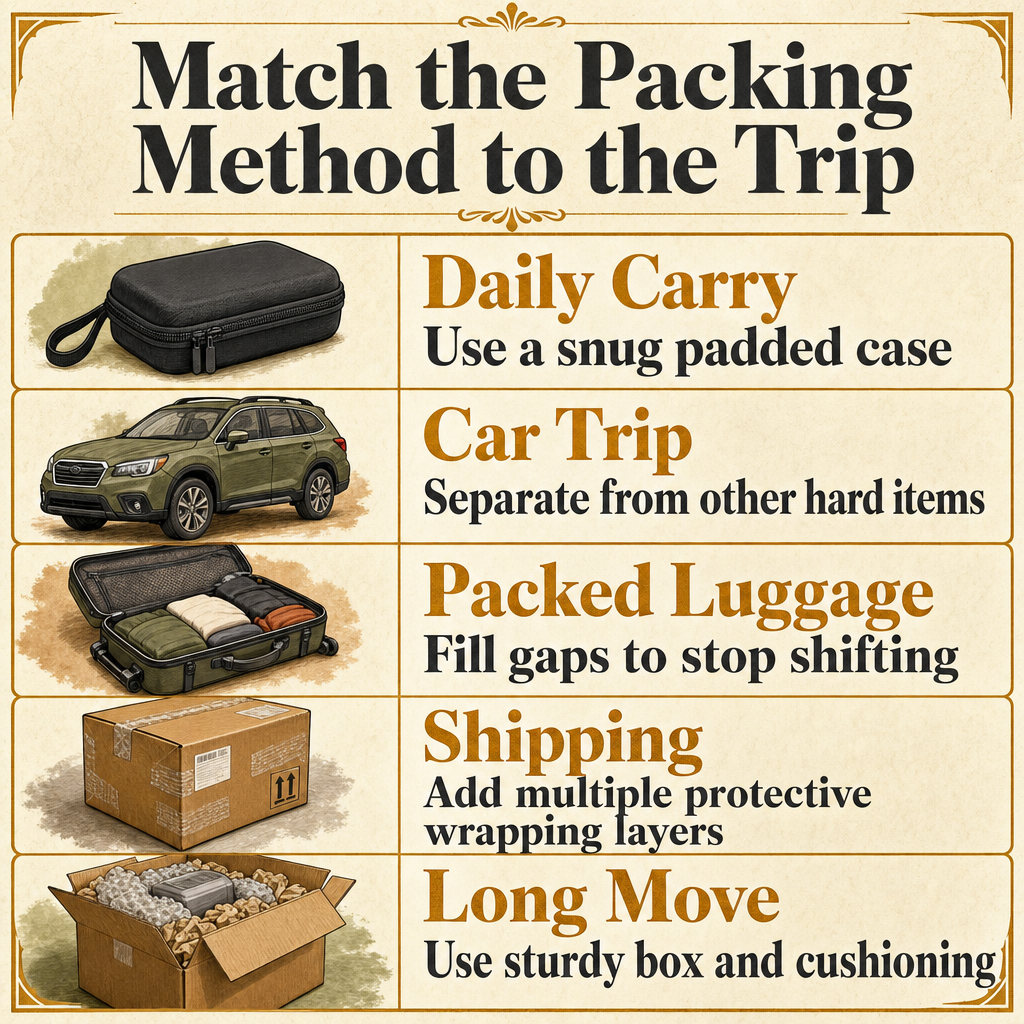
| Trip Type | Packing Method |
|---|---|
| Daily carry | Snug padded case, fill gaps with soft cloth |
| Car trip | Padded case kept upright and away from hard items |
| Carry-on flight | Padded case inside carry-on, accessible for screening |
| Checked luggage | Padded case plus a firm outer wrap or hard case |
| Shipping or long move | Three to four layers of wrap, sturdy box, cushioning on every side |
What Should You Check When You Arrive?
Unpacking glass is just as important as packing it. A few minutes of careful inspection after a trip catches any damage early and gets the case ready for the next journey. Most damage that happens in transit shows up right away, while pieces that survive are usually fine.
Place the case on a stable surface before opening. Hard floors and cluttered tables are a bad idea; if the case pops open and a piece rolls out, the floor or counter is exactly what you do not want it to hit. Open the case slowly and check each piece one at a time.
Inspect the main piece and every removable part separately. Hold each one up to a light and look for new chips at the rim, hairline cracks at the neck, and any looseness at joints. Set aside anything that looks off until it can be repaired.
Remove any damp wrapping material right away. Cloth or paper that was wet from a leak can grow mildew inside the bag and leave odor that is hard to remove. Replace damp padding before the next trip.
Wipe out the inside of the case and let it dry before storing it. A clean, dry case is ready for the next trip and will not transfer odor to other items in storage.
- Place the case on a stable surface and open it slowly before handling any glass.
- Inspect the main piece and removable parts separately for new chips or hairline cracks.
- Discard any damp wrapping material before storing the case to prevent mildew and odor.
- Wipe out the inside of the case and let it dry fully before putting it away.
- Check that accessory compartments and closures are still in good shape for the next trip.
Frequently Asked Questions
What is the best material for wrapping a glass pipe or bong?
Soft cloth, bubble wrap, or packing paper all work well as long as they cushion without leaving hard contact points. Wrap removable glass parts separately and fill empty space in the case so nothing shifts during the trip.
Should a glass piece be empty before travel?
Yes. Clean the piece, remove loose debris from bowls or grinders, and let every part dry fully before packing. Trapped water can wet the case or clothing, and debris can spill into the bag.
Is a padded bag enough for a glass bong?
A snug padded bag with a firm outer wall works well for many short trips. For shipping and long moves, add extra wrapping plus a sturdy outer box cushioned on every side.
Can glass accessories go in a carry-on bag?
TSA guidance permits clean glass items in carry-on and checked bags, but the screening officer makes the final decision at the checkpoint. Check current rules for your specific trip before leaving for the airport.
How do you stop glass from moving inside a case?
Choose a close-fitting case, wrap delicate areas first, separate removable parts, and fill every gap with soft cloth or padding. Close the case and gently shake it to test for movement before you travel.
What Is the Smartest Way to Keep Glass Safe on the Road?
Glass survives travel best when it cannot move. The combination of a clean and dry piece, separate wrapping for removable parts, a snug padded case, and fill material in every gap handles almost any road trip or carry-on flight. For shipping and long moves, the same approach plus a sturdy outer box with three to four layers of wrapping turns the case into a small piece of luggage rather than a fragile item.
Most breakage in transit comes from movement and contact with hard objects, not from heat. A simple packing routine (clean, dry, separate, wrap, fill, test) addresses the actual cause and keeps the same case ready for the next trip. Pick the case that fits your piece, fill the gaps, and you have solved most of the problem.
If you travel often, a two-case setup pays off quickly: a compact padded case for daily carry and a larger case or double-box kit for longer trips. Both options are widely available, and keeping the routine consistent is more important than chasing the perfect bag.
Finally, take a minute to check the pieces when you arrive. New chips and hairline cracks are easier to handle right away, and the case stays clean and dry for the next trip. With a little pre-trip effort, glass can travel just as reliably as anything else in your bag.
Sources
- Simple Glass Pipe: How to Pack Glass Accessories for Summer Travel
- SCHOTT AG: Borosilicate Glass — Material Properties
- LOOKAH: Can You Wrap a Glass Bong So It Won’t Break?
- Gatorbeug: What Is the Best Strategy to Use for Bong Bags?
- Aegg Creative Packaging: Thermal Shock — An Explanation of Why Glass Breakage Occurs and How to Prevent It
- Transportation Security Administration: Glass — What Can I Bring?