

A quality glass smoking piece is easiest to judge by running five checks in order: borosilicate glass instead of soft soda-lime, balanced thickness across the wall, base, and joint, smooth welds, a round 1:10 ground-glass joint if it has one, and a surface free of rim chips, hairline cracks, stress haze, and uneven perc slits. The guide walks through each check so you can inspect any piece in three minutes.
If a piece fails any one of these checks badly — a soft-glass label, lumpy welds, an oval joint, or a hairline crack near a weld — walk away. Most failures start at the same few stress points. Once you know what to look for, they are easy to spot under any decent light.
What Glass Is a Quality Smoking Piece Actually Made From?
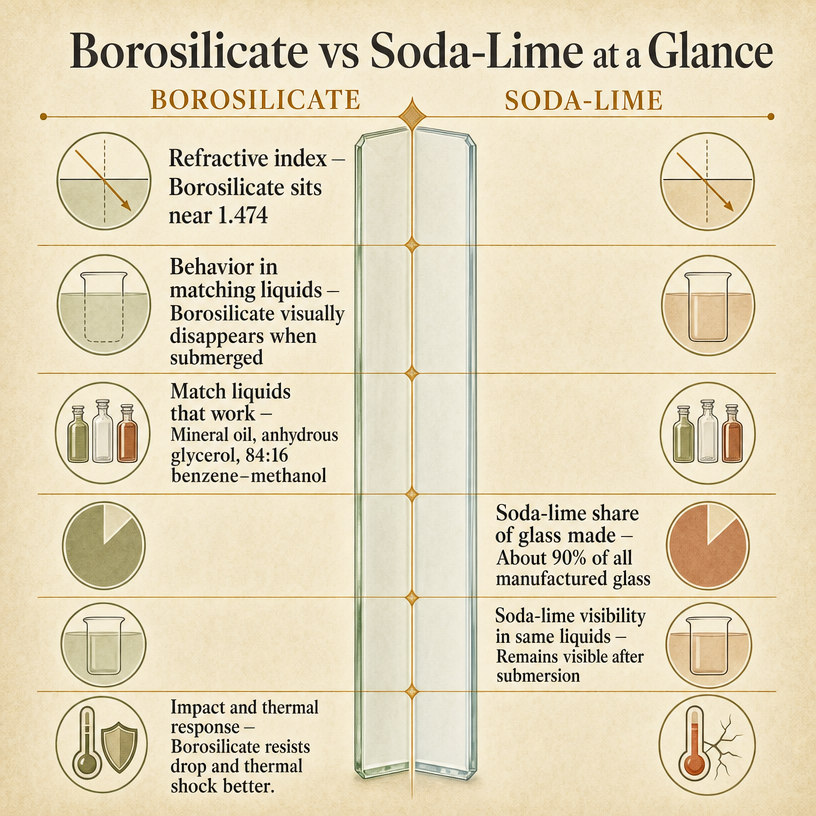
Most quality smoking pieces are made from borosilicate glass. Borosilicate uses silica and boron trioxide as its main glass-forming ingredients. It is harder to break on drop, more resistant to cracking from big temperature changes, and holds higher clarity over time than soda-lime (soft) glass [1].
Soda-lime is by far the most common glass in the world. About 90 percent of all manufactured glass is soda-lime, so a piece with no label at all is most likely soft glass [1].
The reason borosilicate wins for daily use is thermal expansion. Borosilicate has a very low coefficient of thermal expansion. It resists thermal shock far better than soft glass, which expands more when heated and is far more crack-prone under repeated heat cycles [2]. That difference is what lets a borosilicate bong survive cold rinses and hot smoke without splitting along a weld.
You can confirm the material with a simple field test before buying. Borosilicate has a refractive index close to 1.474. It visually "disappears" when submerged in mineral oil, anhydrous glycerol, or a dry 84:16 benzene–methanol mixture at room temperature. Soda-lime stays clearly visible in the same liquids [10]. Most shops will not let you dunk inventory, but the test is useful for reselling or for verifying a piece a friend handed you.
If you are shopping online, look for an explicit "borosilicate" or "boro" line in the product description. Check for a maker’s mark on the glass itself. Generic unbranded imports are the most common source of soft-glass mislabeling, especially in low-priced beaker and straight-tube shapes. Browsing well-made [[LINK:link-001|Glass Bongs]], [[LINK:link-002|Glass Hand Pipes]], and [[LINK:link-003|Glass Dab Rigs]] from a known maker is the easiest way to skip the guesswork.
- Borosilicate resists impact and thermal shock better than soda-lime and holds clarity longer [1].
- Soda-lime accounts for about 90 percent of all manufactured glass, so an unlabeled piece is most likely soft glass [1].
- Low thermal expansion is the real reason borosilicate survives cold rinses and hot smoke without cracking at welds [2].
- Refractive-index testing in mineral oil, anhydrous glycerol, or an 84:16 benzene–methanol mixture will make borosilicate visually disappear while soda-lime stays visible [10].
- An explicit "borosilicate" or "boro" label, paired with a visible maker’s mark, is the fastest pre-buy check.
How Thick Should the Glass on a Quality Smoking Piece Be?
Glass thickness on smoking pieces is measured in millimeters. Most pieces fall between 3mm and 9mm of wall thickness. Pieces under 2mm are considered fragile. Borosilicate bongs at about 5mm are described as an industry standard for daily use [3].
A single thickness number on a product page tells you very little. It usually describes just one section, often the wall of the tube.
Quality depends on three thicknesses at once: the wall (chamber sturdiness), the base (tip resistance), and the joint (crack resistance around bowl and downstem insertions). A piece advertised as 7mm thick might have a 7mm wall, a 3mm base, and a thin unreinforced joint [4]. The strongest pieces balance all three zones. Each one takes a different kind of stress during normal use [5].
Inspect thickness in person with a finger wrap around the wall, a flat palm on the base, and a close look at the joint where the bowl or downstem sits. Thin walls feel almost warm to the touch on first grab. A thick base has a noticeable flat footprint. The joint zone should look beefy relative to the wall. That is where leverage from inserting and removing parts concentrates stress.
This is also where the rest of the buying guide comes in. For a deeper walk through choosing a bong from top to bottom, the [[LINK:link-004|complete guide to smoking accessories for beginners]] and the [[LINK:link-005|glass bong buying guide]] cover size, percolation, and shape choices. If you are weighing glass against other materials, the [[LINK:link-006|complete guide to specialty pipes]] is a useful side reference.
- Measure thickness on the wall, the base, and the joint separately — a single number rarely covers all three [4].
- Wall thickness drives chamber sturdiness and how the piece feels in the hand during cleaning and use [5].
- Base thickness drives tip resistance, so a flat, thick base is the single biggest stability upgrade on a beaker or straight tube [4].
- Joint thickness drives crack resistance around bowl and downstem insertions, which is the most common failure zone on a piece with removable parts [4].
- Anything under 2mm is fragile and 5mm is the daily-use benchmark; pieces over 7mm are heavy and usually unnecessary for normal sessions [3].
| Zone | What to inspect | Failure mode if thin |
|---|---|---|
| Wall | Side of the tube or chamber | Flex on heat and easy chip from light tap |
| Base | Flat bottom of beaker or straight tube | Tipping and wobble on a flat surface |
| Joint | Female ground joint and male bowl seat | Crack propagation around the bowl insert |
| Mouthpiece | Lip and rim where lips contact glass | Chips that grow into rim fractures |
What Do Good Welds Look Like on a Smoking Piece?
Welds are the seams where two pieces of glass were joined while hot. A clean weld should be smooth, slightly rounded, and visually continuous with the surrounding glass.
Sharp changes between parts act as stress concentration points. A hard ridge where a downstem meets a tube, or a step where a perc was attached, are examples. Rough weld zones are more likely to chip on light impact [6].
Visible weld defects are an instant red flag. Lumpy weld beads, sharp ridges between parts, visible seam lines that did not fully blend, and micro-bubbles trapped near welds all correlate with weaker structure [6]. A talented blower leaves almost no seam visible. A rushed one leaves beads the size of a pinhead lined up along a joint.
Run a fingertip along every transition. A good weld feels like one continuous piece of glass. A bad weld feels like a bump, a ridge, or a soft hill. Bubbles inside the wall away from welds are usually cosmetic. Bubbles trapped near a weld are not — they indicate that the two parts were not hot enough to fully fuse when they were joined.
Welds are also where the bowler’s skill shows up most. Clean joint welds with smooth transitions are cited across the industry as a sign of a talented blower. That craft is what lets a piece survive weeks of heating and cooling without splitting along the seam [3]. If you want a closer look at how this craft translates into a beginner-friendly piece, the guide to [[LINK:link-007|choosing a first smoking piece]] walks through what to look for at this level.
- Clean welds are smooth, slightly rounded, and visually continuous with the surrounding glass [6].
- Sharp ridges or hard steps between parts act as stress concentration points and chip more easily on light impact [6].
- Lumpy weld beads and visible seam lines correlate with weaker structure and are an instant red flag [6].
- Micro-bubbles trapped near a weld indicate the two parts were not hot enough to fully fuse during joining.
- Run a fingertip along every transition — a good weld feels like one continuous piece of glass rather than a bump or ridge.
How Do You Inspect a Ground-Glass Joint on a Smoking Piece?
A ground-glass joint is the conical connection where a bowl or downstem seats into the body of the piece. Quality ground-glass joints use a standardized 1:10 conical taper. They are labeled with an "ST" (standard taper) symbol followed by two numbers. The first number is the outer diameter in millimeters at the widest point of the male joint. The second is the ground length in millimeters [7]. Common sizes are 14/20, 14/23, 19/22, and 24/40.
Matching the same size on both sides gives you interchangeability. A correctly ground joint should look and feel perfectly round. Look down the open end of the female joint against a strong light and confirm the opening is a clean circle, not an oval.
Mismatched tapers or off-round (oval) joints introduce micro-leaks and an uneven draw. If the angle of a standard taper is not perfectly set, the glass is extremely rigid and presents a fracture risk on insertion [7].
Test the fit with a matching bowl or downstem before you buy if the shop allows it. The part should slide in with light hand pressure. It should seat smoothly with a small twist. It should stay put without wobble. If it rocks, binds partway in, or has visible daylight at any point around the rim, the joint is either mismatched or under-ground and will leak air.
Joint care matters as much as joint geometry. Standard taper joints are precision-ground. Dropping a bowl on a hard surface can round off the edge and turn a previously good seal into a leaky one. For a quick refresher on what those "10mm, 14mm, 18mm" labels actually mean in everyday use, the [[LINK:link-008|glass joint sizes explained]] guide maps the common sizes to the parts you are most likely to find on a shelf.
- Standard taper ground joints use a 1: 10 conical taper and are labeled "ST" followed by two numbers, the first in millimeters and the second in ground length [7].
- Look down the female joint against strong light and confirm the opening is a clean circle rather than oval.
- Mismatch tapers or off-round joints cause micro-leaks, uneven draw, and a fracture risk on insertion because the glass is extremely rigid [7].
- A matching bowl or downstem should seat smoothly with a small twist and stay put without wobble or visible daylight at the rim.
- Dropped bowls round off the ground edge, so a previously good seal can turn leaky after one bad drop on a hard surface.
Which Defects Should You Look For Before You Buy a Glass Smoking Piece?
Even a well-made material on a well-shaped piece can ship with defects. The most common field defects are rim or edge chips on the joint or mouthpiece. Hairline or star-fracture cracks near welds and joints are also common. Residual stress lines and haze banding at transitions show up too. Blocked or unevenly spaced perc slits are another red flag. Base defects such as uneven grind, warped base, or off-centre tube round out the list [9].
Each one is a reliability issue rather than a cosmetic one. Glass can hold together until a small stress event causes the failure to propagate.
Rim chips deserve special attention. A small chip on the lip or on the joint rim can break the seal between two parts. It also acts as a crack starter under thermal cycling [9]. Run a fingertip along every rim and the inside edge of the mouthpiece. A healthy rim feels smooth all the way around. A chipped one has a catch you can hear as much as feel.
Hairline cracks are the most dangerous because they can be "quiet" on arrival. A crack that you can barely see can hold together until you clean the piece, tap it on a counter, or just heat and cool it through normal use. Then it propagates weeks later [2].
Hold the piece under a strong lamp and tilt it slowly. A hairline crack usually shows up as a bright reflective line that does not move with the surface.
Annealing is the part you cannot see. Annealing is the process of slowly cooling hot glass objects after they have been formed. It relieves residual internal stresses introduced during manufacture [8]. Glass that has not been properly annealed is likely to crack or shatter when subjected to small temperature changes or mechanical shock. It may even fail spontaneously [8]. You will not see whether a kiln annealed the piece, but a manufacturer that brags about kiln time is usually one that did.
Below is a quick defect checklist you can run through in about a minute under good light. The piece should pass every row, not most of them. Each defect shortens the usable life of the piece in a predictable way.
- Rim or edge chips on the joint or mouthpiece break the seal and act as crack starters under thermal cycling [9].
- Hairline or star-fracture cracks near welds and joints are reliability issues, not cosmetic ones, and often propagate weeks after first use [2].
- Residual stress lines and haze banding at transitions suggest the piece was not properly annealed and may fail under small temperature changes [8].
- Blocked or unevenly spaced perc slits cause one-sided bubbling and signal a rushed final assembly.
- Base defects such as uneven grind, warped base, or off-centre tube reduce stability and make the piece more likely to tip over [9].
| Where to look | Defect | Why it matters |
|---|---|---|
| Joint rim | Edge chip | Breaks seal and starts a crack under cycling |
| Mouthpiece lip | Edge chip | Uncomfortable on lips and a crack starter |
| Near welds | Hairline crack | Quiet at first, propagates after a stress event |
| Transitions | Haze banding | Sign of poor annealing and residual stress |
| Perc slits | Blocked or uneven slits | One-sided bubbling, rushed assembly |
| Base | Uneven grind or off-centre tube | Reduces stability and increases tipping risk |
Where Do Glass Smoking Pieces Usually Crack First?
Glass almost always cracks from thermal stress rather than impact, even though a drop is what most people blame [2].
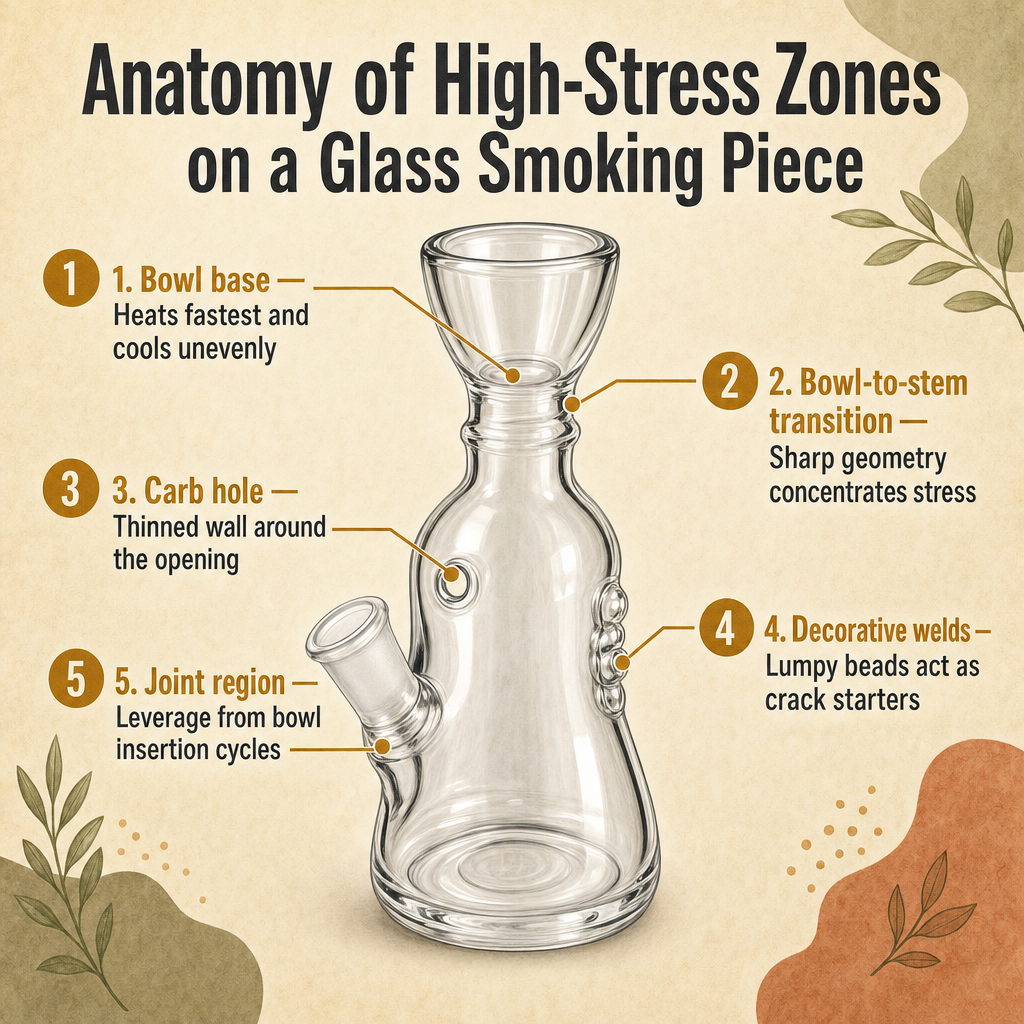
The cracks you see weeks after buying a piece usually start at one of five high-stress zones: the bowl base, the bowl-to-stem transition, the carb area, decorative welds, and the joint region [2].
These areas heat fastest, cool unevenly, and experience the most leverage when accessories are inserted or removed. Inspect them in order, and you will catch most of the failures before they start.
The bowl base is where heat sits longest during a session. Any small flaw near it grows under every heat cycle. The bowl-to-stem transition is a sharp geometry change. That is exactly the shape that concentrates stress. The carb hole thins the wall around an opening. Decorative welds concentrate stress around added features. The joint region takes repeated leverage from swapping bowls and downstems [2].
Cracks near welds and joints are treated as reliability issues rather than cosmetic ones for the same reason. Glass can hold together until a small stress event such as cleaning, tapping, or normal thermal cycling causes the crack to propagate [2]. If you can see a bright reflective line under a lamp near any of these five zones, that piece is on a timer.
A practical pre-buy habit is to spend about thirty seconds on each of these five zones with a strong lamp and a slow tilt. If a piece passes all five without a chip, crack, stress line, or visible imperfection, it is almost certainly going to outlast a similar piece that failed even one of the checks.
- Glass almost always cracks from thermal stress rather than impact, even when a drop is what you remember happening [2].
- The five highest-stress zones are the bowl base, bowl-to-stem transition, carb area, decorative welds, and the joint region [2].
- Bowl base failures grow under every heat cycle because that is where heat sits longest during a session.
- Carb holes thin the wall around an opening, so chips near a carb usually grow into rim fractures.
- Joint-region cracks are caused by repeated leverage from inserting and removing bowls and downstems, which is the most common failure mode on pieces with removable parts [9].
Frequently Asked Questions
How can you tell if a smoking piece is borosilicate or soft glass?
Refractive-index testing is one field method. Borosilicate has a refractive index close to 1.474 and visually disappears when submerged in mineral oil, anhydrous glycerol, or a dry 84:16 benzene–methanol mixture. Soda-lime remains visible in the same liquids [10]. Borosilicate is also harder to break on drop, more resistant to thermal shock, and keeps higher clarity over time than soda-lime, which accounts for about 90 percent of all manufactured glass [1].
What glass thickness is best for a daily-use bong?
Glass thickness usually ranges from 3mm to 9mm. Pieces under 2mm are considered fragile. Borosilicate bongs at about 5mm are described as an industry standard for daily use [3]. Thickness ratings usually describe only one section such as the wall, so the base and joint should be inspected individually. Base thickness drives tip resistance and joint thickness drives crack resistance around bowl and downstem insertions [4].
Do maker’s marks or labels matter when judging glass quality?
Yes — clean joint welds with smooth transitions are a sign of a talented blower. Lumpy weld beads, sharp ridges, visible seam lines, and micro-bubbles near welds correlate with weaker structure [6]. A printed or etched maker’s mark is most useful when paired with visible craft: matched weld quality, smooth transitions between parts, and consistent wall thickness across the piece rather than uneven thinning where parts were joined [3].
Is a hairline crack on a glass piece only a cosmetic issue?
No — hairline cracks and microfractures can hold together on arrival and propagate weeks later when a small stress event such as cleaning, tapping, or normal thermal cycling occurs [2]. A visible crack near a weld or joint should be treated as a reliability issue rather than a cosmetic one. That is where high-stress zones such as the bowl base, bowl-to-stem transition, carb, decorative welds, and joint region tend to fail first [9].
So Is the Glass Smoking Piece You Are Looking At Actually Well Made?
A glass smoking piece is well made when five things line up. The glass is borosilicate rather than soft soda-lime. The thickness is balanced across the wall, base, and joint rather than strong in only one zone. The welds are smooth and free of beads, ridges, and trapped bubbles. The joint, if there is one, is a clean round 1:10 standard taper. The surface is free of rim chips, hairline cracks, stress haze, and uneven perc slits. A piece that passes all five will almost always outlast a similar piece that fails any one of them, because glass failures cluster at the same stress points.
Use this checklist in order whenever you shop. You will sort well-made pieces from cheap ones in about three minutes. Start with the material and a maker’s mark. Run a fingertip along the welds. Inspect the joint for roundness and fit. Finish with a slow tilt under a strong lamp looking for hairline cracks near the five high-stress zones.
The same inspection applies whether you are buying beakers, straight tubes, recyclers, dab rigs, or hand pipes. Borosilicate and clean craft beat thickness alone every time.
If you want to keep going, the rest of the [[LINK:link-001|glass bongs]], [[LINK:link-002|glass hand pipes]], and [[LINK:link-003|glass dab rigs]] collections at Treehouse Lifestyle are sorted by category so you can compare welds, joints, and thickness side by side. Every order over $150 ships free. The next read after this one is the [[LINK:link-005|glass bong buying guide]], which builds on the same inspection logic to walk through size, percolation, and shape choices.
Sources
- Wikimedia Foundation: Borosilicate glass — Wikipedia summary API
- Tahoe Grinder Co.: Why Glass Pipes Crack: Thermal Shock, Cleaning Mistakes & Storage Errors
- Smoke Cartel: Glass Thickness and Quality
- Thick Ass Glass: Ideal Thickness for a Glass Bong — Choosing the Right Glass
- Badass Glass: Bong Thickness: What is a Good Thickness For a Bong?
- Au Bong Shop: Common Glass Defects — What They Look Like and Why They Matter
- Wikimedia Foundation: Ground glass joint — Wikipedia
- Wikimedia Foundation: Annealing (glass) — Wikipedia
- Au Bong Shop: Common Glass Defects — Inspection Guide
- Iced Tea Pitcher: How Can You Tell If PYREX Is Borosilicate?