
A buyer’s guide to finding the best container for keeping cannabis fresh, potent, and aromatic
A Storage container buying guide helps you pick a container that keeps cannabis fresh by blocking four threats: oxygen, UV light, heat, and improper humidity. Oxygen turns active THC into CBN, dulling effects. UV light breaks down cannabinoids and terpenes. Heat accelerates every degradation pathway. Too little humidity makes material brittle; too much invites mold. The best containers counter all four with airtight seals, UV-protective glass, and odor-neutral materials.
What Breaks Down Cannabis in Storage?
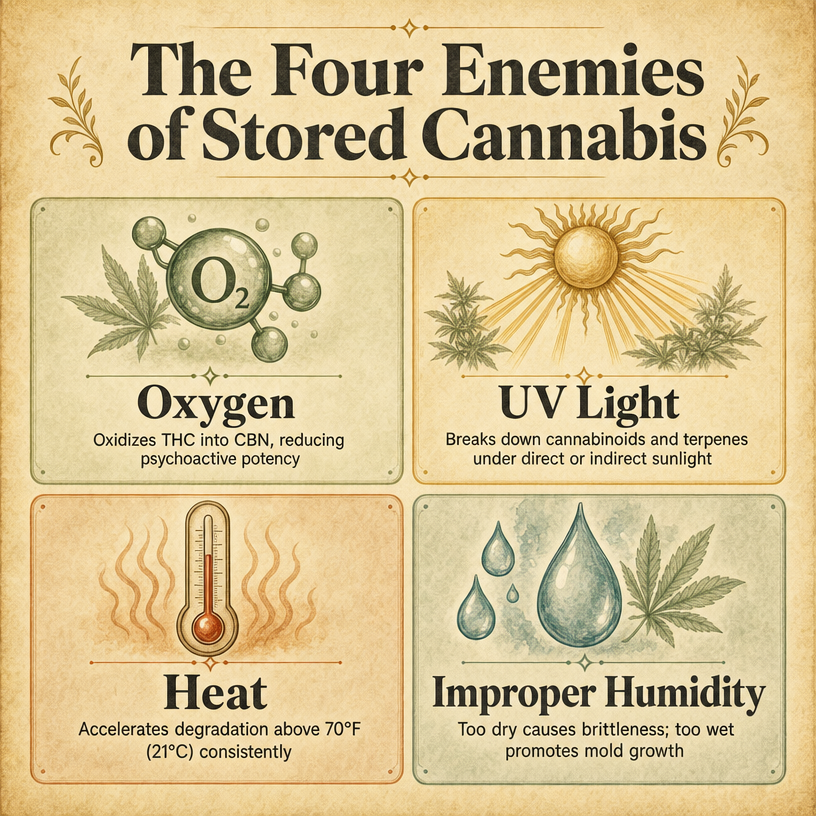
Before you choose a container, understand what you are protecting against. Cannabis is a natural organic material that continues to interact with its environment after harvest. Four environmental factors work continuously to degrade the compounds that make cannabis potent and aromatic.
- Oxygen oxidizes THC into CBN, reducing psychoactive potency over time [1] [2]
- UV light from sunlight or indoor lighting breaks down both cannabinoids and terpenes [1] [2]
- Heat above 70°F (21°C) accelerates all degradation pathways and dries out material [2]
- Too little humidity causes brittleness and terpene loss; too much promotes mold growth [2]
Oxygen is the most persistent threat. When air reaches cannabis, oxidation begins converting THC into CBN, a far less psychoactive compound. The result is cannabis that feels weaker and less satisfying. Oxidation happens slowly at room temperature but speeds up every time the container opens, introducing fresh oxygen each cycle.
UV light works even when a container sits on an indoor shelf. Ultraviolet radiation penetrates many materials and breaks apart cannabinoid and terpene molecules. This degradation is gradual and easy to miss until your cannabis has noticeably lost potency and aroma.
Heat acts as an accelerant for both oxidation and UV damage. When temperatures stay above 70°F (21°C), chemical reactions that degrade cannabis speed up dramatically. Warm conditions also dry out plant material, making it harsh and brittle. Storing cannabis near heat sources or in vehicles during summer can ruin a stash in weeks.
Humidity completes the four threats. Too little causes terpene loss and crumbly texture. Too much creates conditions for mold and mildew growth, which is dangerous to consume. The ideal range is 55–62% relative humidity, which is why many experienced users add humidity control packs inside their containers.
What Material Is Best for a Cannabis Storage Container?
Container material determines how well it handles airtight sealing, odor retention, durability, and compatibility with humidity control. Not all materials perform equally, and the wrong choice can undermine even the best storage practices.
- Glass: non-porous, odor-neutral, inert, creates reliable airtight seal with quality lids [1] [3]
- Rigid plastic: porous over time, may retain odors, potential static charge that attracts trichomes [1] [3]
- Metal: durable and light-blocking, but uncoated metal can react with cannabis and affect flavor [1]
- Silicone-sealed glass: combines the best properties of glass and silicone for smell proofing and long-term freshness [3]
Glass is the preferred material for several reasons. It is non-porous, meaning it does not absorb odors or residues from the material inside. It does not leach chemicals into your cannabis the way some plastics can. Paired with a quality silicone or rubber seal, glass creates a reliable airtight closure that holds up over repeated use. Amber and UV-protected glass adds a layer of protection by blocking the ultraviolet wavelengths that degrade cannabinoids and terpenes.
Rigid plastic has improved in quality but still presents drawbacks. It is more porous than glass and can retain odors even after cleaning. Certain plastics may leach chemicals into your material, particularly when exposed to warmth. Static charge is another concern with plastic containers — the buildup can attract trichomes, the crystalline structures that hold a disproportionate share of the plant’s active compounds.
Metal offers excellent durability and full light-blocking capability, but presents its own complications. Unless the interior is fully lined with a food-safe coating, metal can react with organic material and affect flavor. Some metal containers also lack the precision silicone seals that make glass jars effective at maintaining airtight conditions.
Silicone-lined lids on glass jars combine the best properties of both materials. The glass body provides non-porous, inert storage while the silicone seal delivers airtight performance and smell proofing. Silicone is flexible enough to maintain a reliable seal even under heavy daily use.
Read How Do I Store My Smoking Accessories the Right Way? for more detail.
Read What Makes a Storage Container Smell Proof? for more detail.
| Material | Odor Retention | Seal Quality | Best For |
|---|---|---|---|
| Glass (amber/UV-protected) | None — non-porous | Excellent with silicone gasket | Long-term freshness |
| Rigid plastic | Can retain odors over time | Moderate; prone to warping | Short-term, budget use |
| Metal (coated interior) | None when coated | Good; depends on liner | Durability and light blocking |
| Silicone-sealed glass | None — non-porous body | Excellent; flexible seal | Smell proofing and travel |
Which Features Matter Most in a Storage Container?
A container made from the right material can still fall short if it lacks the structural elements that actually protect your cannabis. Here are the features with the biggest impact on long-term freshness and potency retention.
- Airtight silicone or rubber gasket seals that compress firmly to minimize oxygen exposure [1] [2]
- Amber or opaque glass that blocks ultraviolet light and protects cannabinoid and terpene content [3]
- Compatibility with humidity control packs to maintain the 55–62% relative humidity range [2] [3]
- Solid construction with quality hinges, sturdy lids, and thick materials that hold up to daily use
Airtight sealing is non-negotiable if you want to slow oxidation. Every opening introduces fresh oxygen that begins degrading the material inside. A loose or low-quality seal defeats the purpose of using the container in the first place. Look for lids with silicone or rubber gaskets that compress firmly when closed. Test the seal by opening and closing the container a few times before relying on it for long-term storage.
UV protection matters whether your container sits in a cabinet, on a shelf, or in a bag. Standard clear glass offers almost no protection from ultraviolet light, meaning cannabis stored in clear jars can degrade even under indirect indoor lighting. Amber glass blocks most UV wavelengths and is widely regarded as a superior choice for preserving cannabinoid and terpene content. Opaque containers achieve the same result through a different approach.
Humidity control compatibility separates casual storage from serious preservation. Quality storage jars are designed to work with humidity control packs, which maintain the 55–62% relative humidity range cannabis requires. If you plan to store for more than a few weeks, this feature makes a measurable difference in how long your cannabis stays fresh.
Durability and build quality determine whether a container holds up under daily use. A container with a fragile latch, thin glass, or a seal that degrades quickly is a poor long-term investment. Examine hinges, lid closures, and material thickness before purchasing. Containers marketed specifically for cannabis storage tend to be better constructed than generic food containers that were never designed with these requirements in mind.
See Pulsar Chorus Wax Storage Glass Compartment 5ct as one current product example.
How Do I Choose the Right Storage Container for My Needs?
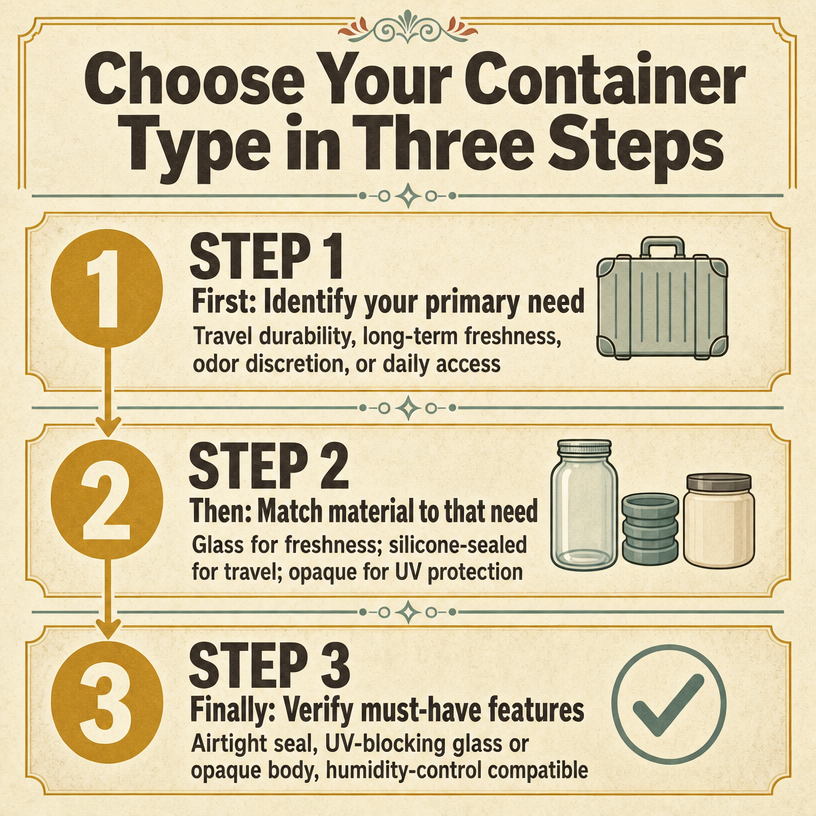
The best container depends on how you actually use cannabis and what you need to protect. A container that excels for one person may be completely wrong for another. Matching your container to your specific situation is what separates an informed purchase from an expensive mistake.
- Daily use: small to medium glass jar with airtight seal, holds one to two weeks of supply, easy-open lid [1]
- Long-term storage: amber glass jar with silicone seal, humidity control pack, stored in cool dark conditions [2] [3]
- Travel: durable silicone-sealed container with reinforced closure, compact size, odor-blocking properties [3]
- Odor discretion: airtight silicone-sealed glass jar that locks in aromatic compounds and prevents smell escape [1]
- Bulk organization: stackable uniform containers with labeling capacity for strain tracking and date management
For daily use and quick access, prioritize containers that are easy to open and close repeatedly without compromising the seal. A smaller glass jar with a push-lock or screw-top lid works well for one to two weeks of supply. Leave some headspace rather than filling completely — less air cycles in each time you open the lid.
For long-term storage, focus on UV protection, airtight performance, and humidity control compatibility. A larger amber glass jar with a wide mouth and a quality silicone seal is the standard recommendation. Add a humidity control pack rated for the container size and check the seal periodically to make sure it remains firm. Store in a cool, dark place.
For travel and portability, durability and smell proofing take priority over maximum freshness features. A silicone-sealed container with thick walls and a secure latch handles being tossed in a bag or suitcase without cracking or accidental opening. Many users keep a dedicated travel container rather than risking their primary storage setup.
For odor discretion, the silicone seal is the most important feature to evaluate. Airtight containers lock in aromatic compounds, preventing them from escaping into surrounding air. Glass containers with silicone-sealed lids perform best for smell proofing because neither material absorbs or retains odors the way plastic can.
For bulk storage and organization, stackable containers with consistent sizing make the most efficient use of shelf space. Look for uniform diameter and height if you plan to arrange them in rows. Labeling is a practical consideration — write the strain name and date on the container or use a removable label that does not leave residue.
How Do I Keep a Storage Container Working Well Over Time?
A quality storage container is an investment that performs better with proper maintenance. A few simple habits extend both the life of the container and the freshness of your cannabis.
- Clean containers every four to eight weeks using warm water and mild soap; allow all components to dry completely before reassembling [1] [2]
- Replace humidity control packs every two to six months depending on pack type, container size, and ambient conditions [2]
- Inspect seals monthly for compression, cracks, or hardening; replace worn seals promptly to maintain airtight performance [1]
- Store containers in cool, dark, and dry locations away from heat sources and direct light exposure [2]
Clean the container periodically to prevent residue buildup that can affect flavor and aroma. Empty it completely, disassemble any removable seals or lids, and wash all components with warm water and mild soap. Avoid harsh chemicals or abrasive scrubbers that can damage silicone seals or UV-protective coatings. Allow all components to dry completely before reassembling — any moisture left inside creates conditions for mold growth.
Humidity Control packs require periodic replacement to stay effective. They work by absorbing or releasing moisture to maintain a consistent level, but have a finite capacity. Over time they become saturated and stop regulating. Most packs last between two and six months depending on container size and ambient conditions. Mark a calendar to replace them on schedule.
Inspect seals regularly, especially on containers used daily. A seal that has become compressed, cracked, or worn allows air exchange that accelerates degradation. Run your finger along the gasket to check for areas that feel soft, hardened, or irregular. Replacing a worn seal is usually inexpensive and takes only a moment.
Storage conditions matter even with the best container available. Keep containers away from radiators, heating vents, and windows that receive direct sunlight. If your home runs warm, consider a bedroom closet or another cooler area. Consistent temperatures below 70°F (21°C) dramatically slow the degradation processes that affect cannabis quality.
What Are Common Questions About Smoking Accessories?
Does a storage container really make a difference for cannabis freshness?
Yes. Without a proper container, oxygen, UV light, heat, and humidity continuously degrade cannabinoid potency and terpene aroma. An airtight, UV-protective container slows all four degradation pathways and significantly extends the usable life of your cannabis.
Is glass better than plastic for storing cannabis?
Glass is generally preferred because it is non-porous, does not retain odors, and creates a reliable airtight seal. Rigid plastic can work but is more prone to static charge, which can attract trichomes, and may develop odors over time. Silicone-lined lids on glass jars combine the best of both materials for smell proofing.
What is the ideal temperature and humidity for storing cannabis?
Keep storage temperatures consistently below 70°F (21°C). The ideal relative humidity for long-term storage falls between 55% and 62%, which is why many users add humidity control packs inside their containers. Too dry above this range causes brittleness; too moist invites mold.
Do I need UV protection in a storage container?
If your container will ever sit under any direct or indirect sunlight, yes. UV light rapidly degrades cannabinoids and terpenes. Amber glass blocks most UV wavelengths and is widely regarded as the best material choice for protecting cannabis over time.
Can I use any airtight container for cannabis storage?
Not every airtight container is suitable. The material matters — glass and food-grade silicone are safe choices; certain plastics can leach into your material or create static. The container must also be opaque or UV-protective, and ideally compatible with humidity control packs if you are storing for more than a few weeks.
What Is the Best Cannabis Storage Container for My Situation?
Choosing the right cannabis storage container comes down to understanding what threatens your specific stash and matching container features to those threats. For most people, an amber or opaque glass jar with a silicone-sealed airtight lid and a humidity control pack delivers the best all-around protection against oxygen exposure, UV light, heat, and humidity fluctuations.
If your priority is daily access, a smaller jar that holds one to two weeks of supply keeps cannabis fresh without cycling too much air in and out. For months of storage, invest in the largest quality jar that fits your stash with a humidity control pack inside. For frequent travel, a durable silicone-sealed container with a reinforced closure handles movement without cracking or losing its seal.
Whatever container you choose, features matter more than price. A well-designed container at any price point outperforms a poorly designed one, and maintenance habits — cleaning, humidity pack replacement, and seal inspection — matter as much as the initial purchase. Treehouse Lifestyle carries a range of Storage Containers suited to every use case, and free shipping on orders $150+ makes it easy to stock up on the right container for your needs.
Where Does This Smoking Accessory Information Come From?
- Calyx Containers: Benefits of Airtight Weed Containers
- Cannavine: The Ultimate Guide to the Best Cannabis Storage Containers
- Startpage (aggregating Munchmakers, King Palm, Green Society, and other sources): Cannabis storage container feature comparisons