
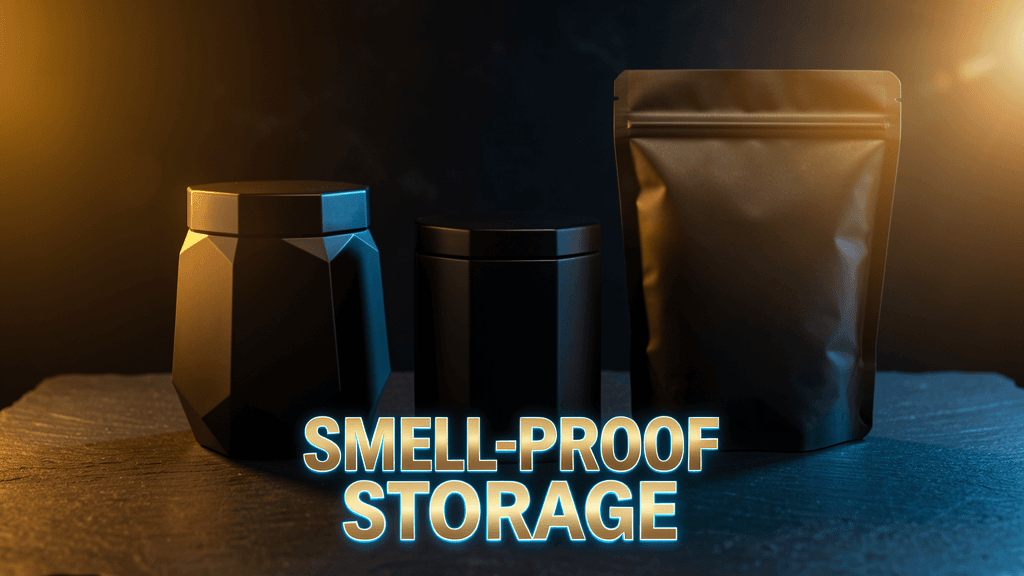
A guide to the containers, bags, and features that actually keep odors contained
A smell-proof storage container works by combining an airtight hermetic seal with activated carbon to trap and neutralize odor molecules. The seal blocks gas from escaping, while the activated carbon adsorbs any odors that manage to get past it. Neither method alone is as effective as using both together. This guide explains exactly how these systems work, which features matter most, and how to choose the right smell-proof container for your needs.
What Is Smell-Proof Storage and Why Does It Matter?
If you have ever opened a kitchen cabinet and caught a whiff of coffee, spices, or dried herbs, you have experienced how odors escape their containers. Standard Storage Containers — even ones with snap lids or screw-top closures — allow some degree of gas exchange. They reduce airflow, but they do not stop odor molecules from drifting out over time. Smell-proof storage is different. It is designed specifically to contain strong aromas, preventing them from escaping into the surrounding environment.
- A hermetic seal blocks gas exchange completely, unlike standard snap or screw lids that allow some air passage [4]
- Activated carbon adsorbs odor molecules onto its vast internal surface, trapping them rather than letting them escape [1]
- The two mechanisms work together — the seal provides the barrier, and the carbon captures what the seal does not stop
- Smell-proof containers protect contents from both escaping odors and external contamination
The difference comes down to two factors. First, smell-proof containers use a true airtight barrier — often called a hermetic seal — that prevents gas molecules from passing through the closure. Second, they incorporate an adsorption medium, almost always activated carbon, which captures any odor molecules that might escape or enter. [1] [4] Together, these two mechanisms work in both directions: they keep internal odors in and external contaminants out.
For anyone who stores aromatic materials — including smoking accessories, herbs, or specialty food items — smell-proof containers are a useful alternative to standard options. They are particularly helpful in shared living spaces, travel situations, or anywhere discretion matters. The combination of a hermetic seal and carbon media is what separates a product designed to contain odors from one that merely reduces them.
When shopping for smell-proof storage, you will find options ranging from compact hard-sided containers to larger roll-top bags. Understanding how the underlying mechanisms work helps you evaluate claims and choose a product that actually performs.
Browse Bags / Cases to explore related options.
How Does Activated Carbon Trap Odors?
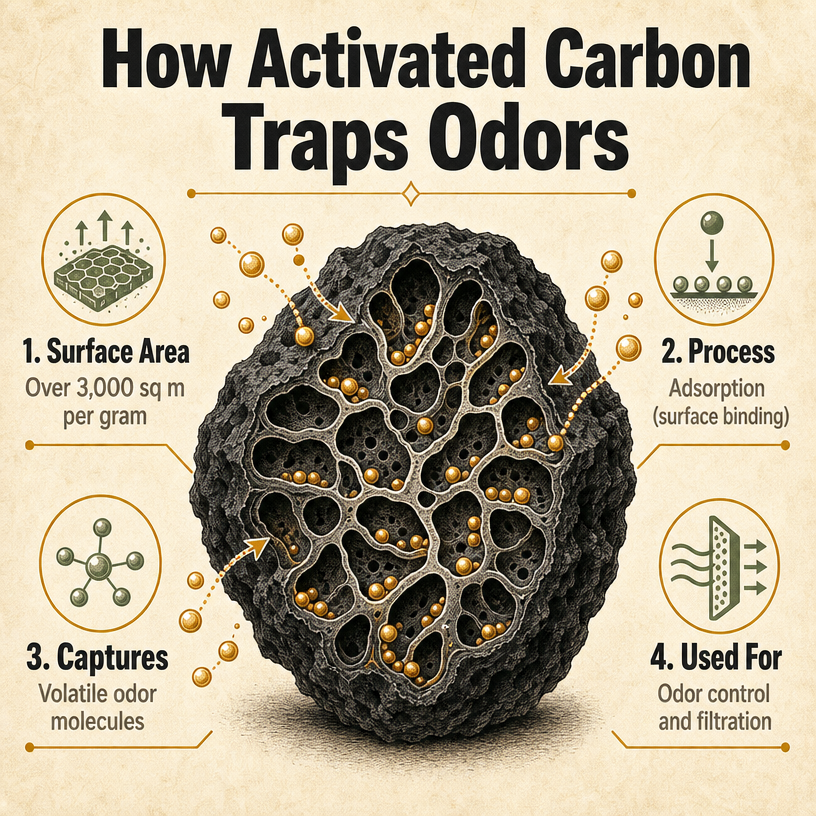
Activated carbon is the industry standard for odor control, and understanding why requires a quick look at how it works at the molecular level. The key is a process called adsorption — not absorption, which is what happens when a sponge soaks up water. Adsorption occurs when molecules adhere to the surface of a solid material rather than being taken into its bulk. [2] In smell-proof containers, odor molecules in the air stick to the enormous internal surface area of activated carbon rather than escaping into the room.
- Adsorption is a surface phenomenon — molecules adhere to a surface rather than being absorbed into the material’s bulk [2]
- Activated carbon’s microporous structure gives it over 3,000 square metres of surface area per gram [1]
- The material captures volatile organic compounds and aromatic molecules by providing an enormous surface for them to bond to
- Activated carbon is activated through a manufacturing process that develops its pore structure, increasing adsorption capacity
What makes activated carbon especially effective is its structure. It is full of microscopic pores — so many, in fact, that a single gram of activated carbon can have a surface area exceeding 3,000 square metres. [1] Those pores give odor molecules an enormous amount of surface to cling to. The more surface area available, the more molecules can be trapped at any given time.
The term "activated" refers to the manufacturing process that creates this pore structure. Raw carbon is heated and treated to develop a network of tiny openings. The result is a material with extraordinary adsorption capacity relative to its size. This is why even small carbon inserts or filter panels in a smell-proof container can handle a meaningful amount of odor control.
Activated carbon is particularly good at capturing volatile organic compounds — the class of carbon-based molecules that produce most smells. This includes the terpenes found in cannabis, which are highly volatile and responsible for strong aromatic profiles. [3] The carbon filter in a smell-proof container continuously works to pull these molecules from the air inside the enclosure, binding them to its surface until the adsorption sites are exhausted.
Read How Do I Store My Smoking Accessories the Right Way? for more detail.
Browse Desktop Vaporizers to explore related options.
What Two Mechanisms Do Smell-Proof Containers Use?
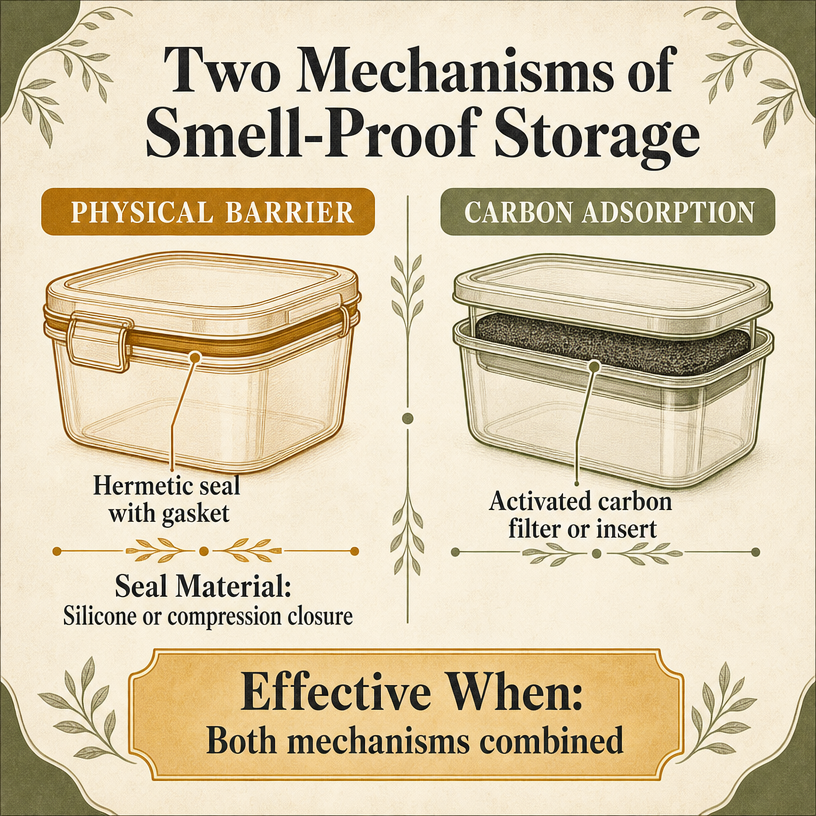
Every effective smell-proof container relies on two distinct mechanisms working in tandem. Understanding what each one does — and what it cannot do alone — helps you evaluate products and avoid marketing hype.
- A hermetic seal provides the physical barrier that prevents gas molecules from passing through the closure [4]
- Activated carbon provides adsorption capacity, capturing odor molecules that are in the air inside the container [1]
- Neither mechanism works well alone — a poor seal overwhelms the carbon, while carbon alone cannot stop gas leaks
- Silicone gaskets are common and durable, but they are more permeable to gases than some alternative materials [5]
The first mechanism is the physical barrier. This is the container’s hermetic seal, which prevents gases from passing through the closure. A true hermetic seal makes the interior completely airtight, blocking both the escape of internal odors and the entry of external air. [4] This is different from a standard airtight container, which may use a snap lid or screw thread that still allows some degree of gas exchange over time. Look for containers that explicitly describe their closure as hermetic or use silicone gasket seals designed for gas blockage.
The second mechanism is adsorption via activated carbon. The carbon does not create a physical barrier — it captures odor molecules that are already in the air. If the seal is imperfect, the carbon will work harder and exhaust faster, because it has to adsorb molecules that keep leaking through the gap. This is why neither mechanism alone is sufficient. A perfect seal without carbon will trap odors inside, but any small leak will let molecules escape. Carbon without a good seal will adsorb some molecules, but the continuous inflow of air through the gap will overwhelm it quickly. [1] [4]
The seal material itself matters. Silicone rubber is widely used for gaskets and seals because it resists a wide temperature range and holds up well over time. [5] However, silicone rubber is more permeable to gases than many other rubber compounds. This means that while a silicone gasket provides a useful barrier, it is not a perfect gas blocker. The combination of a well-designed compression or screw-thread closure with a silicone gasket, paired with activated carbon, delivers the best overall performance.
Read What Is the Difference Between a Bubbler and a Bong? for more detail.
| Mechanism | What It Does | Common Materials |
|---|---|---|
| Physical Barrier | Blocks gas molecules from passing through the closure | Hermetic seal with silicone gasket or compression closure |
| Carbon Adsorption | Captures and holds odor molecules from the air inside the container | Activated carbon filter, insert, or liner |
What Types of Smell-Proof Containers Are Available?
Smell-proof products come in several distinct forms, each suited to different use cases and carrying preferences. Knowing what is available helps you match a container type to your specific needs.
- Hard-sided containers use jar or box designs with integrated carbon inserts and latch or screw-top hermetic seals
- Stash jars are compact hard-sided containers purpose-built for storing aromatic accessories, typically with lid-mounted carbon filters
- Roll-top smell-proof bags use a fold-and-clip closure that compresses a silicone seal strip for an airtight barrier
- Zipper smell-proof bags incorporate a carbon-filtered panel and a specialized sealed zipper for odor containment
Hard-sided containers are the most common category. These typically look like standard storage jars or tackle boxes but include both a hermetic seal and a carbon insert or filter layer. Some use a jar design with a screw-top lid that has an integrated silicone gasket and a carbon foam insert in the lid. Others use a latch-lock design with a compression closure that presses a silicone seal against the container body. Hard-sided containers work well for home storage where you want a reusable, durable option.
Stash jars are a subcategory of hard-sided containers designed specifically for aromatic materials. They usually feature a jar body with a lid that contains a carbon filter. Some use a double-lid design where the outer lid provides the hermetic seal and the inner lid holds the carbon media. These are typically sized for personal use and are popular for keeping smoking accessories organized at home.
Smell-proof bags fall into two main styles. Roll-top bags — sometimes called dry bags — use a fold-and-clip closure that compresses a silicone seal strip as you roll the top down. This creates both an airtight barrier and a degree of water resistance. Zipper smell-proof bags incorporate a specially designed zipper with an integrated silicone seal and often include a carbon-filtered panel sewn into the bag wall. Bags are more portable than hard-sided containers and work well for travel or carrying smaller quantities on the go.
See ICE-CUBE GLASS HAND PIPE as one current product example.
What Features Should You Look for in a Smell-Proof Container?
Not all smell-proof products are created equal. The difference between a container that actually works and one that merely looks the part comes down to a handful of specific features. Here is what to evaluate before you buy.
- Seal type: look for explicitly hermetic, airtight, or gas-tight closures with compressed silicone gaskets rather than standard snap or screw lids
- Carbon media: evaluate the amount and quality of activated carbon — more is better, and replaceable inserts extend the product’s useful life
- Wall thickness and durability: thicker walls and denser materials maintain seal integrity longer and resist impact damage
- Smell-lock closure design: a secondary locking mechanism keeps the primary seal compressed during transport and handling
- Construction quality: smooth seams, smooth-operating zippers, and firm latch mechanisms indicate better overall build quality
First, examine the seal type. A true hermetic seal is the foundation of any effective smell-proof container. Look for products that describe their closure explicitly as hermetic, airtight, or gas-tight. Avoid products that only claim to be "leak-proof" or "spill-proof" — those terms refer to liquids, not gases. The best seals use a silicone gasket that is compressed when the closure is engaged, whether through a latch mechanism, a screw thread, or a roll-top clip.
Second, evaluate the carbon media. The amount and quality of activated carbon in a container directly affects its performance and lifespan. Larger containers or those designed for heavy use should have more carbon media — not just a thin panel, but a substantive insert or filter layer. If the carbon element is replaceable, that is a significant advantage, because it extends the useful life of the container considerably.
Third, consider the wall thickness and material durability. Thicker walls help maintain the integrity of the internal environment and provide some insulation against temperature changes. High-density plastics or metal bodies resist impacts better than thin-walled designs and are less likely to develop cracks that compromise the seal over time.
Fourth, check for a smell-lock closure design. Some containers add a secondary locking mechanism beyond the primary seal — a flip latch, a threaded collar, or a secondary clip — that keeps the primary seal compressed even if the container is jostled or carried. This is especially important for bags and portable containers that may be tossed into a backpack or luggage.
Fifth, look at the overall construction quality. Seams should be smooth and well-finished. Zippers on bags should operate smoothly without snagging. Latch mechanisms should feel firm and engaging, not loose or wobbly. If possible, test the seal by closing the container, waiting a few seconds, and attempting to pull it open — a good seal will require noticeable force to break.
See INSIDE OUT LINEWORK SWIRL HAND PIPE SPOON as one current product example.
How Do You Maintain a Smell-Proof Container?
A smell-proof container is a long-term investment, but it requires some basic maintenance to keep performing at its best. The good news is that most maintenance tasks are simple and infrequent.
- Inspect silicone gaskets monthly for compression, cracking, or degradation and replace immediately if damage is found
- Replace activated carbon inserts every 2 to 3 months for regular use, or more frequently for heavy use scenarios
- Clean the container body with warm water and mild soap, removing carbon elements first to avoid water damage
- Store containers with the seal engaged in a cool, dry place away from direct sunlight to extend component life
Start with regular gasket inspection. The silicone seal or gasket that creates the hermetic barrier is the most critical component. Over time, these gaskets can wear, compress permanently, or develop small cracks. Inspect the gasket periodically — at least once a month for frequently used containers — and look for signs of flattening, cracking, or degradation. If the gasket looks compressed or damaged, replace it. Many manufacturers sell replacement gasket kits.
Carbon media has a limited lifespan. Activated carbon works by adsorbing odor molecules onto its surface, but the adsorption sites eventually fill up. When that happens, the carbon can no longer capture additional molecules and odors will begin to escape. Most manufacturers recommend replacing carbon inserts every two to three months for regular use. Heavy use — frequent opening and closing, or storing very aromatic materials — may require more frequent replacement. Some containers have modular, user-replaceable carbon inserts, while others require full lid or panel replacement.
Cleaning the container body is straightforward. Wash the interior with warm water and mild soap, rinse thoroughly, and allow it to dry completely before reassembling. Do not submerge containers with integrated carbon media in water, as this can damage the carbon or cause it to shed. For hard-sided containers with removable carbon inserts, remove the carbon element before washing the lid or body.
Store the container properly when not in use. Keep it closed with the seal engaged — this maintains the gasket shape and keeps the carbon media working even during storage periods. Store in a cool, dry place away from direct sunlight, which can degrade both the container materials and the carbon over time.
Read How Do I Maintain My Vaporizer for Best Performance? for more detail.
What Are Common Questions About Smoking Accessories?
What makes a storage container smell proof?
A smell-proof container combines a physical airtight barrier — typically a hermetic seal with silicone gaskets or a compression closure — with an adsorption medium, almost always activated carbon. The seal blocks gas exchange, while the activated carbon traps odor molecules in its microporous surface. Neither mechanism alone is as effective as using both together.
Will a regular airtight container keep odors in?
A standard airtight container with a snap or screw lid reduces some odor escape, but it does not use activated carbon and therefore cannot adsorb volatile odor molecules that do escape the seal. For cannabis and other strong-smelling materials, a container specifically designed as smell-proof — with both a hermetic seal and carbon media — is more effective than a standard airtight container.
How does activated carbon work in smell-proof containers?
Activated carbon has an extremely high surface area — over 3,000 square metres per gram — due to its microporous structure. Odor molecules in the air inside the container are adsorbed onto the vast internal surface of the carbon, binding them to the carbon’s surface rather than allowing them to escape. This is called adsorption, a surface phenomenon distinct from absorption.
Do smell-proof containers also protect contents from outside odors?
Yes. A properly sealed smell-proof container with a hermetic seal and activated carbon works in both directions: it prevents the escape of internal odors and also blocks external odor molecules from entering. This is especially useful for keeping stored contents fresh and uncontaminated by ambient smells.
How often do you need to replace the carbon in a smell-proof container?
Carbon filters and inserts in smell-proof containers gradually become saturated as their adsorption sites fill up. Replacement frequency depends on how often the container is opened and how strong the odor load is, but most manufacturers recommend replacing carbon inserts every 2 to 3 months for regular use. Some containers have replaceable filter modules, while others require full insert replacement.
What Is the Right Smell-Proof Container for Your Needs?
Choosing the right smell-proof container comes down to matching the product type to your use case and paying attention to the specific features that drive actual performance. For home storage of smoking accessories, a hard-sided stash jar or container with a latch-lock hermetic seal and a replaceable carbon insert offers a durable option with good long-term value. For travel or portability, a roll-top or zipper smell-proof bag provides the odor containment you need in a form factor that fits easily into a backpack or bag.
Whatever type you choose, prioritize three things: a genuine hermetic seal with a compressed silicone gasket, a meaningful amount of activated carbon media, and solid overall construction. These are the features that separate products that actually contain odors from ones that merely reduce them. A container with those fundamentals in place, maintained according to the schedule outlined above, will serve you well for years.