
Size, Filtration, Portability, and Maintenance Compared
A bubbler vs bong comparison comes down to portability versus filtration. A bubbler is a small, one-piece handheld water pipe with a fixed chamber and a carb hole. A bong is a larger, modular water pipe with a removable bowl and downstem, often with percolators for extra filtration. Bubblers are built for on-the-go use; bongs are built for home use and maximum smoke cooling.
What Is a Bubbler and How Does It Work?
A bubbler is a small, one-piece water pipe that combines a bowl, a fixed stem, a water chamber, and a mouthpiece into a single glass piece. The name comes from the audible bubbling sound you hear when smoke passes through the water. Because the entire device fits in your palm, Bubblers are sometimes called hand pipes or one-hitters, though they differ from dry hand pipes because they use water for filtration. [1]
- One-piece construction with a fixed bowl, stem, water chamber, and mouthpiece fused together
- Small carb (carburetor) hole covered while lighting, uncovered to clear the chamber
- Bubbling sound produced when smoke passes through water, giving the device its name
- Compact handheld size designed for portability and use on the go
- Single water chamber provides basic smoke cooling and filtration
Using a bubbler is straightforward. You add water through the mouthpiece or a side opening until the chamber is partially filled. Ground herb is packed into the small bowl at the top. You place your mouth on the mouthpiece, cover the carb hole with a finger, and light the herb while inhaling slowly. The pressure change pulls smoke down through the stem and into the water, where it bubbles and cools before traveling up the fixed stem to your lungs. [1]
When you uncover the carb hole, fresh air rushes in and pushes any remaining smoke out of the chamber and into your lungs. This clearing action is what makes the carb hole essential to how a bubbler works. [2]
The key characteristic of a bubbler is its one-piece, fixed design. The stem, chamber, and mouthpiece are all fused together. This means there are no loose parts to lose and no assembly required before use. The compact shape is specifically designed for portability, making bubblers a common choice for people who want a water-filtered smoking experience away from home. [1] [8]
What Is a Bong and How Does It Work?
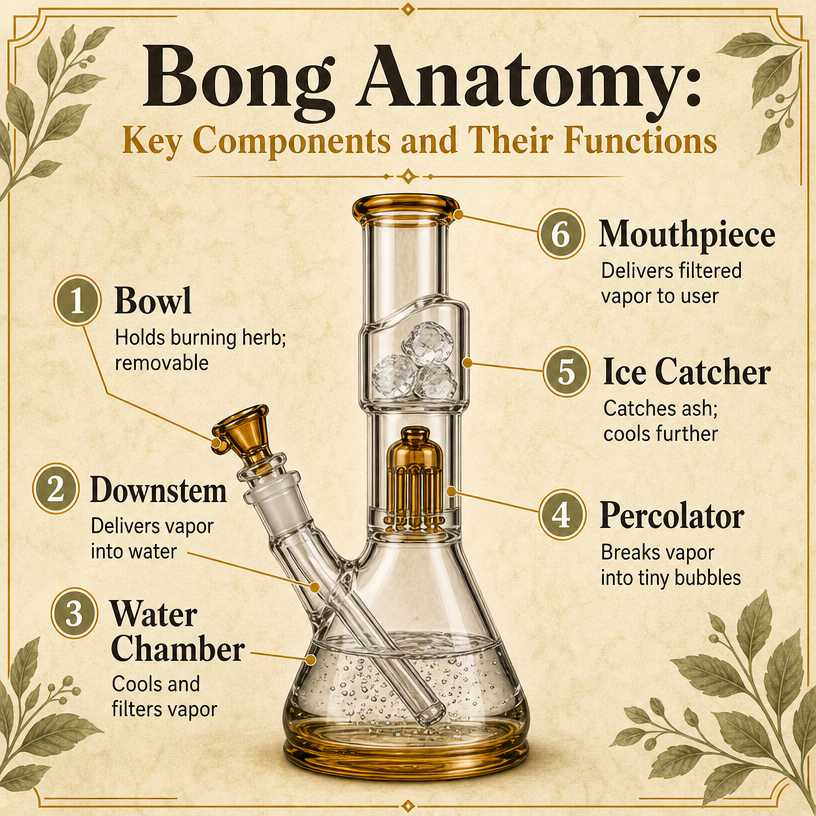
A bong is a larger water pipe with a modular design. The main components are the base (where water sits), the downstem (a tube that delivers smoke into the water), the removable bowl (which holds the burning herb), and the neck (the tube that carries smoke from the base to your mouth). [1] [2]
- Base holds water and forms the foundation of the bong structure
- Downstem is a removable or fixed tube that delivers smoke into the water
- Bowl holds burning herb and can be removed to clear the airway after a hit
- Percolator breaks smoke into small bubbles for enhanced cooling and filtration
- Ice catcher holds ice cubes above the water line for additional cooling
Unlike a bubbler, a bong separates these components so each piece can be removed, replaced, or upgraded independently. The bowl slides or screws into the downstem and can be taken out to clear the airway after a hit. This is fundamentally different from the carb hole mechanism used in bubblers. [1]
Bongs range in size from compact 4-inch models to elaborate multi-foot setups. Larger bongs hold more water and provide a longer smoke path, which allows more time for cooling before inhalation. [3] Many bongs also include optional features like percolators and ice catchers, which add extra stages of filtration and cooling. [4]
A percolator is a secondary filtration device inside the bong that contains tiny slits or holes. Smoke passing through a percolator is broken into many small bubbles, which increases the surface area of smoke in contact with the water. This process, called diffusion, enhances the cooling and filtration effect beyond what a simple water chamber provides. [4] [6]
An ice catcher is a notched section near the top of the neck that holds ice cubes above the water line. As smoke rises past the ice, it cools further before reaching your lungs. [2] These features make bongs the preferred choice for users who want maximum smoke cooling and filtration in a home setup. [1] [4]
Read What Are Hand Pipes and Bubblers, and How Do They Differ? for more detail.
Read What Is a Bong and How Does It Work? for more detail.
Bubbler vs Bong: Which Is More Portable?
Portability is one of the clearest differences between bubblers and bongs. A standard bubbler measures roughly 5 to 8 inches tall and fits entirely inside your hand or a jacket pocket. Because the bowl, stem, and chamber are all one piece, there is nothing to disassemble before packing it away. You can carry a bubbler in a bag, a coat pocket, or a dedicated case without worrying about loose components. [1] [2]
- Bubblers fit in a palm or pocket and have no loose parts, making them easy to transport
- Bongs require a flat, stable surface and are prone to damage during transport
- Mini bongs offer a middle ground but still use removable bowls and generally deliver harsher hits than full-sized bongs
- Bubblers need no assembly or disassembly, while bongs must be carefully packed to avoid breaking glass components
Bongs are not designed for travel. Even a compact mini bong requires a flat, stable surface to function properly and is difficult to transport without risking damage to the glass. Larger bongs are intended for a permanent or semi-permanent location in a home. [1]
The gap between the two narrows slightly with Mini Bongs, which measure 4 to 10 inches tall and offer more flexibility than full-sized models. [3] Some people refer to very small bongs as bubblers because they share the compact footprint, but a mini bong still uses a removable bowl rather than a fixed carb hole for clearing, and it typically produces harsher hits because there is less water and a shorter smoke path to cool the smoke. [3] [8]
If you need a water pipe you can carry with you, a bubbler is the practical choice. If maximum filtration and smoke quality are your priorities and you plan to use the device in one location, a bong is the better option. [1] [8]
| Feature | Bubbler | Bong |
|---|---|---|
| Size | 5–8 inches | 4 inches to several feet |
| Design | One-piece, fixed | Modular with removable parts |
| Portability | Fits in palm or pocket | Requires flat surface |
| Best for | On-the-go use | Home use |
| Clearing method | Carb hole | Removable bowl |
How Does Water Filtration Work in Bubblers and Bongs?
Both bubblers and bongs rely on the same two scientific mechanisms to cool and filter smoke: convective heat transfer and diffusion. Understanding how these work helps explain why bongs and bubblers feel different to use and why bongs with additional features cool smoke more effectively. [4] [5]
- Combustion at the bowl produces hot smoke containing particulate matter and gases
- Inhalation creates negative pressure that draws smoke into the water through the downstem
- Heat transfer occurs as water absorbs thermal energy from the hot smoke, lowering its temperature
- Diffusion breaks smoke into tiny bubbles, increasing surface area contact with water so ash and heavy particulates are trapped
- Smoke travels up the neck and into the lungs after passing through the water
Convective heat transfer is the process by which hot smoke transfers its thermal energy to the cooler water it passes through. Water has a high heat capacity, meaning it can absorb a significant amount of heat without a large temperature increase. As smoke bubbles through the water, heat flows from the smoke to the water, reducing the temperature of the smoke before it reaches your lungs. [4] [6]
Diffusion is the process of breaking smoke into small bubbles to increase the surface area of smoke that contacts the water. When smoke is broken into many tiny bubbles, each bubble has a large surface area relative to its volume. This allows heat transfer and particulate trapping to occur much more efficiently across the entire volume of smoke. [4] [6]
The stages of filtration in a water pipe follow a consistent sequence. First, combustion occurs at the bowl, producing hot smoke. Second, inhalation creates negative pressure that draws smoke into the water through the downstem or stem. Third, thermal transfer and diffusion occur as smoke bubbles through the water, with heat absorbed by the water and larger particulates trapped in the liquid. Fourth, the remaining smoke travels up the neck and into your lungs. [6]
Percolators improve this process by creating smaller bubbles than a standard water chamber alone. Smaller bubbles mean a greater surface-area-to-volume ratio, which makes both heat transfer and diffusion more effective. [4] [5] Bongs with percolators can have multiple filtration stages, while bubblers typically have a single water chamber with no percolator. [1] [7]
Browse Percolator Bongs to explore related options.
Bubbler vs Bong: Which Is Easier to Clean?
Cleaning frequency and difficulty matter because residue buildup affects both performance and flavor. Both bongs and bubblers should be cleaned regularly, but the structural differences between them create a meaningful gap in how easy each is to maintain. [1] [7]
- Bongs separate into individual components (base, downstem, bowl) for soaking and thorough scrubbing
- Bubblers are one-piece, making the interior of the fixed stem difficult to access with brushes
- Isopropyl alcohol and coarse salt form an effective DIY cleaning solution for both device types
- Soaking separated bong components in a sealed bag allows for thorough, hands-off cleaning
- Flushing a bubbler requires routing cleaning solution through the entire one-piece passage, which can miss deeply lodged residue
Bongs are easier to clean because their components can be fully separated. You can remove the bowl and downstem from the base, soak each piece individually, and access interior surfaces that would be impossible to reach in a one-piece device. This modular design allows for a thorough clean with less physical effort and less risk of damaging the glass during scrubbing. [1] [7]
Bubblers present a greater cleaning challenge. Because the bowl, stem, chamber, and mouthpiece are all fused together, you cannot separate the components for individual soaking and scrubbing. The interior curves of the fixed stem can be difficult to access with a brush. You must route cleaning solution through the entire internal passage as a single system, which can be less effective at reaching deeply lodged residue. [1]
For both device types, regular cleaning after each use is the most effective maintenance approach. Isopropyl alcohol and coarse salt make an effective DIY cleaning solution. The salt acts as an abrasive to dislodge residue while the alcohol dissolves tar and oils. For bongs, you can shake the solution through separated components in a sealed bag. For bubblers, you plug the openings and swish the solution through the internal chamber, repeating several times to flush the passage. [1]
Running clean water through a bubbler or bong after each use helps reduce residue buildup and extends the time between deep cleans. Leaving dirty water sitting in either device encourages residue accumulation and can produce an unpleasant taste when you next use it. [1] [7]
Read What Are the Parts of a Bong, Rig, or Pipe and How Do They Work? for more detail.
| Cleaning Factor | Bubbler | Bong |
|---|---|---|
| Disassembly | Not possible — one-piece fused design | Fully separable — bowl, downstem, base |
| Interior access | Difficult — fixed internal curves | Easy — individual pieces can be soaked |
| Deep clean effort | High — must flush entire passage | Low — soak parts separately in a bag |
| Recommended cleaner | Isopropyl alcohol and coarse salt | Isopropyl alcohol and coarse salt |
How Do I Choose the Right Water Pipe for My Needs?
Choosing between a bubbler and a bong comes down to how you plan to use it. The right choice depends on whether portability or filtration is more important to you, along with budget, storage space, and how much maintenance you are willing to perform. [1] [2]
- Identify your primary use case: portability (bubbler) or home filtration (bong)
- Determine your filtration needs: single-chamber cooling (bubbler) or multi-stage cooling with percolators (bong)
- Measure your available storage space: a drawer or bag (bubbler) or a dedicated flat surface (bong)
- Consider your cleaning routine: quick rinses (bubbler) or thorough disassembled soaks (bong)
- Set a budget that accounts for the device cost and ongoing maintenance supplies
Think through the following factors step by step. First, consider where you will use the device most often. If you want to use it in different locations, a bubbler’s compact one-piece design is better suited to that lifestyle. If you primarily smoke at home, a bong’s larger size and superior filtration are worth the trade-off in portability. [1] [8]
Second, evaluate how much filtration you want. A bong’s larger water capacity, longer smoke path, and optional percolators provide more cooling stages than a bubbler’s single chamber. [4] [5] If you prefer a more filtered experience and do not need to transport your device, a bong is the stronger choice. [1]
Third, assess your available storage space. A bubbler stores easily in a drawer, bag, or shelf. A bong requires a dedicated flat surface and enough vertical clearance to operate safely without tipping. [1] [3]
Fourth, factor in your budget and cleaning preferences. Bongs generally require more cleaning solution and more frequent attention because their larger water chambers hold more residue. Bubblers are less expensive upfront and take up less space, but deep cleaning a bubbler’s fixed internal passage can be more labor-intensive than cleaning a bong’s removable parts. [1] [7]
Fifth, decide whether you want to start with a smaller device and upgrade later. Mini bongs offer a middle ground for buyers who want something more portable than a full-sized bong but with a removable bowl and slightly larger water capacity than a standard bubbler. [3] [8]
Read How Do I Maintain My Vaporizer for Best Performance? for more detail.
What Are Common Questions About Smoking Accessories?
What’s the actual difference between a bubbler and a bong?
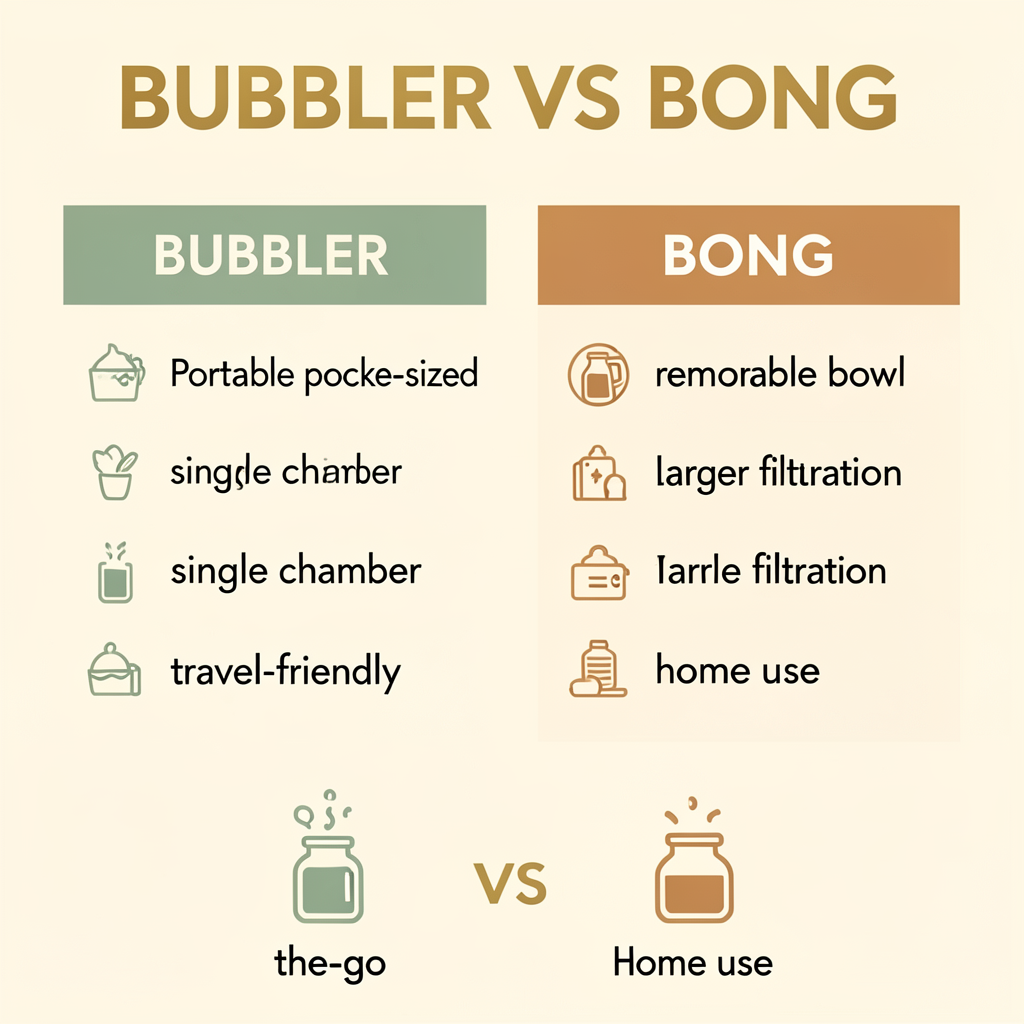
The main difference is size and design. Bubblers are small, one-piece handheld water pipes with a fixed chamber and a carb hole. Bongs are larger, modular water pipes with separate removable bowls and downstems, often featuring percolators for extra filtration.
Which is more portable — a bubbler or a bong?
Bubblers are significantly more portable. Their compact one-piece design fits in a palm or pocket, making them ideal for travel. Bongs are larger and designed primarily for home use on a flat surface.
How does water filtration work in a bubbler versus a bong?
Both use two filtration mechanisms: convective heat transfer (water absorbs heat from hot smoke, cooling it) and diffusion (smoke is broken into tiny bubbles, increasing surface area so ash and particulates are trapped). Bongs extend this with larger water capacity, longer smoke paths, and optional percolators.
Which is easier to clean, a bubbler or a bong?
Bongs are generally easier to clean because their modular components (bowl, downstem, base) can be separated for thorough cleaning. Bubblers have fixed one-piece construction that makes deep cleaning more difficult.
Can a small bong be used as a bubbler?
Mini bongs under 6–7 inches are sometimes called bubblers and offer greater portability, though they typically produce harsher hits due to less water capacity and shorter smoke paths compared to full-sized bongs.
Should I Choose a Bubbler or a Bong?
The choice between a bubbler and a bong depends entirely on your priorities. If you want a device you can carry anywhere, store easily, and use without setup, a bubbler is the right choice. Its one-piece design, small footprint, and simple carb-hole mechanism make it a practical option for on-the-go use. [1] [2]
If you want maximum smoke cooling, advanced filtration options, and a device built for home use, a bong is the better investment. The modular design makes bongs easier to clean and maintain over time, and features like percolators and ice catchers provide additional cooling stages that bubblers cannot match. [1] [4]
Many smokers find that owning both fits their lifestyle: a bubbler for travel and convenience, and a bong for home sessions. Browse the full selection of bubblers and bongs at Treehouse Lifestyle to find the right fit for your setup.
Where Does This Smoking Accessory Information Come From?
- Smoke Cartel: Bubbler vs Bong: Main Differences (Size, Hits, Cleaning)
- Vessel Brand: Bubbler Vs. Bong – What’s The Difference?
- Badass Glass: Bong Sizes Guide & How to Choose the Right One
- Grasscity: The Science of Bong Water: Filtration, Cooling & Smoother Hits
- Leafly: Cannabis science 101: The complex chemistry of the bong
- Thick Ass Glass: How Does A Water Bong Work | Smoke Physics
- Healthline: How Does a Bong Work? Benefits, Risks, and Myths
- Hemper: What is a Bong and The Science Behind How it Works