
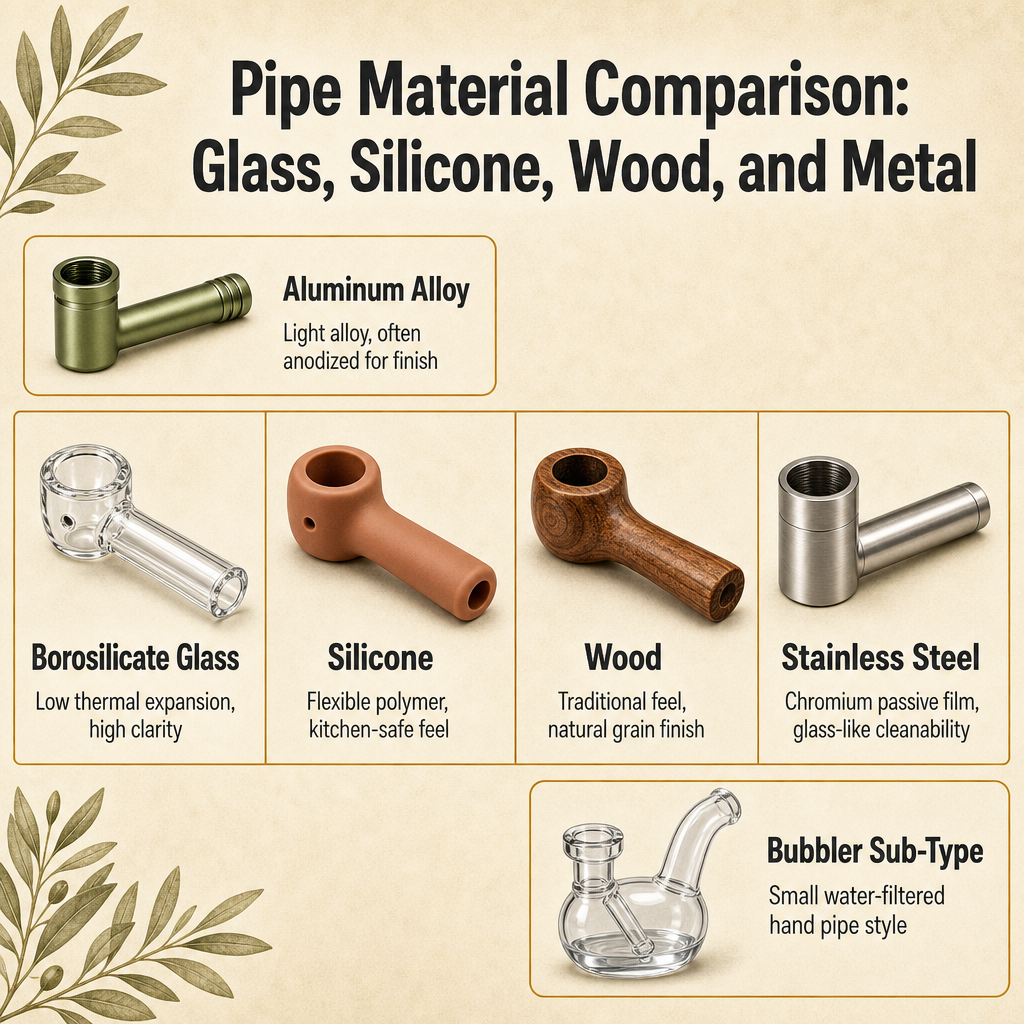
Hand pipes are made from four main material families: glass (most commonly borosilicate), silicone, wood, and metal (typically stainless steel, aluminum, or titanium). Glass borosilicate is favored for clarity and thermal-shock resistance, silicone for flexibility and drop-resistance, wood for traditional feel and weight, and metal for slim profile and durability.
The best pipe material depends on how and where you plan to use the pipe, how much cleaning and maintenance you want to do, and how the price, weight, and feel of each option fit your preferences.
This guide walks through each material family’s properties, the practical trade-offs between them, and the parts and accessories you will use with any of them, so you can pick the right material with confidence. Treehouse Lifestyle’s hand-pipes-and-bubblers category currently lists products in all four families, including glass, silicone, wood, and metal sub-categories, so each option below maps to a real storefront aisle.
What are the most common materials used to make hand pipes?
Most hand pipes sold today fall into one of four material families. The biggest group is glass, and within glass the large majority are made from a specific kind called borosilicate. The next three families are silicone, wood, and metal, and the metal group usually splits into stainless steel, aluminum, and titanium sub-types.
These families are treated as separate material choices rather than style choices because each one behaves very differently in the hand. Glass is rigid and clear. Silicone bends. Wood feels warm and natural. Metal is slim and tough. Those four personalities drive almost every other decision you will make, from how you clean it to where you can take it.
Inside the broader hand-pipes-and-bubblers category Bubblers, brands tag products by material so shoppers can compare options in the same family at a glance. Borosilicate glass is its own sub-tag, as is each metal sub-type, because the differences between stainless steel, aluminum, and titanium matter more than the word "metal" alone suggests [5].
Two quick notes on vocabulary. A "bubbler" is a small water-filtered hand pipe, not a separate material, so bubblers show up in the same material tags as straight hand pipes [6]. And "spoon pipe" is just a common shape name for a small glass hand pipe, so you will see that term in glass product listings.
- Glass (mostly borosilicate): rigid, clear, and the most common material for hand pipes, with borosilicate getting its own sub-tag on the storefront.
- Silicone: a flexible polymer that bends and absorbs drops, used for travel-friendly and budget-friendly designs.
- Wood: traditional material with natural grain, usually chosen for feel and weight rather than transparency.
- Metal (stainless steel, aluminum, titanium): slim profile, durable, and lightweight depending on the alloy used.
How does borosilicate glass differ from regular glass for pipes?
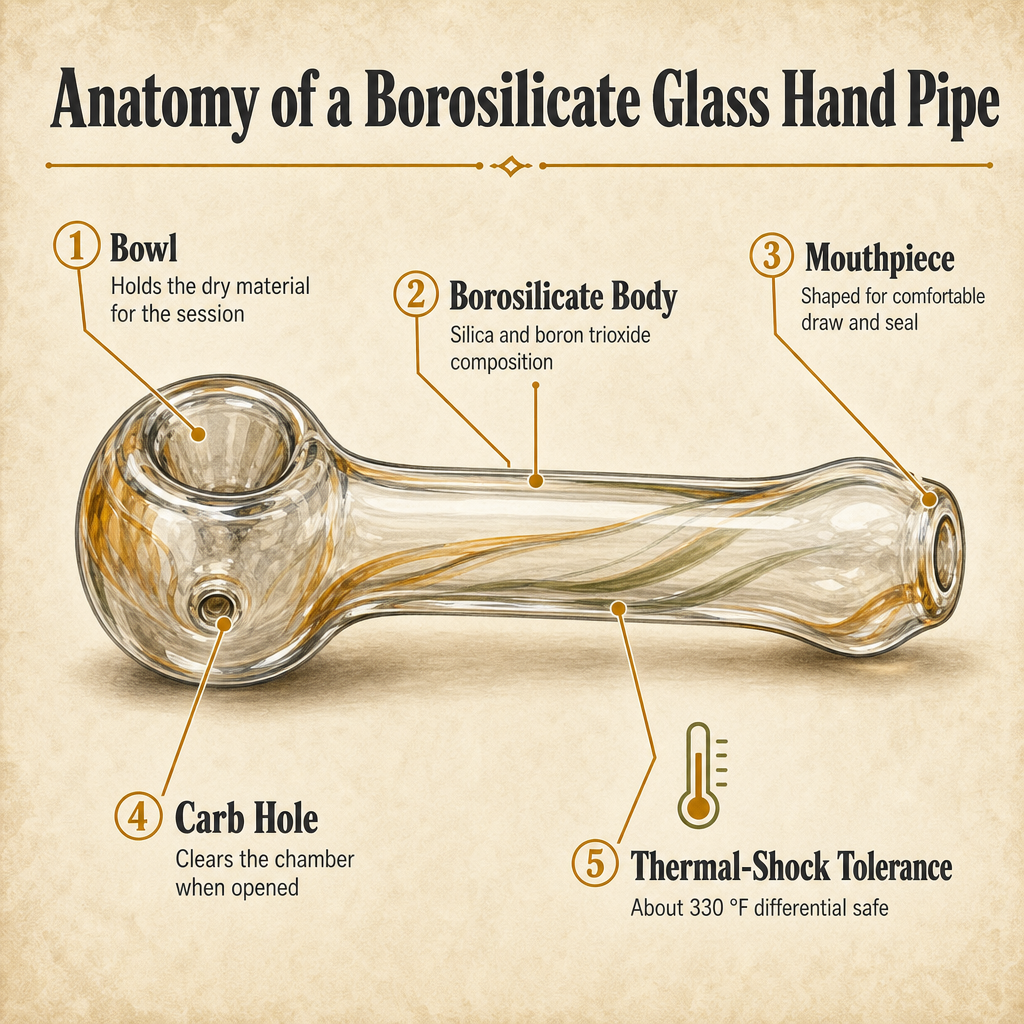
There are two main kinds of glass used in everyday products. Soda-lime glass is the common window and bottle glass. Borosilicate glass is a special composition that contains silica and boron trioxide as its main glass-forming ingredients, and it has been the laboratory and premium pipe glass standard for more than a century [1].
The difference shoppers notice most is how each kind of glass handles temperature change. Borosilicate has a very low coefficient of thermal expansion (about 3 × 10⁻⁶ K⁻¹ at 20 °C) and can handle temperature swings of roughly 330 °F (166 °C) without cracking. Soda-lime glass expands more with heat and is more likely to fracture when one part of it heats up faster than another.
Borosilicate is also harder to break when dropped and keeps its clarity longer than soda-lime glass, which can slowly cloud or scratch. Those properties are why most premium pipe makers pick borosilicate, and why the storefront tags it as its own sub-category rather than lumping it in with generic glass.
Borosilicate has a real history behind it. German glassmaker Otto Schott developed the formula in the late 19th century, and Corning brought it to the North American market in 1915 under the Pyrex brand [1]. The Pyrex name is still a useful shorthand for laboratory-grade glass, even though most pipe glass today is not actually branded Pyrex.
If you want the full picture on glass as a hand-pipe material, the cluster’s main guide on hand pipes and bubblers What Are Hand Pipes and Bubblers, and How Do They Differ? covers styles and shapes, and the glass-versus-silicone accessories comparison Glass vs Silicone Smoking Accessories: Which Should You Choose? dives deeper into the borosilicate side of that matchup.
- Composition: silica and boron trioxide are the main glass-forming ingredients, not just silica and soda.
- Thermal-shock tolerance: handles about a 330 °F (166 °C) temperature differential without fracturing.
- Clarity: stays clear longer than soda-lime glass and resists clouding from use and cleaning.
- Drop resistance: harder to break on impact than soda-lime glass, though it can still shatter on hard surfaces.
- Heritage: developed by Otto Schott in the late 1800s and brought to North America by Corning as Pyrex in 1915.
What are the practical differences between silicone, wood, and metal hand pipes?
Silicone, wood, and metal each bring a very different feel to a hand pipe, and that feel is the main reason shoppers pick one over another. Understanding what each material actually is, beyond the label, makes the choice easier.
Silicone is a family of polymers built from repeating siloxane units (–O–SiR₂–O–SiR₂–). The most common silicone is polydimethylsiloxane, often shortened to PDMS. It is used in sealants, adhesives, lubricants, cooking utensils, thermal insulation, and electrical insulation, which is why silicone rubber shows up in so many kitchen products [2].
Wood is the most traditional option. Pipes made from hardwoods are turned or carved, sometimes inlaid, and finished with a food-safe oil or wax. The grain is unique on every piece, which is part of the appeal. Wood has a warm, solid feel in the hand that metal and silicone do not.
The metal family covers three main alloys. Stainless steel is an iron-based alloy that resists corrosion because it contains at least 10.5% chromium, which forms a passive film on the surface that protects the metal and self-heals when exposed to oxygen [3]. Aluminum has a density of about 2.70 g/cm³ (around one-third that of steel) and a melting point of 660.32 °C, and is often used in cookware in anodized form, which adds a protective oxide layer to the surface [4]. Titanium is the lightest of the three for its strength.
In everyday use, the practical differences come down to weight, finish, and feel. Silicone is the lightest and most flexible. Wood has the heaviest, warmest feel. Metal sits in between, with stainless steel on the heavier side, aluminum light, and titanium light and strong. Each of these families has its own aisle on the storefront, including the metal hand pipes sub-category Metal Hand Pipes, so you can browse them side by side.
- Silicone base: a polysiloxane polymer (most often PDMS) used across kitchen and insulation products, giving silicone its flexible, rubber-like feel.
- Wood finish: natural hardwood grain with a unique pattern on every piece, usually sealed with a food-safe oil or wax.
- Stainless steel: iron alloy with at least 10.5% chromium that forms a self-repairing passive oxide film on the surface.
- Aluminum alloy: density about 2.70 g/cm³, often anodized to add a protective surface oxide layer for cookware-style durability.
- Weight and feel in hand: silicone is light and bendable, wood is warm and dense, metal ranges from slim aluminum to heavier stainless steel.
| Property | Silicone | Wood | Metal |
|---|---|---|---|
| Base material | Polysiloxane polymer (PDMS) [2] | Hardwood, turned or carved | Stainless steel, aluminum, or titanium alloy |
| Weight feel | Lightest, flexible in the hand | Heaviest, warm, solid | Slim profile, varies by alloy |
| Surface finish | Matte polymer, color-impregnated | Natural grain, oil or wax sealed | Chromium passive film or anodized oxide layer [3] [4] |
| Drop behavior | Bends and absorbs impact | Can crack on hard impact | Resists dents on most alloys |
| Storefront tag | material:silicone | material:wood | material:metal (plus alloy sub-tags) [5] |
Are silicone hand pipes heat resistant?
Silicone handles heat well compared with most organic plastics, and that is one of the main reasons it crossed over from kitchen tools into hand-pipe design. The polymer chemistry behind silicone is what gives it that advantage in everyday handling.
The most common silicone, polydimethylsiloxane, is used in cooking utensils, baking mats, hot-food container seals, and thermal insulation, because the siloxane backbone tolerates temperatures that would soften or warp many ordinary plastics [2]. That same backbone is why silicone hand pipes do not get brittle in cold weather or floppy in mild heat the way some plastics do.
Silicone rubber is also widely used in kitchen applications because it stays flexible across a wide temperature range and tolerates many of the cleaning solutions used for glass and metal accessories. For a shopper, the practical takeaway is that silicone behaves more like a kitchen tool than like a cheap plastic part.
If you want to see how silicone pipes stack up in person, the silicone hand pipes sub-category on the storefront Silicone Hand Pipes collects the silicone options currently in stock alongside the rest of the hand-pipes lineup.
- Polymer backbone: repeating siloxane units (–O–SiR₂–O–SiR₂–) give silicone its temperature and chemical stability.
- Kitchen heritage: PDMS is used in cooking utensils, baking tools, and kitchen seals because of its heat tolerance.
- Flexibility in use: silicone stays flexible across a wide temperature range and does not get brittle in cool conditions.
- Cleaning chemistry: silicone tolerates many of the cleaning solutions used for glass and metal accessories.
- Practical takeaway: silicone behaves more like a heat-tolerant kitchen material than like an everyday plastic part.
Do metal pipes change the taste compared to glass or wood?
The short answer is that the alloy and the surface finish matter more than the word "metal" does. Stainless steel and anodized aluminum tend to behave a lot like glass because their surfaces are sealed off from the material inside. Bare or unfinished metal is a different story.
Stainless steel works in food processing, pharmaceutical, and cookware settings because its chromium passive film keeps the metal from interacting with whatever it touches. The biological cleanability of stainless steel is comparable to glass, which is one reason the same alloy shows up in kitchen sinks and brewing equipment [3].
Anodized aluminum gets a similar protective layer. The anodizing process grows an oxide layer on the surface of the aluminum, which seals the metal underneath and gives the cookware-style finish you see on many aluminum accessories. That oxide layer is what anodized aluminum is judged on, not the raw aluminum itself [4].
Wood behaves differently. The grain can absorb and slowly release oils and moisture, which is why seasoned wood users notice a distinct character to wood pipes that metal and glass do not have. Glass borosilicate is the most neutral of the group, since the glass itself does not absorb or react much with whatever passes through it.
If you are also weighing metal against silicone in larger formats, the glass-vs-silicone bong comparison Glass vs Silicone Bong: Which Material Should You Actually Buy? walks through similar material trade-offs in a different product family.
- Stainless steel: a chromium passive film seals the surface, and biological cleanability is comparable to glass.
- Anodized aluminum: an oxide layer is grown on the surface during manufacturing, sealing the metal underneath.
- Bare metal: unfinished metal lacks the protective layer, which is why most consumer pipes use stainless or anodized aluminum instead.
- Wood: grain can absorb and release small amounts of material over time, giving wood a distinct feel compared with glass and metal.
- Glass borosilicate: the most neutral surface of the four, since glass does not absorb or react much with what passes through.
| Material | Surface layer | Flavor neutrality |
|---|---|---|
| Stainless steel | Chromium passive film (self-repairing) [3] | Comparable to glass; cleanability close to borosilicate |
| Anodized aluminum | Grown oxide layer from anodizing process [4] | Sealed surface behaves like glass for most sessions |
| Bare aluminum | No protective layer | Can pick up or impart off-notes; rarely sold this way |
| Wood | Natural grain with oil or wax finish | Distinct character; grain holds and slowly releases residue |
| Borosilicate glass | Inert glass surface [1] | Most neutral of the four; minimal interaction |
Which pipe material is easiest to clean and maintain?
Cleaning effort varies a lot by material, and the ranking below reflects how the four families behave in real use, not just on paper. The good news is that none of them are difficult once you know the routine for each one.
Stainless steel and borosilicate glass come out on top for routine cleanability. Stainless steel’s biological cleanability is comparable to glass, which is why both materials show up in food and pharmaceutical settings where cleanliness is critical [3]. Borosilicate glass holds up to isopropyl alcohol, salt, and pipe-cleaning brushes without scratching, as long as you avoid sudden temperature swings.
Silicone is next on the list, mostly because it bends. Many silicone hand pipes can be partially disassembled, which lets you reach into corners that are awkward in glass or wood. The flexibility also means silicone tolerates more aggressive cleaning solutions than some of the other materials.
Wood needs the most care. The grain can hold residue if the pipe is not cleaned regularly, and wood should not be soaked in alcohol the way glass can be. Most wood pipe owners use a thin bristle pipe brush, a small amount of alcohol on a cotton swab, and a food-safe oil or wax on the outside to keep the finish from drying out.
To compare the four at a glance, here is the cleaning effort ranked from easiest to most careful.
- 1. Stainless steel and borosilicate glass (tied): both tolerate alcohol, salt, and brushes; stainless cleanability is comparable to glass.
- 2. Silicone: flexibility lets you reach corners and disassemble parts; tolerates a wider range of cleaning solutions.
- 3. Anodized aluminum: similar to stainless on routine cleaning; avoid harsh abrasives that can damage the anodized layer.
- 4. Wood: needs the most care because grain can hold residue; use gentle cleaners and condition the outside with food-safe oil.
How do borosilicate, silicone, wood, and metal pipes compare on durability and price?
Durability is where the four families really split. Each material fails in a different way, and the right choice depends on which kind of failure you can live with. Glass borosilicate is harder to break on impact than soda-lime glass and resists thermal shock up to about 330 °F differentials, but it can still shatter if it lands on tile or concrete [1].
Silicone is the most forgiving on drops. Because the polymer bends, a silicone hand pipe can fall off a table or out of a bag without cracking. The trade-off is that silicone can pick up small surface scratches over time, especially if it is stored next to keys or metal accessories.
Metal durability comes down to the alloy. Stainless steel has an annealed tensile yield strength around 210 MPa (30,000 psi) for AISI 304, the most common grade, which is plenty for everyday use [3]. Aluminum alloys reach 200–600 MPa yield strength in commercial products, while pure aluminum is much softer at 7–11 MPa, so the strength of an aluminum pipe depends on whether it is pure aluminum or an alloy [4].
Wood is durable in its own way. A well-made hardwood pipe can last for years if it is not dropped and not soaked in liquid, but it does need more maintenance than the other three. The natural grain is part of the appeal and also the reason wood needs the most careful handling.
On price, borosilicate glass and stainless steel typically sit at the higher end, silicone and aluminum sit in the middle, and wood spans a wide range depending on craftsmanship. The storefront breaks this out clearly with the glass hand pipes Glass Hand Pipes and wood hand pipes Wood Hand Pipes sub-categories, so you can sort by material and price in the same view.
If you want a quick side-by-side summary of the four families, here is how they compare on the most common durability signals.
- Borosilicate glass: resists thermal shock up to about 330 °F differentials, harder to break than soda-lime glass, but can still shatter on hard impact.
- Silicone: most drop-resistant of the four because the polymer bends; can pick up surface scratches over time.
- Stainless steel: AISI 304 has about 210 MPa yield strength, resists corrosion via the chromium passive film, slim profile.
- Aluminum alloy: density 2.70 g/cm³, yield strength 200–600 MPa for commercial alloys, lighter than steel.
- Wood: durable when cared for, but needs the most maintenance and should not be soaked; unique grain on every piece.
- Price tiers: borosilicate and stainless steel usually higher, silicone and aluminum middle, wood ranges with craftsmanship.
| Material | Failure mode | Typical price tier |
|---|---|---|
| Borosilicate glass | Shatters on hard impact; resists thermal shock to ~330 °F [1] | Higher end |
| Silicone | Surface scratches over time; very drop-resistant | Middle |
| Stainless steel | Dents under heavy force; corrosion-resistant via chromium film [3] | Higher end |
| Aluminum alloy | Alloy-dependent strength (200–600 MPa); pure aluminum is soft [4] | Middle |
| Wood | Cracks on hard drops; grain holds residue if not cleaned | Wide range by craftsmanship |
Which pipe material should you choose for your routine?
The right material depends less on which one is "best" in the abstract and more on how you actually use a hand pipe. The four profiles below cover the most common shopper routines, and each one points to the material that fits it best.
If you mostly use your hand pipe at home and like to see what you are doing, borosilicate glass is the easy pick. Clarity, thermal-shock tolerance, and easy cleaning line up with a sit-down routine, and the glass hand pipes aisle has a wide range of shapes and sizes.
If you carry a pipe in a bag, take it outside, or just want something that survives drops, silicone is built for that. The silicone hand pipes sub-category collects the current travel-friendly options.
If you want a traditional feel, weight in the hand, and a unique grain pattern, wood is the natural fit. The wood hand pipes sub-category is where to start, with both budget and craftsman-level options.
If you want a slim profile, durable finish, and a more modern look, metal is worth a look. The metal hand pipes sub-category breaks down the stainless, aluminum, and titanium options.
If you are shopping for a gift, borosilicate glass and stainless steel tend to make the strongest impression because of how they look and feel out of the box. Silicone is a more forgiving pick if you are not sure how the recipient will use it.
Treehouse Lifestyle offers free shipping on orders $150+, so if you are picking up a hand pipe along with other accessories, you can stock the rest of your kit in the same order.
- 1. Home collector: borosilicate glass for clarity, thermal-shock tolerance, and easy cleaning; browse the corresponding sub-category.
- 2. Traveler or on-the-go user: silicone for drop-resistance and flexibility; browse silicone options.
- 3. Traditional feel shopper: wood for weight, warmth, and unique grain; browse wood options.
- 4. Modern slim-profile shopper: metal for slim shape and durable alloy finish; browse metal options.
- 5. Gift buyer: borosilicate glass or stainless steel for the strongest first impression; silicone for a more forgiving pick if you are not sure how the recipient will use it.
Frequently Asked Questions
What are the most common materials used to make hand pipes?
Most hand pipes are made from one of four material families: glass (most often borosilicate), silicone, wood, or metal (typically stainless steel, aluminum, or titanium). Treehouse Lifestyle’s hand-pipes-and-bubblers category currently lists products in all four families, plus borosilicate-glass, aluminum, stainless-steel, and titanium sub-tags inside the metal family.
How does borosilicate glass differ from regular glass for pipes?
Borosilicate glass contains silica and boron trioxide as its main glass-forming constituents, has a very low coefficient of thermal expansion, and can withstand temperature differentials of about 330 °F (166 °C) without fracturing. Compared to soda-lime glass (the common window and bottle glass), borosilicate is harder to break when dropped, more resistant to cracking from thermal changes, and keeps its clarity longer, though it is usually more expensive.
Are silicone hand pipes heat resistant?
Silicone rubber is a polymer built from repeating siloxane units, and the most common form, polydimethylsiloxane (PDMS), is used in sealants, adhesives, cooking utensils, thermal insulation, and electrical insulation. That kitchen heritage is why silicone is widely used in cooking applications where flexibility and heat tolerance matter more than they do with many ordinary plastics.
Do metal pipes change the taste compared to glass or wood?
Stainless steel resists corrosion because it contains at least 10.5% chromium, which forms a passive film on the surface, and its biological cleanability is comparable to glass. Anodized aluminum gets a similar protective oxide layer added during manufacturing. Because of those surface films and easy cleanability, stainless and anodized aluminum tend to behave more like glass on flavor neutrality than bare wood or unfinished metal do.
Which pipe material is easiest to clean and maintain?
Stainless steel’s cleanability is comparable to glass, which is why both materials show up in food, pharmaceutical, and cookware applications. Silicone is flexible enough to disassemble and rinse easily in many designs. Wood needs the most care because its grain can hold residue, and glass borosilicate is durable but can shatter if dropped, which affects how you handle it during cleaning.
How do borosilicate, silicone, wood, and metal pipes compare on durability and price?
Borosilicate glass is harder to break when dropped than soda-lime glass and resists thermal shock up to about 330 °F differentials, but it can still shatter on hard impact. Silicone is flexible and drop-resistant by design. Stainless steel alloys have annealed tensile yield strengths around 210 MPa (AISI 304) and aluminum alloys reach 200–600 MPa yield strength, while pure aluminum is much softer at 7–11 MPa. On price, borosilicate and stainless steel typically sit at the higher end, silicone and aluminum at the middle, and wood at the lower end depending on craftsmanship.
Which pipe material comes out on top for you?
There is no single best pipe material, because the four families are built around different shopper priorities. Borosilicate glass wins on clarity, thermal-shock tolerance, and easy cleaning. Silicone wins on drop-resistance and travel-friendliness. Wood wins on traditional feel and natural grain. Metal wins on slim profile, durable alloy finish, and modern look.
The smartest way to pick is to start with the routine you actually have. A home collector who values transparency usually lands on borosilicate. A traveler who drops things usually lands on silicone. A traditionalist who values weight and grain usually lands on wood. A shopper who wants slim and modern usually lands on metal.
Each of those choices maps to a real storefront aisle. You can browse glass hand pipes, silicone hand pipes, wood hand pipes, and metal hand pipes side by side, and the borosilicate-glass, aluminum, stainless-steel, and titanium sub-tags let you drill down inside the glass and metal families.
If you want to keep learning, the parent guide on hand pipes and bubblers covers styles and shapes, and the glass-vs-silicone accessories comparison digs deeper into the two most-shopped materials. Treehouse Lifestyle offers free shipping on orders $150+, so you can pick up your pipe along with the rest of your kit in one order.
Sources
- Wikipedia (sourced to Schott AG and Corning published references): Borosilicate glass
- Wikipedia (sourced to peer-reviewed polymer chemistry literature): Silicone
- Wikipedia (sourced to ISO, ASTM, AISI, and metallurgical textbooks): Stainless steel
- Wikipedia (sourced to materials-science references): Aluminium
- Treehouse Lifestyle (Treehouse Cannabis Co.): Hand Pipes & Bubblers category listing
- Treehouse Lifestyle (GRAV®): GRAV® Wedge Bubbler – Assorted Colors (product 17812)