
A glass bong and a silicone bong are both water pipes, but they are built for very different priorities. Glass bongs, typically made from borosilicate glass, give you flavor neutrality, interior visibility, and access to more intricate percolator designs. Silicone bongs give you flexibility, grip, and impact resistance at the cost of transparency and filtration complexity. Clean borosilicate glass is the better-supported choice when flavor neutrality is the priority, silicone is the stronger choice for travel and drop-prone settings, and a hybrid glass-and-silicone piece splits the difference — although its glass components remain breakable. [1] [2]
The right material depends on how you actually use a piece. A careful home setup with stable storage favors glass. A backpack, dorm room, or shared space favors silicone. A hybrid covers both when you are willing to accept that the glass parts inside still need to be handled with care. The rest of this guide walks through what each material is, how they compare on durability, flavor, visibility, filtration, and cleaning, and how to match the choice to your routine.
What Is a Glass Bong and What Is a Silicone Bong?
A glass bong is a rigid water pipe made from glass, most often borosilicate glass. Borosilicate has a low coefficient of thermal expansion and strong resistance to thermal shock, acids, alkalis, and many solvents. Those are real material properties, and they explain why glass dominates technical glassware and high-end water pipes alike. They do not, however, make a finished bong shatterproof. A hard impact can still break even thick borosilicate, and sudden temperature swings can stress the piece. [3]
Glass is rigid and transparent. Rigidity lets a maker cut precise chambers, bends, slits, and percolator shapes. Transparency lets you see the water level, watch for residue building up, and inspect interior parts without taking the piece apart. You can find a wide range of glass options in the Glass Bongs collection at Treehouse Lifestyle.
A silicone bong uses a flexible, food-grade silicone polymer for some or all of its body. Silicone bends, grips a surface rather than skating across it, and absorbs shock that would crack or shatter glass. Most silicone pieces still use a glass bowl, downstem, or other glass insert, so the label silicone usually means the outer body is flexible rather than every component. You can browse the Silicone Bongs lineup to see how that plays out across different shapes.
There are also hybrid pieces that combine a silicone outer shell with glass airflow parts. A hybrid can deliver a more forgiving body while preserving some of the design complexity of a glass piece. That trade-off is worth keeping in mind, because the glass components inside a hybrid remain breakable on hard impact.
In plain terms, the materials start with these baseline differences:
- Glass is rigid, transparent, and the better-supported choice when flavor neutrality and interior visibility matter most.
- Silicone is flexible, grippy, and impact resistant, which makes it well suited to travel and shared spaces.
- Hybrid pieces combine a silicone outer body with glass parts, giving you some benefits of both materials at the cost of added complexity.
- Borosilicate glass resists heat and many chemicals better than ordinary glass, but neither glass nor silicone is indestructible in real-world use.
Which Material Is Less Likely to Break When Dropped or Travelled?
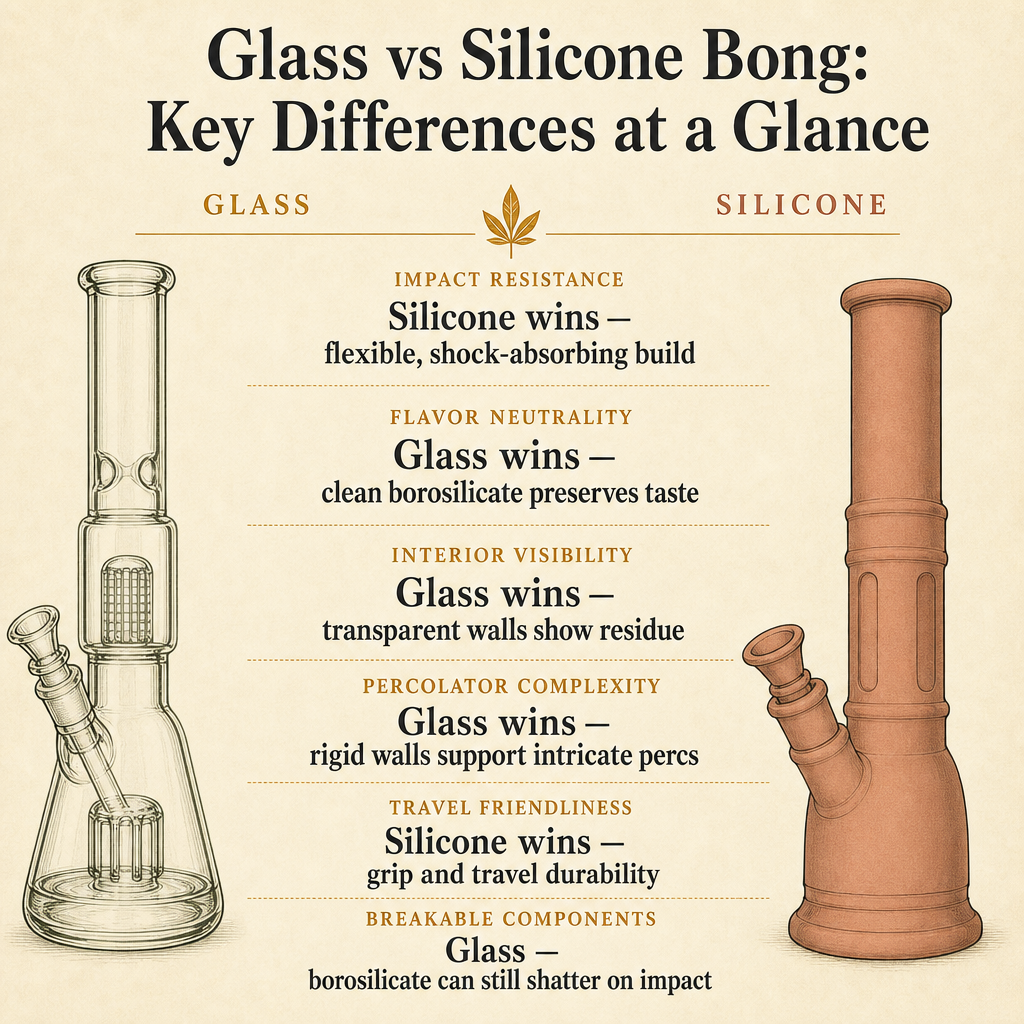
Silicone is the clear winner for drops and travel. Its flexibility absorbs shock, while even heavy-duty borosilicate can shatter when it hits a hard floor or edge. GRAV describes silicone as adding grip, shock absorption, and travel utility, and frames it as a practical answer to the fact that even their thick borosilicate pieces can break. [1] Thick Ass Glass makes the same point from a different angle, calling silicone water pipes flexible, impact resistant, portable, and less prone to resin adhesion than glass. [2]
That does not mean silicone is unbreakable. Seams can wear, glass bowls can crack, downstems can chip, and any glass insert inside a hybrid still has all the usual vulnerabilities. A hybrid may protect its outer body while leaving a critical airflow component exposed to a hard hit.
Borosilicate glass handles temperature swings better than ordinary soda-lime glass. DWK Life Sciences explains that borosilicate has a low coefficient of thermal expansion and strong thermal-shock resistance, along with good resistance to acids, alkalis, and solvents. [3] Those are useful properties, but thermal-shock resistance is not the same as impact resistance. Pouring boiling water into a cold piece can still stress the glass, and dropping the same piece can end the discussion rather abruptly.
If you are weighing the materials for real-world handling, the practical comparison looks like this. For more context on how water pipes are built and used in general, see What Is a Bong and How Does It Work?. If you are weighing the same material question across other accessories in your kit, Glass vs Silicone Smoking Accessories: Which Should You Choose? covers the wider glass-vs-silicone decision for smoking accessories.
- Silicone absorbs shock from drops and bumps in ways glass cannot, making it the safer pick for transport.
- Even heavy-duty borosilicate glass can shatter on hard impact, despite its strength in heat and resistance to many cleaners and solvents.
- Hybrid pieces protect the outer body but still expose any glass bowls, downstems, or percolators to breakage.
- Storage matters: a stable home setup with careful handling favors glass, while shared or mobile setups favor silicone.
| Scenario | Glass bong | Silicone bong | Hybrid |
|---|---|---|---|
| Drop from table height | Likely to chip or shatter | Usually survives | Outer body survives, glass parts at risk |
| Backpack or road trip | High breakage risk | Built for travel | Reasonable middle ground |
| Shared dorm or group space | Frequent bumps likely | Tolerates handling | Tolerates handling |
| Sudden temperature change | Can stress even borosilicate | Handles temperature range | Follow the glass part’s limits |
Does Glass or Silicone Preserve Flavor Better?
Clean borosilicate glass is the better-supported choice when flavor neutrality is the priority. Glass does not usually hold onto odors and flavors the way silicone can, so a clean glass piece gives you a more neutral starting point from one session to the next. Thick Ass Glass explicitly favors clean borosilicate when flavor neutrality is the priority, because silicone can retain odors or flavor over time, particularly when residue is not fully removed. [2] HEMPER makes the same call from a retailer’s view, listing flavor neutrality among glass’s main advantages over silicone. [4]
Silicone can retain odors or flavor over time, especially when residue is left behind after a session. A quick rinse may not be enough to fully clear a flexible body, and an opaque piece can make it harder to tell what is still sitting inside. None of this makes silicone unusable; it just means cleaning habits matter more, and a structured routine is the difference between a neutral surface and a sticky one.
If flavor neutrality is your main buying reason, plan around it. Consider the cleaning routine as part of the product rather than a separate chore, and you can keep either material performing well. For an overview of how different small formats stack up on the same question, the What Are Hand Pipes and Bubblers, and How Do They Differ? guide is a useful companion read.
A few practical habits tend to matter more than the material itself:
- Rinse or clean after each session so residue does not have time to set into the surface.
- Follow the manufacturer’s cleaning method rather than improvising with whatever cleaner is nearby.
- Consider opaque silicone as a clean-by-routine piece rather than a clean-by-sight piece.
- Consider glass as the easier material to keep neutral, but still clean it on a regular schedule.
Can You See Inside a Glass Bong the Way You Can With Silicone?
No. Transparent glass gives you a direct view of the water level, residue, and interior parts. An opaque silicone body hides those details, so you may need to rely on touch, smell, disassembly, and a consistent cleaning routine rather than a glance. HEMPER lists transparency and interior visibility as one of the main advantages of glass over silicone. [4]
Visibility is more than a styling point. It helps you notice when water needs changing, when residue is building up on the walls, or when a downstem and percolator need attention. With silicone, the outside may look clean even when the inside still needs work, which is exactly the kind of situation a structured routine prevents.
What you can inspect at a glance is worth spelling out, because the difference is larger than it sounds. For a broader walkthrough of inspection and cleaning habits, see How Do You Clean a Bong the Right Way?.
- Glass shows the water level through its transparent walls, so you do not have to guess when it is time for a refill.
- Glass makes residue and blocked-looking interior passages easier to spot during use and cleaning.
- Silicone may require more hands-on inspection because the body can be opaque and interior details are hidden.
- A clear view does not replace cleaning, but it does shorten the time it takes to notice when cleaning is overdue.
| What you want to check | Glass bong | Silicone bong |
|---|---|---|
| Water level | Visible at a glance | Often hidden by opaque walls |
| Residue on interior walls | Easy to spot through transparent glass | Hard to see without disassembly |
| Downstem and percolator condition | Visible in many designs | Hidden by opaque body |
| Whether the piece is fully clean | Easy visual check | Best judged by routine, not sight |
Which Material Supports More Percolator Designs?
Rigid glass supports more intricate visible percolator designs than flexible silicone. Glass can hold precise chambers, tubes, slits, and other fixed pathways without needing to flex around them, which is why most of the elaborate filtration designs in the water pipe category are built from glass. Thick Ass Glass calls out complex percolators as a clear borosilicate advantage over silicone. [2] HEMPER agrees, listing intricate percolators among glass’s strengths over silicone. [4]
Silicone can still be designed with useful water chambers and simple filtration, but flexibility places real limits on how much detailed internal work the body can support. A silicone body needs to flex without compromising seals, which rules out many of the precise, rigid designs that define glass percolators.
Some pieces solve this with a hybrid build: a silicone outer shell around glass airflow components. That can preserve some of the filtration complexity of a glass piece while giving the outer body more drop safety. You can explore this category in the Percolator Bongs collection, which focuses on pieces built around percolator designs.
If complex filtration is part of your wish list, these points tend to decide the comparison:
- Glass offers the widest range of visible, rigid percolator shapes because the body can hold precise chambers without flexing.
- Silicone favors simpler construction and travel durability, with less room for intricate internal pathways.
- Hybrid pieces can add glass percolator internals inside a silicone body, but those glass parts remain breakable.
- More complex interiors also mean more parts to inspect, disassemble, and clean, so factor that into the choice.
How Do You Clean a Glass Bong vs a Silicone Bong?
The two materials need different cleaning workflows, and the right approach depends on which one you own. GRAV’s glass-cleaning guide recommends warm-water rinsing first, then a glass-compatible cleaner or high-concentration isopropyl alcohol with coarse salt for stubborn residue, a thorough final rinse, and air drying. The same guide warns against sudden temperature changes, such as pouring boiling water into cold glass. [5]
For removable silicone parts, GRAV’s own material guidance recommends warm soapy water, scrubbing as needed, thorough rinsing, and complete drying. The same post notes that GRAV’s removable silicone parts are dishwasher-rated and that glass-specific cleaner should not be used on silicone. [1] Other manufacturers may differ, so always confirm dishwasher use and cleaner compatibility with the specific product rather than assuming it for every silicone bong.
If you want a real-world example of how the silicone workflow plays out on a piece with a glass insert, the SILICONE BEAKER BONG WITH REMOVABLE GLASS BOWL listing is a useful reference. The important point is to regard glass and silicone as separate care routines instead of assuming they are interchangeable just because they appear in the same type of water pipe.
A reliable glass routine looks like this:
A silicone routine looks different because the material is flexible and usually comes apart into separate pieces. Where glass asks you to manage cleaner residue, silicone asks you to manage seams, soap film, and hidden interior surfaces. GRAV’s silicone care guidance is the clearest reference here, and it is worth treating it as the baseline rather than improvising. [1]
Dishwasher use is the most common point of confusion. GRAV states that its removable silicone parts are dishwasher-rated, but that does not mean every silicone bong on the market is. Confirm the dishwasher rating on the specific product before trying it, and do not assume glass-specific cleaners are compatible with silicone just because they work on the rest of the water pipe.
Run the silicone routine as a numbered checklist so you do not skip a step:
- Start with a warm-water rinse to loosen fresh residue and avoid sudden temperature changes on cold glass.
- Use a glass-compatible cleaner, or the manufacturer-approved alcohol-and-coarse-salt method for stubborn residue.
- Rinse every chamber and opening thoroughly so no cleaner or loosened residue remains.
- Let the piece air dry fully before putting it back into storage.
- Separate removable silicone parts from glass bowls, downstems, or inserts when the product instructions allow it.
- Wash the silicone with warm soapy water and scrub any areas that tend to collect residue, including seams.
- Rinse thoroughly, paying attention to seams and openings where soap can hide.
- Dry every part completely before reassembly, and confirm dishwasher use with the maker before trying it.
- Never use a glass-specific cleaner on silicone unless the manufacturer confirms it is compatible.
Who Should Buy a Glass Bong, a Silicone Bong, or a Hybrid?
A glass bong is the best fit for a careful home user who values flavor neutrality, visibility, and complex percolator designs. A silicone bong is the better match for someone who prioritizes portability, grip, and resistance to ordinary impacts. A hybrid is a practical middle ground when you want glass airflow parts with a more forgiving outer body. HEMPER, GRAV, and Thick Ass Glass all converge on this same general split. [4] [1] [2]
Match the material to your routine rather than chasing a generic winner. Think about where the piece will live, how often it moves, how much you care about visibility and flavor neutrality, and whether you want complex percolators or a simpler build. The honest answer for most buyers is the material that fits the way they actually use a piece, not the material that wins on a single feature.
There is no magic material that wins every category. Glass trades impact resistance for transparency and design freedom. Silicone trades some visibility and flavor neutrality for flexibility and easier travel. Hybrid designs trade simplicity for a compromise between the two. With Treehouse Lifestyle offering free shipping on orders $150+, you can build out a glass, silicone, or hybrid setup without paying extra to get it home.
Use these guidelines to make the call:
- Buy glass if the piece will stay in a stable home spot and you care most about visibility, a neutral material profile, and complex percolators.
- Buy silicone if you carry the piece, share space with others, or expect more bumps and drops in everyday handling.
- Buy a hybrid if you want some glass design features but do not want a fully exposed glass body on the outside.
- Choose a simpler design if easy inspection and care matter more than having every possible chamber or percolator.

Frequently Asked Questions
Is a glass or silicone bong better for everyday use?
It depends on what everyday use looks like. Glass suits a careful home routine where flavor neutrality, visibility, and complex filtration matter, and where the piece is unlikely to be bumped or transported. Silicone suits an everyday routine that involves movement, shared spaces, or travel, where impact resistance matters more than transparency or percolator complexity. A hybrid covers both if you can accept that the glass components remain breakable.
Will a silicone bong break if I drop it?
Silicone bongs are built for impact resistance. The flexibility of silicone absorbs shock in ways even heavy-duty borosilicate glass cannot match, and most ordinary drops will not destroy a silicone piece the way they would a glass one. Hybrids that combine a silicone body with internal glass percolators still expose their glass parts to breakage on hard impact.
Does glass or silicone keep the flavor cleaner?
Clean borosilicate glass is the better-supported choice when flavor neutrality is the priority. Silicone can retain odors or flavors over time, particularly when residue is not fully removed during cleaning. If taste is your top concern, plan to deep-clean a silicone bong thoroughly after each use rather than relying on a quick rinse alone.
Can silicone bongs use the same percolators as glass bongs?
Not to the same degree. Rigid glass supports more intricate visible percolator designs than flexible silicone, which is limited by the need to flex without compromising seals. Hybrid pieces can pair a silicone body with glass percolator internals, which preserves some filtration complexity while keeping the outer body drop-resistant, although the glass parts remain breakable.
Can you put a silicone bong in the dishwasher?
Only if the manufacturer confirms it for that specific product. GRAV notes that its removable silicone parts are dishwasher-rated and that glass-specific cleaner should not be used on silicone. Other manufacturers may differ, so always check the product’s own care guidance rather than assuming dishwasher compatibility for every silicone bong.
Are silicone bongs harder to tell when they are clean?
Often, yes. An opaque silicone body can make it harder to judge when the piece is fully clean, since you cannot see the interior the way you can through transparent glass. The fix is a structured routine of warm soapy water, a thorough rinse, and complete drying rather than relying on a visual check alone.
So Which Material Should You Actually Buy?
Glass and silicone both earn a place in the water pipe category, but they earn it for different reasons. Glass is the right call when flavor neutrality, interior visibility, and access to more complex percolator designs are your top buying reasons, and when the piece will live in a stable home spot. Silicone is the right call when portability, grip, and resistance to ordinary drops and bumps are your top buying reasons, and when the piece will travel or live in shared spaces. A hybrid splits the difference, with the caveat that any glass component inside still needs the same care as a stand-alone glass piece. [1] [4]
The cleanest decision is the one that matches how you actually use a water pipe rather than the one that wins on a single feature. Pick glass for control and visibility. Pick silicone for resilience and travel. Pick a hybrid when you want a sensible compromise and understand its limits. With free shipping on orders $150+, you can build out the right setup at Treehouse Lifestyle without overpaying to get it home — and you can adjust later as your routine changes.
Sources
- GRAV: Why We’ve Embraced Silicone
- Thick Ass Glass: Pros & Cons of Silicone vs. Glass Bongs
- DWK Life Sciences: Why Borosilicate Glass Properties Make All the Difference in Pharma Labs
- HEMPER: Silicone vs Glass Bongs: Which Is Right for You?
- GRAV: How Clean Your Bongs & Pipes