

A vase bong is a working water pipe built into a vase-shaped body. It uses the same bowl, downstem, water chamber, and mouthpiece as any other bong. The vase form changes proportions, water capacity, and how the piece sits on a table. It does not add a filtering stage.
What is a vase bong, and why does it look like home decor?
Start with the category. A vase bong is a shape and a style, not a separate kind of device. It is a water pipe with a vase silhouette, which is why it can sit on a shelf and read as decor until someone looks closer. [1]
The naming varies by seller and by maker. The same object gets sold as a vase bong, a vase water pipe, a bud vase bong, or a house-coined name. One brand calls its vase-with-concealed-glass product a Vong, a term it coined partly because short social captions left little room for description. [13] Search only one phrase and you will see only part of the market.
The shape has a real history behind it. Vintage narrow-necked vases already had a wide base that could hold water and a narrower neck that worked as a smoke chamber and a mouthpiece. That is why makers began drilling them near the base for a downstem and a bowl. [4]
The vase function is part of the product, not a marketing afterthought. Most of these pieces are built to hold real or artificial flowers between sessions, so the interior needs to be rinsed and dried before flowers or fresh water go back in. [3]
If you are comparing shapes, it helps to see several of them in one place. The Bongs category groups the current forms together, and a listing such as the Daze Glass – 18 Inch Massive Clear Glass Water Pipe shows the level of spec detail a clear glass piece usually comes with.
- Vase bong: the most common search term, and the label most listings use when the body shape is the main selling point.
- Vase water pipe: a softer term some shops prefer, usually on the same product photographed in a home setting.
- Bud vase bong: points to the small end of the format, where the body is closer to a single-stem vase.
- Decorative or sculptural water pipe: covers larger pieces where the silhouette leads the description.
- Maker-coined names such as Vong: brand terms that will not show up if you search only generic phrases.
How is a vase bong put together inside?
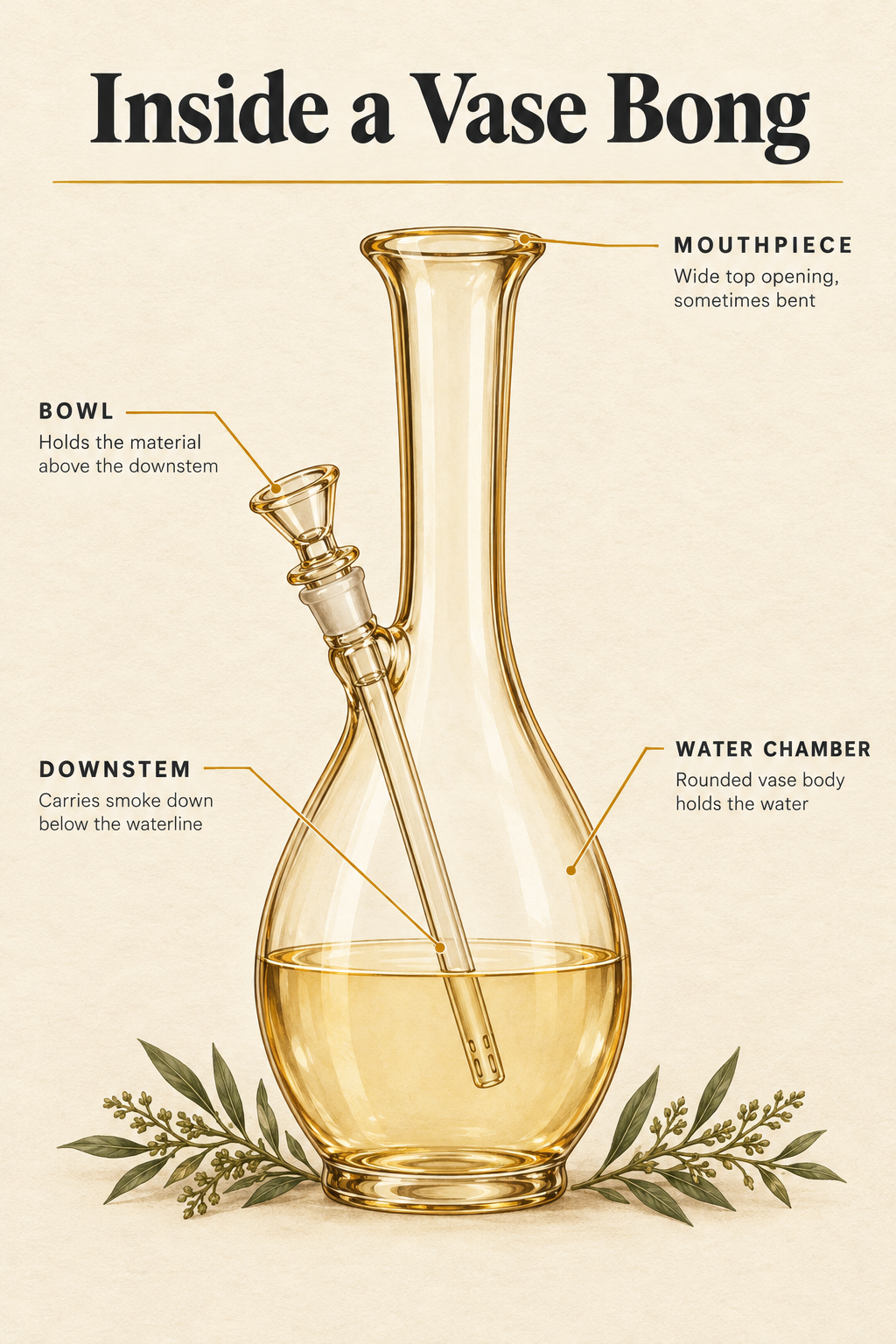
Every bong follows the same route, and the order is what makes the parts make sense. Material sits in the bowl, the downstem carries the smoke below the waterline, the water chamber holds the water that the downstem ends in, and the neck carries everything up to the mouthpiece. [12]
A vase bong runs that same sequence. What the vase form changes is proportions, stability, and water capacity, which is why the shape reads as a design choice rather than a different kind of device. [5]
On many pieces, the mouthpiece, downstem, and bowl only appear once you lift out the flowers or the arrangement. That is why a vase bong can look like a plain vase from across the room. [1]
It also helps to think of the piece as two objects joined together. The vase body is one object. The glass path is another. The join between them is where most of the variation sits, and it is the first place to look when you want to know how serviceable a piece will be. [3]
This article stays on shape and assembly. For the background before you shop, start with What Are the Different Types of Bongs?, then How Do I Choose the Right Glass Bong for My Needs? for material and thickness. What Bong Size Should You Get? goes deeper on height, and What Is a Percolator Bong and How Does It Work? explains what an added percolation stage does.
- Bowl: holds the material at the top of the glass path, above the downstem.
- Downstem: carries smoke down into the water and releases it below the waterline.
- Water chamber: the rounded vase body holds the water the downstem sits in.
- Mouthpiece: the opening at the top of the neck, which may be straight, bent, or offset.
Vase bong vs beaker bong: what is actually different?
A beaker bong is defined by a flat, wide base that flares up into a straight neck. [5] Vase-form pieces often start from a similar wide base, but they carry the water in a rounded, teardrop, or tapered body with a wider open top. [12]
Both follow the same path and use the same parts, so the honest answer stays narrow: the practical difference between the two shapes is proportions and looks, not a documented performance gap.
Water volume is one real difference. A wide flared base needs more water to reach the same depth than a narrower body does, so the same visual water line is not the same amount of water from piece to piece. [10] That is a pouring difference, not a ranking.
The other is how much of the interior you can reason about at a glance. A straight tube shows one column. A rounded body curves, so the water line reads differently at the front than it does at the sides.
Both shapes show up in current listings. A wide-base piece with a straight neck such as the Human Grade Trinity Water Pipe makes the contrast easy to see in a single photo.
- Shared parts: the bowl, downstem, water chamber, and mouthpiece are the same in both shapes.
- Shared path: smoke travels through the bowl, the downstem, the water, the neck, and the mouthpiece either way.
- Different proportions: what changes is the base footprint, the body taper, the water volume, and how much of the interior you can read at a glance.
- No ranking: neither shape adds a filtration stage that the other lacks.
- Water volume: a wider body needs more water to reach the same depth, which is a pouring difference rather than a performance one.
| Spec | Beaker bong | Vase-form bong |
|---|---|---|
| Base | Flat and wide, flares upward | Often a similar wide base, with a rounded body above it |
| Body | Conical, with straight sides | Rounded, teardrop, or tapered |
| Top opening | Narrows into the neck | Often keeps a wider open top |
| Water volume | Rises as the base widens | Rises as the body widens |
| Visibility | One straight column of water to read | A curved wall, so the level reads differently around the body |
| Parts | Bowl, downstem, water chamber, mouthpiece | Bowl, downstem, water chamber, mouthpiece |
How do you keep a vase bong from tipping over?
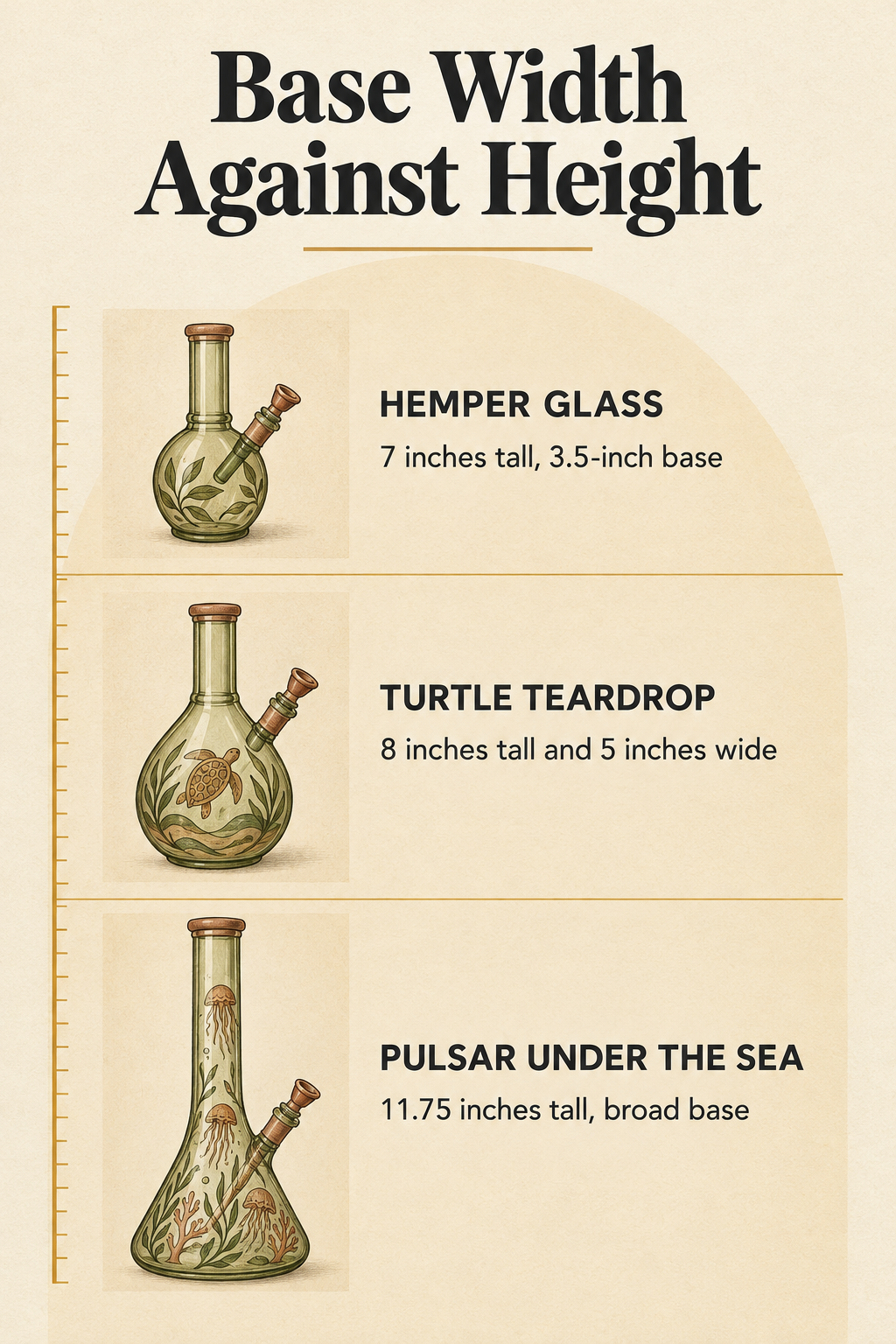
The spec that predicts steadiness is base width against total height. Nothing in the vase label tells you that, which is why two pieces that look alike online can behave very differently on a table. [6]
The current market shows that relationship in several proportions. A 7-inch glass piece sits on a 3.5-inch base. [6] An 8-inch teardrop-form piece is 5 inches wide, with the body shaped for balance. [3] An 11.75-inch piece is built on a broad base to carry the extra height. [8]
The wider the base relative to the height, the more margin you have near a table edge, on a rug, or on a lap. A narrow base under a tall body gives you less margin.
Work through this one in sequence rather than looking for a single number, because each step changes how much margin the next one needs.
If you are still deciding between formats, What Is the Best Smoking Piece for a Beginner? covers the beginner angle on piece size and handling.
- Measure the footprint. Base width is the number that decides how much of the piece touches the table.
- Compare base width with total height. Low and wide leaves more margin than tall and narrow.
- Check where the body widens. A body that carries its widest point low keeps more mass near the base.
- Match the piece to the surface. A soft rug, a crowded table, and a shelf each change how much margin you need.
How much water should go in a vase bong?
The usual guidance for wide-base pieces is to fill to just above the downstem opening, with about 1 to 2 inches of water over the downstem as the common range. [10]
Both directions of error are easy to spot once you know what to look for. Less water means bigger bubbles and less contact between the smoke and the water. More water means bubbles cluster and draws get harder. [10]
Remember that volume is not the same thing as depth. A wide flared base needs more water to reach the same depth as a narrower body, so two pieces filled to the same line can hold quite different amounts. [10]
On a piece with a fixed downstem held by a rubber grommet, the opening is easy to find once you know to look for it. It sits inside the body, below where the bowl goes. [2]
Fill in a fixed order the first time, and the level becomes easy to repeat on every refill.
- Add water to the body, starting a little below the level you expect to need.
- Locate the downstem opening inside the body so you have a reference point.
- Check the depth above that opening, aiming for about 1 to 2 inches.
- Adjust in small amounts, then check again rather than pouring to a guess.
- Re-check after cleaning or refilling, since the level shifts once the piece is emptied and dried.
Which downstem, joint, and bowl setup should you choose?
This is the choice that decides how much you can swap later, so it deserves more attention than the color of the glass.
Some vase bongs use a fixed downstem held by a rubber grommet. It is cleaned and swapped through the mouth opening, and the bowl is usually a custom fit for that body. [2]
Others use a standard 14mm female ground joint that accepts any 14mm male bowl. That is the compatibility spec to read first if you already own bowls or plan to add parts later. [6]
Perc style is a feature to compare, not a score. One retail listing pairs a colored downstem with a ball perc. [6] An independent listing of the same style shows an angled downstem with a slit ball perc and confirms the same 14mm joint. [7]
Mouthpiece shape matters less than the whole path. A wider opening can ease airflow and lip contact, but draw depends on the piece as a whole. A bent or offset neck is the feature most often credited with keeping water away from the mouthpiece. [9]
- Fixed grommet downstem: simple and sealed, cleaned and swapped through the mouth opening, usually matched to one bowl.
- Standard 14mm female joint: accepts any 14mm male bowl, which is what you want if you plan to swap parts.
- Bowl fit: a 14mm male bowl matches a 14mm female joint, while a grommet setup may only take its own bowl.
- Perc style: ball perc, slit ball perc, or a plain open downstem — compare the design rather than a ranking.
- Mouthpiece: a wider opening or a flared lip changes how the top feels, and a bent neck moves the opening away from the water line.
- Wall thickness: thin glass calls for more careful handling than a heavier wall. [7]
How do you clean a vase bong you cannot see through?
Material is what makes this section matter. Porcelain and ceramic are opaque, so the water line and the buildup are hidden and you end up working blind. Glaze crazing can trap residue, and a hairline crack can stay hidden under the glaze. [11]
A glass body shows the water level, the buildup, and any cracks at a glance, which is why many buyers choose glass when they plan to keep one piece for years. [11]
The method itself is the same either way: coarse salt plus isopropyl alcohol, shaken through the body, with the bowl soaked separately. The ratio that appears in maker guides is 3 to 4 teaspoons of salt per half cup. [2]
Two warnings come up repeatedly. Do not put these pieces in the dishwasher, and do not use extremely hot water. [2] A thin 3mm wall also calls for careful handling, so carry the body like glassware rather than like a jug. [7]
Finish with a rinse and a full dry, because most of these pieces go back to holding flowers or fresh water between sessions. [1]
- Empty the water and rinse the body.
- Add coarse salt and isopropyl alcohol, about 3 to 4 teaspoons of salt per half cup.
- Shake the mixture through the body so it reaches the walls and the base.
- Soak the bowl separately instead of shaking it loose inside the body.
- Rinse thoroughly with warm water, not extremely hot water.
- Dry completely before flowers or fresh water go back in.
What should you check before buying a vase bong?
A complete listing tells you five things: height, base width, glass thickness, joint size, and what bowl is included. [6] When one of those is missing, that is the question to send before you order.
Detailing changes between makers. One listing states a 7-inch height, a 3.5-inch base, 3mm borosilicate walls, a 14mm female joint, and a matching 14mm male bowl. [6] An independent listing of the same style converts those figures to metric and warns about the thin wall. [7] A teardrop-form piece states 8 inches tall and 5 inches wide with a 3-inch fixed downstem and a 9mm medium bubble bowl. [3] A larger piece states 11.75 inches and a 14mm joint. [8]
Care terms belong in the same check. A piece that warns against the dishwasher and against extremely hot water is telling you how the maker expects it to be handled. [2]
Then compare the current listings in the bongs and water pipes category and read the spec line on each one before you commit. Orders that meet the shop minimum also come with free shipping on orders $150+.
- Body style and exact height.
- Base width against height.
- Joint spec, and which bowl is included.
- Fixed downstem or standard replaceable joint.
- Wall thickness and material.
- Mouthpiece shape you can use comfortably.
- Care instructions and the seller’s return terms.
Frequently Asked Questions
Is a vase bong as good as a beaker bong?
They are built from the same parts and follow the same path, so the practical difference is proportions and looks rather than a documented performance gap. A beaker is defined by a flat wide base flaring into a straight neck. Vase-form pieces often start from a similar base but carry the water in a rounded, teardrop, or tapered body with a wider open top. Choose by which base-to-height ratio and water capacity suit where you will actually keep it. [12]
Do vase bongs tip over easily?
That depends on base width against total height, not on the vase label. Current market examples range from a 7-inch bong on a 3.5-inch base to an 8-inch piece that is 5 inches wide, up to an 11.75-inch version built on a broad base. A teardrop body is shaped for balance. Measure the footprint, compare it with the height, and check whether the widest part of the body sits low. [6]
Can you put real flowers in a vase bong?
The vase function is part of the product for most of these pieces, and many are built to hold real or artificial flowers between sessions. The preparation step matters more than the flowers: the piece needs to be rinsed and dried so the glass path and the interior are clear before flowers or fresh water go back in. [1]
Is a porcelain vase bong harder to clean than glass?
It is harder to inspect. Ceramic and porcelain are opaque, so the water line and the buildup are hidden, glaze crazing can trap residue, and a hairline crack can stay under the glaze. Glass shows the water level, the buildup, and cracks at a glance. The cleaning routine is the same coarse salt plus isopropyl alcohol method either way. [11]
So does the vase shape change the hit?
The vase shape changes proportions, water capacity, stability, and how much of the interior you can see. It does not change the parts, and it does not add a filtering stage. [12]
So pick by conditions instead of by a winner. Choose a wide-base, lower-height piece when it will sit on a busy table or near an edge. Choose a teardrop body when you want the balance that form is shaped for. [3] Choose glass over porcelain when you want to see the water line and the buildup without guessing. [11]
After shape, two setup details matter most: the joint spec and whether the downstem is fixed or replaceable. Those decide what you can swap later. [2]
One last point worth keeping straight. Water pulls out heat and some water-soluble compounds, but it does not purify smoke, and no body shape changes that. [14]
Compare the current listings in the bongs and water pipes category, read the spec line before you order, and pick the proportions that fit where the piece will actually live.
Sources
- Smoke Cartel: Vase Bongs | Shop Discreet Water Pipes
- My Bud Vase: What’s In The Box | Vase Bong Usage & Care
- My Bud Vase: Turtle Vase Bong | Green Mosaic Shell
- The New York Times: Vintage Vases Find New Life as Bongs
- Hemper: The Complete List of Every Type of Bong, Shape, and Material
- CaliConnected: Hemper 7" Glass Vase Bong
- Zamnesia: Vase Bong (Hemper)
- Pulsar (retailed by VapeO2): Pulsar Under The Sea Vase Glass Water Pipe – 11.75" / 14mm
- Billy Mart: Bong Mouthpieces Explained: Does Shape And Size Matter?
- Thick Ass Glass: How Much Water in a Beaker Bong You Need for Good Filtration
- Smoke AFM: Glass vs Ceramic Bongs: Which Material Actually Smokes Better?
- Barney’s Farm: Bong Types Explained: Beaker, Straight Tube and Recycler
- Mantelpiece: 9 Ways to Adorn Your Vong (Vase~Bong)
- Centers for Disease Control and Prevention: Hookahs