

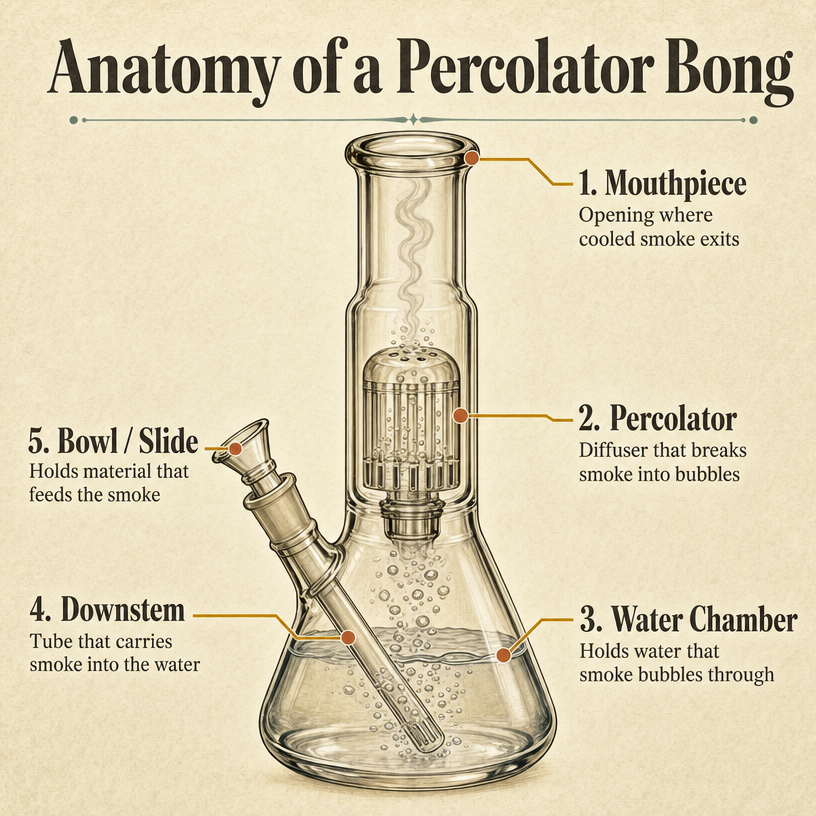
A percolator bong guide starts with one idea: a perc is an internal diffuser that forces smoke through small holes, slits, or discs so it breaks into fine bubbles. More bubbles mean more smoke touches the water, which is why percs make hits feel smoother. The main types are diffused downstem, showerhead, tree, honeycomb, inline, matrix, and turbine, each trading diffusion, drag, durability, and cleaning in a different way.
What Does a Percolator Do Inside a Bong?
A percolator is a piece of glass inside the water pipe. Its only job is to push smoke through small openings so the smoke is split into many small bubbles [1] [2] [3].
When smoke is broken into small bubbles, more of the smoke touches the water. That is what people mean when they say a perc filters or cools the smoke. The perc is not a magic filter; it just changes how the smoke moves through the water [3].
Every perc design has to balance two things. More openings or more stages of diffusion can create a softer draw, but they also add drag, which is the resistance you feel when you pull air through the pipe. More parts also mean more places for residue to collect [1] [2].
Diffused downstems are the simplest form of percolation. A downstem is the small tube that slides into the joint of the bong and carries smoke down into the water. A diffused downstem has slits or holes at the bottom, which is enough to break the smoke into bubbles without adding a lot of drag [2] [3].
- A percolator, or perc, is an internal diffuser that forces smoke through small holes, slits, or discs [1] [2] [3].
- Breaking smoke into bubbles increases the amount of smoke that touches the water [3].
- More openings or more perc stages can improve diffusion but also add drag, weight, and cleaning effort [1] [2].
- A diffused downstem is the simplest form of percolation and a useful baseline for understanding more complex percs [2] [3].
What Are the Most Common Types of Bong Percolators?
Most perc types you see in a shop are built around one of two ideas. Some percs use a flat or curved surface with many small holes, and others use a set of tubes or arms that split smoke into different paths. The shape changes how the bubbles form and how the air moves through the pipe [2] [3].
Showerhead percs are a flared or skirted shape with slits around the edge. Smoke is pushed outward through the slits and forms a wide ring of bubbles. Tree percs use a central stem with horizontal arms that end in smaller openings, so each arm creates its own stream of bubbles [1] [2].
Honeycomb percs use a thin disc with many small holes, similar to a fritted glass filter used in labs. Inline percs are a horizontal tube with slits across its length, often sitting near the bottom of the chamber. Matrix percs use a cylindrical chamber with a grid of holes that smoke passes through, sometimes in more than one direction [2] [3] [4].
Turbine or cyclone percs use angled openings that spin the water as smoke passes through. The result is a swirling motion that breaks smoke into bubbles without using a fine grid. Each design has its own look, its own drag level, and its own cleaning routine, which is why it helps to understand what you are actually buying [2] [3].
If you are new to percs and want a wider overview of bongs and water pipes in general, the parent guide on bongs and water pipes is a good place to start.
- Diffused downstem: a small tube with slits or holes at the bottom, the simplest form of percolation [2] [3].
- Showerhead perc: a flared or skirted shape with slits around the edge that pushes smoke outward into bubbles [1] [2].
- Tree perc: a central stem with multiple arms, each ending in smaller openings that create many bubble streams [1] [2].
- Honeycomb perc: a thin disc with many small holes, often described as having roots in scientific glass filtration [2] [4].
- Inline perc: a horizontal tube with slits along its length, normally sitting near the bottom of the chamber [2] [3].
- Matrix perc: a cylindrical chamber with a grid of holes that smoke passes through, often in several directions [2] [3].
- Turbine or cyclone perc: angled openings that spin the water and create a swirling bubble action [2] [3].
Which Bong Percolator Type Is Best for You?
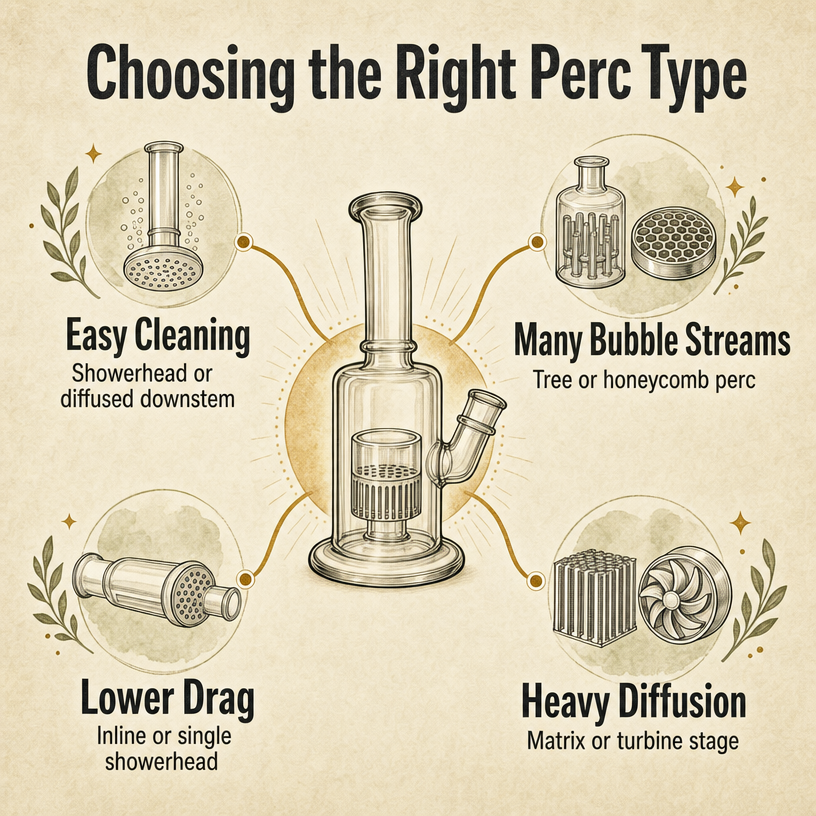
There is no single best perc. Each type trades one feature for another, and the right choice depends on how you use the piece, how much drag you can live with, and how much cleaning you are willing to do [1] [2].
Showerhead percs are usually described as consistent and among the easier percs to clean. Tree percs create more bubble streams because of the extra arms, but those arms are also more delicate and harder to reach when you clean. Honeycomb and fritted-disc percs create a high number of small bubbles but the small holes can clog if the piece is not cleaned regularly [1] [2] [4].
Inline and matrix percs tend to sit low in the chamber, which can keep drag reasonable, but matrix percs add more glass and more internal surfaces. Turbine percs are known for a spinning water action rather than a dense bubble cloud, and they are often paired with a second perc stage in larger pieces. Multi-perc setups can feel lighter on the draw but they also add resistance and more parts to clean [2] [3].
A simple rule of thumb is to match the perc to your priorities. If you want easy cleaning, look at diffused downstems or single showerheads. If you want lots of bubbles, look at tree or honeycomb designs. If you want lower drag, look at inline or single-stage percs. If you want heavy diffusion and do not mind more parts, matrix and turbine stages are common choices [2] [3].
If you want help thinking about glass thickness, joint size, and overall size in plain language, the glass bong buying guide walks through the choices that matter for everyday use.
The table below compares the most common perc types on the features that usually drive a decision. The ratings are descriptive, not numeric scores. They reflect how glass specialists and product guides tend to describe each style in plain English.
- Showerhead percs are usually consistent and are commonly named as one of the easier percs to clean [1] [2].
- Tree percs create many bubble streams through their arms, with more delicate parts and harder-to-reach surfaces [1] [2].
- Honeycomb percs use many small holes for a high number of small bubbles but the small holes can clog if cleaning is skipped [2] [4].
- Inline and matrix percs tend to sit low in the chamber and keep drag reasonable, with matrix adding more glass and surfaces to clean [2] [3].
- Turbine percs use a spinning water action rather than a dense bubble cloud and are often found in multi-perc setups [2] [3].
| Perc Type | Diffusion | Drag | Fragility | Cleaning Effort |
|---|---|---|---|---|
| Diffused downstem | Low | Low | Low | Low |
| Showerhead | Medium | Medium | Low | Low to medium |
| Tree | High | Medium to high | High | Medium to high |
| Honeycomb | High | Medium | Medium | Medium |
| Inline | Medium | Low to medium | Low | Low to medium |
| Matrix | High | Medium to high | Medium | High |
| Turbine or cyclone | Medium to high | Medium | Medium | Medium to high |
How Do You Fill and Dial In a Percolator Bong?
The right water level for a percolator bong is the level that covers the perc openings without flooding the chamber above them. Too little water and the perc will not bubble evenly. Too much water and the perc can splash, slow the draw, or push water up into the mouthpiece [1] [3].
Most glass makers and sellers suggest starting with a small amount of water and tuning from there. A gentle draw is the best way to test, because a hard pull can flood a perc that would otherwise be at the right level [1] [3].
Temperature matters a little too. Cold water can feel sharper on the glass, while warm water can carry more smell. Many people use room temperature water as a default and change it once they know how the piece behaves.
Some percs need a different water level than others. A showerhead usually wants the slits fully submerged. A tree perc wants water above the arm openings but below the central stem joint. A honeycomb disc should be fully under the water line so all of the holes bubble. Inline percs usually want the slits just covered. Each piece is a little different, so the dial-in routine is the same: start low, test, and add a little at a time [1] [3].
- Pour a small amount of water into the chamber through the mouthpiece so it settles at the perc [1] [3].
- Tip the piece gently to make sure the water reaches the perc evenly before you take a draw.
- Take a slow test draw and watch how the perc bubbles. Add a small amount of water if the bubbling looks weak or uneven [1] [3].
- Stop adding water when the openings are fully submerged and the draw feels even, with no splashback into the mouthpiece.
- For a multi-perc piece, fill the bottom chamber first, then add a small amount through the top so each stage is covered without flooding the one above it.
How Do You Clean a Percolator Bong Without Breaking It?
Percolator bongs usually need more cleaning than simple water pipes. The extra chambers, arms, holes, and channels that create more bubbles also give residue more places to settle. Skipping cleaning can clog small holes, slow the draw, and change how the perc performs [2] [5].
The simplest routine uses isopropyl alcohol and coarse salt, plus pipe cleaners or cotton swabs for smaller openings. Soaking is usually safer than scrubbing for fragile parts like tree arms or honeycomb discs, because those pieces can crack if you push too hard with a brush [2] [5].
Routine cleaning matters more than deep cleaning. A quick rinse and a fast alcohol soak after each use is much easier than soaking a piece that has been sitting for weeks. It also helps protect the seals on removable downstems and ash catchers.
If a perc is clogged, do not try to force it. Soak it longer, use a softer brush, or try a different cleaning mix. Most clogs come loose with patience, and the most common way to break a perc is to push too hard on a soft piece [2] [5].
- Empty the piece and give it a quick warm rinse to loosen fresh residue before it dries on the glass [2] [5].
- Pour in isopropyl alcohol and a small amount of coarse salt, then cover the openings and shake gently so the mix reaches the perc.
- Let the piece soak for at least thirty minutes, longer for heavy buildup, and avoid scrubbing fragile arms or discs with hard tools [2] [5].
- Use pipe cleaners or cotton swabs to reach smaller openings, and rinse the piece thoroughly with warm water after the soak.
- Let the bong dry fully before reassembling removable parts like downstems and bowl slides, so the seals do not stick.
Are Percolator Bongs Worth the Extra Cost and Care?
A percolator bong is more glass, more parts, and more cost than a simple water pipe. The reason people buy them is the draw. A good perc setup can make a noticeable difference in how the smoke feels in the chamber, which is the whole point of the category [1] [2].
There are real trade-offs to think about. More bubbles usually means more drag, heavier pieces, and more cleaning time. Some percs are also easier to break than others, especially tree percs with thin arms, so buyers who travel or share pieces with friends often prefer simpler designs [1] [2] [5].
An ash catcher is a small add-on water piece that sits between the bowl and the downstem of a bong. It catches ash and debris before it reaches the main chamber, and many models include their own perc. That extra stage of diffusion can also keep the main percolator bong cleaner between deep cleans, which is helpful for tree or honeycomb pieces that are harder to clean in the first place.
If you are shopping for a percolator bong, it helps to match the perc to how you actually use the piece. Browse the percolator bongs subcategory to see what shapes and sizes are available, and pair the piece with a matching ash catcher if you want an easier cleaning routine. Treehouse Lifestyle offers free shipping on orders $150+, which is worth knowing if you are kitting out a setup with a piece and an accessory.
A percolator bong is not a magic filter, and the public health record is clear on this point. The CDC lists bongs as one method of smoking cannabis, and research from UCSF has shown that water pipes still expose users and bystanders to fine particulate matter and most of the same smoke chemicals as other modes of smoking [6] [7]. A perc changes the feel of the draw; it does not change the underlying nature of smoke.
That context matters for anyone comparing a percolator bong to a plain water pipe or to other bong types. The honest summary is that percs change the experience of the piece, not the safety of it, and the rest of the decision is about feel, drag, cleaning, and budget [6] [7].
- Percolator bongs add more diffusion than a plain water pipe, which is the main reason people buy them [1] [2].
- More percs usually means more drag, heavier glass, and more cleaning time, especially for tree or honeycomb designs [1] [2] [5].
- Fragile percs like tree arms and thin discs need gentler cleaning routines and benefit from an ash catcher to reduce buildup.
- An ash catcher with its own perc adds another stage of diffusion and helps keep the main piece cleaner between deep cleans.
- A percolator bong changes how a draw feels, but public health research makes clear that water pipes still expose users and bystanders to fine particulate matter and smoke chemicals [6] [7].
Frequently Asked Questions
What does a percolator do in a bong?
A percolator is a diffuser inside the water pipe that forces smoke through small holes, slits, or a perforated disc so it breaks into many fine bubbles. Breaking the smoke up increases the surface area that touches the water, which is what most people mean when they describe a perc as filtering or cooling the smoke [1] [2] [3].
Are percolator bongs harder to clean than regular bongs?
Yes. The extra chambers, arms, holes, and channels that create more bubbles also give residue more places to collect. Shops and glass specialists typically recommend routine cleaning with isopropyl alcohol and salt, plus pipe cleaners or cotton swabs for the smaller openings, and soaking rather than scrubbing fragile arms or discs [2] [5].
How much water should you use in a percolator bong?
The right water level is whatever covers the perc’s openings without flooding the chamber above them. A common test is to fill just enough to submerge the slits or holes, then take a gentle draw and add water a little at a time until the bubbling looks even and the draw feels smooth, without splashback [1] [3].
What is the difference between a showerhead perc and a tree perc?
A showerhead perc is a flared or skirted structure with slits around its edge that pushes smoke outward into bubbles. It is generally consistent and is often described as one of the easier percs to clean. A tree perc divides smoke through multiple arms ending in smaller openings, which can produce more bubble streams but has more delicate parts and harder-to-reach surfaces [1] [2].
Does a percolator make bong smoke safer?
No. Percolators increase smoke-to-water contact, but public-health research has shown that water pipes still expose users and bystanders to fine particulate matter and most of the same smoke chemicals as other modes of smoking. A perc changes the experience of the draw; it does not make the smoke harmless [6] [7].
What is an ash catcher and how does it relate to a percolator bong?
An ash catcher is a small add-on water piece that sits between the bowl and the downstem of a bong. It catches ash and debris before it reaches the main chamber, and many models include their own perc, which adds another stage of diffusion and helps keep the main percolator bong cleaner between deep cleans.
Is a Percolator Bong the Right Pick for You?
A percolator bong is a water pipe with an internal diffuser that breaks smoke into bubbles. The common styles are diffused downstem, showerhead, tree, honeycomb, inline, matrix, and turbine, and each one trades diffusion, drag, durability, and cleaning effort in a different way [1] [2] [3].
If you want a simple, easy-to-clean piece, start with a diffused downstem or a single showerhead. If you want more bubbles and do not mind more cleaning, look at tree or honeycomb designs. If you want lower drag, look at inline or single-stage percs. Match the perc to the routine you actually want to keep [2] [3].
An ash catcher is a useful add-on for any of these pieces, since it keeps the main chamber cleaner and can add another stage of diffusion. Browse the percolator bongs subcategory and the ash catchers subcategory to see what is in stock, and remember that Treehouse Lifestyle offers free shipping on orders $150+ for shoppers kitting out a full setup.
Whatever you pick, the public health record is the same. A percolator changes the feel of a draw, not the underlying nature of smoke, and the rest of the decision is about feel, drag, durability, and how much cleaning you are willing to do [6] [7].
Related reading: Percolator Bongs · What Is a Bong and How Does It Work? · What Are the Different Types of Bongs? · How Do I Choose the Right Glass Bong for My Needs? · Bongs · Ash Catchers.
Sources
- Thick Ass Glass: Showerhead vs Tree Perc | A Practical Comparison
- Roots Glass: Types of Bong Percolators: 10 Percs Ranked & Explained
- Thick Ass Glass: How Bong Percolators Work: The Physics of Smooth Hits
- Prism Water Pipes: The Complete Guide to the Honeycomb Percolator
- MÜV: What is a Percolator Bong and How Does It Work?
- Centers for Disease Control and Prevention: About Cannabis
- UCSF Center for Tobacco Control Research and Education: New Study: Secondhand Bong Smoke is full of Hazardous Fine Particles