

Shapes, Materials, and Features Explained
Bongs come in three primary shapes — straight tube, beaker, and recycler — each with distinct trade-offs in stability, hit smoothness, and maintenance. Beyond shape, the material (glass, silicone, ceramic, acrylic) and internal components called percolators determine how cool and clean each hit feels. This guide walks through every major bong type, explains how percolators work, compares materials side by side, and outlines the features that matter most when you are ready to buy.
What Are the Main Bong Shapes?
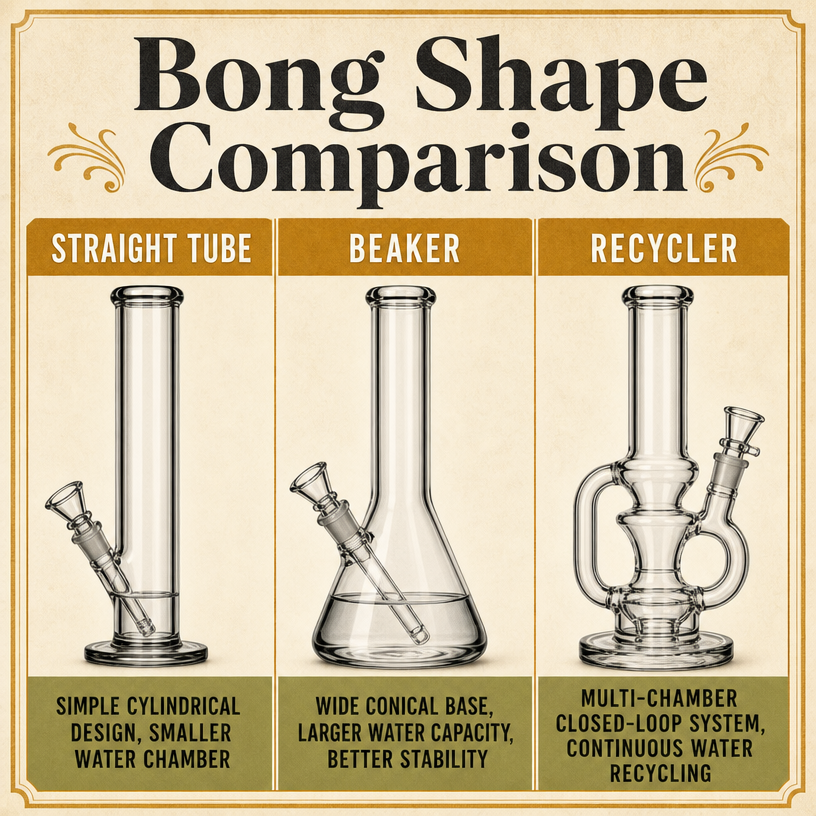
The simplest bong design is the straight tube — a cylindrical body with a fixed bowl at the top, a water chamber at the base, and a mouthpiece at the very top. When you light material in the bowl and inhale, smoke travels in a straight line up through the water and out the mouthpiece. [1] [7] The direct path makes Straight Tube Bongs easy to use and straightforward to clean. The smaller water chamber means less filtration compared with wider designs, so hits tend to feel more direct.
- Straight tube — simple cylindrical design, small water chamber, easy to clean and maintain
- Beaker — wide conical base, larger water capacity, better stability and cooler hits
- Recycler — multi-chamber closed-loop system, smoothest hits, most involved cleaning
Beaker bongs have a conical base that widens toward the bottom, giving them a distinctly triangular silhouette. The wider base holds more water than a straight tube of the same height, which means smoke has more contact with water before reaching the mouthpiece. [1] [3] [6] The wider foot also makes beaker bongs more stable on flat surfaces, which matters if you keep your bong on a coffee table or desk. The combination of better stability and larger water capacity is why many experienced users prefer beaker-style bongs.
Recycler bongs use a two-chamber system. Smoke moves from the first chamber into a second, then travels back up and out — a closed loop that continuously recycles water and smoke through the chambers. [1] [5] This design forces smoke to pass through water multiple times, producing a noticeably smoother hit than single-chamber designs. The trade-off is that recycler bongs have more individual parts to clean and maintain.
Each bong shape carries its own practical trade-offs. Straight tubes are the easiest to take apart and clean, making them a practical choice for people who want low maintenance. Beaker bongs offer a middle ground — more stable than a straight tube, smoother hits, and still relatively straightforward to maintain. Recycler bongs deliver the smoothest experience but require the most attention when it comes to cleaning because their multiple chambers trap residue more readily. [3]
Read What Smoking Accessories Do Beginners Need? for more detail.
How Do Percolator Bongs Work?
Bongs use water and airflow to cool smoke before you inhale it. When you light material in the bowl and draw air through the system, smoke is pulled downward into the water chamber. The smoke then bubbles up through the water and travels toward the mouthpiece. [1] [7] This basic mechanism has been refined over decades, with designers adding internal glass components called percolators — or percs — to increase the cooling and filtration effect.
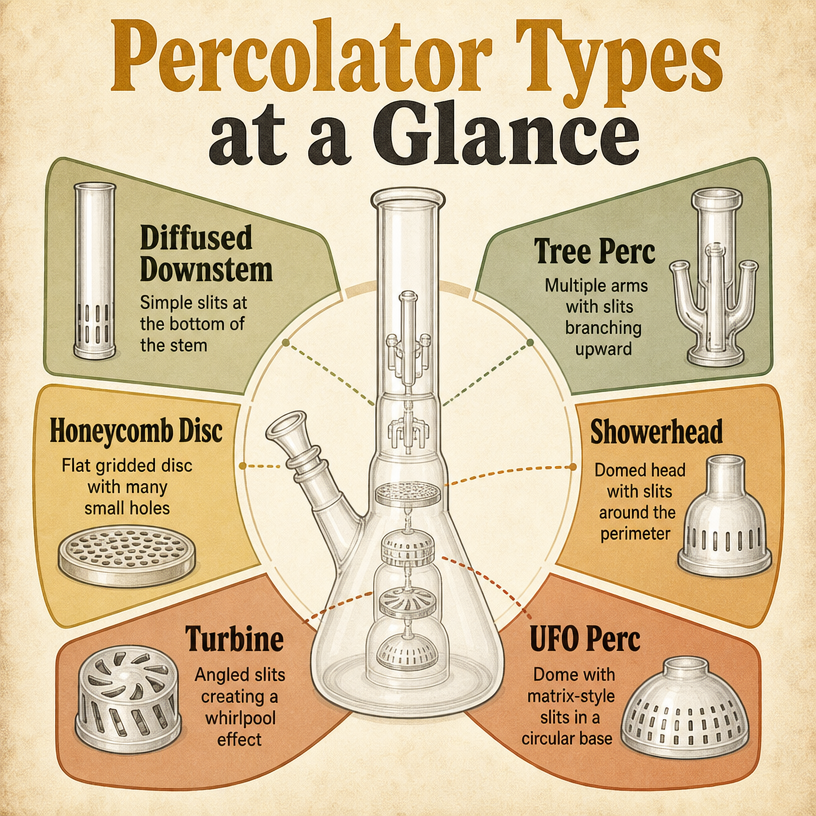
- Diffused downstem — slits in the stem diffuse smoke into bubbles; simplest perc design
- Tree perc — multiple branching arms with slits; thorough filtration but fragile glass arms
- Honeycomb disc — flat gridded disc with many holes; strong filtration and stable structure
- Showerhead perc — dome with perimeter slits; even bubble diffusion throughout water
- Turbine perc — angled slits create a whirlpool effect; effective cooling and filtration
- UFO perc — dome with matrix of holes across the entire surface; fine diffusion but harder to clean
Percolators are internal glass components that break smoke into many small bubbles as it passes through water. [1] The increased surface area between smoke and water cools the smoke more effectively than a plain water chamber alone. Different perc designs produce different bubble sizes and filtration patterns, which affects how the hit feels.
The simplest percolator is a diffused downstem — a stem with small slits at the bottom that diffuse smoke into bubbles as it enters the water. [5] This design is found on many entry-level bongs and is easy to clean because it is part of the stem assembly.
Tree percs feature multiple arms branching upward from a central base, each arm with small slits. [1] [5] As smoke rises through the water it passes through each arm, creating extensive filtration with many small bubbles for a smooth experience. The trade-off is that tree percs have multiple glass arms that can break if the bong is dropped, and their complex structure makes cleaning more involved than simpler designs.
Honeycomb discs are flat circular pieces of glass perforated with many small holes arranged in a grid pattern. Smoke must pass through the entire disc, producing a large number of tiny bubbles simultaneously for maximum cooling and filtration. [5] The flat shape also provides structural support, making it less prone to damage than more delicate designs.
Showerhead percs work like a bathroom showerhead — a domed top with vertical slits around the sides. Smoke enters the dome and exits through the slits, breaking into many individual streams of bubbles. [1] [5] This design produces a very even, wide spread of bubbles throughout the water.
Turbine percs use angled slits to create a spinning or whirling water effect as smoke passes through, increasing contact time between smoke and water for effective cooling. [5] The spinning motion also helps filter out larger particles and produces a visual whirlpool effect in the base.
UFO percs have a dome shape similar to showerhead percs but with a matrix of small holes covering the entire surface rather than just the sides. [1] [5] This creates extremely fine diffusion and thorough filtration, though the complex geometry makes cleaning more difficult.
The right percolator for you depends on your priorities. Simpler percs like the diffused downstem produce less drag and are easier to maintain. More complex percs like honeycomb, turbine, and UFO designs produce cooler, smoother hits but add resistance to the draw and require more attention during cleaning.
Read What Is a Bong and How Does It Work? for more detail.
What Is the Best Bong Material?
Glass is the most widely used material for bongs, and borosilicate glass is the industry standard for quality pieces. It tolerates temperature changes without cracking and preserves the flavour of smoke better than most alternative materials. [2] [4] Borosilicate glass is non-porous, meaning it does not absorb oils or flavours from previous sessions, and it maintains its clarity with regular cleaning over many years of use.
- Borosilicate glass — non-porous, heat-resistant, preserves flavour, the industry standard for quality bongs
- Silicone — nearly unbreakable, easy to clean, may affect flavour and retain odours over time
- Ceramic — distinctive aesthetic, retains heat well, porous material absorbs flavours, fragile and heavy
- Acrylic — inexpensive and durable, but scratches easily, hard to clean thoroughly, should be avoided
Silicone bongs are nearly indestructible — they survive drops and bends that would shatter a glass piece. [2] [4] [6] They are easy to clean with soap and water and resist staining. The trade-off is that silicone can retain odours after repeated use, and some users report that it affects the flavour of smoke. Certain cleaning solutions can also degrade silicone over time.
Ceramic bongs offer excellent heat retention and allow for distinctive hand-painted designs and sculptural shapes. [2] The trade-offs are significant: ceramic is heavier and more fragile than glass, the porous material can absorb flavours from previous sessions, and the increased heat retention means the bong stays warm long after use.
Acrylic bongs are the least recommended material. They scratch easily, cannot be cleaned thoroughly with isopropyl alcohol, and can retain harmful residues. [4] For anyone who values smoke quality and easy long-term maintenance, acrylic is not a practical choice.
Read How Do You Clean a Bong the Right Way? for more detail.
What Features Should I Look for When Buying a Bong?
Joint size is the first technical spec to check. It determines which bowls, downstems, and accessories will fit your bong. The three common sizes are 10mm, 14mm, and 18mm, with 14mm being the most widely used standard for mid-sized bongs. [3] An 18mm joint is typically found on larger bongs. Using the wrong accessory size means a poor seal and potential leakage during a session.
- Match the joint size (10mm, 14mm, or 18mm) to your existing bowls and accessories — 14mm is the most common standard
- Choose glass that is at least 3mm thick for better durability against thermal stress and accidental drops
- Look for a diffused downstem if you want additional filtration and smoother hits from the stem design
- Check for ice catchers if you want the option to add ice for extra cooling during a session
- Consider an ash catcher to reduce residue buildup and extend the time between deep cleanings
- Decide between a removable downstem (easier to clean) and a fixed downstem (more durable)
Glass thickness is measured in millimetres and directly affects durability. Thicker walls withstand thermal stress and accidental drops better, though they add weight and cost. [3] Most quality bongs have glass that is at least 3mm thick. Anything below that is more prone to cracking from temperature changes or minor impacts.
The downstem is the tube that connects the bowl to the water chamber. A diffused downstem has slits at the bottom that break smoke into small bubbles as it enters the water, producing a smoother hit than a standard open-end stem. [3] [5] The length and width of the downstem also affect how many bubbles form and how much resistance the bong produces when you draw from it.
Ice catchers are notches in the neck of a bong that hold ice cubes above the water line for additional cooling. [3] This feature is not present on every bong, so check for it if extra cooling is a priority.
Ash Catchers are accessories that attach to the joint and trap ash before it enters the water chamber, keeping the bong cleaner between deep cleanings. [3] [4] They reduce the frequency of thorough cleanings needed and protect the main water chamber from ash buildup.
Some bongs have fixed stems rather than removable downstems. Fixed-stem designs tend to be more durable because there is no separate joint where the downstem connects. The trade-off is that cleaning a fixed downstem requires more patience since you cannot simply remove it for soaking.
How Do You Clean and Maintain a Bong?
Regular cleaning keeps a bong performing well and extends its lifespan. After each session, rinse the bong with warm water to remove loose residue before it dries and hardens. Hot water works better than cold for cutting through oils. [3] This quick rinse only takes a minute but prevents buildup that becomes difficult to remove later.
- Disassemble the bong and rinse each component with warm water after each session
- Soak components in isopropyl alcohol (90%+) and coarse salt for several hours or overnight
- Seal all openings, shake gently, and let the solution work through all internal surfaces
- Rinse thoroughly with warm water until the runoff is completely clear
- Air dry on a clean surface before reassembling
- Allow extra soaking time for bongs with percolators — each internal component traps residue
For a thorough clean, start by disassembling the bong — remove the bowl, downstem if removable, and any other attached accessories. Give each component a rinse under warm running water to remove loose particles. [3]
Prepare a cleaning solution. The most widely used method is isopropyl alcohol of at least 90% concentration combined with coarse salt. [3] The alcohol dissolves sticky resin and oil buildup while the salt provides an abrasive scrubbing action. Commercial bong-cleaning products are also available and work on the same principle.
Seal all open ends of the bong — use rubber bong plugs, plastic wrap, or clean tape to close the mouthpiece, base opening, and any other joints. This keeps the cleaning solution inside the piece. [3] Shake the bong gently for one to two minutes so the solution reaches all internal surfaces.
Let the bong soak for several hours or overnight if there is heavy residue buildup. For stubborn spots, a second soak with fresh solution may be necessary. [3]
After soaking, rinse each component thoroughly with warm water until the runoff is completely clear and there is no trace of alcohol or salt. Any residue left behind will affect the flavour of your next session and may pose health risks if ingested. [3]
Allow the bong to air dry completely on a clean, lint-free surface before reassembling and using it again. Placing it on a towel or paper towel works well. Using a bong before it is fully dry can cause moisture problems inside the stem and chamber.
Bongs with percolators require more attention during cleaning because each internal component adds surfaces where residue collects. Tree percs, honeycomb discs, and other multi-arm designs need longer soak times and careful attention to ensure every arm and chamber is reached. [3] [5] Factor in this extra maintenance time when choosing a bong with multiple percolators.
What Are the Different Percolator Types?
Percolators — percs — are internal glass components that diffuse smoke into small bubbles as it passes through water, increasing cooling and filtration beyond what a plain water chamber provides. [1] [5] Different perc designs produce different bubble sizes, patterns, and levels of filtration. Understanding the main types helps you choose a bong that matches your preferences.
- Diffused downstem — slits at the bottom of the stem; simplest perc, easy maintenance, modest filtration
- Tree perc — multiple branching glass arms with slits; thorough multi-stage filtration, moderate drag
- Honeycomb disc — flat disc with a grid of small holes; even wide-area diffusion and strong filtration
- Showerhead perc — dome with perimeter slits; wide even bubble spread throughout the water chamber
- Turbine perc — angled slits create a whirlpool effect; effective cooling with a distinctive visual effect
- UFO perc — dome below a flat perforated disc; combines showerhead and honeycomb diffusion mechanics
A diffused downstem is the simplest perc option. It is the stem itself with small slits at the bottom rather than a sealed tube. [5] Smoke enters the water through those slits, creating small bubbles. This design is easy to clean and produces minimal drag, but the filtration is modest compared with dedicated perc designs.
Tree percs have several vertical glass arms branching from a central base, each arm with one or more slits. [1] [5] Smoke enters the water through the base and rises through each arm, getting diffused at each set of slits. The more arms a tree perc has, the more diffusion it provides. Tree percs are popular because they balance strong filtration with a manageable draw resistance.
Honeycomb percs are flat circular glass discs with a grid of small holes. [1] [5] Smoke passes through the entire disc and is broken into a large number of tiny bubbles at once. The flat disc shape is structurally sound and distributes smoke evenly across the water chamber.
Showerhead percs have a dome at the bottom with vertical slits around the perimeter. [1] [5] Smoke fills the dome and exits through the slits as a wide, even spread of bubbles. The dome shape helps distribute smoke uniformly across the base.
Turbine percs feature angled slits that create a swirling water effect as smoke passes through. [5] The spinning motion extends the time smoke spends in contact with water and creates a visually distinctive effect. Turbine percs provide good cooling but add more draw resistance than simpler designs.
UFO percs combine elements of showerhead and honeycomb designs. A dome sits below a flat disc perforated with many small holes. [1] [5] Smoke collects in the dome and exits through the disc, combining the even distribution of a showerhead with the fine diffusion of a honeycomb.
Each perc type involves a trade-off between filtration quality, draw resistance, and cleaning effort. Simpler designs like the diffused downstem are easiest to maintain. Complex percs like honeycomb, turbine, and UFO designs provide superior cooling and filtration but require more attention during cleaning.
Browse Percolator Bongs to explore related options.
What Is the Difference Between a Beaker Bong and a Straight Tube Bong?
Straight tube and Beaker Bongs are the two most common bong shapes. They share the same basic operating principle — a bowl, a water chamber, and a mouthpiece — but their different shapes produce noticeably different experiences. [1] [3] [6]
- Straight tube — simple cylindrical design, smaller water chamber, more direct hits, easier to store and transport
- Beaker — wide conical base, larger water capacity, cooler and smoother hits, more stable on flat surfaces
- Beaker bongs hold more water and deliver cooler hits than straight tubes of equivalent height
- Straight tube bongs are narrower and easier to store or transport; beaker bongs are better for fixed home use
- Both styles require similar maintenance effort; straight tubes dry faster, beaker bongs need more water to rinse
The straight tube design is a simple cylinder. Its smaller water chamber means smoke has less contact with water before reaching your mouth, so hits tend to be more direct. [1] The narrow base makes straight tube bongs easier to store and more portable than a beaker of the same height.
The beaker design widens at the base, which holds more water and gives smoke a longer path through the liquid. [1] [3] The result is cooler, smoother hits compared with a straight tube of the same overall height. The wider foot also gives the bong a lower centre of gravity, making it harder to knock over on a flat surface.
Stability is one of the most practical differences between the two styles. A straight tube bong with a narrow foot is easier to tip over, especially on uneven surfaces. A beaker bong is significantly more stable on a desk or table because of its wide, low-profile base. [6] This matters less for solo use at a consistent location, but it is a meaningful consideration if the bong sits in a high-traffic area.
Cleaning and maintenance are straightforward for both styles. Straight tubes have a simple interior that wipes clean easily and dries quickly. Beaker bongs require more water for rinsing and take a little longer to dry because of their wider base, but the difference is minor. Both styles typically use removable downstems or fixed-stem designs with comparable maintenance needs.
For portability, straight tube bongs have the advantage. Their narrow profile fits more easily in bags and lockers, and a shorter straight tube bong can be quite compact overall. Beaker bongs are better suited to a fixed home location where their stability and cooling power are an asset.
Both styles are available in a wide range of materials and price points. Treehouse Lifestyle carries straight tube and beaker bongs in glass, silicone, and other materials across a range of budgets. Free shipping on orders $150+ applies to all bong purchases.
What Are Common Questions About Smoking Accessories?
What is the smoothest type of bong?
Recycler bongs produce the smoothest hits because their closed-loop multi-chamber system continuously recycles water, maximising smoke contact with water for cooling and filtration. Beaker bongs offer the next-smoothest experience with less maintenance complexity.
What is the most durable bong material?
Silicone bongs are the most durable — they are nearly indestructible and ideal for travel. Among glass bongs, borosilicate glass with a thickness of 3mm or above offers the best balance of durability and flavour purity.
What is the most common joint size for bongs?
14mm is the most common joint size for bongs. 18mm joints are typically found on larger bongs, while 10mm is less common and usually limited to small or portable models.
How often should you clean a bong?
Rinse a bong after every session and perform a deep clean with isopropyl alcohol and salt at least once a week, or whenever residue buildup becomes visible. Bongs with multiple percolators may need cleaning more frequently.
Do percolators make bongs harder to clean?
Yes — percolators add internal glass surfaces that trap residue, making bongs with multiple percs more labour-intensive to clean. Simple diffused downstem bongs are the easiest to maintain. The more complex the perc system, the more attention it requires during cleaning.
Which Bong Type Is Right for You?
Bongs come in more varieties than most people expect, and each design involves specific trade-offs. Straight tube bongs are the simplest and most portable option — easy to clean, straightforward to use, and available at nearly every price point. Beaker bongs add stability and cooler hits through a larger water chamber, making them a practical upgrade for home use. Recycler bongs deliver the smoothest experience available but require the most involved cleaning routine, which matters if you prefer low-maintenance equipment.
Material choice is equally important. Borosilicate glass is the standard for quality bongs — it preserves flavour, cleans thoroughly, and lasts for years with proper care. Silicone is the best choice if you need something that can survive travel and rough handling. Ceramic and acrylic bongs each have their place, but neither offers the all-round practicality of glass or the durability of silicone.
Percolators are worth understanding even if you start with a simple design. They dramatically change the smoking experience, and the wide range of perc types means there is something for every preference — from the modest diffused downstem to the elaborate honeycomb and turbine styles. Just remember that each additional perc adds cleaning complexity.
Think about where you will use your bong most often, how much maintenance you are willing to do, and what features matter to you. Joint size, glass thickness, ice catchers, and ash catchers are all worth checking before you buy. Treehouse Lifestyle carries a wide selection of bongs across all major shapes, materials, and price points, with free shipping on orders $150+. Browse the full range to find the bong that fits your setup and your smoking preferences.
Where Does This Smoking Accessory Information Come From?
- HEMPER: The Complete List of Every Type of Bong, Shape, and Material
- Grasscity: Glass vs. Silicone vs. Ceramic Bongs: Which is Best?
- Terp Tubes: Bong Buying Guide: How to Choose the Best One for You
- Tank Glass: 6 Types of Materials used to manufacture Bongs
- DankStop: What are the Different Types of Percs?
- Smoke Honest: The Different Types of Bongs and What They Offer
- Fire & Flower: What Are the Different Types of Bongs? A Beginner’s Guide