

The Hitoki Trident is a tabletop device that lights ground flower with a 445nm laser instead of a flame. A rechargeable laser sits at the top of a three-part column and fires downward into a ceramic loading chamber, and the draw then passes through a glass water base before it reaches a silicone hose.[1]
Hitoki calls the Trident a laser-powered combustion device rather than a vaporizer, even though some retailers and reviewers describe it as a desktop flower vaporizer.[1] That wording matters if you are shopping for a device that heats flower without igniting it.
This guide walks the parts in order from top to base. It covers the exact load-and-fire sequence, what the red, green and blue settings are labelled for, the laser class wording printed on the unit, and how the smaller Hitoki Saber compares. Prices are the manufacturer’s listed retail figures.
What Is the Hitoki Trident, and How Does a Laser Light the Flower?
The Hitoki Trident V3 is one integrated unit rather than a modular kit. The top section holds the battery and the laser, the middle holds the ceramic loading chamber, and the bottom is a glass water base that the other two sections stack onto.[1][8]
The beam path runs downward. Hitoki specifies a 445nm laser, and independent reviews of earlier generations confirm the wavelength and describe a continuous nine-second beam that starts on a double-tap.[1][5][6] The beam ends at nine seconds whether or not the button is still held.
Hitoki’s own FAQ states plainly that the Trident is a laser-powered combustion device, not a vaporizer.[1] Some marketplace listings call it a desktop flower vaporizer anyway, so it is worth checking the manufacturer’s wording rather than a reseller label.
Published coverage does not fully agree on what the beam does to the material. One specialist outlet describes the laser as scorching the flower rather than combusting it efficiently, while a hands-on reviewer reports ignition fast enough that smoke is there as the draw begins.[5][7] Read those as observations from different tests rather than a settled technical answer.
For the wider categories this device sits between, browse our Bongs and Vaporizers collections.
- One integrated unit: battery, laser, chamber and water base are sold together rather than as separate pieces
- 445nm laser housed in the top section, directly above the loading chamber
- Downward beam path: the laser fires from the top of the column into the ceramic chamber below
- Continuous nine-second beam that starts on a double-tap and ends on its own at nine seconds
- Glass water base sits in the draw path between the chamber and the hose
- Manufacturer wording says combustion device, while some reviewer wording says scorching rather than efficient combustion
What Are the Main Parts of a Hitoki Trident, From Top to Base?
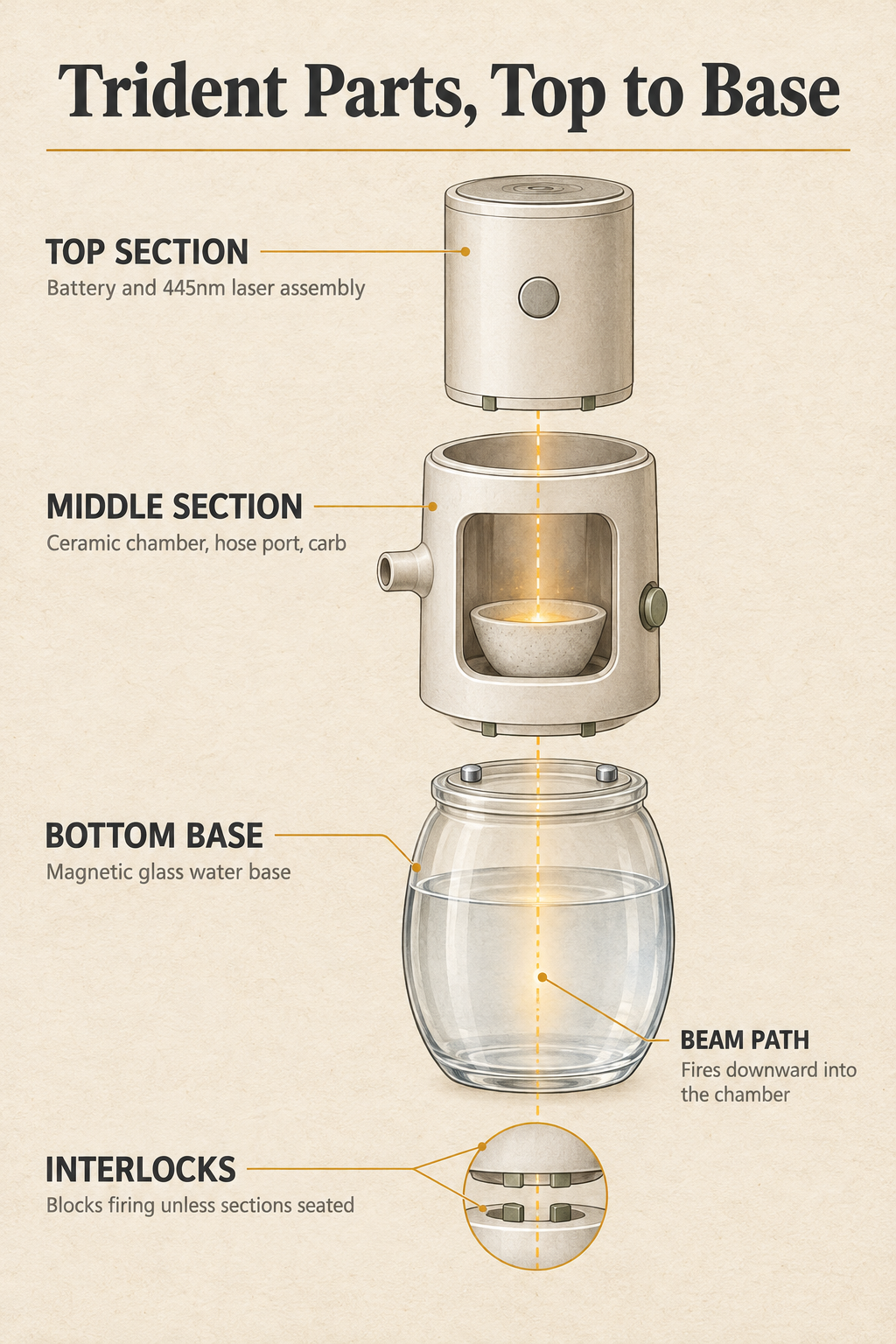
It helps to picture the Trident as a stack of three sections, because each one does a single job and each one has to be seated before the laser will fire. Knowing the order saves a lot of fumbling on the first session.
The V3 replaced the threaded acrylic water cylinder of the earlier generation with a magnetic glass base that has a lipped edge, and V3 coverage describes that as one of the more noticeable handling changes.[8][5] The base lifts off for filling and rinses out as a single piece.
The mouthpiece end depends on the generation and the kit. The standard part is a long flexible black silicone hose, the adjustable silicone mouthpiece is a bundle item or add-on, and reviewers describe the hose as prone to kinking where it meets the connector.[6][1]
If you want a battery device that heats flower without a beam in the path, a dry herb vaporizer such as the Arizer Go SRT Vaporizer follows a different routine from the very first step.
For background on how water pieces are built and how shape changes the draw, see What Is a Bong and How Does It Work?, What Are the Different Types of Bongs? and How Do I Choose the Right Glass Bong for My Needs?.
- Top section: houses the battery and the 445nm laser assembly, and slides or clicks off the body for loading
- Middle section: holds the ceramic loading chamber, the hose port and the carb button
- Bottom section: the magnetic glass water base with a lipped edge for stability on a flat surface
- Draw path: a black silicone hose connects at the port on the middle section and ends in the mouthpiece
- Add-on part: the adjustable silicone mouthpiece ships as a bundle item rather than standard on every kit
- Wear points: the hose connector, the chamber rim and the base seal are what long-term reviewers watch
How Do You Load and Fire a Hitoki Trident, Step by Step?
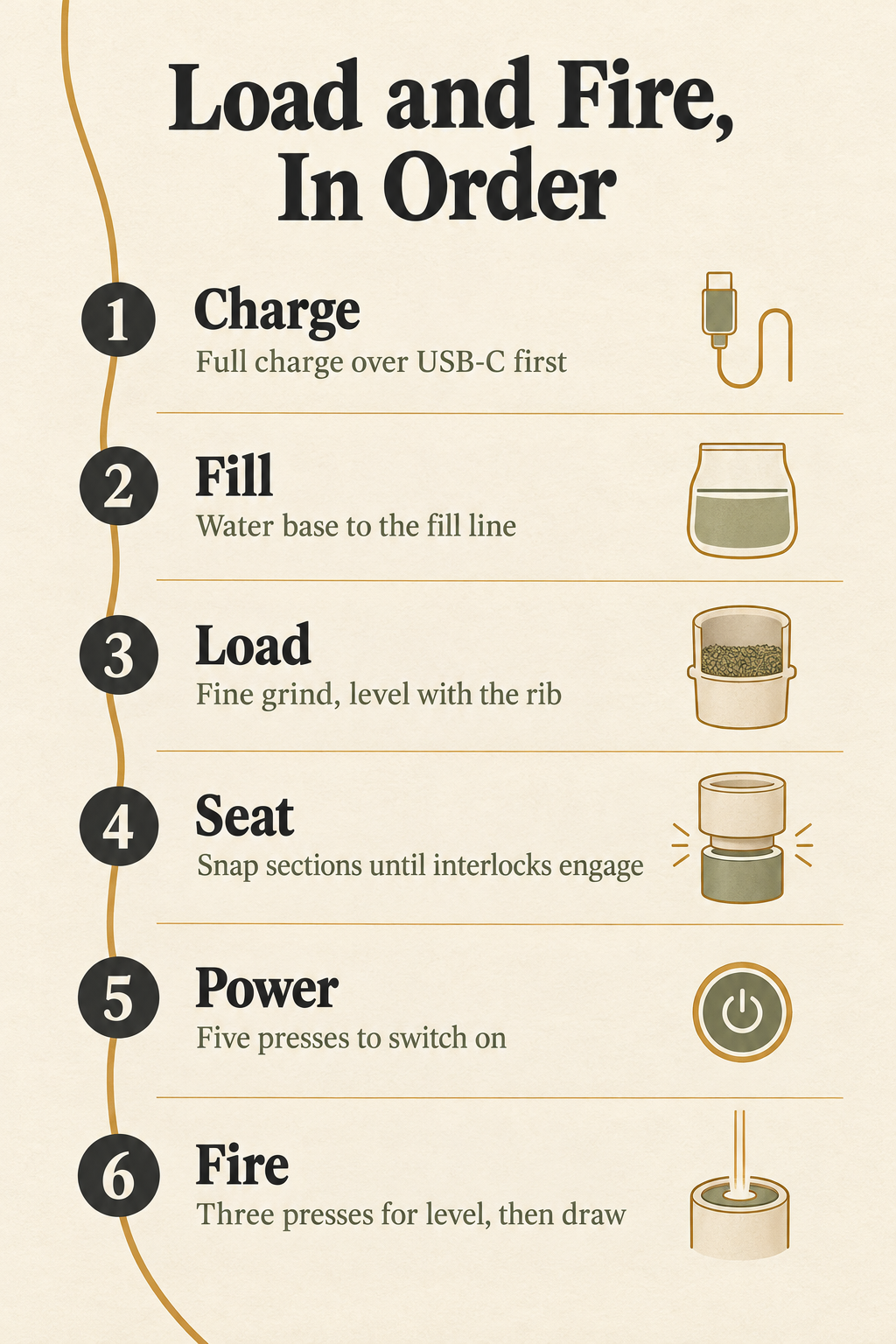
Every source describes the same order, and none of them mentions a preheat or oven-style ramp-up. The sequence below is the one Hitoki and independent reviewers both give, and it takes about a minute once you have done it twice.[8][11]
The loading detail matters more than it looks. The laser burns a small focused area, so an overfilled or unevenly packed chamber lights poorly, and reviewers report a full chamber giving two to three solid hits per bowl.[6][8]
Water goes into the base only to the fill line at the bottom of the stem. Putting in more than that makes the base harder to seat and gains you nothing.
Battery figures differ slightly by generation. Hitoki’s V3 page states roughly 280 to 300 sessions per charge and about 90 minutes over USB-C with pass-through charging, while earlier-generation reviews report 280-plus hits and about 1 hour 45 minutes to recharge.[1][5]
The routine is not transferable from other devices. Something like the Dr Dabber XS e-Rig Portable Vaporizer loads and heats on its own pattern, so the Trident sequence is specific to this unit.
- Charge fully: Hitoki states about 90 minutes to full on the V3 over USB-C, with pass-through charging so it can run while plugged in
- Fill the base: add water only to the fill line at the bottom of the stem, then set the base on a flat surface
- Grind fine: a fine, even grind gives the beam a consistent surface to work on
- Load to the rib: fill the ceramic chamber only to the rib around the outside, never above it
- Tamp flat: press the material level with the poker, but do not pack it tight
- Keep it upright: the column stays vertical for the rest of the sequence
- Seat the sections: click the chamber and top section back on until the interlocks engage, or the laser will not fire
- Insert the hose: push the silicone hose into the port on the middle section
- Power and fire: five quick presses switch the unit on, three presses cycle the heat level, then hold or double-tap to fire while you draw
What Do the Red, Green and Blue Heat Settings Control?
There is one button on top and no screen. Five quick presses power the unit on or off, and three presses cycle through the three levels.[1][5]
The levels run red, then green, then blue, and blue is the hottest of the three.[8] That order inverts the red-is-hottest convention used on many other battery devices, which reviewers have flagged as a source of confusion.[7] Go by the colour you see rather than by what a habit tells you.
Hitoki assigns each level to a condition of the material rather than to a strength of experience. Red is labelled for well-cured dry flower and for saving battery, green for fresher or denser material, and blue for flower infused with concentrate.[1][8]
Concentrate has its own handling rule. Hitoki advises layering concentrate on top of ground flower rather than dropping a bare glob into the chamber, and reviewers confirm a bare glob can clog the airflow.[1][7] The Saber uses the same three-level scheme with a highest setting labelled for infused material.[2]
- Red: Hitoki labels this the coolest level, intended for well-cured dry flower and for conserving battery
- Green: the middle level, labelled for fresher or denser material
- Blue: the highest setting, labelled for flower infused with concentrate
- Control scheme: five quick presses power on or off; three presses cycle between the levels
- Colour caution: blue is hottest on this device, the inverse of the red-is-hottest order on many others
- Concentrate rule: layer it on top of ground flower, because a bare glob can clog the airflow
What Do the Laser Class Labels on a Hitoki Device Actually Say?
The unit carries a laser warning label, and the wording is worth reading before the first session. Hitoki’s own disclosure states the device contains a Class 4 visible laser.[4] It also says the unit must not be altered or modified, and that nothing belongs in the ignition chamber or water tank except smoking material and water as the manufacturer defines them.
The same disclosure warns that white or shiny reflective material in the beam path can cause reflections, and says to stop using the device at once if the viewing cylinder is compromised.[4] A hands-on review of the shipping product records the on-device Class 4 warning text, a second sticker about reflection from misuse, and interlocks that keep the laser from firing when the sections are open.[6]
The terminology comes from federal rules rather than marketing. The FDA describes a Class IV product as presenting an immediate hazard from the direct or the reflected beam.[9] The rule at 21 CFR 1040.10 defines human access to include radiation reflected off a single flat surface introduced through an opening.[10]
Hitoki’s product FAQ answers the laser question by describing the beam as fully enclosed, active only during sessions, and comparable to sunlight. That is the manufacturer’s characterisation, and it sits next to the Class 4 label rather than replacing it.[1][4]
Both statements can be true of the same device: the enclosure is real, and the classification is real. Read the label, keep the chamber contents as specified, and do not modify the unit.
- Class 4 visible laser: the classification printed on the device and repeated in Hitoki’s disclosure
- No modification: altering the unit is prohibited in the manufacturer’s own wording
- Chamber and tank contents: only smoking material and water as the manufacturer defines them
- Reflective material: white or shiny items in the beam path can produce reflections
- Compromised cylinder: stop use immediately if the viewing cylinder is damaged
- Interlocks: reviewers report the laser will not fire unless the sections are seated
What Changed Between the Original Trident and the Trident V3?
Shopping a used or discounted listing means identifying the generation before you look at the price. The V3 brought a magnetic glass water base with a lipped edge, replacing the threaded acrylic water cylinder used earlier.[8] It also added a wider laser burn radius, a black silicone hose, a more compact body and pass-through charging.[1]
Battery reporting is close but not identical across sources. Hitoki’s V3 page states about 280 to 300 sessions per charge and roughly 90 minutes to recharge, while earlier-generation reviews report 280-plus hits and about 1 hour 45 minutes.[1][5][6]
The naming has moved too. The original Trident was first sold under the Saber name before the company rebranded, and Hitoki now sells a different, smaller product that also carries the Saber name.[6][2] Identify a unit by generation and listing date rather than by the name on the box.
The practical rule: V3 specifications should never be attached to a listing that only says Trident, and older review figures should not be applied to a V3.
- Water base: magnetic glass with a lipped edge on the V3, threaded acrylic cylinder on the earlier generation
- Beam: wider laser burn radius on the V3, described by the manufacturer as an airflow improvement
- Hose: black silicone on the V3, while reviewers describe the earlier hose as long and prone to kinking at the connector
- Body: more compact on the V3, still a tabletop piece rather than a pocket device
- Charging: pass-through charging added on the V3, with USB-C on both generations
- Recharge time: about 90 minutes on the V3 per Hitoki, against about 1 hour 45 minutes reported on earlier units
- Name trap: the original Trident was sold as the Saber before a rebrand, and today’s Saber is a different product entirely
| Feature | Original Trident | Trident V3 |
|---|---|---|
| Water base | Threaded acrylic water cylinder | Magnetic glass base with a lipped edge |
| Burn radius | Narrower laser burn radius | Wider laser burn radius for airflow |
| Hose | Long hose that kinks at the connector | Black silicone hose |
| Body | Taller three-part column | More compact body |
| Charging | USB-C | USB-C with pass-through charging |
| Sessions per charge | 280-plus reported by reviewers | 280 to 300 stated by Hitoki |
| Recharge time | About 1 hour 45 minutes | About 90 minutes |
Is the Hitoki Saber the Same Thing, and Which One Should You Buy?
The Saber is not a smaller Trident. It is a separate base unit that takes interchangeable Bubbler, Portable or Recycler attachments, and Hitoki states it can also connect to a glass rig you already own through an adapter.[2][3]
Pricing separates them clearly: $599.99 for the Trident V3, $299.99 for the Saber Solo and $359.99 for the Saber Bubbler Kit.[1][2][3]
Hitoki is explicit that the Saber is also a laser combustion device rather than a dry herb vaporizer, and that loads as small as 0.2 to 0.3 can be used in it.[2] The borosilicate Bubbler attachment is listed as compatible with Saber units only.
Neither device is a pocket item. Reviewers describe both as at-home pieces, and the Trident in particular as a tabletop column with a hose that can catch on nearby objects while the laser is firing.[7][6]
Work the decision in the order below and the choice usually makes itself.
- Decide on form first: one integrated tabletop column (Trident) or a modular base you re-attach to different tops (Saber)
- Check whether you already own glass: the Saber can connect to an existing rig through an adapter, and the Trident cannot
- Budget the difference: $599.99 for the Trident V3, against $299.99 for the Saber Solo and $359.99 for the Saber Bubbler Kit
- Match the load size: the Saber is listed for loads as small as 0.2 to 0.3
- Confirm attachment compatibility: Bubbler, Portable and Recycler tops are Saber-only parts
What Does a Trident Cost, and How Do You Keep It Clean?
Hitoki lists the Trident V3 at $599.99 with a 1-year warranty and a 7-day satisfaction window. The Signature Series bundle adds an exclusive logo, a 3-year extended warranty, an adjustable mouthpiece, a cleaning kit and a dab knife infuser.[1]
The V3 box holds the laser device, a glass water base, a ceramic loading chamber, a black silicone hose with connector, a poker tool, a high-output charging adapter, a USB Type-C cable and a manual. That covers a complete first session, so the add-ons are extras rather than necessities.[1]
Cleaning follows the same pattern on every generation: rinse the water base with warm water and isopropyl alcohol, clear ash from the ceramic chamber, and swab the laser lens with a cotton swab and isopropyl alcohol.[1][5] Earlier-generation reviewers recommend the lens swab after each full session so residue does not dim the beam.
Two handling notes come up in every long-term review. The unit behaves as a tabletop piece rather than something you carry around, and the hose is the part most likely to catch and pull the column while the laser is firing.[6][7]
At this price, free shipping on orders $150+ covers both the Trident V3 and the Signature Series bundle.
- $599.99: Trident V3 with a 1-year warranty and a 7-day satisfaction window
- Signature Series bundle: exclusive logo, 3-year extended warranty, adjustable mouthpiece, cleaning kit and dab knife infuser
- In the box: laser device, glass water base, ceramic chamber, black silicone hose with connector, poker, high-output charging adapter, USB-C cable and manual
- Base and chamber: warm water and isopropyl alcohol for the base, and clear ash out of the chamber
- Lens: swab with a cotton swab and isopropyl alcohol, and reviewers suggest doing it after each full session
- Placement: a flat, stable surface, because the hose is the part most likely to catch and pull the unit
Frequently Asked Questions
Is the Hitoki Trident a vaporizer?
Hitoki’s own FAQ says no. The company describes the Trident as a laser-powered combustion device, even though some retailers and reviewers call it a desktop flower vaporizer. Hitoki makes the same statement about the Saber, calling it a modular laser combustion device rather than a dry herb vaporizer.[1][2]
How much flower fits in a Trident chamber, and how many hits does it give?
The ceramic chamber on the earlier generation holds less than a gram, and reviewers report two to three solid hits per bowl. Fill only to the rib around the outside of the chamber and tamp the material flat, because the laser burns a small focused area and an overfilled or uneven chamber lights poorly.[5][6]
Can the Hitoki Saber attach to a glass bong I already own?
Hitoki says it can. The Saber is a modular base unit that takes interchangeable Bubbler, Portable or Recycler attachments, and the company states it can also connect to a user’s own glass rig through an adapter. The borosilicate Bubbler attachment itself is listed as compatible with Saber units only.[2][3]
Will the laser fire if the Trident is not fully assembled?
Can you put concentrate straight into the Trident chamber?
So Is a Hitoki Trident Worth It for Your Setup?
A laser bong is a narrow purchase, and the Trident is honest about what it is. It is a $599.99 tabletop column that lights a small ceramic chamber with a 445nm beam, passes the draw through a glass water base, and hands it to you through a hose.[1] It is not a vaporizer, it is not a pocket device, and it is not the cheap way into water filtration.
The case for it is mechanism and build. Three sections click together, and the interlocks work. The magnetic glass base lifts off in one piece, and pass-through charging plus roughly 280 to 300 sessions per charge on the V3 are the kind of details that show up in daily use rather than in a spec sheet.[1][8] The case against it is that the same money buys a good glass piece plus a dry herb vaporizer, and neither one asks you to read a Class 4 laser label.
If you want the integrated column, buy the generation deliberately. V3 specifications do not apply to a listing that only says Trident, and today’s Saber is a different, smaller product from the unit that once carried that name.[6][8] If you want the smaller footprint or you already own glass you like, the Saber’s modular base at $299.99 to $359.99 covers that ground.[2][3] Either way, load to the rib, tamp flat, seat the sections, and swab the lens after each session.
Sources
- Hitoki (manufacturer): Trident V3 product page and FAQs
- Hitoki (manufacturer): Saber Kits product page
- Hitoki (manufacturer): Saber Bubbler Kit product page
- Hitoki (manufacturer): Laser Disclosure
- Weedmaps News: Everything you need to know about the Hitoki Trident ‘laser bong’
- Mashable: Hitoki Trident laser bong review
- Engadget: Hitoki Trident hands-on: precision craftsmanship, laser bong
- GreenState: Hitoki Trident V3 review: updated tech, same lasers
- U.S. Food and Drug Administration: Laser Products and Instruments
- U.S. Code of Federal Regulations, 21 CFR 1040.10: 21 CFR 1040.10 Laser products
- Ganjapreneur: The Trident by Hitoki Review