

Choosing the right glass bong comes down to matching three things: the shape and style that fits your smoking preference, glass quality that will last, and a size that suits your space and session needs. This guide walks through every major decision point — bong types, borosilicate versus soft glass, percolator styles, and sizing — so you can pick a bong that actually works for you.
A bong (also known as a water pipe) is a filtration device generally used for smoking cannabis, tobacco, or herbal substances. [1] The word "bong" comes from the Thai word for a bamboo waterpipe, and bongs have been used for centuries by cultures in Laos, Thailand, and Africa. [1] Whether you are upgrading from a smaller pipe or buying your first water pipe, the choices can feel overwhelming. This article breaks each decision down so you know exactly what to look for.
What Are the Main Types of Glass Bongs?
Glass bongs come in several distinct silhouettes, each with its own characteristics. The shape affects how smoke moves through the water, how easy the bong is to store, and how much smoke it holds per session. Here are the most common types you will find when shopping.
Straight tube bongs are the simplest design. Smoke travels straight down from the bowl into the water chamber. This design is easy to clean, inexpensive to manufacture, and a popular choice for beginners. Straight tubes cool smoke through the water but offer minimal diffusion without additional features.
Beaker bongs have a wide, cone-shaped base that sits sturdier on a flat surface than a straight tube. The larger water chamber allows more smoke to collect and cool before you inhale. Beaker bongs are a good middle ground between compact size and smoke volume.
Recycler bongs use a dual-chamber system where smoke is forced through multiple tubes before reaching you. The design pulls water and smoke back down into a lower chamber, cycling the airflow. This can result in a smoother, more controlled draw, though recycler bongs tend to be taller and require more cleanup.
The minor variants worth knowing are the multifilter or showerhead bongs, which use a diffusion plate instead of a percolator, and the tunnel or disc-base designs that sit lower to the ground. These shapes each affect drag and diffusion differently.
- Straight tube — simple design, easy to clean, minimal diffusion
- Beaker — wider base, more stable, larger water chamber for cooling
- Recycler — dual-chamber airflow system, cycles water back for a controlled draw
- Tunnel or disc-base — lower profile, sits sturdier on flat surfaces
What Glass Type Should I Look for in a Bong?
The glass type determines how long your bong lasts, how it handles temperature changes, and how clear it stays over time. There are two broad categories: borosilicate glass and soft glass (soda-lime glass). Understanding the difference helps you avoid buying a bong that will crack or cloud quickly.
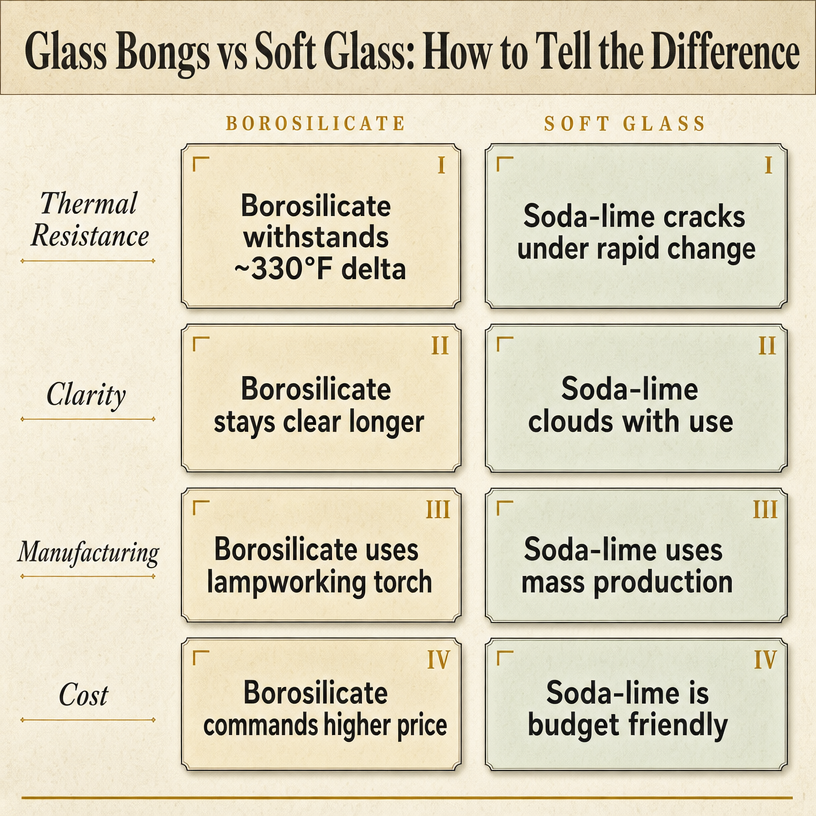
Borosilicate glass contains silica and boron trioxide as its main glass-forming constituents, which gives it a very low coefficient of thermal expansion. [2] It can withstand temperature differentials of approximately 330°F (166°C) without fracturing. [2] This means you can pour hot water into a cold bong or add ice without worrying as much about thermal shock cracking the glass.
Lampworking is a glassworking technique that uses a torch to melt and shape glass, and borosilicate is among the glass types commonly used in this process. [3] This is why quality handcrafted bongs are often made from borosilicate — it holds its shape precisely and tolerates the torch work needed for complex percolator rigs.
Soft glass (soda-lime glass) is less expensive and more common in mass-produced bongs. It is more prone to thermal stress cracking and tends to cloud or etch over time, especially with heavy use. Soft glass bongs work fine as an entry point, but they do not hold up as well long-term.
How can you tell the difference? Borosilicate glass typically has higher clarity and transparency that is maintained over a longer period. [2] It also tends to feel heavier in hand compared to soft glass of the same size. If a bong looks slightly greenish, hazy, or feels unusually light, it is likely soft glass.
- Thermal resistance — borosilicate withstands ~330°F temperature differential without fracturing
- Clarity — borosilicate stays clearer and more transparent longer than soda-lime glass
- Manufacturing — borosilicate is commonly used in lampworking for handcrafted smoking pieces
- Cost — borosilicate bongs command a higher price, reflecting their durability and craftsmanship
What Percolator Style Should I Choose?
A percolator is an extra water diffusion feature inside the bong that breaks smoke into smaller bubbles before it reaches you. More bubbles means increased surface area contact with the water, which affects the overall smoking experience. There are several common percolator designs, each with its own characteristics.
Dome percolators feature a dome-shaped component with small slits or holes. Smoke passes through the dome and is diffused by the slits, creating a curtain of bubbles. Dome percolators are common in inline and beaker-style bongs.
Tree percolators have vertical tubes with multiple slits at different heights, resembling a tree trunk with branches. Each slit produces its own row of bubbles, increasing diffusion across multiple water levels. Tree percs can add more drag (resistance) to the draw.
Showerhead percolators use a vertical tube with a flared head containing many small holes, similar to a showerhead. Smoke emerges from the holes in a wide, dispersed pattern. This style is known for producing many small bubbles and is common in high-end rigs.
Inline percolators are simple horizontal slits inside a tube, offering straightforward diffusion without complexity. They are often found in straight tube designs and produce a moderate level of bubble diffusion.
Turbine percolators use an angled disc with slits that create a swirling effect in the water as smoke passes through. This design can produce a self-clearing action where water and smoke mix vigorously before reaching you.
Percolators do add extra surface area inside the bong, which means they require more frequent cleaning to maintain good airflow. If you prefer low-maintenance equipment, a simple bong without percolators may suit you better.
- Dome percolator — dome-shaped component with slits, produces a curtain of bubbles, common in inline and beaker designs
- Tree percolator — vertical tube with multiple slit levels, increases diffusion but can add more drag to the draw
- Showerhead percolator — flared head with many small holes, produces fine, dispersed bubbles in high-end rigs
- Inline percolator — simple horizontal slits inside a tube, straightforward diffusion in straight tube designs
- Turbine percolator — angled disc with slits, creates swirling water action and a self-clearing effect
How Do I Find the Right Bong Size for My Lifestyle?
Bong height is measured from the base to the top of the mouthpiece and typically ranges from about 6 inches to over 20 inches. The right height depends on your space, your storage needs, and how you plan to use the bong. Here is a practical checklist to help you decide.
Think about where you will use and store the bong most of the time. A larger bong over 14 inches delivers more smoke volume per hit, but it requires more counter space and a wider storage area. If you have limited room or plan to store the bong in a bag or drawer, a smaller bong under 10 inches may be more practical.
Consider your session preferences. Larger bongs hold more smoke per fill, which means fewer refills during a session. Smaller bongs cool smoke less effectively due to the shorter distance between the water and mouthpiece, so hits can feel warmer.
Check the joint size before you buy accessories. The joint is the connection point where the bowl or nail attaches to the bong. Standard sizes are 10mm, 14mm, and 18mm. Using the wrong accessory size means the piece will not fit securely, which can cause leaks or make the bong difficult to use.
Think about who else will be using the bong. A medium-sized bong in the 10-to-14-inch range works well for sharing because it produces a manageable amount of smoke per hit without requiring constant refills.
- Measure your storage space — know the height and width available before you buy
- Match joint size to your accessories — standard joints are 10mm, 14mm, or 18mm
- Consider portability needs — smaller bongs under 10 inches travel more easily
- Account for session size — larger bongs hold more smoke per fill and need fewer refills
- Factor in sharing — a 10-to-14-inch bong balances smoke volume and ease of handling for group sessions
What Are the Key Bong Components and How Do They Work?
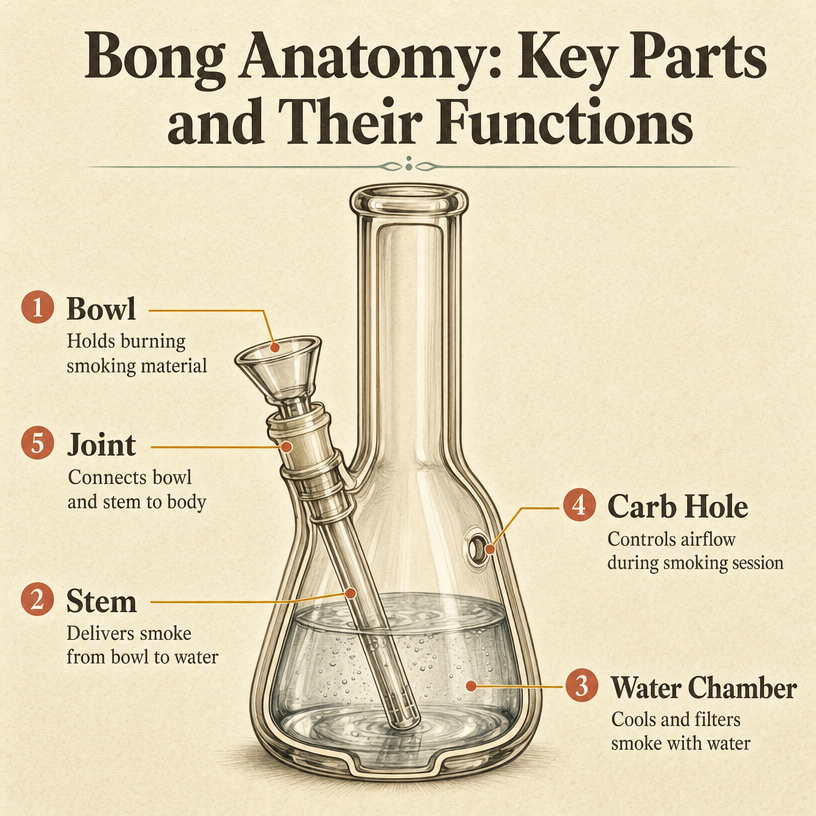
Understanding the anatomy of a bong helps you evaluate quality, troubleshoot problems, and shop for compatible accessories. Every bong, regardless of shape or size, shares a set of core components that work together.
The bowl is the removable piece that holds the burning smoking material. Bowls come in different sizes to match joint sizes and can be made from glass, metal, or ceramic. A good bowl should fit snugly in the joint without wobbling.
The stem (or downstem) delivers smoke from the bowl into the water chamber. Stems can be fixed or removable. Removable stems are easier to clean; fixed stems require more careful handling. Some stems include a diffused end with slits for additional bubble diffusion.
The water chamber is the main body of the bong where smoke bubbles through the water. The water level matters — enough to submerge the openings on the stem or percolator, but not so much that it splashes into your mouth. Most bongs have a fill line marked inside the glass.
The carb hole (also called a choke, kick hole, rush, or bink depending on region) controls airflow during a smoking session. [1] Covering the carb hole while inhaling builds smoke in the chamber; releasing it allows fresh air to flush the smoke out and into your lungs.
The joint is the connection point where the bowl and stem attach to the body. Joint angles are typically 45 degrees or 90 degrees, and the size must match your bowl and stem. A bong with a 45-degree joint is generally more stable than one with a 90-degree joint when set on a flat surface.
- Bowl — holds burning smoking material, removable, comes in sizes to match the joint
- Stem (downstem) — delivers smoke from bowl to water, can be fixed or removable
- Water chamber — main body where smoke cools through water, fill to the appropriate water line
- Carb hole — controls airflow during a session, covers while inhaling to build smoke, releases to clear [1]
- Joint — connection point for bowl and stem, must match in size (10mm, 14mm, or 18mm) and angle (45° or 90°)
How Do I Maintain and Care for a Glass Bong?
A clean bong performs better, tastes better, and lasts longer. Regular maintenance prevents residue buildup that can affect airflow and flavor. Here is a straightforward cleaning routine that works for most glass bongs.
Disassemble the bong and rinse it with warm water to remove loose debris. Separate the bowl, stem, and any removable percolator parts. Set aside anything that cannot be submerged in liquid.
Prepare a cleaning solution. Coarse salt and isopropyl alcohol (at least 70% concentration) is a standard method. Pour the salt into the bong first, add enough alcohol to create a slurry, and seal the openings with stoppers or caps. Shake the bong gently so the salt scrubs the interior surfaces. For stubborn residue, let the solution soak for 15 to 30 minutes before shaking.
Rinse every part thoroughly with warm water after cleaning. Salt left behind can scratch the glass, and alcohol residue can affect the taste of your next session. Repeat the rinse step at least twice.
Air dry all components completely before reassembly. Place parts on a lint-free surface or paper towel. Moisture inside the bong can breed bacteria and cause cloudiness in the glass over time.
Store the bong in a padded or hard case if you have one. Avoid leaving it in direct sunlight or extreme temperatures. Bong storage options are available if you need a dedicated solution.
Replace parts showing signs of wear. A cracked bowl, a warped stem, or a damaged joint can make a bong difficult to use or potentially unsafe. Checking seals and connections before each use is a good habit.
- Disassemble and rinse — separate bowl, stem, and removable parts, rinse with warm water first
- Apply cleaning solution — coarse salt and isopropyl alcohol (70%+) with gentle shaking or soaking
- Scrub stubborn buildup — use cotton swabs or pipe cleaners for tight areas and percolator slits
- Rinse thoroughly — repeat warm water rinses until all salt and alcohol are removed
- Air dry completely — let all components dry fully before reassembling to prevent bacteria growth
- Store properly — use a padded or hard case, avoid direct sunlight and extreme temperatures
Frequently Asked Questions
What is the difference between borosilicate glass and regular glass in a bong?
Borosilicate glass contains silica and boron trioxide, which gives it much higher thermal resistance than standard soda-lime glass. It can withstand temperature differentials of roughly 330°F (166°C) without fracturing. [2] It also maintains clarity and transparency longer, making it the preferred material for quality smoking pieces.
What size glass bong is best for beginners?
A medium-sized bong in the 10-to-14-inch range is generally the best starting point. Smaller bongs cool smoke less effectively and can deliver warmer hits, while very large bongs are harder to store and clean. Start mid-size and adjust based on your space and session habits.
Do percolators actually make a difference in a bong?
Percolators add extra water diffusion stages that break up smoke into smaller bubbles, increasing surface area contact with the water. Different percolator designs — dome, tree, showerhead, inline, turbine — offer varying levels of diffusion and draw resistance. More complex percolators generally produce more bubbles and can alter the smoking experience compared to a bong with no percolator.
How often should I clean my glass bong?
Clean your bong at least once a week with regular use, or immediately when you notice residue buildup affecting flavor or airflow. A simple method uses isopropyl alcohol and coarse salt; for stubborn buildup, let the solution soak before scrubbing.
What Is the Right Glass Bong for You?
Choosing a glass bong does not have to be complicated. Start with the shape that matches your space and smoking style, then look for borosilicate glass for durability and long-term clarity. From there, decide whether you want percolator diffusion, what size fits your lifestyle, and whether you need a standard joint size for your accessories.
Treehouse Lifestyle offers a curated selection of glass bongs in a range of styles, sizes, and price points, with free shipping on orders $150+. Whether you need a compact straight tube for travel or a recycler with multiple percolators for home use, you can explore the full collection and find a bong that fits your needs.