
A practical guide to choosing your first bong, pipe, bubbler, or vaporizer based on material, size, filtration, and budget
The best smoking piece for a beginner depends on three factors: how much water filtration you want, how portable you need the piece to be, and how much you are willing to spend. Glass hand pipes are the most affordable and portable option. Bubblers add water filtration in a compact form. Bongs offer smooth hits but require more water and maintenance. Focus on borosilicate glass construction, a comfortable size for your hand, and a joint size (14mm or 18mm) that makes finding accessories straightforward. Avoid soft glass pieces as your first purchase — it cracks more easily under rapid temperature changes than borosilicate glass [1] [2] [3].
What Are the Main Types of Smoking Pieces?
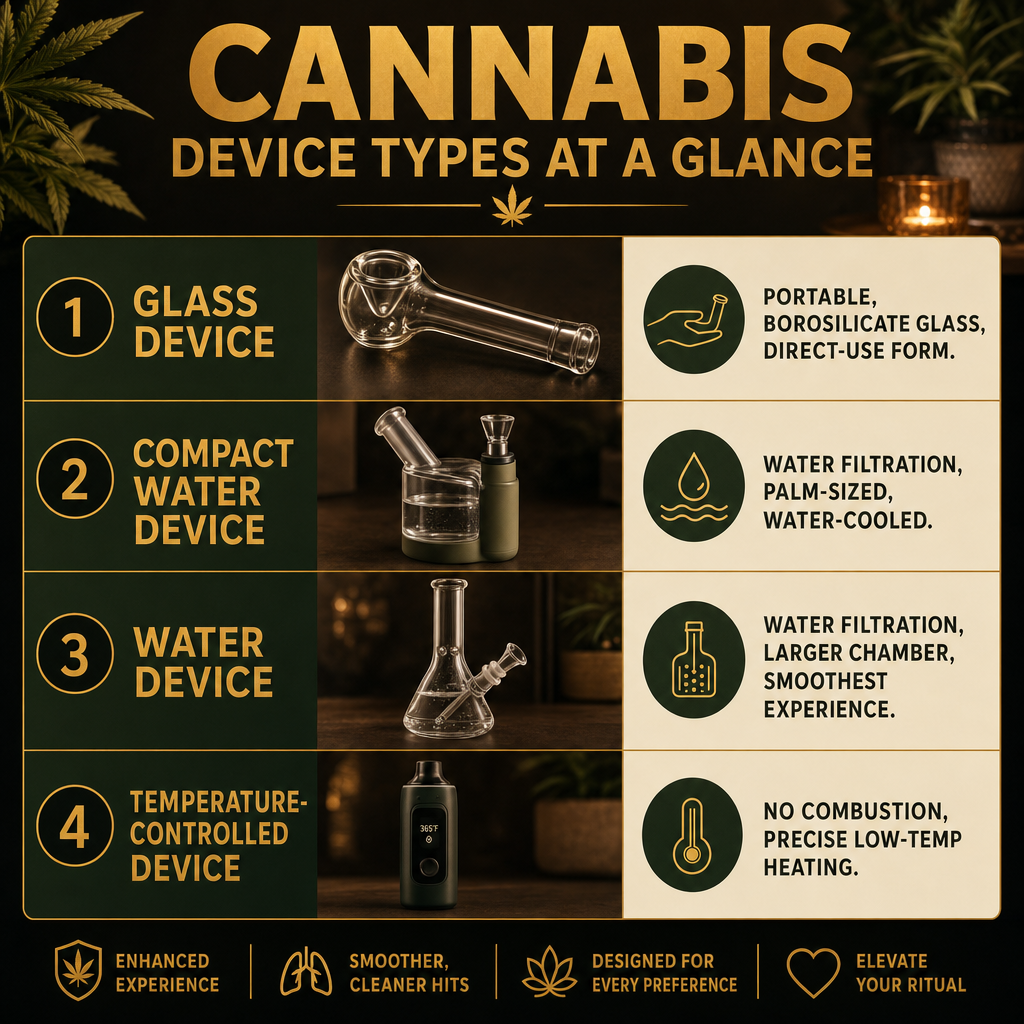
If you have walked into any shop or browsed online, you have probably seen at least a dozen different shapes and names. Glass Hand Pipes, Bongs, bubblers, and vaporizers all do the same basic job — they hold herbal material so you can light it and inhale the smoke. What changes is how they do it, how much they filter, and how easy they are to carry around.
- Glass Hand Pipe — dry smoking, no water, most portable, typically $5–$30, borosilicate glass recommended [1]
- Glass Bubbler — water filtration, compact palm-sized body, requires small amount of water, typically $20–$60 [4] [5]
- Bong / Water Pipe — water filtration, larger body, smoothest hits, requires more water and maintenance, typically $30–$200+ [4]
- Dry Herb Vaporizer — no combustion, temperature-controlled heating, requires power/batteries, typically $50–$300+ [6]
The four types most beginners encounter are glass hand pipes, bubblers, bongs (water pipes), and dry herb vaporizers. Each one sits in a different spot on the spectrum between simplicity and filtration. Understanding that spectrum is what makes choosing your first piece much easier [4].
A glass hand pipe is a single, solid piece with a bowl and a mouthpiece. There is no water involved. You pack the bowl, light it, and inhale directly. Hand pipes are the most portable and the easiest to clean. They are also the least expensive entry point into smoking. Most hand pipes are small enough to fit in a pocket.
A bubbler looks like a small bong but sits in between a hand pipe and a full-sized bong in almost every way. It uses water to filter and cool the smoke, but the body is compact and designed to be held in one hand. Bubblers are a popular choice for beginners who want some water filtration without the size and maintenance of a full bong [4] [5].
A bong (sometimes called a water pipe) is larger and uses water in a chamber at the base. Smoke travels through the water before you inhale it, which cools and filters it. Bongs produce larger hits than hand pipes and bubblers, and they tend to feel smoother on the throat. The tradeoff is that they need more water, more cleaning, and are not very portable.
A dry herb vaporizer heats herbal material at a lower temperature than combustion, producing vapor instead of smoke. This is a fundamentally different experience. The temperature profile of vaporization releases different compounds than burning does [6]. Vaporizers require charged batteries or a power source and tend to cost more upfront than passive smoking pieces.
Read What Are the Different Types of Dab Rigs? for more detail.
What Should You Look for in Smoking Piece Materials?
The material your smoking piece is made from matters more than most beginners expect. It affects how long the piece lasts, how clean the flavor stays, and whether it can handle the heat of daily use without cracking. The two materials most common in smoking pieces are borosilicate glass and soft glass.
- Borosilicate glass — low thermal expansion, heat resistant, non-porous, flavor neutral, best for daily use and long-term value [1] [2] [3]
- Soft glass (soda-lime glass) — higher thermal expansion, cracks more easily under temperature stress, less expensive, avoid for first purchase [2] [3]
- Silicone — virtually unbreakable, easy to clean, good for travel, but can retain odors over time
- Ceramic and bamboo — specialty materials, unique aesthetics, less common sizing, harder to find accessories for
Borosilicate glass is the industry standard for quality smoking pieces. It has a low coefficient of thermal expansion, which means it resists cracking when you go from cold water to hot flame or from a warm room to cold outdoor air. It is non-porous, so it does not absorb flavors or odors from the material you smoke. And it distributes heat evenly across the surface [1] [2].
Soft glass (also called soda-lime glass) has a higher coefficient of thermal expansion. That makes it more prone to cracking under rapid temperature changes. If a seller does not clearly state borosilicate, it is safest to assume the piece is made from soft glass [2]. Soft glass pieces are often cheaper and can be fine for occasional use, but they are not the best choice for a first piece you plan to rely on.
Some pieces are made from silicone, ceramic, or bamboo. Silicone is nearly unbreakable and is a good choice for people who are rough on their gear or who want something travel-friendly. Ceramic and bamboo offer aesthetic variety and unique smoking experiences, but they are less common for beginners and harder to find in consistent sizes and shapes.
For a first smoking piece, borosilicate glass gives you the best combination of durability, flavor preservation, and value. You can find borosilicate hand pipes in the $10–$25 range, and they will outlast many soft glass pieces that cost half as much [2] [3].
When shopping, look for the words "borosilicate glass" on the product page or label. If a listing does not mention it, ask the seller or look for a different option. reputable brands and retailers usually state the material clearly. Treehouse Lifestyle carries a range of borosilicate glass pieces across hand pipes, bubblers, and bongs, and product pages specify the material for each item.
Read What Smoking Accessories Do Beginners Need? for more detail.
Read Bong vs Pipe vs Vaporizer: Which Is Right for You? for more detail.
Read What Are Specialty Pipes and How Do You Choose the Right One? for more detail.
What Size Smoking Piece Is Right for a Beginner?
Smoking pieces come in a wide range of sizes. A one-hitter pipe might be only two inches long. A large beaker bong can stand two feet tall. Size affects two things: how the piece smokes and how easy it is to use and store.
- One-hitter / chillum (2–3 inches) — discreet, fast, harsh hits, easy to overpack, best for occasional use
- Standard hand pipe / bubbler (4–6 inches) — recommended starting size, comfortable grip, good smoke distance, portable [4] [5]
- Small bong (8–12 inches) — water filtration in manageable size, stable on flat surfaces, requires more water than a bubbler [4]
- Large bong (14+ inches) — impressive clouds and smooth hits, heavy and tippy, more water and cleaning required, not ideal for beginners
Very small pieces — sometimes called one-hitters, dugouts, or chillums — are discreet and cheap. They heat up quickly and can produce harsh hits because the smoke has almost no distance to travel before reaching your mouth. They are also easy to overpack, which wastes material.
Medium-sized hand pipes and bubblers, in the 4- to 6-inch range, are the most common recommendation for beginners. They are large enough to pack a reasonable amount, give the smoke some room to cool before you inhale it, and still fit comfortably in your hand and a jacket pocket [4] [5].
Small bongs in the 8- to 12-inch range offer water filtration in a manageable size. They are stable enough to sit on a table without tipping, but they are not so tall that they feel awkward to handle. This is a good middle ground if you know you want water filtration but do not want a full-sized bong.
Large bongs over 14 inches produce impressive clouds and very smooth hits, but they are heavy, harder to store, require more water, and are easier to knock over. They are not ideal for beginners who have not yet learned how to handle and clean a water pipe.
For your first piece, aim for something that fits in your hand comfortably and sits stably on a flat surface. A 5-inch hand pipe or an 8-inch bubbler gives you room to learn without the downsides of going too small or too large [4].
Do You Want Water Filtration in Your Smoking Piece?
Water filtration is the main functional difference between a bong or bubbler and a dry hand pipe. When smoke passes through water, it cools down and picks up moisture before you inhale it. Many beginners find that water-filtered hits feel less irritating on the throat than dry hits [4].
- Hand pipe (dry) — no water needed, least maintenance, most portable, clean after each use with a quick rinse
- Bubbler (small water chamber) — water filtration, palm-sized, requires small amount of water, moderate cleaning time [4] [5]
- Bong (large water chamber) — maximum water filtration, larger and less portable, requires more water and more thorough cleaning [4]
- Percolator bong — adds internal diffusion, cooler smoke, more cleaning complexity, higher price point, not necessary for a first piece [4]
That cooling effect is real, but it is important to understand what it does and does not do. Water filtration changes the temperature and moisture content of the smoke. It does not remove any specific substance or make the smoke "cleaner" in terms of what you are inhaling. The experience tends to feel smoother simply because the heat is reduced.
Bubblers are the entry point into water filtration. They hold a small amount of water — typically just enough to cover the bottom of the chamber. They are portable, easy to load, and require less water and cleaning than a full bong. If you want water filtration but do not want the commitment of a large bong, a bubbler is the practical middle ground [4] [5].
Bongs use more water and have more internal surface area for the smoke to interact with. A larger water chamber means more cooling and diffusion. Some bongs also have percolators, which are internal devices that break the smoke into more bubbles and increase the surface area contact with water [4].
The tradeoff with water filtration is maintenance. Every water piece needs to be emptied, rinsed, and refilled after each use to prevent buildup and odor. Over time, residue collects in the hard-to-reach corners of the downstem, the base, and any percolators. Cleaning a bong with a percolator takes noticeably longer than cleaning a hand pipe or a simple bubbler.
If you are new to smoking and unsure whether you will use a piece regularly, start with a hand pipe or a bubbler. Both are easier to maintain than a bong, and you can always move up to a bong later once you know what you want. Treehouse Lifestyle offers free shipping on orders $150+, so you can try a hand pipe and a bubbler together if you want to compare the two experiences.
What Smoking Piece Features Actually Matter?
Once you narrow down the type and size you want, a few specific features will determine which piece is the right buy. Joint size, downstem design, and percolator type are the terms that come up most often when shopping for bongs and water pipes. Understanding them helps you avoid buying accessories that do not fit.
- Joint size (14mm vs 18mm) — determines accessory compatibility; 14mm is more common for smaller bongs and bubblers, 18mm for larger pipes [4]
- Fixed vs removable downstem — removable downstems are easier to clean and replace; fixed downstems are simpler but can be harder to maintain over time
- Percolator type (tree, honeycomb, showerhead, UFO, etc.) — each creates a different bubble pattern; more percs mean cooler hits and more cleaning complexity [4]
- Base shape (straight, beaker, recycler) — beaker bases hold more water and are more stable; straight tubes are simpler and easier to clean
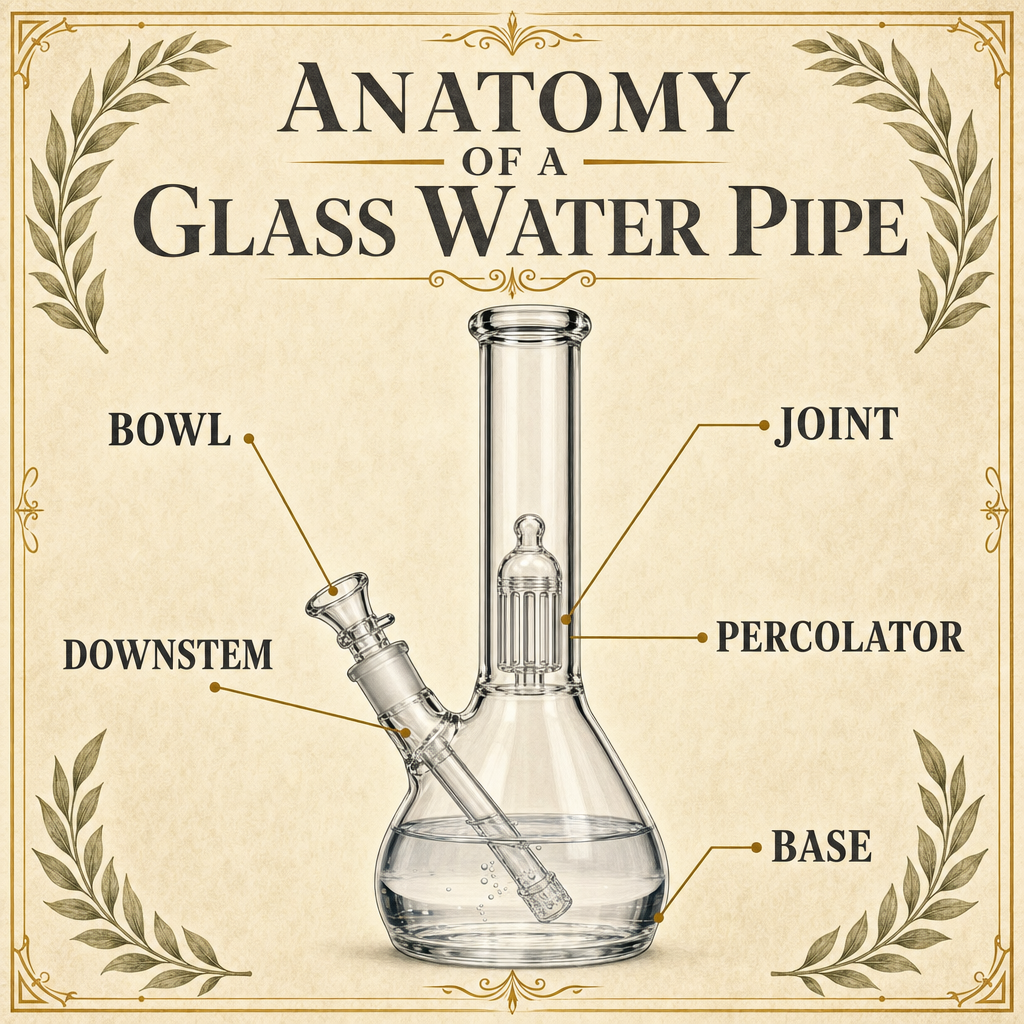
The joint is the connection point where the bowl (the part that holds the herbal material) slides into the pipe. The two standard sizes are 14mm and 18mm. The difference is the diameter of the opening. Most smaller bongs and bubblers use 14mm joints. Larger bongs more commonly use 18mm. This matters because bowls, downstems, and other accessories are sized to match [4].
If you buy a 14mm bong and later want to upgrade the bowl or add a new downstem, you need to look for 14mm accessories. Buying a piece with the more common 14mm joint makes finding replacement parts and upgrades easier, especially at the beginning when you are still learning what you like.
The downstem is the tube that channels smoke from the bowl into the water in the base of the pipe. Some downstems are fixed (blown into the body of the pipe). Others are removable, which makes them easier to clean and replace if they break. Removable downstems also give you more flexibility in choosing the length and style later.
A percolator is a filtration device inside the pipe that breaks smoke into small bubbles as it passes through the water. The more bubbles, the larger the surface area of smoke that contacts the water at once. Percolators are popular because they produce cooler, smoother-feeling hits. The most common types are tree percs, honeycomb percs, and showerhead percs. Each creates a different bubble pattern and has a different cleaning profile. [4]
For a first bong, a simple straight-tube or beaker-base design without a percolator is the best choice. It teaches you how the pipe works, is straightforward to clean, and costs less than a percolator model. You can always add a percolator bong to your collection later once you have a reference point for what feels different. A silicone beaker bong with a removable glass bowl, for example, gives you the durability of silicone on the outside with the flavor benefits of a glass interior.
See SILICONE BEAKER BONG WITH REMOVABLE GLASS BOWL as one current product example.
How Much Should a Beginner Spend on a Smoking Piece?
Smoking pieces cover a massive price range. A basic one-hitter can cost as little as $3. A scientific-grade borosilicate hand pipe might run $12–$20. A mid-range bubbler or small bong falls in the $25–$75 range. High-end artisan bongs with multiple percolators can easily exceed $300.
- $3–$15 — basic one-hitters, very cheap hand pipes, often soft glass, fine for a single use but not for regular ownership
- $15–$30 — entry-level borosilicate hand pipes and simple bubblers, recommended starting point for most beginners [1] [2]
- $30–$75 — quality bubblers, small bongs, thicker glass, better base stability, good value for a first water pipe
- $75–$150 — mid-range bongs, functional percolators, solid glass thickness, durable construction, for committed beginners who know they want water filtration
- $150+ — artisan and luxury pieces, complex percolator systems, specialty glasswork, for collectors and enthusiasts rather than first-time buyers
For a first piece, you do not need to spend much to get something functional and durable. The goal is to find a piece that lets you explore what you like without a big financial commitment. A solid borosilicate hand pipe in the $10–$20 range will outlast a $5 soft glass piece and provide a noticeably better experience [1] [2].
In the $20–$50 range, you can find well-made bubblers and small bongs with decent thickness glass and functional designs. Look for borosilicate glass and a stable base. Avoid pieces that look thin or have seams that look uneven. A little extra spent here buys you a piece that will hold up to regular use.
The $50–$100 range is where you start seeing quality percolators, thicker glass, and more refined craftsmanship. If you know you want a bong and you have the budget, this range offers good value. You do not need to spend this much on your first piece, but if you are going to make the jump to a bong, spending around $60–$80 gets you something that will last.
Above $100, you are paying for artisan design, complex percolator systems, and brand name craftsmanship. These pieces are collector items as much as functional smoking tools. Most beginners do not need to spend this much, and the difference in actual smoking experience between a $80 bong and a $300 bong is smaller than the price suggests.
Set a budget based on how confident you are that you will use the piece regularly. If you are trying smoking for the first time or want something simple for occasional use, keep the initial investment low. If you already know you want water filtration and plan to use it most days, a mid-range piece in the $40–$80 range is a reasonable upgrade from the cheapest options.
What Are Common Questions About Smoking Accessories?
How do you clean a glass smoking piece?
Glass smoking pieces can be cleaned with isopropyl alcohol and coarse salt. Disassemble the piece, add the salt and alcohol, shake vigorously, then rinse thoroughly with warm water until no residue remains. For heavy buildup, let the piece soak for several hours before shaking.
Is a bong better than a pipe for a beginner?
A bong is not automatically better than a pipe for every beginner. Bongs produce smoother hits because the water filters and cools the smoke, but they require water, more maintenance, and are less portable. A hand pipe is simpler, more portable, and easier to clean, making it a practical starting point for many beginners.
What is a percolator and do you need one?
A percolator is an internal filtration device inside a bong that further diffuses and cools smoke by breaking it into smaller bubbles. Percolators create a smoother hit but add cost, complexity, and more cleaning requirements. As a first piece, a simple bong without a percolator is easier to maintain and significantly less expensive.
What is the difference between a bubbler and a hand pipe?
A bubbler is a compact water pipe that combines features of a hand pipe and a bong, providing water filtration in a smaller form factor that fits in your palm. A standard hand pipe is a dry pipe with no water — smoke goes directly from the bowl into your mouth. Bubblers require water to function; hand pipes do not.
Can a smoking piece be too small to use comfortably?
Yes. Pieces that are too small can be awkward to hold, difficult to light, and may produce harsh hits because there is less distance for the smoke to travel before inhalation. A piece that fits comfortably in your hand with room to grip it firmly is the practical minimum for regular use.
How Do You Choose the Right First Smoking Piece?
Choosing your first smoking piece comes down to three honest questions. Do you want water filtration or not? How portable do you need the piece to be? What is your realistic budget?
If you want the simplest, most portable option with the lowest barrier to entry, a borosilicate glass hand pipe in the $10–$20 range is the right starting point. It teaches you the fundamentals of packing, lighting, and inhaling without adding the variable of water. If you later decide you want something that feels cooler on the inhale, you have a clear path to a bubbler or bong.
If you want water filtration but prefer something compact, a bubbler gives you that experience in a palm-sized form. It requires only a small amount of water and is significantly easier to clean and maintain than a full bong.
If you are confident you want water filtration and do not mind the extra maintenance, a small bong in the 8- to 12-inch range with a 14mm joint will serve you well. Start with a simple model without a percolator so you can learn the basics before adding complexity.
No matter which type you choose, prioritize borosilicate glass construction, a comfortable size for your hand, and a joint size that makes finding accessories simple. Avoid soft glass for your first purchase. And remember — you can always upgrade as you learn what you actually use and enjoy. Treehouse Lifestyle carries hand pipes, bubblers, and bongs across every price tier mentioned here, all with free shipping on orders $150+.
Where Does This Smoking Accessory Information Come From?
- HEMPER: Types of Hand Pipes: Your Guide to Smoother Hits
- Tahoe Grinder Company: Borosilicate vs ‘Soft Glass’
- Museum of Glass: Borosilicate Glass vs. Soft Glass – What’s the Difference?
- Smoke Cartel: Perfect Bong Guide: Styles, Materials & Budgets
- Elf Glass: 7 Glass Pipe Types: A Powerful Beginner’s Visual Guide
- HEMPER: The Difference Between Vaporizing and a Bong