

A complete guide to ceramic, quartz, one-hitter, glass blunt, stone, and novelty pipes for every type of smoker
Specialty pipes cover a wide range of hand-held smoking devices that go beyond standard cigarette-style or mass-produced pipes. They include one-hitters, glass blunts, Hand Pipes made from glass or quartz, ceramic pipes, stone pipes, and novelty or theme pipes — each with distinct material properties, designs, and maintenance needs. This guide walks through every major type so you can understand the differences, compare materials side-by-side, and pick the right pipe for how you smoke.
What Makes a Pipe a Specialty Pipe?
The term "specialty pipe" refers to hand pipes, one-hitters, glass blunts, and similar devices that are crafted from higher-quality materials or designed with features that set them apart from mass-market alternatives. Where a standard pipe might be machine-stamped from aluminum or built from cheap wood, a specialty pipe is made from quartz, ceramic, or borosilicate glass, often with hand-finished details and purpose-built engineering.
- Specialty pipes use premium materials including borosilicate glass, quartz, ceramic, stone, and clay — each chosen for heat resistance, flavor preservation, or durability rather than low cost.
- Many feature hand-finished construction and engineering details like stable wide-based bowls, spiral chambers, or frozen glycerin cores that actively change the smoking experience.
- Mass-market pipes are machine-made from cheaper materials with less attention to airflow, heat distribution, and how the material affects flavor over time.
- Specialty pipes are worth considering when you want better heat resistance, more consistent airflow, or a device matched to a specific smoking style or frequency.
Some specialty pipes also incorporate unique mechanisms — helix chambers that create a smoke vortex, glycerin-filled cores that cool smoke, or auger systems that push ash forward automatically. These are not purely aesthetic differences. They affect how the pipe handles heat, how the smoke moves through it, and how the material interacts with what you are smoking.
What Are One-Hitters and How Do They Work?
A one-hitter is a small, discreet pipe designed for a single inhalation of dry herb. Each load holds approximately 0.1 to 0.3 grams, which is roughly one hit — hence the name. One-hitters are also called bats, tays, testers, or oneys depending on region, and they have historical counterparts in other traditions: Japan’s kiseru, the Middle East’s midwakh, and Morocco’s sebsi all serve the same basic purpose. [1]
- One-hitter bowls hold approximately 0.1 to 0.3 grams per load, which is about a single inhalation’s worth of dry herb. [1]
- Regional equivalents include Japan’s kiseru, the Middle East’s midwakh, and Morocco’s sebsi, each reflecting local tradition. [1]
- Modern one-hitters are made from glass, metal, or ceramic. Glass one-hitters are especially popular because the material does not retain or transmit flavor. [1]
- A dugout keeps the pipe and herb together in a compact, pocket-friendly case, making the system popular for private, on-the-go use.
The one-hitter pipe itself is a thin, cylindrical tube, typically two to four inches long. One end holds a small bowl; the other is the mouthpiece. The bowl is sized to hold a pinches worth of dry herb — enough for one session, no more. The design is meant to be portable and low-profile.
A dugout is a small wooden case that pairs with a one-hitter. It has two compartments: one sized to hold the thin pipe itself, and another wider compartment that holds a stash of dry herb. This keeps the pipe and the material together in one pocket-sized unit. [1]
Read What Are Hand Pipes and Bubblers, and How Do They Differ? for more detail.
Read The Complete Guide to Cleaning Smoking Accessories for more detail.
What Materials Are Specialty Pipes Made From?
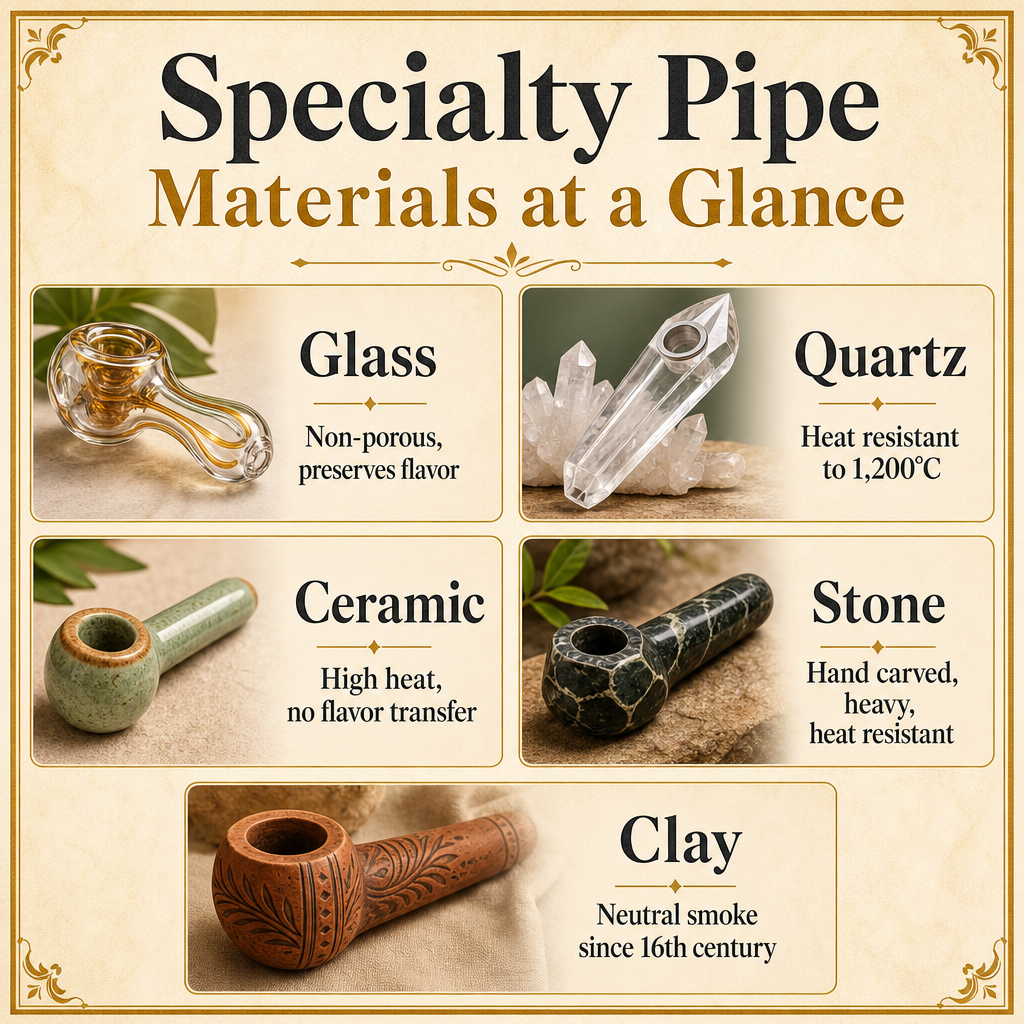
The material a pipe is made from directly affects how it handles heat, how long it lasts, how heavy it feels, and what the smoke tastes like when it reaches you. Specialty pipes are made primarily from glass, quartz, ceramic, stone, or clay. Each material has a distinct set of properties that make it better suited to certain types of smokers.
- Borosilicate glass is non-porous, blocks odors, and preserves the full flavor profile of herbal material without adding taste. Fragile under impact. [8]
- Quartz glass withstands temperatures up to 1,200°C without melting, outperforming borosilicate glass in thermal stability. Non-porous and flavor-neutral. [4]
- Ceramic handles high heat consistently without cracking and does not alter smoke flavor. Quality indicators include smooth finishes, even glazing, and sturdy bases. Sensitive to thermal shock. [3]
- Stone pipes (soapstone, catlinite) are hand carved and heat resistant but heavy and lack moisture-absorbing properties. [2] [5]
- Clay pipes date to the 16th century and provide a neutral smoke favored for flavor testing. Bowls become very hot during use. [2] [5]
Glass pipes are made from borosilicate glass, which is non-porous and blocks the passage of odors and chemicals. This means the material does not retain the smell of previous sessions, and it does not add any flavor of its own to what you are smoking. [8] Glass is fragile under impact — it cracks or breaks if dropped on a hard surface — but it handles normal heating and cooling cycles well when used consistently.
Quartz glass can withstand temperatures up to 1,200°C without melting or deforming, thanks to strong silicon-oxygen bonds in its molecular structure. [4] That is significantly higher than standard borosilicate glass can handle, which makes quartz more thermally stable under repeated high-heat use. Like glass, quartz is non-porous, which means it does not trap smells and it does not affect flavor. [4]
Ceramic pipes handle high temperatures consistently without cracking and do not impart flavor to smoke. Quality indicators include smooth finishes, even glazing, and sturdy bases. [3] Thermal shock from sudden temperature changes can cause cracking, so it is best to heat ceramic gradually and let it cool naturally. [3]
Stone pipes — including soapstone (steatite) and catlinite (pipestone) — are hand carved and known for heat resistance, but are heavy and lack moisture-absorbing properties. [2] [5] Stone is a durable material that does not crack easily, but the extra weight makes stone pipes less convenient for carrying around.
Clay pipes date to the 16th century and provide a neutral, pristine smoke favored for flavor testing, though bowls become very hot during use. [2] [5] The lack of added flavor makes clay popular for comparing the taste of different herbs, but the heat issue means handling with care is essential.
Read What Are the Different Types of Hand Pipes? for more detail.
How Do Glass Blunts Work?
A glass blunt is a straight-sided glass tube that works differently from a traditional hand pipe. Where a hand pipe relies on you to load, light, and ash manually, a glass blunt uses a metal screw (called an auger) or a sliding plunger mechanism to push ash forward and fresh herb toward the heat source as you smoke. [6] This means the blunt stays lit without needing to be relit after every inhalation, and the bowl stays clean throughout the session.
- Glass blunts use a twisting auger or sliding plunger to push ash forward and fresh herb toward the heat source, eliminating the need for rolling papers. [6]
- Blunt wraps are derived from either tobacco leaves (containing nicotine) or hemp fibers (nicotine-free), and burn slower than standard rolling papers. [7]
- Glass blunt capacity is approximately 1.5 to 2 grams, making it larger than a one-hitter and smaller than a standard hand pipe. [6]
- The glass blunt mechanism is convenient and keeps the bowl clean during a session, but sticky or damp herb can cause the herb to stick to the glass or auger, affecting performance.
The auger-style glass blunt works by twisting the exposed end of the metal screw, which pushes herb into a compact spiral shape and advances it toward the heat source. The sliding plunger style moves the herb forward along a wider airflow channel. [6] Both styles let you smoke a pre-loaded amount without rolling papers or tobacco wraps, and without the burn rate issues that come with traditional blunt wraps. [6] [7]
A glass blunt holds approximately 1.5 to 2 grams of herb, which is more than a one-hitter but less than a full-sized hand pipe. [6] It is more portable than a hand pipe in some ways — the straight tube shape is easy to pack into a bag — but the glass construction means it needs a protective case to avoid breakage.
How Do You Clean and Maintain a Specialty Pipe?
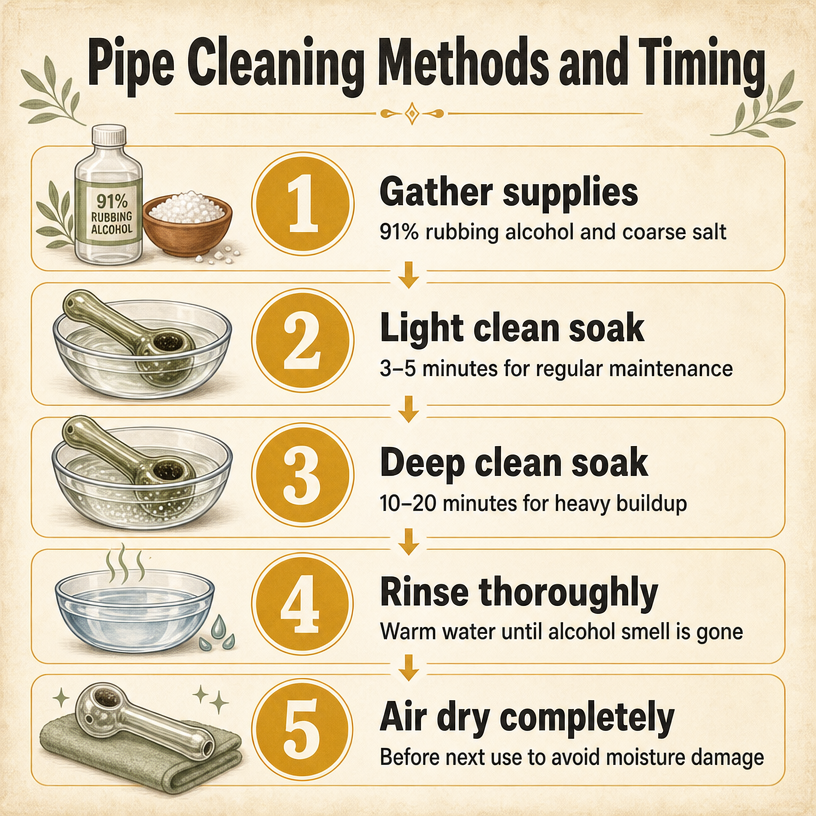
Regular cleaning keeps specialty pipes performing well and extends their usable life. The standard method uses isopropyl alcohol and coarse salt. The alcohol dissolves resin buildup, and the salt provides gentle abrasion that helps break down deposits in hard-to-reach places. [9] The strength of the alcohol and the soaking time depend on how dirty the pipe is.
- Gather 91% isopropyl alcohol and coarse salt. The alcohol dissolves residue; the salt provides abrasion for hard-to-reach buildup. [9]
- Light clean soak: submerge the pipe for 3 to 5 minutes, then scrub and rinse with warm water. [9]
- Deep clean soak: submerge for 10 to 20 minutes in 91% isopropyl alcohol with coarse salt for heavy buildup, then scrub, rinse, and air dry. [9]
- Rinse with warm water until no alcohol smell remains, then air dry completely before reassembling or storing. [9]
The most common approach uses 91% isopropyl alcohol, which works faster than lower concentrations. [9] For a light clean — when residue is thin and mostly translucent — a soak of three to five minutes is usually enough. For heavy buildup that has darkened the glass or ceramic, a deep soak of ten to twenty minutes in 91% isopropyl alcohol combined with coarse salt is the standard recommendation. [9]
After soaking, scrub the pipe with a pipe cleaner or soft brush to dislodge any remaining residue. Rinse thoroughly with warm water until no alcohol smell remains. Residue left behind can affect flavor on the next use and may cause irritation. [9] Allow the pipe to air dry completely before the next use. Any moisture trapped in a sealed chamber can cause problems that are difficult to fix.
Read How Do You Clean a Bong the Right Way? for more detail.
What Are the Differences Between Hand Pipes, Glass Blunts, and One-Hitters?
These three types of hand-held pipes cover most of what the specialty pipe category has to offer, but they serve different situations. Understanding the practical differences makes it easier to pick the right one or decide to own more than one.
- Use case: hand pipes are the most versatile and work for personal sessions and small groups. Glass blunts are well-suited for group sessions where keeping the pipe lit without rolling is an advantage. One-hitters are designed for solo, on-the-go, discreet use.
- Portability: one-hitters are the most portable — small enough to fit in a dugout and carry in a pocket. Glass blunts are moderately portable but need a protective case. Hand pipes vary widely in size and are the least convenient to carry.
- Capacity: hand pipes typically hold 0.5 to 3 grams per bowl. Glass blunts hold approximately 1.5 to 2 grams. One-hitters hold 0.1 to 0.3 grams per load.
- Ease of use: one-hitters are the simplest — pack, inhale, done. Hand pipes and glass blunts both have a short learning curve but are straightforward once you have used them once or twice.
- Maintenance: one-hitters are the easiest to keep clean — the small bowl wipes out quickly. Glass blunts require the most attention because the auger or plunger mechanism needs to stay clear of residue. Hand pipes fall in the middle.
A hand pipe is the most general-purpose option. You pack the bowl, light it, and smoke until the bowl is finished. There is no automatic advancing mechanism, no water filter, and no need for rolling papers. Hand pipes come in glass, quartz, ceramic, and other materials, and they range from simple straight-tube designs to pipes with percolation chambers, helix cores, or glycerin cooling cores. [8]
A glass blunt handles the session differently by pushing herb forward automatically as you smoke. It does not need to be relit after every inhalation the way a hand pipe does. The trade-off is that the mechanism adds complexity: the auger or plunger needs occasional cleaning, and it works best with herb that is dry rather than sticky. [6]
A one-hitter is the smallest and most discreet of the three. It holds roughly one hit per load and is designed for fast, private use. It does not have a relighting issue because there is nothing to keep lit — you finish the bowl in a single inhalation and you are done. [1]
Browse Pipe Types to explore related options.
Browse One Hitters to explore related options.
What Should You Look for When Buying a Specialty Pipe?
Choosing the right specialty pipe comes down to matching your priorities to what is available. Material, design, mechanism, and budget all play a role. Thinking through each factor before you buy helps you avoid a pipe that does not suit how you actually smoke.
- Material determines heat resistance, flavor preservation, durability, and weight. Glass and quartz are non-porous and preserve flavor. Ceramic handles high heat well. Stone is durable but heavy.
- Base stability and joint quality are structural factors that affect safety and longevity. Wide, heavy bases resist tipping. Solid bowl-to-stem joints indicate better construction.
- Percolation features add functional value. Helix chambers use the Venturi effect for a vortex-cooled draw. Glycerin cores use frozen liquid for cooled hits. [8]
- Brand reputation reflects quality consistency, customer support, and craftsmanship. Established brands typically outperform unknown manufacturers on all three. [2]
- Budget range varies widely. Entry-level glass hand pipes are affordable; advanced features and premium materials increase cost. Matching your budget to your actual priorities — not the most expensive option available — is the smart approach.
Material is the foundation of everything else. Glass and quartz pipes are the top choices for flavor preservation because they are non-porous and do not add taste to smoke. Ceramic also ranks highly for neutral flavor, while stone and clay each add subtle mineral characteristics that some smokers prefer in specific tasting situations. [2] [3] [4]
The base and joint quality matter more than most buyers realize. A pipe with a wide, heavy base is harder to knock over. The joint where the bowl connects to the stem or body should feel solid — any wobble or gap is a sign of poor construction that will affect performance over time. [3]
Percolation features such as helix chambers or glycerin cores add real functional differences. A helix pipe uses the Venturi effect to create a smoke vortex, cooling the draw without water. [8] A glycerin pipe has a frozen glycerin core that absorbs heat from the smoke for a cooler hit. [8] These features add to the price but genuinely change the experience.
Brand reputation matters in this category. Established brands with a track record of consistent quality, good customer support, and reasonable warranty policies are worth paying a premium over an unknown manufacturer selling the same design for less. [2]
Budget sets the outer boundary. Entry-level glass hand pipes are among the most affordable specialty options, while advanced percolation features and premium materials push prices upward. If you are building a collection or upgrading from a mass-market pipe, investing in a quality piece from a retailer you trust makes a meaningful difference. Treehouse Lifestyle carries a wide selection across all material types and price points, and offers free shipping on orders $150+.
Browse Beaker Bongs to explore related options.
What Are Common Questions About Smoking Accessories?
What is the difference between a specialty pipe and a standard pipe?
Specialty pipes are hand-crafted or designed with specific materials like quartz, ceramic, or borosilicate glass, and often feature unique mechanisms such as helix chambers or glycerin cooling cores. Standard mass-market pipes are typically machine-made from cheaper materials with less attention to heat resistance, airflow, and flavor preservation.
How much herb does a one-hitter hold?
A one-hitter holds approximately 0.1 to 0.3 grams per load, which is roughly a single inhalation’s worth. This makes them the most portable and discreet option in the specialty pipe category.
What is the best pipe material for flavor?
Borosilicate glass and quartz are the top materials for flavor preservation because they are non-porous and do not impart additional taste to smoke. Ceramic also ranks highly for neutral flavor, while stone and clay add subtle mineral notes that some smokers prefer for specific tasting sessions.
How often should you deep clean a specialty pipe?
Light cleaning with isopropyl alcohol and coarse salt should be done every few uses or when residue becomes visible. A deep clean is recommended once a week for frequently used pipes, soaking for 10 to 20 minutes in 91% isopropyl alcohol combined with coarse salt to break down buildup.
Are quartz pipes better than glass pipes?
Quartz withstands temperatures up to 1,200°C compared to standard borosilicate glass, making it more thermally stable under repeated high-heat use. Both are non-porous and preserve flavor well, but quartz’s superior heat resistance makes it more durable over time for heavy users.
What are novelty and theme pipes?
Novelty or theme pipes are designed around creative concepts, pop culture aesthetics, or collectible styles. They are primarily made from borosilicate glass and function the same as standard glass hand pipes — the novelty is in the visual design rather than the smoking performance.
What Is the Right Specialty Pipe for You?
Specialty pipes represent a meaningful upgrade from standard mass-market options in terms of material quality, design, and smoking experience. Whether you choose a one-hitter for its portability and discretion, a glass blunt for its hands-free session management, or a hand pipe in quartz or ceramic for larger personal sessions, the right pipe is the one that matches how and where you actually smoke.
Material choice drives most of the other differences. Glass and quartz deliver the cleanest flavor. Ceramic handles high heat without altering taste. Stone and clay add character that experienced smokers sometimes seek out. Think about what matters most to you — flavor purity, session size, portability, or cooling — and let that guide your decision.
Maintenance is a real consideration and not one to overlook. A pipe that is difficult to clean will get cleaned less often, which affects flavor and longevity. If you want something low-maintenance, a simple glass hand pipe or a one-hitter is easier to keep in good condition than a glass blunt with an auger mechanism.
Use this guide to narrow down the type and material that fits your priorities, then shop from a retailer with a wide selection and fair pricing. Treehouse Lifestyle offers free shipping on orders $150+, making it a practical option whether you are buying your first specialty pipe or adding to an existing collection.
Where Does This Smoking Accessory Information Come From?
- Wikipedia: One-hitter (smoking)
- Wikipedia: Tobacco pipe
- Ancient Creations Pipes: Guide to Choosing the Best Ceramic Smoking Accessories
- ATCera: Enhanced Heat-Resistant Quartz Glass Pipes: Applications, Benefits, and Innovations
- Smokingpipes.com: Common Tobacco Pipe Materials: Briar, Meerschaum, and More
- Smoke Cartel: Glass Blunt 101: How to Pack, Twist, and Smoke Like a Pro
- Select Vape: Blunt Wrap: What is it Used for?
- HEMPER: Types of Hand Pipes: Your Guide to Smoother Hits
- High Artifact: How to Clean a Pipe With Isopropyl Alcohol (Fast Method)