

A plain-English guide to spoon, Sherlock, chillum, and other dry pipe styles
Hand pipes are the most common category of smoking accessories, encompassing several distinct shapes — spoon pipes, Sherlock pipes, chillums, steamrollers, one-hitters, and hammer pipes among them. Each style has a different stem shape, carburetor design, and set of characteristics that suit different preferences and situations. This guide breaks down every major type so you can identify, compare, and choose the right hand pipe for your setup.
What Is a Hand Pipe and How Does It Work?
A hand pipe is a simple, portable smoking device that you hold in your hand. It consists of a few basic parts that work together to deliver smoke from the bowl to your mouth. Understanding these parts makes it easier to compare styles and figure out which pipe suits you best.
- Bowl — the chamber where material is packed and ignited
- Stem — the tube that carries smoke from the bowl to the mouthpiece
- Mouthpiece — the opening you inhale from
- Carb (carburetor) — a hole that controls airflow during smoking
The bowl is the small chamber where you pack your material. The stem is the tube that connects the bowl to the mouthpiece, carrying smoke away from the heat source. The mouthpiece is the opening you put your lips against to inhale. Most hand pipes also have a carb — a small hole on the side of the pipe that controls airflow while you smoke. [8]
When you light material in the bowl and inhale, air flows through the pipe, carrying smoke up the stem and out the mouthpiece. Covering the carb hole while inhaling restricts airflow and helps draw smoke through the stem. Releasing the carb lets fresh air rush in and clear any remaining smoke from the chamber. [8] This basic mechanism works the same way across most hand pipe styles, even though the shapes differ widely.
Hand pipes have been made from wood, metal, stone, ceramic, and glass throughout history. [4] The shape and configuration of each style affects how the pipe feels in your hand, how the smoke cools on its way to your mouth, and how easy the pipe is to clean and maintain.
Read What Smoking Accessories Do Beginners Need? for more detail.

What Are the Main Types of Hand Pipes?
Hand Pipes come in a surprisingly wide variety of shapes. Each type has a distinct look and a set of characteristics that make it better suited for certain situations. Here is a breakdown of the most common styles you will find in shops and online.
- Spoon pipe — bowl, straight or slightly curved stem, carb hole; the most common style
- Sherlock pipe — U-shaped curved stem; cools smoke and offers a classic look
- Chillum — straight tube with no carb; discreet, direct, and simple to use
- Steamroller — open-ended straight tube with a top-mounted bowl; delivers a large, rapid hit
- One-hitter — tiny cylindrical tube for a single serving; often stored in a dugout case
- Hammer pipe — T-shaped with a flat base; stands upright and resists tipping over
Spoon pipes are the most widely recognized hand pipe style. They feature a bowl, a straight or slightly curved stem, and a carb hole on the side. [1] Their familiar shape makes them easy to hold and use, which is why they are the default choice at most retailers. Spoon pipes work well for solo sessions and small groups alike.
Sherlock pipes are known for their iconic curved stem, which forms a U-shape. This curve cools smoke before it reaches the mouthpiece, giving a noticeably different experience than a straight-stemmed pipe. [1] [2] The curved design also makes the pipe more comfortable to hold and smoke from. Sherlock pipes are popular for both their function and their classic aesthetic.
Chillums are straight tube pipes with no carb hole. You pack one end and inhale from the other. [1] [2] Because there is no carb to manage, the smoking process is straightforward — pack, light, and inhale. Chillums are typically more discreet and deliver a direct hit. They are a favorite among people who prefer a simple, no-frills experience.
Steamroller pipes are straight tubes with a bowl on top and open ends. When you cover the mouthpiece and inhale, air clears the chamber rapidly, delivering a large and immediate hit. [1] [2] The name comes from the forceful airflow that resembles the sound of a steamroller. These pipes are straightforward in design but are best suited for experienced users who want a strong, unfiltered hit.
One-hitter pipes are small cylindrical tubes designed to hold enough herb for a single inhalation. They are often paired with a dugout case for discreet portability. [1] [3] [5] One-hitters are favored by people who want a minimal, travel-friendly option. The small bowl means a single serving, with no excess material to waste.
Hammer pipes are T-shaped with a flat base, allowing the pipe to stand upright so the packed bowl will not tip over. [1] [2] This stability makes them a practical choice for home use. The shape also distributes heat more evenly across the bowl, which some users prefer.
Read What Are Hand Pipes and Bubblers, and How Do They Differ? for more detail.
What Materials Are Hand Pipes Made From?
Hand pipes are made from a range of materials, each with its own characteristics. The material affects how the pipe feels, how it handles heat, how easy it is to clean, and how the flavour comes through over time. Here is what you need to know about the most common options.
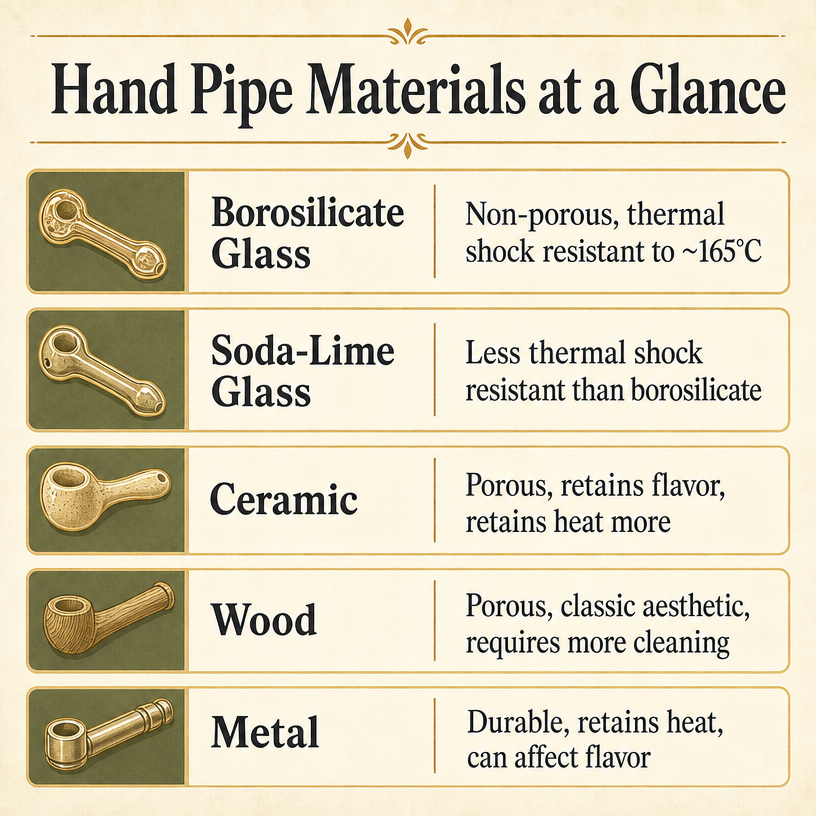
- Borosilicate glass — non-porous, thermal shock resistant to ~165°C, cleanest flavour, easiest maintenance
- Soda-lime glass — less expensive, less thermal shock resistant, more prone to cracking
- Ceramic — porous, retains flavour, retains heat, classic aesthetic
- Wood — porous, classic look, absorbs oils, requires more frequent cleaning
- Metal — highly durable, retains heat, can affect flavour, travel-friendly
- Stone — dense and durable, retains heat, porous, needs regular cleaning
Borosilicate glass is the material of choice for quality hand pipes. It is non-porous, meaning it does not absorb oils or flavours between sessions, and it can withstand temperature shocks of around 165°C without cracking. [6] [7] This thermal resistance makes it the most durable glass option for smoking accessories. If you want the cleanest flavour and the easiest maintenance, borosilicate glass is the standard to look for.
Soda-lime glass is less expensive than borosilicate but also less resistant to thermal shock. [7] It can still be used for hand pipes, but it is more prone to cracking if exposed to sudden temperature changes. For everyday use, borosilicate is the more practical choice.
Ceramic pipes have been used for centuries and offer a unique aesthetic. Because ceramic is slightly porous, it can retain flavours from previous sessions, which some users enjoy but others find undesirable. [4] Ceramic also retains heat more than glass, which can affect how the pipe feels during a session.
Wood pipes offer a classic, natural look and have a long history in smoking culture. Like ceramic, wood is porous, which means it absorbs oils and requires more frequent cleaning to maintain flavour quality. [4] Wood pipes are best suited for occasional use rather than daily sessions.
Metal pipes are highly durable and resistant to damage from drops or impacts. However, metal retains heat more than glass or ceramic, and some users report that metal can affect the flavour of smoke. [4] Metal is a practical choice for travellers or anyone who needs a pipe that can withstand rough handling.
Stone pipes — often made from materials like soapstone — are dense, durable, and offer a unique smoking experience. Stone retains heat well, which can lead to a warmer smoke. Like wood and ceramic, stone is porous, so regular cleaning is important to keep the flavour fresh.
Browse Glass Hand Pipes to explore related options.
What Does a Carb Hole Do on a Hand Pipe?
The carb, short for carburetor, is one of the most important functional parts of a hand pipe. It is a small hole on the side of the pipe that you cover and uncover while smoking to control airflow. Understanding how it works will make you a better judge of different pipe styles.
- Cover the carb hole before lighting and while inhaling to restrict airflow and draw smoke through the stem
- Release the carb hole when you want fresh air to rush in and clear remaining smoke from the chamber
- Not all pipes have a carb — chillums are an example of a pipe style that relies on direct inhalation with no carb hole
When you light material in the bowl and start inhaling without covering the carb, air enters primarily through the bowl, which can create a weak or uneven draw. Covering the carb hole while you inhale restricts the airflow path and forces air to flow through the material in the bowl, drawing smoke up the stem and out the mouthpiece. [8] This is the standard technique for smoking any carb-style pipe.
When you are ready to clear the remaining smoke from the chamber, you release your finger from the carb hole. This lets fresh air rush into the pipe from the carb opening, sweeping the last bit of smoke up and out through the mouthpiece. [8] This step ensures you get the full effect of the material you packed.
Not all hand pipes have a carb. Chillums, for example, are straight tube pipes with no carb hole. On a chillum, you pack one end and inhale directly from the other. There is no carb to cover or uncover — the airflow is controlled entirely by how you inhale. This makes chillums simpler to use but also means you have less control over the draw compared to a carb-style pipe.
If you are shopping for a hand pipe and want to know whether it has a carb, look for a small hole on the side of the stem, between the bowl and the mouthpiece. If the pipe has no hole in that area, it is likely a chillum-style or carb-less design.
How Do You Choose the Right Hand Pipe?
With so many styles and materials available, choosing the right hand pipe can feel overwhelming. Rather than trying to find the one perfect pipe, it helps to think about your priorities and how you plan to use it. Here is a practical checklist to work through before you buy.
- Portability — one-hitters and small spoon pipes for travel; larger pipes for home
- Discreteness — chillums and one-hitters for subtle use; larger pipes for home display
- Bowl size — small bowls for solo, controlled sessions; large bowls for sharing
- Ease of cleaning — straight tubes clean more easily than curved stems
- Budget — glass pipes from quality brands offer the best value; free shipping on orders $150+ at Treehouse Lifestyle
Portability matters if you plan to take your pipe on the go. One-hitters are the most portable option — small enough to fit in a pocket, often stored in a matching dugout case. Spoon pipes and Sherlock pipes are compact but less discreet. Steamroller pipes, with their open-ended design, are generally better suited for home use.
Discreteness is a priority for some users. If you need something subtle, a chillum or one-hitter is less conspicuous than a large spoon pipe or a Sherlock. Some one-hitters are designed to look like everyday objects, adding an extra layer of subtlety.
Bowl size determines how much material you pack per session. Larger bowls hold more and are better for sharing or longer sessions. Smaller bowls are ideal for solo use or when you want to control your portion size precisely.
Ease of cleaning depends partly on the material and partly on the pipe shape. Straight tubes like chillums and steamrollers are easier to clean through than curved pipes like Sherlock pipes, which have more hard-to-reach surfaces. Glass pipes can be soaked in cleaning solution without damage, whereas some materials require more care.
Budget is always a factor. Hand pipes range from inexpensive basic models to high-end artisan pieces. Borosilicate glass pipes from established brands tend to offer the best balance of quality and value. Treehouse Lifestyle offers free shipping on orders $150+, so you can stock up on accessories and save on delivery costs.
Flavour preference plays a role too. If you want the cleanest possible taste and the easiest maintenance, a borosilicate glass pipe is the best choice. If you enjoy the ritual of cleaning and appreciate a more characterful smoke, wood or ceramic pipes offer a different experience.
Read What Is a Bong and How Does It Work? for more detail.
How Do You Clean and Maintain a Hand Pipe?
A clean hand pipe makes a noticeable difference in flavour and overall smoking experience. Residue buildup — often called reclaim — can clog the stem, affect the taste of your sessions, and make the pipe harder to use over time. Here is a step-by-step process for keeping your pipe in good condition.
- Disassemble the pipe and remove any screens or filters
- Soak in isopropyl alcohol and coarse salt for several hours or overnight
- Scrub the bowl, stem, and carb area with a pipe brush or toothbrush
- Rinse thoroughly with warm water until the water runs clear
- Allow the pipe to air dry completely before reassembling
First, disassemble the pipe if it has removable parts. Some spoon pipes and Sherlock pipes have bowls that can be unscrewed, which makes cleaning much easier. Remove any screens or filters as well.
Second, prepare a cleaning solution. The most common approach is to use isopropyl alcohol (at least 90%) combined with coarse salt. The alcohol dissolves residue while the salt provides friction to scrub away buildup. You can also use commercially available pipe cleaning solutions designed for smoking accessories.
Third, seal the pipe openings with caps or rubber plugs if available, then place the pipe in a resealable bag or container with the cleaning solution. Let it soak for several hours or overnight for best results, especially if the pipe has heavy buildup.
Fourth, after soaking, shake the pipe gently or use a pipe cleaning brush to scrub the bowl, stem, and carb area. A thin brush designed for pipes or a soft-bristled toothbrush works well for reaching small areas. Be careful with glass pipes — they are durable but can chip if you use excessive force.
Fifth, rinse the pipe thoroughly with warm water to remove all traces of cleaning solution. Any remaining alcohol or residue can affect the flavour of your next session. Rinse until the water runs completely clear.
Sixth, let the pipe air dry completely before reassembling and using it again. Place it on a clean surface with good airflow. Using a pipe before it is fully dry can cause steam or moisture issues inside the stem.
Cleaning frequency depends on how often you use the pipe. With regular use, aim to clean your hand pipe at least once a week. If you notice visible residue buildup, darker smoke, or a change in flavour, it is time for a clean. Pipes used daily may need cleaning more frequently.
Browse Cleaning Supplies to explore related options.
What Are Common Questions About Smoking Accessories?
What is the most common type of hand pipe?
The spoon pipe is the most widely used hand pipe style. It features a bowl, a straight or slightly curved stem, and a carb hole on the side. Its familiar shape and easy-to-use design make it the default choice at most smoke shops.
What is the difference between a chillum and a spoon pipe?
A chillum is a straight tube pipe with no carb hole. You pack one end and inhale from the other. A spoon pipe has a bowl, a stem, and a carb hole that controls airflow. Chillums are typically more discreet and deliver a direct, unfiltered hit.
What is a Sherlock pipe?
A Sherlock pipe has a distinctive U-shaped or curved stem that cools smoke before it reaches the mouthpiece. The curved design also makes it more comfortable to hold and smoke from. Sherlock pipes are popular for both their function and classic aesthetic.
What is a one-hitter pipe?
A one-hitter is a small cylindrical tube designed to hold enough herb for a single inhalation. They are often paired with a dugout case for discreet portability. One-hitters are favored by people who want a minimal, travel-friendly option.
What material is best for a hand pipe?
Borosilicate glass is generally considered the best material for quality hand pipes. It is non-porous, meaning it does not absorb oils or flavours between sessions, and it can withstand temperature shocks of around 165°C without cracking. Ceramic, wood, and metal each have their own characteristics, but glass offers the cleanest flavour and easiest maintenance for most users.
How often should you clean a hand pipe?
A hand pipe should be cleaned at least once a week with regular use, or whenever residue buildup becomes visible. Cleaning involves soaking the pipe in isopropyl alcohol and salt, scrubbing the bowl and stem with a brush, and rinsing thoroughly with warm water.
What Hand Pipe Style Is Right for You?
Hand pipes come in more varieties than most people expect, and each style has its own strengths. Spoon pipes are the go-to choice for their simplicity and versatility. Sherlock pipes add a touch of classic style with a cooler smoke. Chillums offer a straightforward, carb-free experience. Steamrollers are for those who want a bold, unfiltered hit. One-hitters are the most portable option available. Hammer pipes bring stability and practicality to home setups.
Material matters too. Borosilicate glass is the best all-around choice for most people — it is durable, easy to clean, and delivers the cleanest flavour. If you prefer a more characterful aesthetic, ceramic, wood, and stone each offer a unique experience, though they require more maintenance.
Take some time to think about how and where you plan to use your pipe. Portability, discreteness, bowl size, and ease of cleaning are the factors that matter most for most people. Treehouse Lifestyle carries a wide selection of hand pipes across all major styles and materials, with free shipping on orders $150+. Browse the full range to find the pipe that fits your setup.
Where Does This Smoking Accessory Information Come From?
- Daily High Club: Weed Pipe Types: A Comprehensive Guide
- Chameleon Glass: Your Guide to the Types of Glass Pipes
- It’s 4:20 Somewhere: Best Glass Hand Pipes In 2025: Spoon, Sherlock, Chillum & More Compared
- The Cave Smoke Shop: Introduction to Pipes
- The Utah Bee: Brief History and Guide to Cannabis Pipes
- Tank Glass: The Benefits of Borosilicate Glass in Smoking Pipes
- Glass Pipes Sourcing: Borosilicate vs Soda-Lime Glass: Which is Best for Pipes?
- GRAV: Carb