

A steamroller pipe is a straight, wide-bore dry hand pipe with a small bowl on the side and a large open carb hole at the end opposite the mouthpiece [1] [2]. To use one, cover the open end with your palm, light the bowl while drawing, and lift your palm so a rush of air clears the chamber in a single hit [1] [4].
What Is a Steamroller Pipe and How Is It Shaped?
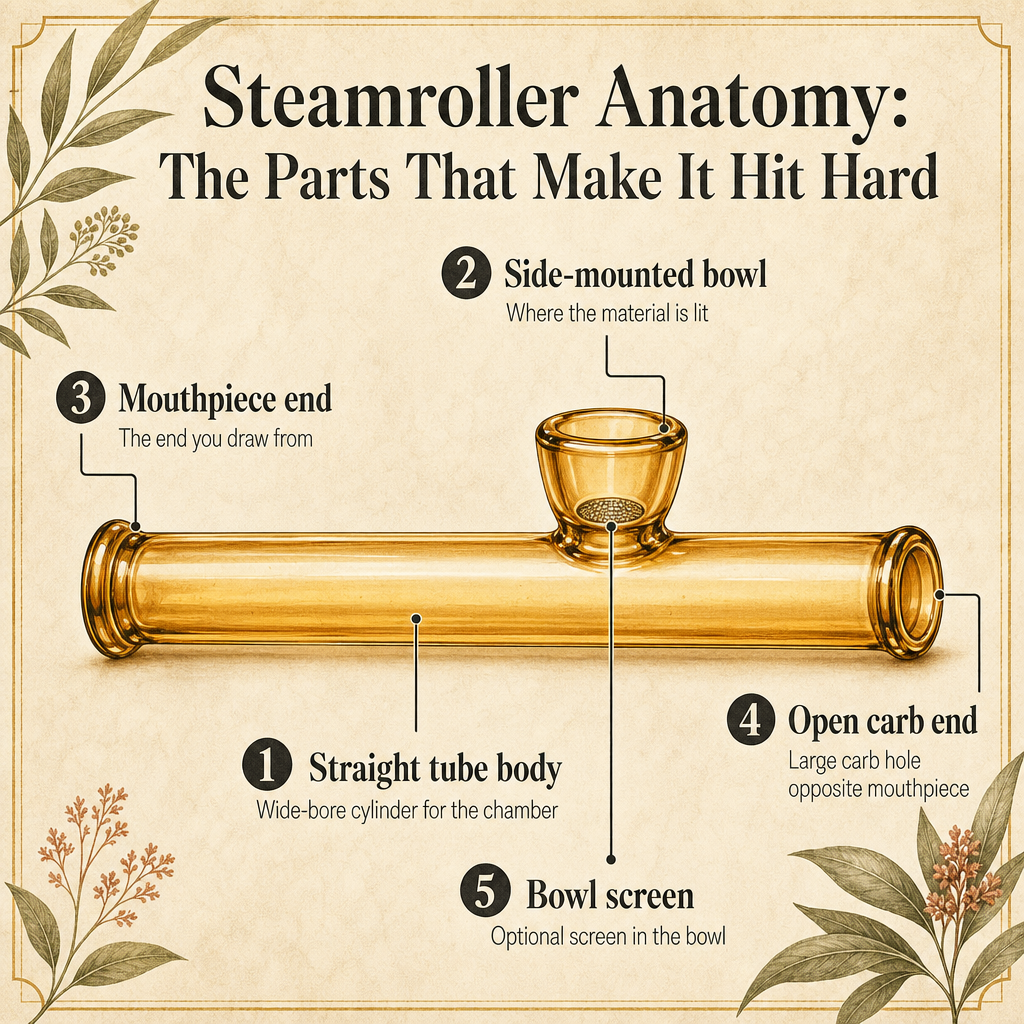
A steamroller is a straight, wide-bore tube with a bowl that sits on the side of the tube rather than at the end. One end of the tube is the mouthpiece, the bowl is mounted partway along the tube, and the far end is left wide open as a carb hole. That open end is the most important part of the design, because the size of that hole is what lets a steamroller clear in a single draw instead of several [1] [4].
Most steamrollers are made from a single piece of tubing with the bowl fused onto the side. The tube itself is usually a few inches longer than a spoon pipe, with a noticeably wider inner diameter. That wider inner diameter is the chamber that fills with smoke before you clear it. A few designs add small extras such as a built-in kickstand on the carb end so the pipe can rest on a flat surface without rolling, or a removable screen that sits inside the bowl to keep small bits from being pulled through [2].
If you compare a steamroller to a sherlock, the shape difference jumps out fast. A sherlock has a curved neck and a small bowl at the end, while a steamroller is straight, longer, and open on one side. You can read more about that curved shape in our guide to What Is a Sherlock Pipe and How Does the Curved Shape Work?. The straight-and-open design is what gives the steamroller its reputation as one of the bigger-hitting hand-pipe styles on the shelf [1] [3].
Because the tube is straight rather than curved, you can also see the chamber fill with smoke through the glass when the carb is covered. That visual cue is part of why the style is so recognizable: you can watch the chamber go from empty to full in a second or two and know exactly when to lift your palm. A spoon or chillum hides most of the chamber inside the body of the pipe, so the steamroller is a friendlier shape for first-time users who want to see what is happening inside the piece before they take the hit.
Length varies between makers, but most retail steamrollers run somewhere between four and eight inches end to end, with a tube diameter wide enough that you can see straight down the barrel. Shorter pieces are easier to carry and store; longer pieces hold a bigger chamber and produce a fuller one-draw clear. Either way, the proportions are what matter — a longer tube with a narrow bore is not really a steamroller, it is just a longer spoon. The wide bore is the defining trait.
- Straight tube body: a wide-bore cylinder that holds the smoke chamber.
- Side-mounted bowl: a small bowl fused to the side of the tube where material is lit.
- Mouthpiece end: the closed end of the tube that you draw from.
- Open carb end: the wide open hole at the far end that controls the hit.
- Bowl screen (optional): a small metal or glass screen placed inside the bowl to block debris.
How Does a Steamroller Pipe Work During a Hit?
A steamroller hits differently from most hand pipes because the carb is the open end of the whole tube, not a small side hole. The technique is a simple cover-light-clear sequence that lets you fill a wide chamber with smoke and then pull it all out in one breath. The order of the steps matters, because covering and uncovering the open end is what controls when the smoke actually moves [1] [2].
If you are new to this style of pipe, our guide on What Are Hand Pipes and Bubblers, and How Do They Differ? covers how hand pipes differ from each other, and our piece on What Are the Different Types of Hand Pipes? lines up the main dry-pipe shapes side by side. For a deeper look at how chamber size affects a hit, our piece on percolator bongs What Is a Percolator Bong and How Does It Work? explains airflow ideas that carry over to any dry piece [4].
Once you have done the cover-light-clear sequence a few times, it becomes second nature. The wider and more open the carb, the more air rushes in when you lift your hand, and the faster the chamber empties. That is also why steamrollers are usually described as a more forceful dry-pipe experience than a spoon or a chillum, which is worth knowing if you have never used a hand pipe before [1] [2] [4].
A small adjustment that helps a lot is the speed of your draw. If you pull slowly while the carb is covered, the chamber fills more completely and you take in a larger volume from a single clear. If you pull more gently, less smoke collects in the tube and the hit is shorter and easier to handle. Most new users find that a slower draw at the start of the session and a steadier pace later on is the easiest way to settle into the rhythm. The bowl itself does not need to be packed full — a small, even layer across the screen is plenty for a single clean clear, and it leaves less ash to clean out of the side bowl afterward.
Because the open carb end is bare glass (or whatever material the pipe is made from), it can get warm during a session. New users sometimes rest that end against a table or a tray between draws, which is fine, but it is worth giving the piece a moment to cool between bowls if you have been drawing for a while. Letting the pipe cool for even thirty seconds between hits keeps the chamber from getting uncomfortably hot and also lets residue firm up a bit, which makes the next tap-out easier.
- Pack the side bowl with a small amount of ground material. Do not pack it tightly, since you want airflow through the bowl.
- Cover the open carb end at the far side of the tube with the palm of your hand. This seals the chamber so smoke builds up inside.
- Place your mouth on the mouthpiece end and begin a slow draw while lighting the bowl with a lighter or hemp wick.
- Keep drawing for a second or two after lighting so smoke fills the wide tube, then lift your palm off the carb end.
- The sudden rush of air pulls the smoke out of the chamber in one draw — clear the rest of your lungs before exhaling.
- Tap out the ash from the side bowl, blow gently into the mouthpiece to clear any loose bits, and the pipe is ready for the next bowl.
What Materials Are Steamroller Pipes Commonly Made From?
Steamrollers show up on shelves in a handful of materials, and the material usually affects weight, price, and how careful you need to be with the piece. Glass is the most common retail option, but you will also see acrylic, ceramic, wood, and metal versions from different makers. Each material has a slightly different feel in the hand and in use [2] [1].
When a steamroller is labeled as glass, it is almost always borosilicate glass. Borosilicate is the standard glass used for hand pipes because it is harder to break on impact and more resistant to cracking from temperature changes than soda-lime glass, which is the glass used for most household bottles and jars [5]. That thermal-shock resistance is why a borosilicate pipe can go from a flame on the bowl to a normal room-temperature rinse during cleaning without cracking as easily as a cheap soda-lime piece.
If you want to browse what is available in this shape, the Treehouse Lifestyle Steamrollers Steamrollers page collects the current options in one place. Material is one of the biggest things that separates one steamroller from another on a shopping page, so it pays to know the trade-offs before you pick one [2] [1].
- Glass (borosilicate): the most common retail material; clearer taste of the material; heavier; can break if dropped.
- Acrylic: light, inexpensive, and tough to crack; can cloud over time with use and cleaning; not as clear as glass.
- Ceramic: heavier than glass with thicker walls; holds heat longer; can chip if knocked against hard surfaces.
- Wood: warm in the hand and very durable; usually paired with a metal or glass bowl insert; needs a different cleaning routine than glass.
- Metal: nearly unbreakable in normal use; the lightest feel; the chamber can heat up faster during long sessions.
How Does a Steamroller Compare to a Spoon, Chillum, or Sherlock?
Steamrollers, spoons, chillums, and sherlocks are all dry hand pipes, but they are designed around very different airflow ideas. Manufacturers list steamroller as its own hand-pipe subtype alongside spoons, chillums, sherlocks, one-hitters, and drop-head or drooper pipes, so the shape is classified as a distinct category rather than a small variation [3].
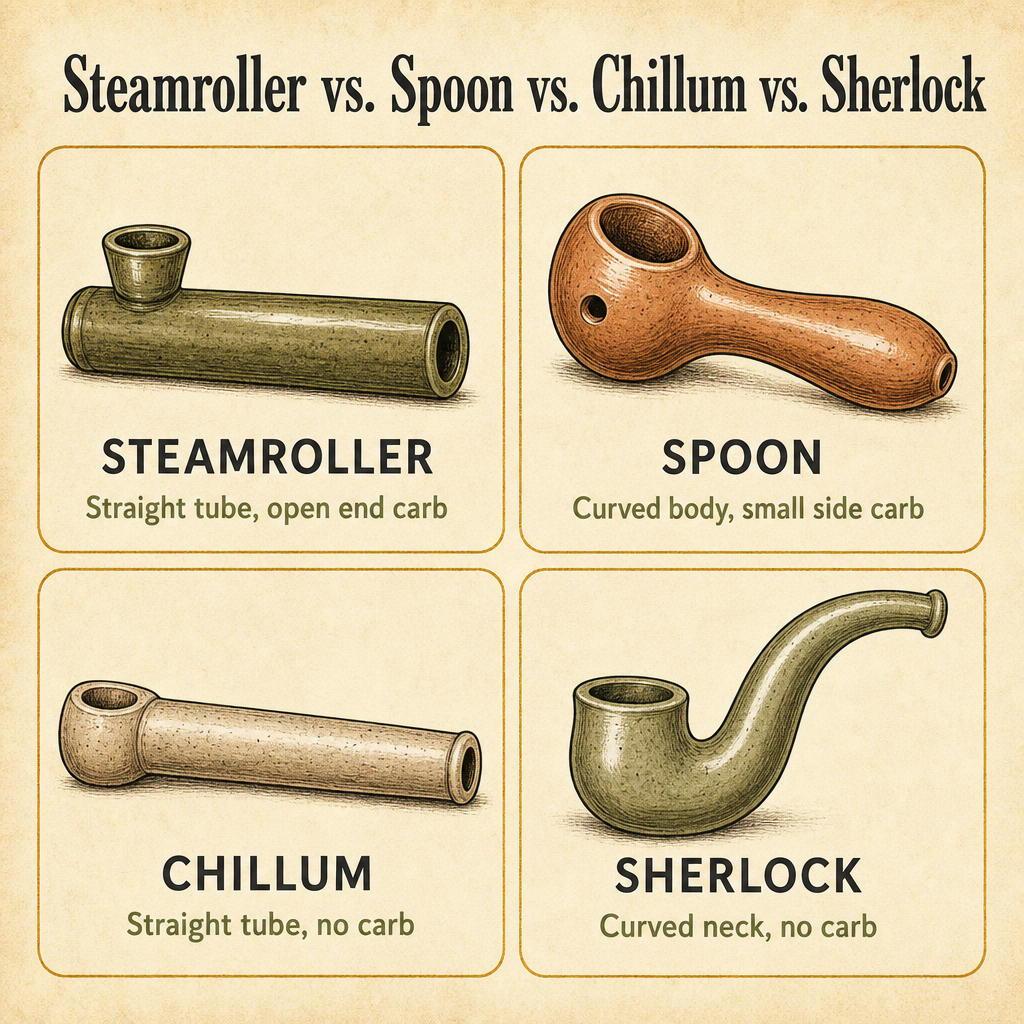
The biggest difference between a steamroller and the others is what sits at the open end of the chamber. A steamroller has a wide open carb hole on one side. A spoon has a small side carb that is barely larger than a pencil eraser. A chillum has no carb at all, so you clear it by pulling harder or by taking the piece off your lips. A sherlock usually has no carb either, and adds a curved neck that cools the smoke a bit more than a straight tube [1] [4].
Because the steamroller carb is so wide, more air travels freely through the pipe when you release it, and the chamber is easier to fill and clear in a single draw. That is also why steamrollers are usually described as drawing with more force than spoons or chillums, and as a less gentle starting point for a first hand pipe. If you want a smaller, gentler first piece, a chillum or a spoon is generally the easier starting point [1] [2] [4].
- Steamroller: straight tube, wide-bore chamber, and a large open carb at the end opposite the mouthpiece.
- Spoon: small curved body with a tiny side carb near the bowl; smaller chamber than a steamroller.
- Chillum: short straight tube with the bowl at one end and the mouthpiece at the other; usually no carb at all.
- Sherlock: long curved neck with a bowl at the far end; usually no carb; the curve cools the draw a bit.
- One-hitter: very small straight pipe sized for a single small serving; no carb; meant for short, controlled draws.
| Style | Shape | Carb | Chamber size | Draw feel |
|---|---|---|---|---|
| Steamroller | Straight tube | Large open end | Wide | Full, one-draw clear |
| Spoon | Curved body | Small side hole | Small | Shorter, more controlled |
| Chillum | Short straight tube | None | Small | Quick, no clear step |
| Sherlock | Curved neck | None | Medium | Slightly longer path |
How Do You Clean a Steamroller Pipe and Keep It Tasting Fresh?
Steamrollers need a routine cleaning pass because the wide tube gives residue a lot of surface to stick to. The good news is that the cleaning method is the same one used for most glass hand pipes, and it only takes a few common supplies. Doing it regularly keeps the airflow open and keeps the inside of the tube from getting a stale smell [2].
The supplies are simple: warm water, isopropyl alcohol (the higher the percentage the better), coarse salt, and pipe cleaners or cotton swabs. A small stopper or piece of paper towel can also help seal the carb end during a soak. The same steps work on a glass or acrylic steamroller; wood and metal pieces usually need a gentler routine and a different solvent, so check the maker’s care notes first [2].
For between-session upkeep, a quick tap-out of the bowl and a short rinse with warm water keeps residue from building up in the first place. That habit is especially helpful with steamrollers because the wide tube holds more air, and any leftover ash or moisture can affect the next draw. If you are also shopping for a smaller dry pipe to rotate between sessions, the Treehouse Lifestyle Chillums Chillums page has the current small-format options.
If the tube starts to feel like airflow is getting weaker even after a routine clean, the most common cause is a thin film of residue on the inside of the glass that the pipe cleaners did not fully remove. Soaking the piece overnight in the alcohol-and-salt mix usually fixes that without any scrubbing. For really stubborn buildup, a thin bottle brush can reach the corners where the side bowl meets the tube, which is where residue tends to settle first. The bowl itself is the easiest part to clean — a cotton swab dipped in alcohol takes care of it in under a minute.
It is also worth doing a quick visual check of the bowl screen (if your pipe has one) every few sessions. A clogged screen makes draws feel weaker because air is fighting to get through, and it also lets small bits of material fall into the chamber where they are harder to reach with a pipe cleaner. Replacing a screen takes a few seconds and restores the airflow back to what it was on day one.
- Empty the bowl and give the pipe a quick tap to knock out loose ash.
- Rinse the whole piece with warm water to wet the inside of the tube and the bowl.
- Pour a mix of isopropyl alcohol and coarse salt into the tube, then plug the mouthpiece and the open carb end with stoppers or paper towel.
- Let the pipe soak for at least 30 minutes so the mix can break down residue on the inside walls.
- Use pipe cleaners or cotton swabs to scrub the bowl and the inside of the tube, pushing all the way through to the carb end.
- Rinse the pipe again with warm water until the water runs clear and there is no alcohol smell left.
- Set the pipe upright on a clean towel and let it air dry completely before the next use.
Who Is a Steamroller Pipe a Good Fit For?
A steamroller is a good fit when you want a wide, one-draw clear and you are comfortable with a more forceful pull. It is less of a fit if you have never used a dry pipe before, if you want small controlled draws, or if you want a piece you can toss in a bag without much worry. Thinking through your experience level and your draw preference up front saves you from buying a piece that is the wrong shape for how you actually use it [1] [2].
Material matters here too. A borosilicate glass steamroller is the most common retail option and is the easiest to clean with the routine in the previous section, but it can break if dropped. An acrylic or metal steamroller is tougher but heavier in the hand or in the bag, depending on the build. Pick the material that fits how and where you plan to use the piece [2] [5].
If you want a starter set rather than a single piece, the Treehouse Lifestyle Hand Pipe Bundles Hand Pipe Bundles page groups several dry-pipe styles together so you can compare a steamroller against a spoon, chillum, or sherlock in one order. Treehouse Lifestyle ships with free shipping on orders $150+, so bundling is a common way to get a couple of shapes at once. The right fit comes down to your draw preference, your experience level, and how much care you want to put into cleaning [1] [3] [4].
- Experience level: a steamroller is generally better for someone who has used a dry pipe before; new users often do better starting with a spoon or chillum.
- Draw preference: if you want a one-draw clear and a fuller chamber, a steamroller fits; if you want smaller, slower draws, pick a chillum or a spoon.
- Session length: steamrollers are built for short, decisive sessions rather than long, slow ones, because the wide chamber empties in one breath.
- Material preference: glass (borosilicate) is the standard; acrylic, ceramic, wood, and metal are the alternatives with different weight and durability trade-offs.
- Storage and travel: a glass steamroller needs a padded case for travel; acrylic and metal travel more easily; ceramic and wood fall in between.
Frequently Asked Questions
What is a steamroller pipe?
A steamroller is a dry hand pipe shaped as a straight cylindrical tube with a small bowl mounted on the side of the tube and a large open carb hole at the end opposite the mouthpiece. It is sold alongside spoons, chillums, sherlocks, one-hitters, and drop-head or drooper pipes as its own hand-pipe subtype.
How does a steamroller pipe work?
You pack the side bowl, cover the open carb end with your palm, light the bowl while drawing, and then lift your palm so a sudden rush of air pulls the collected smoke out of the wide chamber in a single hit.
What does the carb hole on a steamroller do?
The carb hole is a large open hole at the end opposite the mouthpiece. Covering it builds up smoke in the tube; uncovering it pulls a sudden burst of air through the chamber so the smoke leaves in one draw. It is much larger than the side carb on a spoon-style pipe, which is why steamrollers clear in a single hit.
What materials are steamroller pipes made from?
Steamrollers are typically offered in glass, acrylic, ceramic, wood, and metal. Glass is the most common retail variant, and borosilicate glass is the standard glass used for hand pipes because it is harder to break on impact and more resistant to thermal-shock cracking than soda-lime glass.
Is a steamroller pipe good for beginners?
Steamrollers are usually described as less suited to beginners and to anyone who prefers milder draws because the wide bore and large open carb let a larger chamber of smoke be inhaled at once. Smaller-bore shapes like a chillum or a spoon are generally the easier starting point.
How do you clean a steamroller pipe?
Routine cleaning is done by rinsing with warm water, soaking in isopropyl alcohol mixed with coarse salt, scrubbing the bowl and tube interior with pipe cleaners or cotton swabs, rinsing again, and air drying before the next use.
Is a Steamroller Pipe the Right Shape for You?
A steamroller is a straight, wide-bore dry pipe with a side bowl and a large open carb at one end, and that single design choice is what defines the whole experience. Cover the open end, light the bowl, lift your palm, and the wide chamber clears in one breath — which is exactly what makes the style both distinctive and a bit much for a first hand pipe.
If you want a fuller one-draw clear, prefer borosilicate glass for taste and cleaning, and do not mind a heavier piece, a steamroller is a solid pick. If you would rather start with something smaller and more forgiving, a chillum or a spoon is the easier place to begin. Browse the current shapes, compare materials, and choose the one that matches how you actually want to use it.
Sources
- Hemper: Types of Hand Pipes: Your Guide to Smoother Hits
- Zen Leaf Dispensaries: What is a Steamroller Pipe and How Does It Work?
- Chameleon Glass: Steamroller Glass Pipes
- High Times: 10 Best Steamrollers Of 2017
- Wikipedia: Borosilicate glass