

Choosing a hand pipe comes down to matching shape, size, material, and travel features to how you actually plan to use it. Compare spoon, one-hitter, chillum, Sherlock, steamroller, and bubbler styles for comfort and packability, then check origin, destination, and carrier rules before any trip. Federal law defines paraphernalia by intended use, and TSA leaves the final checkpoint call to the officer on duty. [1] [4] [5]
What Are the Main Shapes of Hand Pipes You Can Buy?
Hand pipes come in a handful of well-known shapes, and each shape changes how the pipe feels in the hand, how easy it is to pack, and how much material it can hold. The names you see on a shop page are useful starting points, but naming is not standardized across makers, so the actual shape and features matter more than the label alone. [1]
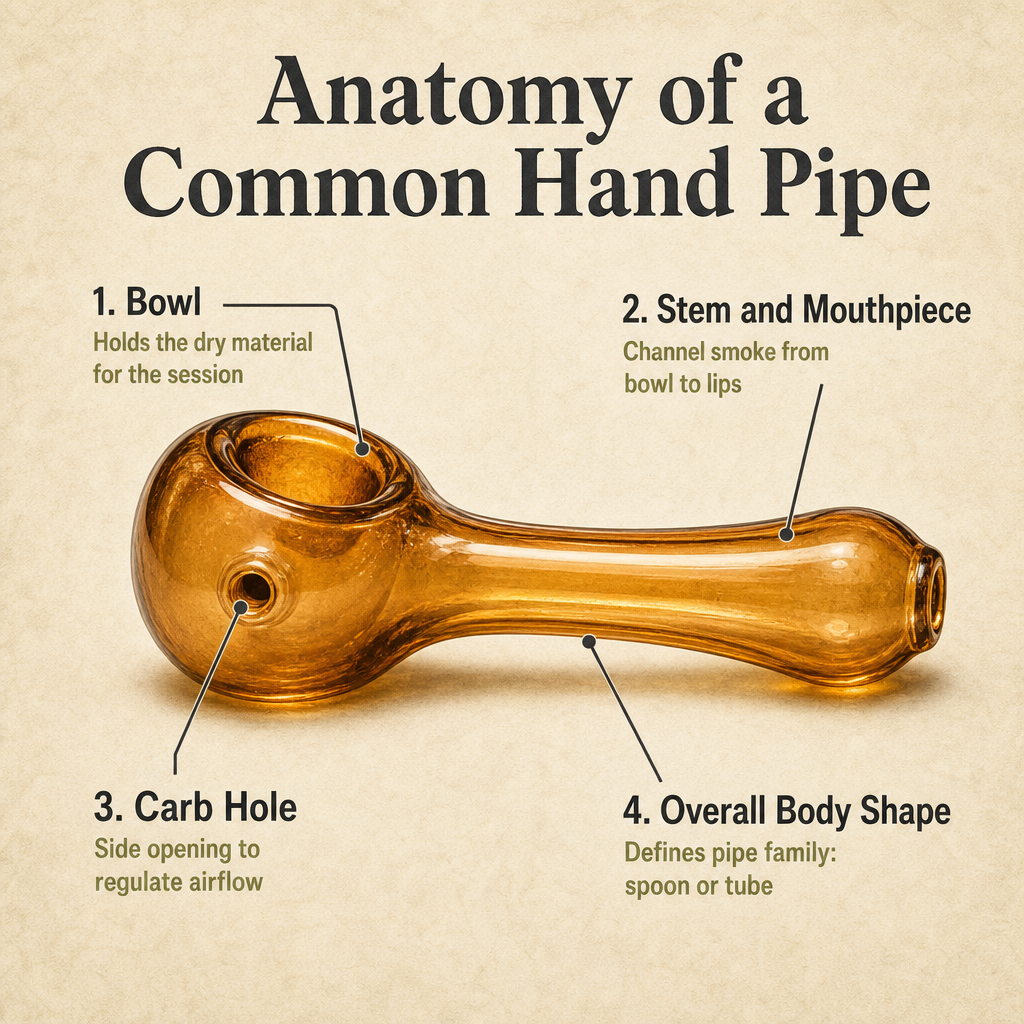
Spoon pipes are the most common. They have a small bowl on one end, a curved or straight stem, and often a side carb hole used to control airflow. One-hitters and chillums are typically small straight tubes. Because the two terms are sometimes used interchangeably, it helps to compare the actual shape and bowl size rather than rely on the wording on a product page. [1]
Sherlock pipes are identified by a longer curved shape, while steamrollers are generally cylindrical and combine tube-like form with high-airflow features. These larger or more exposed forms may be less convenient to pack than compact spoons or one-hitters. A bubbler is a handheld water pipe with a fixed bowl and water chamber, so it adds water handling and cleaning needs that a dry hand pipe does not have. [1]
Each shape works best for a different setting. A compact spoon or a short one-hitter is the easiest to slip into a jacket pocket for a quick walk. A longer Sherlock or a steamroller is better suited to a coffee table than a carry-on. A bubbler asks for a steady surface and a few minutes of water setup, which makes it more of a stay-at-home piece than a grab-and-go one. If you’d like to browse the full range of current hand-pipe shapes in one place, the Hand Pipes category page groups everything by family. For a smaller curved option that travels well, a 4-inch piece like the Grav Labs Mini Sherlock – 25mm/4" – Colors Vary shows how compact a Sherlock-style design can get.
- Spoon pipe: small bowl plus a stem, often with a side carb hole; the most common shape and easy to replace if broken.
- One-hitter or chillum: a small straight tube that holds a single serving; check the actual shape since the naming is not universal.
- Sherlock pipe: a longer curved shape inspired by the classic fictional pipe; usually larger than a spoon.
- Steamroller: a cylindrical tube-shaped pipe with high airflow; the larger, more exposed form is less convenient for travel.
- Bubbler: a handheld water pipe with a fixed bowl and water chamber; adds water handling and a different cleaning routine than a dry pipe.
What Materials Are Hand Pipes Made From and How Do They Compare?
Hand pipes are sold in glass, metal, wood, and other materials, but material alone does not decide whether a pipe is right for a shopper. Construction, shape, cleanability, replacement parts, and intended use should be compared together, because the same material can feel very different from one piece to the next depending on thickness, weight, and how the maker has shaped it. [1] [4]
Glass is the most common material in modern hand pipes. Borosilicate glass has low thermal expansion and notable resistance to thermal shock compared with many ordinary glasses, but it is still glass and should be protected from impact and abrupt temperature changes. The trade-off is visibility: you can see buildup inside the bowl and stem, which makes it easy to know when a clean is due. [3]
Metal hand pipes are typically durable and easy to carry. They tend to be the cheapest option in a shop, and they hold up better to drops than glass does. They also conduct heat from the body, so the outside can get warm during a long session, and they require a different cleaning routine than glass — a metal piece cannot be soaked in the same solvents without affecting the finish, and the inside cannot be inspected the way a glass bowl can.
Wood hand pipes offer a traditional look and a warm feel in the hand. They tend to be more forgiving of small drops than glass, and the material ages into a patina with use. They also need their own cleaning rhythm — alcohol and other harsh solvents can dry out the wood, and a wood bowl is usually emptied and lightly cleaned rather than soaked. Over years, the inside of a well-used wood pipe can change character as the wood seasons, which some owners prefer and others do not.
Because every material has trade-offs, a side-by-side comparison is a direct way to see which one fits your routine. The Treehouse Lifestyle article on What Are Hand Pipes and Bubblers, and How Do They Differ? walks through the main differences, and the deeper Glass vs Silicone vs Wood vs Metal Pipes: Which Material Is Best? comparison breaks down glass, silicone, wood, and metal in detail. For a closer look at packing glass on the road, the How Do You Protect Glass Accessories While Traveling? guide covers the practical travel steps.
A quick decision rule: if you want to see buildup and clean with the widest range of supplies, glass is the easy default. If you want something that survives drops in a backpack, metal is the practical pick. If you want a warm-in-the-hand feel and a piece that ages with you, wood is worth a look. None of the three is a universal winner — the right pick is the one that matches how you actually use it.
- Glass: lets you see buildup, and the most common modern material; borosilicate resists thermal shock but is still breakable on impact.
- Metal: durable and easy to carry, often the cheapest option; the body can run hotter and cleaning takes different supplies than glass.
- Wood: a traditional look and warm feel in the hand, with some natural give if dropped; needs its own cleaning rhythm and may wear over time.
- Material alone does not decide fit: construction, shape, cleanability, and intended use should be compared together.
| Material | Durability | Cleaning | Heat Handling | Typical Price |
|---|---|---|---|---|
| Glass (borosilicate) | Breakable on impact, resistant to thermal shock | Easy — alcohol soak, brush, visible buildup | Holds heat at the bowl only | Low to mid |
| Metal | High impact resistance | Different supplies than glass; no alcohol soak | Body conducts heat during long sessions | Low |
| Wood | Forgiving of small drops | Light cleaning only; no harsh solvents | Warm in the hand; bowl needs care | Mid |
What Size Hand Pipe Should You Pick for Your Routine?
Pipe size is really a question about how much you want to load at once, how portable the pipe needs to be, and how it feels in your hand. A small one-hitter is built for a single serving per session, while a spoon with a larger bowl holds more and serves a longer sit-down. Steamrollers and full-size Sherlock designs are larger still and skew toward home use because they take up more space in a bag. [1]
For solo sessions, a shorter pipe often feels quicker and easier to manage. The lighter weight makes it comfortable to hold for a long evening, and the shorter air path means less time between bowl and draw. For groups, a pipe with a larger bowl or a thicker bowl wall can be more comfortable to pass around without reheating the same material. Heavier pieces can also tire the hand during a long session, so weight matters as much as length.
If you want a single piece that covers both home and travel, a compact spoon with a modest bowl is usually the most flexible choice. A standard spoon like the WIG WAG SPOON PIPE shows the typical size and weight range to expect from this style. Shorter pieces also fit more easily into protective sleeves and small travel cases, which is a useful tie-in with the travel features covered later in this guide.
Think about how you actually use a pipe. A small pipe that you refill often is fine for someone who likes short sessions. A larger bowl that you can finish in one go is fine for someone who sits down for longer evenings. There is no single right size — the right size is the one that matches your routine.
One more sizing check that buyers often skip: how the pipe sits on a flat surface. A piece without a flat base will roll every time you set it down, which becomes annoying fast and is a real reason to favor a design with an anti-roll base or a flat-bottomed spoon. A short test on a level table at the shop is worth a minute of your time before you commit.
- Match bowl size to session length: smaller bowls for short sessions, larger bowls for longer sit-downs or groups.
- Match overall length to where you’ll use it: shorter pipes travel easier, longer pipes stay home.
- Try the pipe in hand when possible: a piece that feels awkward to hold will be awkward to use.
- Pick weight that suits your routine: lower-weight pieces are easier for long sessions, heavier pieces feel more solid but tire the hand faster.
Which Travel Features Keep a Hand Pipe Intact in a Bag or Suitcase?
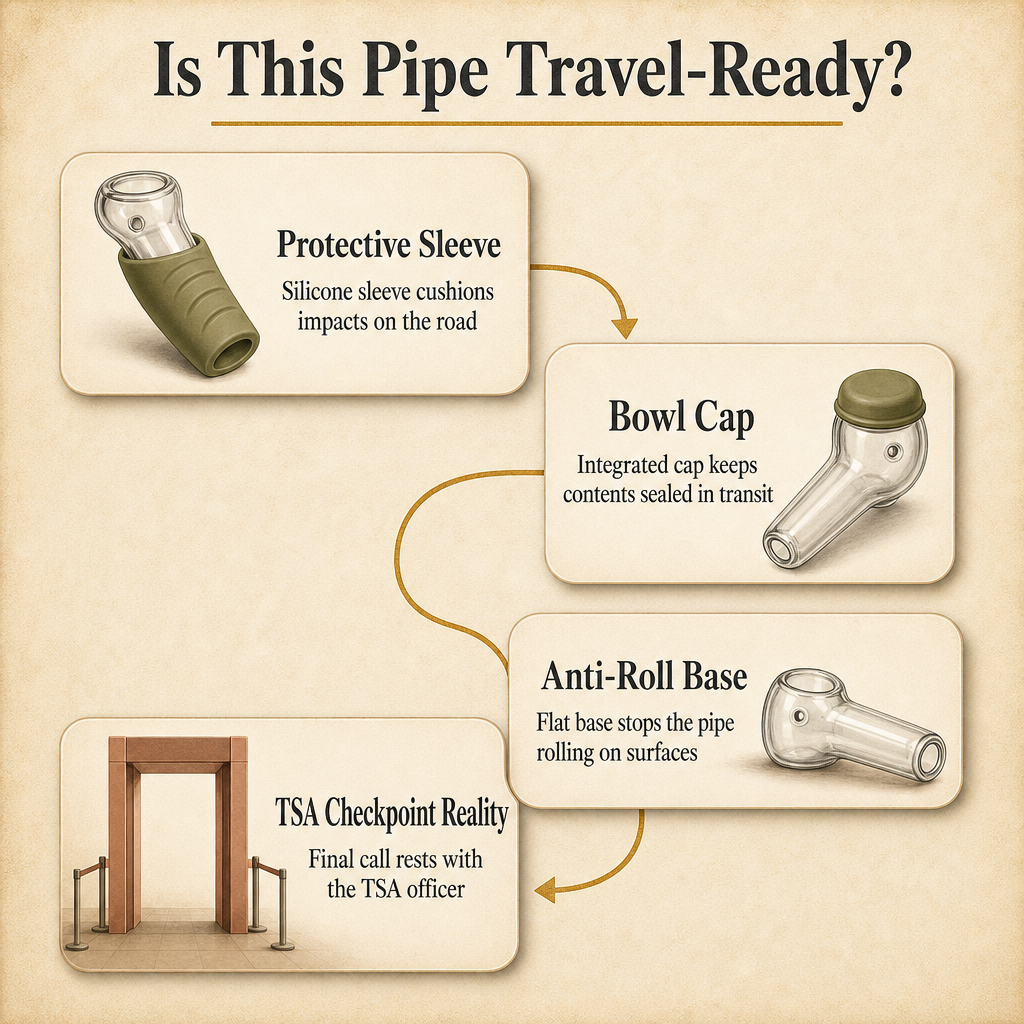
The travel features that matter most are the ones that shield the pipe from impact, keep its contents sealed, and stop it from rolling around on a hotel nightstand. Not every portable pipe includes them, so it helps to know which features to look for when you compare options. [2]
A removable silicone sleeve cushions the body against drops and adds grip without changing the way the pipe draws. An integrated bowl cap seals the contents so loose material does not spill into a backpack or a suitcase. A flat anti-roll base keeps the pipe from rolling off a table or a couch cushion. Modular construction, where the body comes apart into a small number of pieces, makes a deeper clean easier when you are away from home.
These features show up most in newer portable-pipe designs. One current manufacturer example uses a 2.5 mm borosilicate-glass body, a removable silicone sleeve, an integrated bowl cap, a flat anti-roll base, and modular construction — a useful checklist of what to look for, even if not every portable pipe includes all of them. [2]
Beyond the pipe itself, a small padded travel case or a fresh cloth wrap inside a hard case adds another buffer around the glass body. Cleaning supplies packed separately — cotton swabs, a small brush, a soft cloth — also make it easy to refresh the pipe between stops without needing a full kit at home.
A quick packing routine goes a long way: empty the bowl before you pack, drop the pipe into a sleeve or a padded pouch, then place the pouch in the center of a bag where other items cushion it on every side. Avoid letting the pipe rattle against keys, lighters, or hard edges — most in-transit damage comes from contact with other items, not from the bag itself being dropped.
- Removable silicone sleeve: cushions drops and adds grip without changing airflow.
- Integrated bowl cap: seals the contents so loose material does not spill in transit.
- Flat anti-roll base: keeps the pipe from rolling off tables or cushions.
- Modular construction: lets the body come apart for a deeper clean when you are away from home.
- Padded case or wrap: a small travel case adds another buffer around the glass body.
How Does a Spoon Pipe Compare to a One-Hitter, Chillum, or Bubbler?
The comparison most first-time buyers are actually trying to make is between a spoon, a one-hitter or chillum, and a bubbler. Each one handles a different kind of session, and the differences show up in the bowl, the air path, the cleaning needs, and how easy the pipe is to pack. [1]
A spoon pipe has a moderate bowl, a curved or straight stem, and often a side carb hole. The bowl is bigger than a one-hitter, the pipe is heavier in the hand, and the carb hole lets you control airflow at the end of a draw. A one-hitter is a small straight tube sized for a single serving, so loading is quick and the piece is easy to slip into a pocket. Chillums are similar to one-hitters in shape, though the names are sometimes used interchangeably, so check the actual size and features. [1]
A bubbler is a different category. It is a handheld water pipe with a fixed bowl and water chamber, so the air path passes through water before it reaches the mouthpiece. The draw behaves differently from a dry pipe, and the water changes between sessions, but the trade-off is that the user has to handle water, refill the chamber, and clean the piece on a regular schedule. It is not just a dry pipe with a splash of water; it is a different routine. [1]
If the goal is to keep things simple, a spoon or one-hitter is usually the easiest entry point. If the goal is a water-routed draw and the user is willing to manage water, a bubbler is worth considering. For a deeper look at the best starting piece for a first-time buyer, the What Is the Best Smoking Piece for a Beginner? guide walks through the same shapes and what each one asks of the user.
Two practical tie-breakers often decide between a spoon and a one-hitter: how often you want to reload, and how much you want to carry. A one-hitter is the smallest and lightest option, and it reloads after every draw, which can feel tedious over a long evening. A spoon holds a full bowl at a time and reloads after a longer stretch, but it takes up more pocket space. The right answer depends on the rhythm of the session you actually want.
- Spoon pipe: moderate bowl, stem, often a side carb hole; heavier in the hand, easy to find, simple cleaning routine.
- One-hitter or chillum: small straight tube sized for a single serving; most compact and pocket-friendly, fastest to load.
- Bubbler: handheld water pipe with a fixed bowl and water chamber; adds water handling and a deeper cleaning schedule.
- Packability: one-hitters and short spoons pack the easiest; bubblers and steamrollers need a small case and a steady surface.
| Feature | Spoon Pipe | One-Hitter / Chillum | Bubbler |
|---|---|---|---|
| Bowl size | Moderate, single bowl | Single serving | Fixed bowl, water chamber |
| Air path | Dry, with optional carb hole | Dry, short straight tube | Routed through water |
| Cleaning routine | Alcohol soak and brush | Quick alcohol soak | Water change plus chamber clean |
| Packability | Easy in a sleeve or pouch | Easiest — pocket-friendly | Needs a small case and steady surface |
| Best for | Solo or small-group sessions | Short solo sessions | Home use with water setup |
What Legal and Travel Rules Should You Check Before Taking a Pipe on the Road?
Legal and travel rules are layered, and each layer has to be checked separately. Federal law defines drug paraphernalia by intended or designed use and explicitly lists several pipe types and materials, so the legal status of any given pipe depends on context, jurisdiction, and use rather than the product name on a page. [4]
At airport security, TSA says screening focuses on security threats rather than searching for illegal drugs, but suspected illegal substances or evidence of criminal activity discovered during screening are referred to law enforcement, and the final checkpoint decision rests with the TSA officer. That makes the answer about bringing a hand pipe through an airport jurisdiction- and officer-dependent, not a clear yes or no. [5]
State and local rules add another layer. Federal law defines drug paraphernalia by intended or designed use and explicitly lists pipe types and materials in the statute, so what counts as paraphernalia in one state may be treated differently in another. [4] Taking cannabis-related items across state or national borders is illegal in many places, and property owners, hotels, and federal lands can have additional restrictions on top of state law. [6]
Carrier rules are a separate layer. Airlines, trains, and bus operators can have their own policies on accessories, and the rules at the destination may differ from the rules where you started. The Mini Bongs subcategory page is one place to compare designs if you plan to buy a smaller piece specifically for travel.
Practical steps before any trip: check the rules at the origin, at every jurisdiction you pass through, at the destination, at the carrier, and at any property where you will stay. A quick search the week of the trip is enough to catch rule changes.
Two extra notes that often catch travelers off guard. First, the rules can change between the time you buy a pipe and the time you travel with it, so an old habit may not match the current rule. Second, the legal status of the pipe itself is separate from the legal status of any material placed in it, and the two are enforced by different agencies under different statutes — both have to be in order for a trip to go smoothly.
- Federal layer: drug paraphernalia is defined by intended or designed use, and the statute lists specific pipe types and materials.
- TSA layer: screening focuses on security threats, suspected illegal items are referred to law enforcement, and the final call rests with the TSA officer.
- State and local layer: rules vary by state and city, and what counts as paraphernalia can change between jurisdictions.
- Property layer: hotels, rental properties, and federal lands can have additional rules on top of state law.
- Carrier layer: airlines, trains, and bus operators can set their own policies on accessories, separate from government screening rules.
Frequently Asked Questions
What type of hand pipe is easiest for a beginner to handle and clean?
A small spoon or one-hitter is usually easiest for a first-time buyer because the parts are simpler, the pipe has little weight, and there is no water chamber to manage — which keeps cleaning to a quick isopropyl alcohol soak rather than a full disassembly. Trying both shapes in hand, when possible, is more useful than relying on the label, since naming for one-hitters and chillums is not standardized across makers.
Do all hand pipes have a carb hole?
No — carb holes are a feature of some spoon-style designs used to regulate airflow, not a universal part. Shoppers who want a carb should check each pipe individually rather than assume it will be there.
Is a bubbler just a hand pipe with water?
A bubbler is a handheld water pipe with a fixed bowl and water chamber, which is a different maintenance routine than a dry hand pipe. The water changes the path of the draw, but it also means buyers should factor in water handling, refilling between sessions, and a deeper clean than a dry pipe requires.
Can you bring a hand pipe through an airport?
TSA states that screening focuses on security threats rather than searching for illegal drugs, but suspected illegal substances or evidence of criminal activity discovered during screening are referred to law enforcement, and the final checkpoint decision rests with the TSA officer. Travelers should view the answer as jurisdiction- and officer-dependent and plan around origin, destination, and carrier rules before flying with any accessory.
Does the material of a hand pipe change how it should be cleaned?
Yes. Glass and metal can usually be cleaned with isopropyl alcohol and a brush, while wood needs a lighter hand — harsh solvents can dry out the wood and shorten the life of the piece. The cleaning routine is part of the ownership cost of any material, so it is worth factoring in before you choose.
What’s the Best Way to Pick a Hand Pipe You Won’t Regret?
The best hand pipe is the one that fits the way you actually use it. Start with where you’ll use it most — at home or on the road — then narrow the shape down to spoon, one-hitter, chillum, Sherlock, steamroller, or bubbler based on bowl size, handling, and packability. From there, choose the material (glass, metal, or wood) by weighing durability, cleaning effort, and how the pipe feels in the hand, and look for travel features like a silicone sleeve, an integrated bowl cap, an anti-roll base, and modular construction if the pipe will leave the house.
For first-time buyers, a compact spoon or a one-hitter is the easiest place to start, and a bubbler is worth considering if you want a water-routed draw and don’t mind the extra water routine. Once the shape and material are set, double-check the legal and travel rules at the origin, destination, carrier, and property before packing a pipe for a trip — and remember that TSA leaves the final checkpoint call to the officer on duty.
Ready to compare your options? Browse the full hand-pipe category page to see the current shapes, materials, and price points in one place, and pair this guide with the shape-by-shape primer and the material comparison for a closer look at the details. (Note: Treehouse Lifestyle offers free shipping on orders $150+.)
Sources
- Weedmaps: Pipe
- Session Goods: Pipe – Charcoal
- AZoM: Borosilicate Glass – Properties and Applications
- Cornell Legal Information Institute: 21 U.S. Code § 863 – Drug paraphernalia
- Transportation Security Administration: Medical Marijuana
- New York State Office of Cannabis Management: Adult-Use Information