

A blunt pipe is a reusable glass tube with a sliding or twisting chamber that holds ground flower and is smoked like a traditional blunt without any paper or tobacco-leaf wrap [1]. It borrows the cigar-like shape from a rolled blunt and rebuilds it as a refillable accessory, so nothing is burned and thrown away after a single session.
What Is a Blunt Pipe, Exactly?
A blunt pipe is a hand-held dry pipe built in the shape of a blunt. Instead of rolling a cigar or wrap, you pack ground flower into a refillable tube and smoke it through a mouthpiece at one end [1].
The tube shape is what defines the category. A blunt pipe is straighter and a little longer than a typical spoon hand pipe, and it almost always has a moving part inside — either a twisting corkscrew or a sliding plunger — that lets you push used ash forward without relighting [3].
Retailers list blunt pipes in the dry-pipe section of the catalog, right next to chillums, hand pipes, and one-hitters, because they share the same basic job: hold a small amount of flower, light it, and draw smoke through the mouthpiece [5].
If you have ever wished a rolled blunt was reusable and skipped the wrap, the blunt pipe is the accessory that fills that gap. It is not a joint, it is not a bong, and it is not a bubbler — it is its own thing, and the rest of this guide walks through how it works [1].
Curious how the blunt pipe sits next to other tube-shaped gear? The Beaker Bong vs Straight Tube: What Is the Difference? guide is a useful companion read for anyone comparing straight-tube formats, and the rest of this guide walks through materials, the two main designs, and a simple cleaning routine.
- Straight tube-shaped dry pipe with a mouthpiece on one end and a moving chamber inside
- Packed with ground flower and smoked without any paper, leaf, or tobacco wrap
- Sold in the dry-pipe family with chillums, hand pipes, and one-hitters
- Reusable across many sessions — empty the ash, repack, and relight
How Is a Blunt Pipe Different from a Traditional Blunt?
A traditional blunt is ground flower rolled inside a tobacco-leaf cigar wrap or a packaged blunt wrap, lit at one end, smoked down, and then thrown away [2].
A blunt pipe uses no wrap at all. The flower sits inside a glass tube with a metal, silicone, or rubber insert, and the only thing that gets used up is the flower itself [1] [3].
Because there is no tobacco-leaf wrap to deal with, there is no rolling skill required. You grind your flower, unscrew or slide the top, load the chamber, and light the end — the same basic steps every time.
Cleanup is also different. With a rolled blunt, the only option is to throw the used cigar away. With a blunt pipe, cleanup means emptying the chamber and giving the glass a quick soak when residue builds up.
If you want a broader tour of every pipe format on the market before you decide, the What Are the Different Types of Bongs? guide is a good cross-reference for how the blunt pipe differs from bongs and bubblers.
- Traditional blunt: ground flower rolled in a tobacco-leaf cigar wrap, used once, then thrown out
- Blunt pipe: ground flower packed into a refillable glass tube, no wrap involved
- Traditional blunt needs rolling skill; blunt pipe only needs a grinder and a packing step
- Traditional blunt cleanup is disposal; blunt pipe cleanup is emptying the ash chamber and rinsing the glass
- Traditional blunt ash falls out the burning end; blunt pipe ash is pushed out by the internal slider or corkscrew
| Feature | Traditional Blunt | Blunt Pipe |
|---|---|---|
| Wrap material | Tobacco-leaf cigar or blunt wrap | None — flower sits in a glass tube |
| Reusability | Single session, then discarded | Refillable across many sessions |
| How ash is cleared | Falls out the burning end | Pushed out by an internal slider or corkscrew |
| Skill required | Rolling technique | Grind, pack, light |
| Cleanup | Throw the used cigar away | Empty the chamber, soak the glass |
What Materials Are Blunt Pipes Made From?
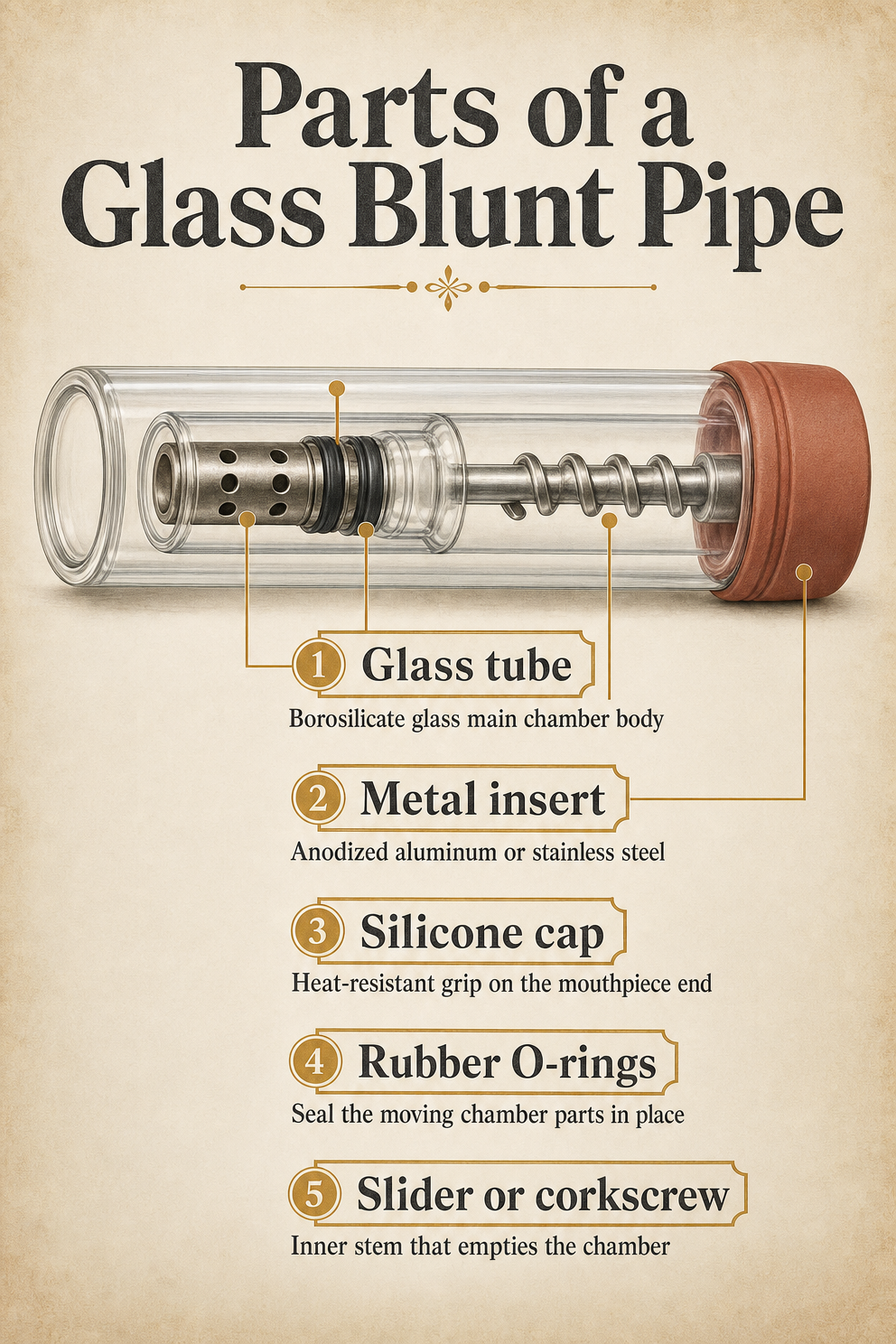
Most glass blunt pipes are built from a small set of standard parts, and each material has a specific job [3].
The outer tube is almost always borosilicate glass, the same kind of glass used in kitchen labware. It handles heat well and lets you see how much flower is left in the chamber.
Inside the tube, a metal insert does the work of pushing ash forward. Manufacturers typically use anodized aluminum or stainless steel for that part because the metal needs to slide without wearing out the glass [3].
Soft parts — the mouthpiece cap, the grip ring, and the seals — are usually silicone and rubber. Silicone caps give you a heat-resistant spot to rest your lips, and rubber O-rings keep the moving chamber from rattling or leaking air.
If you want a full breakdown of how a blunt pipe compares to other specialty formats, the What Are Specialty Pipes and How Do You Choose the Right One? guide walks through the wider pipe family in plain language.
Because each part handles a different job, you can usually disassemble a blunt pipe in under a minute. The glass tube slides off the metal insert once you remove the silicone cap, the O-rings pop out of their grooves, and you are left with five pieces you can rinse individually. Putting it back together is the same motion in reverse.
- Borosilicate glass tube — the main body, chosen because it handles heat and lets you see the chamber level
- Anodized aluminum or stainless steel insert — slides or twists inside the glass to push the ash forward
- Silicone mouthpiece cap — gives you a soft, heat-resistant spot to rest your lips
- Silicone grip ring — makes the tube easier to twist or hold without slippage
- Rubber O-rings — sit between the glass and the moving insert to seal the chamber and quiet the action
Twisty vs Slider Glass Blunts: Which Style Should You Pick?
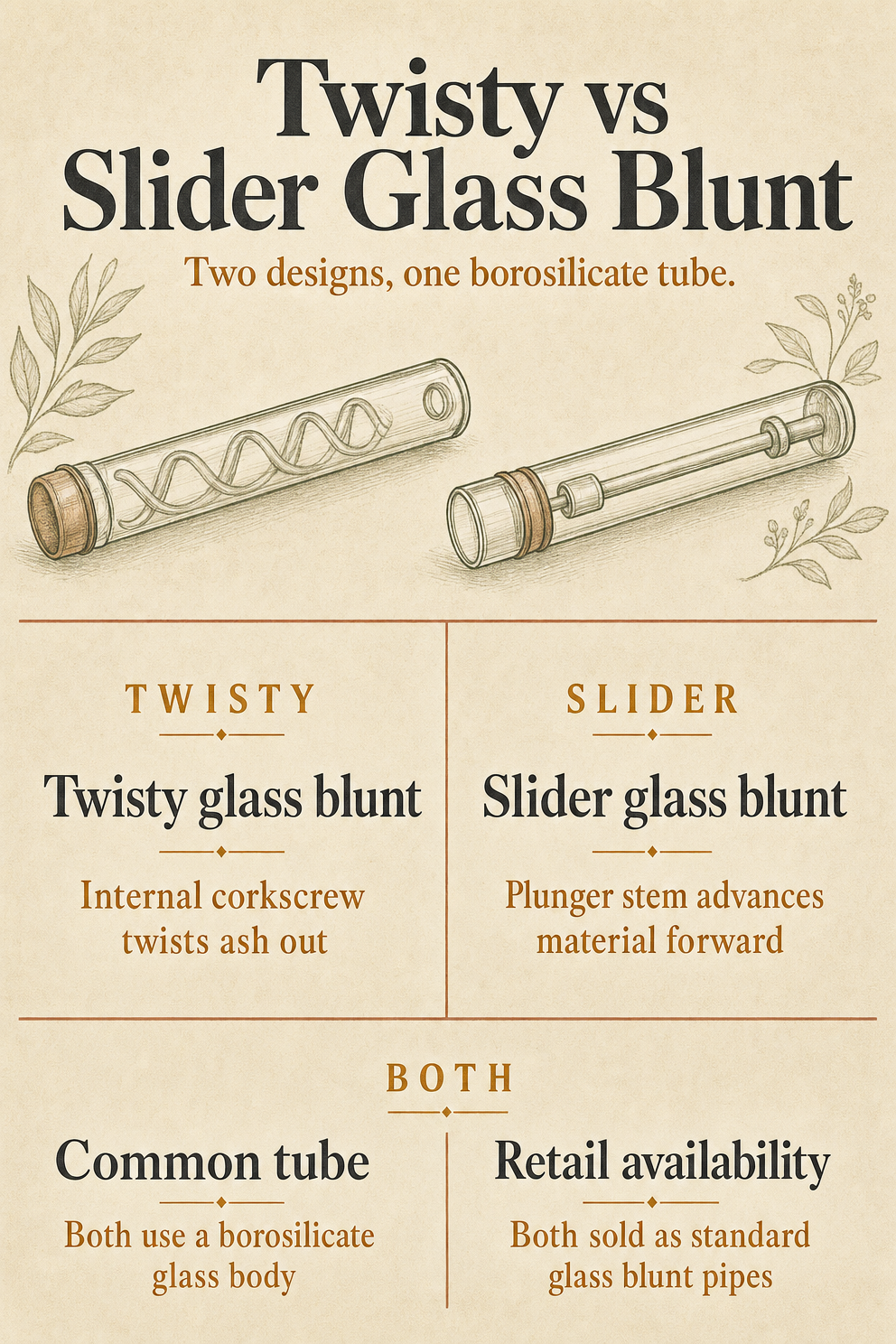
Glass blunt pipes come in two main designs, and the difference comes down to how the chamber empties [1].
A twisty glass blunt has an internal corkscrew. You pack the flower in one end, and when you want more ash gone, you simply twist the cap. The corkscrew pulls the used material forward and out the far end like turning a small screw [3].
A slider glass blunt uses a plunger-style inner stem instead. As you smoke, you push the plunger forward with your thumb and the used flower slides out the other end of the tube [1].
Both styles use the same borosilicate glass body and the same overall tube shape, so the choice comes down to feel. Twisty blunts feel closer to turning a small screw; slider blunts feel closer to pushing a syringe plunger.
If you are browsing a category page and want to see what a complete tube-shaped setup looks like, the SeshGear Jellyfish Double Chamber Glass Beaker Water Pipe – 17" / 14mm F / Colors Vary listing is a good example of a borosilicate tube-format piece from the wider glass family.
Many buyers end up with one of each style because the two pieces feel different in the hand. Twisty models tend to be a little narrower with a small knurled end you grip when you wind the chamber. Slider models tend to be a little wider in the body with a flat thumb pad on the plunger end that makes the push motion intuitive.
Either design works for sharing a session with a friend, since the larger chamber keeps a steady supply of flower in front of the heat without needing a relight between draws.
- Twisty glass blunt — internal corkscrew; you turn the cap to wind ash out of the chamber
- Slider glass blunt — plunger-style stem; you push the stem forward to advance the ash
- Both share the same borosilicate glass tube body and roughly the same overall size
- Twisty tends to feel slower and more mechanical; slider tends to feel quicker and more direct
- Cleanup is similar for both — separate the insert, soak the glass, dry, and reassemble
How Does a Blunt Pipe Compare to a Chillum or One-Hitter?
Blunt pipes, chillums, and one-hitters all live in the dry-pipe family because they hold flower directly inside a hard chamber without water or electronic parts [5].
A chillum is the simplest of the three. It is a straight tube with a small bowl on one end and a mouthpiece on the other, and there is no moving part — once the bowl is cashed, you relight or repack.
A one-hitter is even smaller. It is built to hold a single small pinch of flower, draw one short session, and then cool down. One-hitters are typically tiny and pocketable.
A blunt pipe is the largest of the three. The internal slider or corkscrew means you can keep a longer session going without relighting every minute, and the chamber typically holds roughly a gram of flower at a time [1] [3].
If you are shopping for a chillum-style piece in the same tube format, the Chillums subcategory page is a useful place to compare options side-by-side.
Session length is the other big differentiator. A chillum or one-hitter tends to be a quick, two-minute piece, while a blunt pipe is closer to a five- to ten-minute piece because the chamber keeps a steady supply of fresh material in front of the heat. That is part of why blunt pipes are popular with people who like a longer, slower session without rebuilding between sips.
- Chillum — straight tube with a small fixed bowl on one end and a mouthpiece on the other, no moving parts
- One-hitter — very small tube built to hold a single pinch of flower for one short session
- Blunt pipe (twisty) — straight tube with an internal corkscrew that winds ash forward
- Blunt pipe (slider) — straight tube with a plunger-style stem that pushes ash forward
- All four belong to the dry-pipe family, sold alongside hand pipes and other portable glass pieces
Are Blunt Pipes Reusable, and How Do You Clean One?
Yes — blunt pipes are designed to be reused. The glass body, metal insert, silicone parts, and rubber seals can all handle dozens of sessions before anything needs replacing [1] [3].
Most glass blunt chambers are rated at roughly a gram or more of ground flower. That is the same range as a typical hand-rolled blunt, so a single pack can cover a normal session and you can repack again the next time you sit down.
Cleaning is straightforward because the accessory comes apart into a small number of pieces. You do not need any special tools — just a little patience, isopropyl alcohol for the glass, and a soft cloth.
If you are browsing for the wider dry-pipe family at the same time, the Glass Hand Pipes subcategory page is a solid cross-reference for refillable glass pieces that follow the same routine.
One habit that extends the life of a blunt pipe is letting the glass cool down before you soak it. Putting a still-warm tube into cold isopropyl alcohol can stress the glass and shorten its lifespan. A short wait — enough for the tube to reach room temperature — is all you need before the cleaning step.
- Empty the chamber — slide or twist the insert forward until the used flower drops out into a tray
- Disassemble the parts — pull the metal insert and the silicone cap off the glass tube
- Soak the glass tube — drop it into isopropyl alcohol for a short soak, then rinse with warm water
- Wipe the metal insert — use a soft cloth or cotton swab to clear loose residue from the slider or corkscrew
- Reassemble with the O-rings seated — make sure the seals are in place before the next pack
- Let everything dry fully before repacking so moisture does not sit against the glass
Frequently Asked Questions
Is a blunt pipe the same thing as a rolled blunt?
No. A rolled blunt is ground flower wrapped inside a tobacco-leaf cigar or blunt wrap that is burned and discarded after a session. A blunt pipe is a reusable accessory — most often a glass tube with a sliding or twisting chamber — that is packed, smoked, emptied, and repacked many times.
What are the two main styles of glass blunt pipe?
Glass blunt pipes are sold in two main designs: a twisty blunt with an internal corkscrew that twists to push ash out, and a slider blunt with a plunger-style inner stem that advances the material as you smoke.
What is a blunt pipe usually made from?
Most glass blunt pipes use a borosilicate glass tube paired with an anodized aluminum or stainless steel insert, a silicone cap or grip, and rubber O-rings that seal the moving parts.
How much flower does a blunt pipe hold?
Glass blunt chambers are commonly rated at roughly one gram or more of ground flower, which is noticeably larger than a typical hand-rolled blunt and lets the device be repacked across multiple sessions.
Where do blunt pipes sit in the pipe family?
Retailers categorize glass blunt pipes as dry pipes and stock them alongside chillums, hand pipes, and other portable glass smoking accessories.
So Is a Blunt Pipe the Right Pipe for You?
If you like the shape of a rolled blunt but want something refillable that skips the wrap, a blunt pipe is the closest match in accessory form. You get the straight tube, the mouthpiece, and the slow burn — without the cigar leaf or the single-use cleanup.
Pick a twisty glass blunt if you want the corkscrew action, or a slider glass blunt if you prefer a plunger-style stem. Either way, plan on simple maintenance: empty the chamber, soak the glass every so often, and reseat the O-rings before the next pack.
Browse the wider specialty pipe category to compare borosilicate tube formats side-by-side. With free shipping on orders $150+, you can mix and match pieces to find the format that fits your routine.
Sources
- Weedmaps: How to Use a Glass Blunt: Step-by-Step Guide
- Drug and Alcohol Dependence (UCSF / NIH PMC): A mixed-methods study to inform the clarity and accuracy of cannabis-use and cannabis-tobacco co-use survey measures
- DankGeek: How to Use a Glass Blunt (Twist & Push Styles Explained)
- Grasscity: Glass Blunts & Twisty Glass Blunts
- White Rhino Products: Glass Blunts