
A side-by-side guide to stability, filtration, airflow, and hit style so you can pick the right bong shape for how you smoke.
A beaker bong vs straight tube comparison comes down to base shape. A beaker bong flares into a wide base, giving it a lower center of gravity and more water for cooling smoke. A straight tube bong is a simple cylinder with less water capacity but a faster, crisper hit. Neither is better — it depends on whether you want stability and smooth hits (beaker) or quick clears and easy cleaning (straight tube).
What Is a Beaker Bong and What Is a Straight Tube Bong?
Before comparing these two shapes, it helps to understand what each one looks like and how it is built. Both bong types share the same core parts: a bowl where the material is packed, a downstem that directs smoke into the water, a base that holds the water, and a neck that channels the smoke up to the mouthpiece.
- Beaker bongs flare outward from a narrow base into a wide bottom resembling a laboratory beaker
- Straight tube bongs maintain a uniform cylindrical diameter from base to mouthpiece
- Both shapes share the same core parts: bowl, downstem, water base, and neck
- Both can be made from glass, silicone, or acrylic in a range of sizes
- Both shapes can accommodate ice catchers, percolators, and other upgrades
A beaker bong gets its name from its shape. The base starts narrow and then flares outward, like a classic science-class beaker. The wider base sits flat on a surface and holds more water than a straight tube of the same height.
A straight tube bong is a simple cylindrical tube with a flat or slightly rounded bottom. The diameter stays the same from base to top, giving it a clean, minimalist profile. It is one of the oldest bong designs still in use.
Both shapes can be made from glass, silicone, or acrylic and can include ice catchers, splash guards, or percolators. The base geometry is what sets them apart, and that difference affects every aspect of performance.
Read What Are the Parts of a Bong and What Does Each One Do? for more detail.
Which Bong Type Is More Stable?
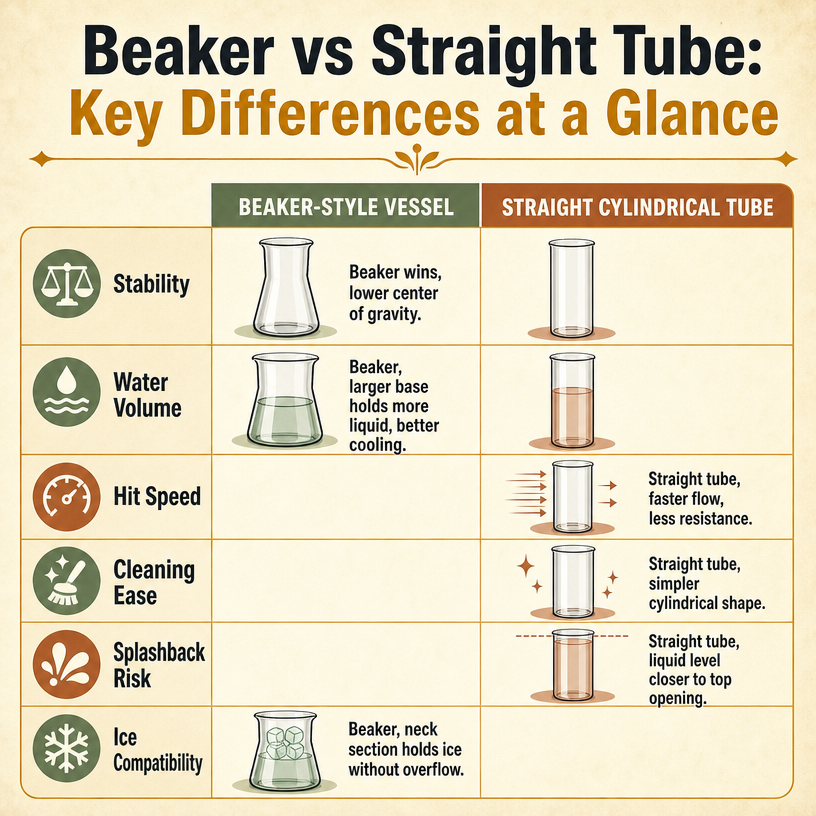
Stability is one of the most practical differences between these two shapes. The flared base of a beaker bong creates a much lower center of gravity compared to a straight tube. That wider footprint makes it hard to tip over accidentally, even if someone bumps the table.
- Beaker Bongs have a wider base that creates a lower center of gravity, making them more resistant to tipping [3]
- Straight tube bongs concentrate their weight in a narrow footprint, making them easier to knock over
- Attaching an ash catcher to a straight tube raises the center of gravity and increases tip-over risk
- Beaker bongs handle uneven surfaces, carpet, and crowded tables more safely than straight tube designs
- The stability difference matters most in social smoking scenarios where the bong may be bumped frequently
Straight tube bongs sit on a narrow cylindrical base. Even with a flat bottom, the weight of the pipe sits in a small footprint. This makes them more prone to tipping, especially on uneven surfaces, thick carpet, or when the bong is filled with water.
The stability gap grows wider when accessories are added. Ash catchers attach to the front of the downstem and add weight toward the top of the bong. On a straight tube, that front-heavy load raises the risk of the piece toppling over. A beaker bong’s wide base absorbs that extra weight without shifting the center of gravity as much [3].
Read What Is a Bong and How Does It Work? for more detail.
Read What Are the Different Types of Bongs? for more detail.
| Feature | Beaker Bong | Straight Tube Bong |
|---|---|---|
| Base shape | Flared, wide bottom | Cylindrical, narrow |
| Center of gravity | Low | High |
| Tip-over resistance | High | Low |
| With ash catcher | Stable | High tip-over risk |
| On uneven surface | Good | Poor |
How Do Water Capacity and Filtration Differ Between the Two Shapes?
Water capacity is where the beaker bong’s geometry pays off most directly. Because the base is wide, it holds more water than a straight tube of comparable height. That additional water means smoke spends more time in contact with water as it travels from the downstem to the surface.
- Beaker bongs hold more water in their wide base, increasing the surface area available for cooling smoke
- More water contact time in a beaker bong leads to cooler vapor before it reaches the mouthpiece
- Straight tube bongs have a smaller water column, so smoke retains more heat during the draw
- The beaker’s wide base also slows smoke travel through the water, softening the delivery
- Water capacity differences become more pronounced as bong height increases
This extra contact affects how the smoke feels. The larger water surface in a beaker bong lets more heat dissipate from the smoke before it reaches the mouthpiece. The result is a cooler, less harsh pull compared to a straight tube with less water.
In a straight tube, smoke moves quickly through a smaller column of water. There is less surface area for heat exchange. This means smoke retains more heat and can feel harsher on the throat, particularly with larger loads.
Water capacity alone does not determine filtration performance. The downstem design, percolators, and how smoke enters the water all play a role. But for two bongs at the same height, the beaker shape will almost always hold more water and deliver a cooler experience.
Read What Is the Difference Between a Bubbler and a Bong? for more detail.
What Are the Differences in Airflow and Hit Style?
Airflow is where Straight Tube Bongs have a distinct advantage. The cylindrical shape creates an unobstructed path from the bowl to the mouthpiece with minimal drag. When you clear a straight tube bong, smoke moves rapidly up the tube in a clean, fast snap that many experienced smokers prefer.
- Straight tube bongs offer less airflow resistance and a faster snap when clearing the chamber [2]
- Beaker bongs slow the draw slightly as smoke expands into the wide base and contracts into the neck
- Straight tube bongs carry a higher risk of splashback during aggressive clears because the waterline sits closer to the mouthpiece
- Beaker bongs have a narrower neck that acts as a buffer, reducing the chance of water reaching your mouth
- The choice depends on whether you prefer fast, punchy hits or slower, more controlled draws
The geometry of a beaker bong introduces slight resistance because smoke expands from the narrow neck into the wide base and then contracts again as it rises. This slows the draw slightly and gives smoke more time to cool, but the hit does not feel as immediate or punchy as a straight tube.
Splashback is another practical concern tied to airflow. In a straight tube bong, the waterline sits close to the mouthpiece because the tube is narrow. Aggressive clears or heavy inhalation can pull water up past the neck and into your mouth. Beaker bongs handle this better because the narrower neck acts as a natural barrier, keeping water contained in the wide base even during a vigorous clear [1].
| Attribute | Beaker Bong | Straight Tube Bong |
|---|---|---|
| Draw speed | Slower, more controlled | Faster, crisper snap |
| Airflow resistance | Slight | Minimal |
| Splashback risk | Low (narrow neck buffers) | High (waterline near mouth) |
| Hit feel | Cooler, smoother | Warmer, punchier |
| Best for | Relaxed, social sessions | Quick, solo clears |
Which Bong Is Easier to Clean?
Cleaning frequency depends on how often you use your bong, but shape determines how much effort each clean requires. Straight tube Bongs are generally easier and faster to clean due to their uniform cylindrical shape. A standard bong brush slides through the entire length of the tube without obstruction.
- Straight tube bongs are easier to clean because their cylindrical shape allows cleaning brushes to pass through without obstruction
- Beaker bongs have flared corners and curves where resin builds up and is harder to scrub away
- Disassemble the bong fully before cleaning — remove the bowl and downstem separately
- Rinse the body with warm water first to flush out loose debris before applying any cleaning solution
- Soak the bong in isopropyl alcohol and coarse salt — longer for beakers (several hours) than straight tubes (30 minutes)
Beaker bongs present more challenges. The flared geometry creates curves and transitions between the narrow neck and wide base where resin builds up. Cleaning brushes do not navigate these transitions smoothly, and resin tends to accumulate in areas where the walls curve outward. These spots often need soaking, manual scrubbing, or repeated rinses to fully clear.
Here is a step-by-step approach that works for either shape, though beaker bongs need more soaking time in step three.
First, disassemble the bong and remove the bowl and downstem. Second, rinse the body with warm water to remove loose debris. Third, fill the bong with a cleaning solution — isopropyl alcohol and coarse salt is a common choice — and let it soak for at least 30 minutes for straight tubes or several hours for beakers. Fourth, shake the solution through the bong, paying attention to areas where the shape transitions. Fifth, rinse thoroughly with warm water until all residue is gone. Sixth, let the bong dry completely before reassembling.
Can You Use Ice with Both Beaker and Straight Tube Bongs?
Ice catchers are small indentations near the top of the neck designed to hold crushed ice. They work differently depending on the bong shape. Beaker bongs are generally better suited for ice use. The narrower neck contains the ice without allowing it to float freely into the water chamber, and the wide base handles the additional volume without the water level rising too high.
- Beaker bongs are better suited for ice because the narrow neck keeps ice contained and the wide base handles extra volume without overflow
- Adding ice to a straight tube bong often raises the waterline close to or past the mouthpiece, increasing splashback risk
- Ice can shift and rattle inside a straight tube during a draw, disrupting the smoking experience
- Some straight tube bongs include ice pinch designs to hold cubes in place, but they do not fully eliminate overflow concerns
- Check product listings for ice catcher perks if you want to use ice regularly
Straight tube bongs are more prone to problems with ice. Because the tube is narrow and the water column is already close to the mouthpiece, dropping in crushed ice can push the water level up past the ice catcher or into your mouth when you start to draw. The ice can also shift and rattle during a hit, which some users find disruptive.
If you enjoy cold hits and want to use ice regularly, a beaker bong with an ice catcher is the more practical choice. Some straight tube bongs come with ice pinch designs that help hold cubes in place. These help, but they do not fully solve the overflow risk that comes with the narrower water column.
Not all bongs include ice catcher perks, so check the product listing before purchasing if ice use matters to you.
Browse Ice Bongs to explore related options.
How Do Beaker and Straight Tube Bongs Handle Ash Catcher Accessories?
Ash catchers are accessory pieces that attach between the bowl and the downstem, catching ash before it enters the main water chamber. They keep the bong cleaner longer and provide an extra layer of filtration. But they also add weight and shift the balance of the bong.
- Ash catchers add front-heavy weight that shifts the center of gravity on any bong
- On a straight tube bong, this added weight raises tip-over risk significantly
- Beaker bongs compensate for accessory weight better because their wide, low base keeps the center of gravity grounded
- If you use ash catchers regularly, choosing a beaker bong from the start avoids stability problems later
- Both beaker and straight tube bongs accept ash catchers with the right joint sizes — compatibility depends on the connection, not the shape
When you attach an ash catcher to a straight tube bong, the added weight sits in front of the downstem joint. On a narrow-based straight tube, this shifts the center of gravity noticeably toward the top of the piece. The result is a bong that is more likely to tip over from a light nudge or even on its own if set down at a slight angle.
Beaker bongs handle this scenario better. The wide, flared base keeps the center of gravity low even when weight is added to the top of the piece. This is why many experienced users recommend pairing ash catchers with beaker-style bongs — the base compensates for the front-heavy load.
If you know you want to use an ash catcher, factor that into your decision from the beginning. Choosing a beaker bong at the outset avoids the frustration of discovering your straight tube is too tip-prone once the accessory is attached.
Which Bong Shape Should You Choose?
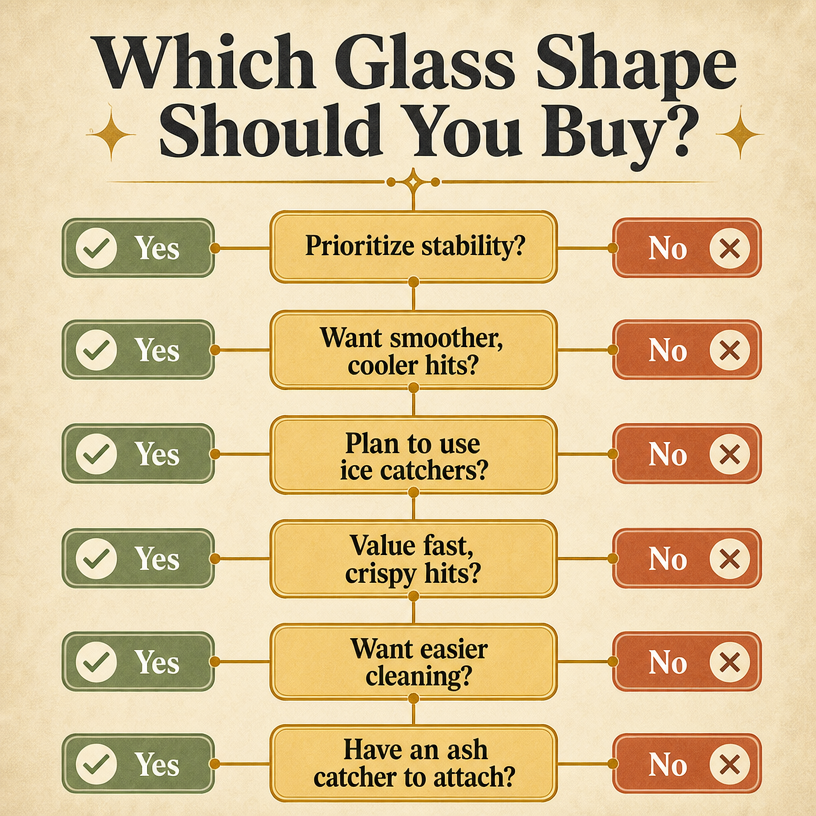
After looking at stability, water capacity, airflow, cleaning, ice use, and accessories, the right choice comes down to how you actually smoke. There is no universally correct answer — both shapes are well-established designs that serve different priorities.
- Choose a beaker bong if you prioritize stability, cooler hits, ice use, or accessory compatibility
- Choose a straight tube bong if you prefer fast draws, easy cleaning, a minimalist profile, and solo sessions
- Hybrid designs that taper slightly into a wider base offer a middle ground between both shapes
- Browse both styles at Treehouse Lifestyle with free shipping on orders $150+ to compare options in your price range
Choose a beaker bong if stability matters to you, if you smoke in social settings where the bong might get bumped, if you want cooler hits from more water, if you plan to use ice regularly, or if you intend to add an ash catcher or other front-heavy accessory.
Choose a straight tube bong if you prioritize a fast, direct draw, if easy cleaning is important to you, if you mostly smoke solo on a stable surface, or if you prefer a minimalist look that is easy to store and transport.
Many modern bongs blend elements of both shapes, featuring a gentle taper into a wider base rather than a full beaker flare. These hybrid designs try to split the difference — offering some of the stability and water capacity of a beaker while keeping the sleek profile of a straight tube. They are worth considering if neither pure shape feels like a perfect fit.
| Priority | Best Choice |
|---|---|
| Stability and tip-over resistance | Beaker bong |
| Cooler, smoother hits | Beaker bong |
| Ice catcher use | Beaker bong |
| Ash catcher accessories | Beaker bong |
| Fast, punchy draws | Straight tube bong |
| Easy cleaning | Straight tube bong |
| Solo sessions on stable surface | Straight tube bong |
| Minimalist profile and transport | Straight tube bong |
What Are Common Questions About Smoking Accessories?
Are beaker bongs more stable than straight tube bongs?
Yes. Beaker bongs have a wider, flared base that provides a lower center of gravity, making them more resistant to tipping than straight tube bongs. This is especially important on uneven or soft surfaces.
Which bong type produces smoother hits?
Beaker bongs generally produce smoother, slower hits because the wider water chamber cools and filters smoke more thoroughly. Straight tube bongs deliver faster, crisper hits with less drag but with less cooling per pull.
Are straight tube bongs harder to knock over?
Yes. Straight tube bongs have a narrow cylindrical base and a higher center of gravity, making them more prone to tipping. The risk increases significantly if an ash catcher or other accessory is attached to the front of the pipe.
Can you put ice in both beaker and straight tube bongs?
Ice works better in beaker bongs because the narrower neck contains the ice without causing water to overflow. In straight tube bongs, adding ice often pushes water up past the mouthpiece, causing splashback and mess.
Which bong is easier to clean?
Straight tube bongs are easier to clean. Their simple cylindrical shape allows cleaning brushes to pass through without obstruction. Beaker bongs have curves and flared corners that trap resin, requiring more soaking and scrubbing effort.
Which Bong Shape Is Right for You?
The difference between a beaker bong and a straight tube bong comes down to base geometry and how it influences stability, water capacity, airflow, and maintenance. Beaker bongs win on stability and water cooling, making them the better choice for group sessions, ice use, and setups with accessories. Straight tube bongs win on draw speed and cleaning simplicity, appealing to solo smokers who value quick, direct hits and easy upkeep.
Think about where you smoke, how often you clean your piece, whether you use ice or accessories, and what kind of hit style you prefer. Those factors will tell you which shape fits your routine. Browse the full selection at Treehouse Lifestyle, where you can filter by shape, size, and features — and enjoy free shipping on orders $150+.
Where Does This Smoking Accessory Information Come From?
- Thick Ass Glass: Beaker vs Straight Tube Bong: Which One For Perfect Rips?
- Insomnia Smoke: Straight Tube Bong vs Beaker Bong: The Connoisseur’s Guide to Glass Geometry
- Thick Ass Glass: What Is a Beaker Bong? Design, Function & Performance
- Grasscity USA: Straight Tube Bong Guide: How to Use, Clean & Maintain
- DankStop: The Great Debate – Beakers vs. Straight Tubes