

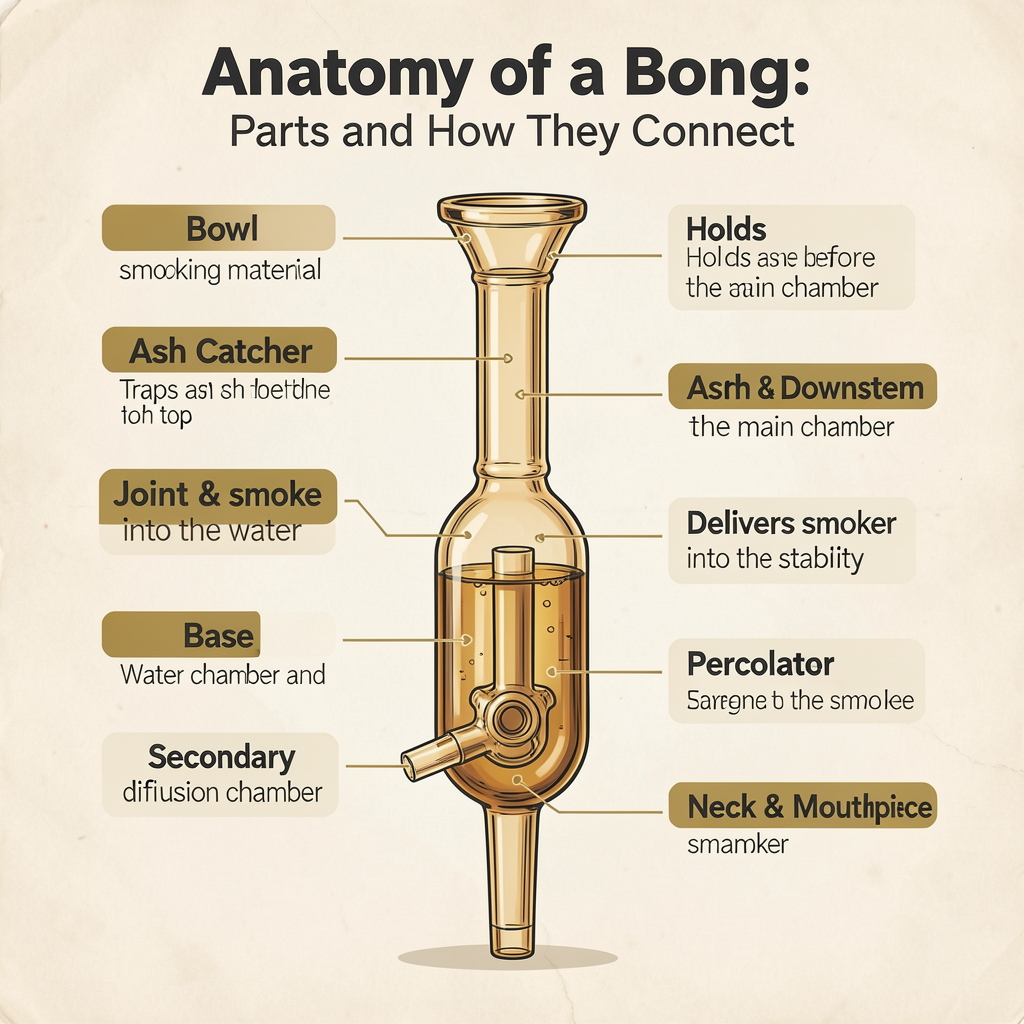
A bong is a water pipe designed to filter and cool smoke before it reaches your lungs. Smoke travels from the bowl through the downstem into the water chamber in the base, where it is filtered and diffused into smaller bubbles. It then rises through the neck, past any ice cubes or percolators, and exits through the mouthpiece. Each component serves a specific function, and understanding how they work together helps you choose the right bong and maintain it properly.
What Does the Base of a Bong Do and Which Shape Should You Pick?
The base is the foundation of a bong and the chamber that holds water. Everything else — the neck, joint, and mouthpiece — connects to it. A well-designed base keeps the bong stable on a flat surface and determines how much water the piece can hold. It also plays a role in how smoothly the bong clears between hits.
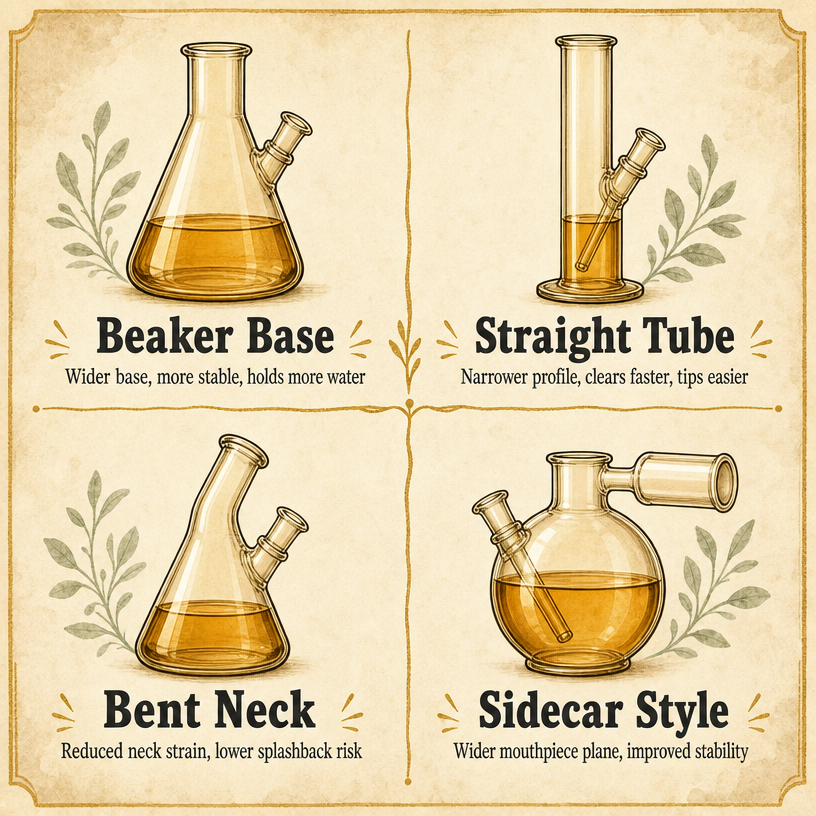
- Beaker base: wider at the bottom, lower center of gravity, holds more water, harder to tip over, good for home use
- Straight tube: narrow cylindrical base, lighter and more portable, clears faster, more prone to tipping on uneven surfaces
- Round base: spherical shape, sits flat on most surfaces, classic look, limited water capacity compared to beaker designs
- Flat bottom or puck base: very stable on smooth surfaces, compact footprint, common in smaller or travel-sized bongs
Bong bases come in several shapes, and each one changes the experience in subtle ways. Some shapes are better for stability, while others favor portability or ease of cleaning. Picking the right base depends on where you plan to use your bong and how much water you want to work with.
Free shipping on orders $150+ applies to eligible accessories at Treehouse Lifestyle.
Browse Bowl Pieces to explore related options.
Browse Beaker Bongs to explore related options.
What Is the Downstem and Why Does the Joint Size Matter?
The downstem is a narrow glass tube that connects the bowl to the water in the base. When you light the bowl, smoke travels down the downstem and bubbles through the water before rising through the neck. Without a downstem, there would be no path for smoke to reach the water chamber.
- Identify the joint size printed on your bong’s joint or measuring the glass with a caliper — the outer diameter must match your bowl and downstem
- Check whether your bong has a female (inside-ground) or male (outside-ground) joint, since this affects which accessories fit
- Use an adapter if your bowl and downstem have different joint sizes — for example, a 14mm female joint with an 18mm male adapter
- Replace a cracked or worn downstem promptly to avoid air leaks that waste smoking material
Modern bongs typically use removable Downstems that thread into the joint. This makes cleaning much easier and lets you swap the downstem for a different style or size. Fixed downstems, where the tube is fused directly to the base, are harder to clean and replace but were more common in older designs. [2]
The joint is the glass fitting where the downstem inserts into the base. Joint size matters because the bowl and downstem must share the same size to form a proper seal. Using mismatched sizes results in air leaks and a poor smoking experience. Joint sizes are standardized at three measurements: 10mm, 14mm, and 18mm outer diameter. [1] [2] [3]
Read What Are the Parts of a Bong, Rig, or Pipe and How Do They Work? for more detail.
Read What Is a Bong and How Does It Work? for more detail.
What Is a Diffused Downstem and How Does It Change the Smoke?
A standard downstem is a plain glass tube with an open end submerged in water. When smoke passes through, it forms a single stream of bubbles. A diffused downstem has one or more slits or small holes at the submerged end. These openings split the smoke into multiple smaller bubbles as soon as it enters the water. [2] [3]
- Standard downstem: plain open tube, minimal diffusion, low drag, suitable for users who prefer an open, fast-pulling hit
- Single-slug diffused: one horizontal slit near the bottom, gentle diffusion, moderate drag, a common入门 option
- Multi-slug diffused: three to six horizontal slits spaced along the tube, more bubble surface area, slightly increased drag
- Honeycomb diffused: a disc with a grid of small holes at the bottom, maximum bubble breakup for the downstem category, more restriction but cooler hits
More bubbles mean a larger surface area for the smoke to interact with the water. This contact cools the smoke faster than a plain tube would allow. Diffused downstems are a common upgrade because the extra diffusion makes the hit feel less harsh without adding much resistance to the draw.
There are several types of diffusion. A single-slug downstem has one wide opening near the bottom. Multi-slug downstems have several horizontal slits stacked along the tube. Honeycomb downstems have a disc at the bottom filled with many small holes, similar in appearance to a honeycomb percolator. Each style produces a different bubble pattern and level of drag.
What Are the Different Percolator Styles and How Do They Work?
A percolator is a second water chamber inside the bong that further diffuses smoke into smaller bubbles after it leaves the main chamber. Think of it as an extra step in the filtration process — smoke travels from the base through a connecting tube, enters the percolator chamber, and bubbles through water a second time before continuing up the neck. [1] [2]
- Tree perc: vertical tube with multiple horizontal arms branching outward, each arm has slits or holes; creates many bubbles at once and is a durable classic design
- Honeycomb perc: a flat disc with a grid of small holes; smoke must pass through the entire grid, creating very fine bubbles and even distribution across the disc
- Showerhead perc: a vertical tube with a flared head full of small directional holes; resembles a showerhead and produces a wide spray of fine bubbles
- Matrix perc: a disc with intersecting horizontal and vertical slits forming a crosshatch pattern; provides consistent bubble production across the entire surface
- Inline perc: a horizontal tube with a series of slits along its length; smoke flows laterally through the tube and exits through the slits, common in straight-tube bongs
- UFO perc: a disc with a raised center pillar and holes radiating outward; designed to minimize splashback while maintaining good diffusion
- Turbine perc: a cone-shaped element with angled slits; as smoke passes through, the slits create a mild spinning effect in the water chamber below
- Swiss perc: a disc with large round holes arranged in a pattern; the larger holes produce bigger bubbles and maintain lower drag than honeycomb designs
Percolators are popular because the additional water contact cools smoke further and can reduce irritation in the throat. They also filter out some particulate matter that passes through the main chamber. The tradeoff is that percs add complexity, can be harder to clean, and introduce more drag to the draw.
There are many percolator styles, each named for the shape of the diffusion element inside the chamber.
Read What Are the Different Types of Bongs? for more detail.
What Is an Ice Catcher and Do You Need One?
An ice catcher is a glass pinch or notch built into the neck of a bong, positioned above the water line. Its purpose is to hold ice cubes in place so cold smoke can pass over them on the way to the mouthpiece. Without an ice catcher, ice cubes tend to float and shift, making inconsistent contact with the smoke stream. [1] [2]
- Add ice cubes only after the bong is filled with water and the downstem is seated — water displacement changes when ice is added
- Use cubed ice rather than crushed ice, as crushed ice melts faster and can slip through or past the pinch
- Clean the ice pinch regularly, as cold water can leave mineral deposits on the glass over time
- If your bong does not have an ice catcher, you can still cool smoke by using very cold water in the base or adding a layer of ice on top of the water surface
Using ice in a bong is entirely optional, but many users prefer it. Cold ice cubes absorb heat from the smoke as it travels upward, dropping the temperature before it reaches your throat. This can reduce the warmth of a hit and make larger inhales more comfortable.
Not every bong has an ice catcher. If the neck is too narrow or the glass shape does not accommodate pinches, ice cubes cannot be used effectively. Some bongs have a single pinch, while higher-end pieces may have two or three stacked pinches that hold multiple ice cubes at once.
Browse Ice Bongs to explore related options.
What Is an Ash Catcher and How Does It Keep a Bong Cleaner?
An ash catcher is a glass attachment that sits between the bowl and the downstem joint. When you clear the bong, ash and debris pass through the bowl, collect in the ash catcher instead of falling directly into the water chamber. Over time, this keeps the main water cleaner, the bong easier to empty, and residue from building up on percolators and inner glass surfaces. [1] [3]
- 90-degree ash catcher: the bowl sits perpendicular to the downstem; a classic style that works with most straight-neck bongs
- 45-degree ash catcher: the bowl sits at a downward angle; useful for bongs with a bent neck or sidecar shape where a 90-degree angle would not align properly
- Ash catcher with perc: includes a small percolator inside the attachment for added diffusion and filtration before smoke enters the main chamber
- Ash catcher with showerhead or honeycomb disc: premium variants that provide percolator-level filtration within the ash catcher itself
Ash Catchers are especially useful for larger bongs with percolators, since cleaning ash out of a complex perc system takes considerably more effort than rinsing a simple ash catcher. Switching to a fresh ash catcher is faster than performing a full bong cleaning and can extend the life of the water in the main chamber by a meaningful margin.
Ash catchers come in a range of designs. The most common styles are 90-degree and 45-degree angle attachments, referring to how the bowl sits relative to the downstem. Some ash catchers include their own percolator, which adds a layer of diffusion before the smoke even reaches the main chamber.
What Are the Different Neck Styles and How Do They Affect the Hit?
The neck is the vertical glass tube that connects the base to the mouthpiece. It is the path smoke travels after leaving the water and before reaching your lips. Neck design affects how comfortably you can hold and clear the bong, how stable it rests on a surface, and how much risk there is of water splashing up toward the mouthpiece during a hit. [3]
- Straight neck: classic vertical tube; simple to clean; smoke path is fully visible; easier to accidentally tip over if nudged hard
- Bent neck: top of the neck angles away from vertical; reduces wrist and neck strain during use; more stable when resting; lower risk of water splashback during clears
- Sidecar style: the mouthpiece plane is wider and offset to one side of the neck; offers a broader hitting edge and improved stability when resting; a popular choice for larger desktop bongs
The most common neck styles are straight, bent, and sidecar. Each has a distinct shape and practical tradeoffs that suit different preferences and use cases.
Straight necks are the classic vertical tube design. They are simple, easy to clean inside, and allow you to see the smoke traveling up toward the mouthpiece. Bent necks angle the top of the tube away from the vertical axis, which reduces neck strain during use and lowers the mouthpiece closer to the base when the bong is resting on a flat surface. This makes the bong more stable when set down between hits and reduces the chance of water splashing up during a fast clear.
What Materials Are Bongs Made From and Why Does It Matter?
Most multi-component bongs are made from glass because it is chemically inert, easy to clean, and allows users to see the water level and smoke path clearly. Glass does not retain odors between uses the way some other materials can, and standard glass cleaning solutions work effectively on it. The main weakness of glass is its fragility — it can crack if dropped or exposed to sudden temperature changes. [1]
- Glass: inert material that preserves flavor clarity; easy to see water and smoke path; can crack or break from impact or thermal shock; the most common material for multi-component bongs
- Silicone: highly durable and drop-resistant; easy to clean with basic rinsing; can absorb flavor oils over long-term use; a good choice for travel or shared living spaces
- Ceramic: retains heat well and often features artistic designs; heavier and more fragile than glass; less common in modular setups; better suited for single-piece or decorative bongs
Silicone bongs have become more popular in recent years because the material is nearly indestructible and can be cleaned simply by rinsing with warm water or tossing it in a dishwasher. Some users note that silicone can affect flavor after extended use, but for durability and travel convenience it is a practical alternative to glass.
Ceramic bongs offer excellent heat retention and often feature distinctive hand-painted designs. However, ceramic is heavier than glass and more prone to cracking from impact. It is less common in multi-component setups but appears frequently in single-piece designs and decorative pieces.
What Are Common Questions About Smoking Accessories?
What are the parts of a bong and what does each one do?
The bowl holds the smoking material at the top of the bong. The downstem connects the bowl to the water in the base. The base holds water and determines how stable the bong sits. Smoke rises through the neck, passes any ice cubes or percolators, and exits through the mouthpiece. Each part has a distinct role and they work together to move and cool smoke before delivery.
What is the difference between a fixed and a removable downstem?
A fixed downstem is fused to the base and cannot be removed without professional repair. A removable downstem threads into the joint and can be taken out for cleaning, replacement, or upgrading to a different style. Removable downstems are the standard in modern bongs because they are far easier to maintain.
Why do some bongs have percolators and do I need one?
Percolators add a second water chamber inside the bong that further diffuses smoke into smaller bubbles after it leaves the main chamber. This extra step cools the smoke further and can make hits feel more comfortable. Whether you want a percolator depends on your preference for airflow and hit intensity — some users prefer the open draw of a non-perc bong.
What joint size do most bongs use and how do I know if it fits?
Joint sizes are standardized at 10mm, 14mm, and 18mm outer diameter. The bowl and downstem must share the same joint size and gender to fit together properly. Using mismatched sizes without an adapter will result in an incomplete seal and air leaks that waste smoking material and reduce performance.
How does an ash catcher improve a bong setup?
An ash catcher sits between the bowl and the downstem and traps ash before it enters the main water chamber. This keeps the bong water cleaner for longer, reduces residue buildup on percolators, and cuts down on how often you need to perform a full deep cleaning of the main piece.
How Do You Choose the Right Bong Parts for Your Setup?
Understanding what each bong part does makes it much easier to shop for a new piece or upgrade an existing one. The base shape sets the foundation for stability and water capacity. The downstem and joint size determine which bowls and accessories are compatible. Percolators and diffused downstems add an extra layer of cooling and filtration if you want a smoother hit. Ice catchers and ash catchers are simple additions that address specific annoyances — hot smoke and dirty water — without changing the core design.
If you are putting together your first serious bong setup, start with a compatible bowl and downstem in the right joint size, then decide whether an ash catcher makes sense for your smoking habits. From there, you can explore percolator styles and base shapes based on how you like your hits to feel. Each part is replaceable and upgradeable, so there is no need to buy everything at once.
Where Does This Smoking Accessory Information Come From?
- High Times: Anatomy of a Bong 101: What are the Different Parts of a Bong?
- AFM Smoke: Parts of a Bong: Complete Glass Anatomy Guide
- ThickAssGlass: Parts Of A Bong | Bong Glossary, Names & Terminology