

A 19mm female joint is the same connection as an 18mm female joint. The true measurement is about 18.8mm, and manufacturers round that number down to 18mm or up to 19mm, so parts sold under either label fit each other with no adapter needed. [2]
The joint is a ground-glass socket with the frosted taper on the inside, so it receives a male part rather than fitting inside one. Most water pipes are female at the joint and most bowls are male, which is why a standard bowl drops straight into the socket. [4]
Nothing about the size changed between the two labels, only the wording. That one fact clears up most of the confusion around 19mm female bongs, because a shopper who already owns a 19mm piece and a drawer of 18mm accessories has everything needed to use it.
Is a 19mm Female Joint the Same as an 18mm Joint?
Yes. The two labels describe one connection. Functional glass settled on three main joint diameters: 10mm, 14mm, and 18mm. The largest of those began as a scientific part measuring roughly 18.8mm across, and the industry shortened the name rather than the glass. [2]
Some manufacturers round 18.8mm down to 18mm, others round it up to 19mm, and a few product pages print the full 18.8mm figure. All three describe the same taper, so a bowl sold as 18mm male seats in a socket sold as 19mm female with nothing in between. [3]
That is why shopping by number alone gets confusing. Product pages are written by different people, and glassblowers usually keep the label they learned first. When you browse Bongs, read 19mm as shorthand for the large ground-glass standard rather than a separate size that needs its own set of accessories. [5]
A bong listing may say 19mm while the bowl in the box is stamped 18mm, and both are correct. What matters is the physical taper, not the print on the glass. The practical rule is short: 19mm and 18mm are interchangeable, while 14mm is a real mismatch that calls for an adapter or a different part.
- 18.8mm — the actual measurement across the wide end of the tapered ground joint.
- 18mm — the rounded-down label for that same connection, common on older listings and packaging.
- 19mm — the rounded-up label, and the one most current product pages use.
- Fit — a male part sold under any of those three labels seats in a female socket sold under any of the others.
| Label | Actual measurement | What it means |
|---|---|---|
| 18.8mm | Wide end of the ground taper | The true scientific dimension |
| 18mm | Same taper, rounded down | Fits every 19mm socket |
| 19mm | Same taper, rounded up | Fits every 18mm socket |
| 14mm | About 14.5mm across | A different size, needs an adapter |
What Does the 19/26 Marking on a Glass Joint Mean?
The sizing system is borrowed from laboratory glassware, where every joint carries a two-number mark such as 19/26 or 24/29. Once you can read the pair of numbers, you can read any joint on any product page. [1]
The number on a listing is a rounded nickname for the wide-end diameter, not a precise engineering spec. American standard taper charts list the same 18.8mm dimension as 19/38, which is another reminder that the label varies while the glass does not. [1]
For a side-by-side of the three common diameters, see What Are 10mm, 14mm, and 18mm Glass Joint Sizes?. If you dab instead of smoking flower, What Do Dab Rig Joint Sizes and Genders Mean? covers the same naming rules on rigs and bangers.
Measuring your own piece is walked through in How Do I Measure My Bong’s Joint Size?, and What Are the Parts of a Bong, Rig, or Pipe and How Do They Work? explains where the joint sits in the overall build. Large-format pieces such as the Vitae Glass 18" Swiss UFO Bong are where the 19mm size shows up most often.
- First number, wide end. The opening number is the diameter of the wide end of the ground joint in millimetres, so a 19/26 joint measures 18.8mm across that wide end.
- Second number, ground length. The number after the slash is the length of the ground zone, meaning how far the tapered surfaces engage, and on a 19/26 joint that engagement is 26mm.
- The taper narrows. Conical ground joints use a 1: 10 taper, so the same 19/26 joint measures 16.2mm across its narrow end.
- The small size follows the same pattern. A 14/23 joint measures 14.5mm across the wide end and 12.2mm across the narrow end, with 23mm of engagement.
- Translate the mark to the shelf label. The 19/26 taper is what shoppers call 19mm, 18.8mm, or 18mm depending on the brand and the glassblower.
How Do You Measure a 19mm Female Joint?
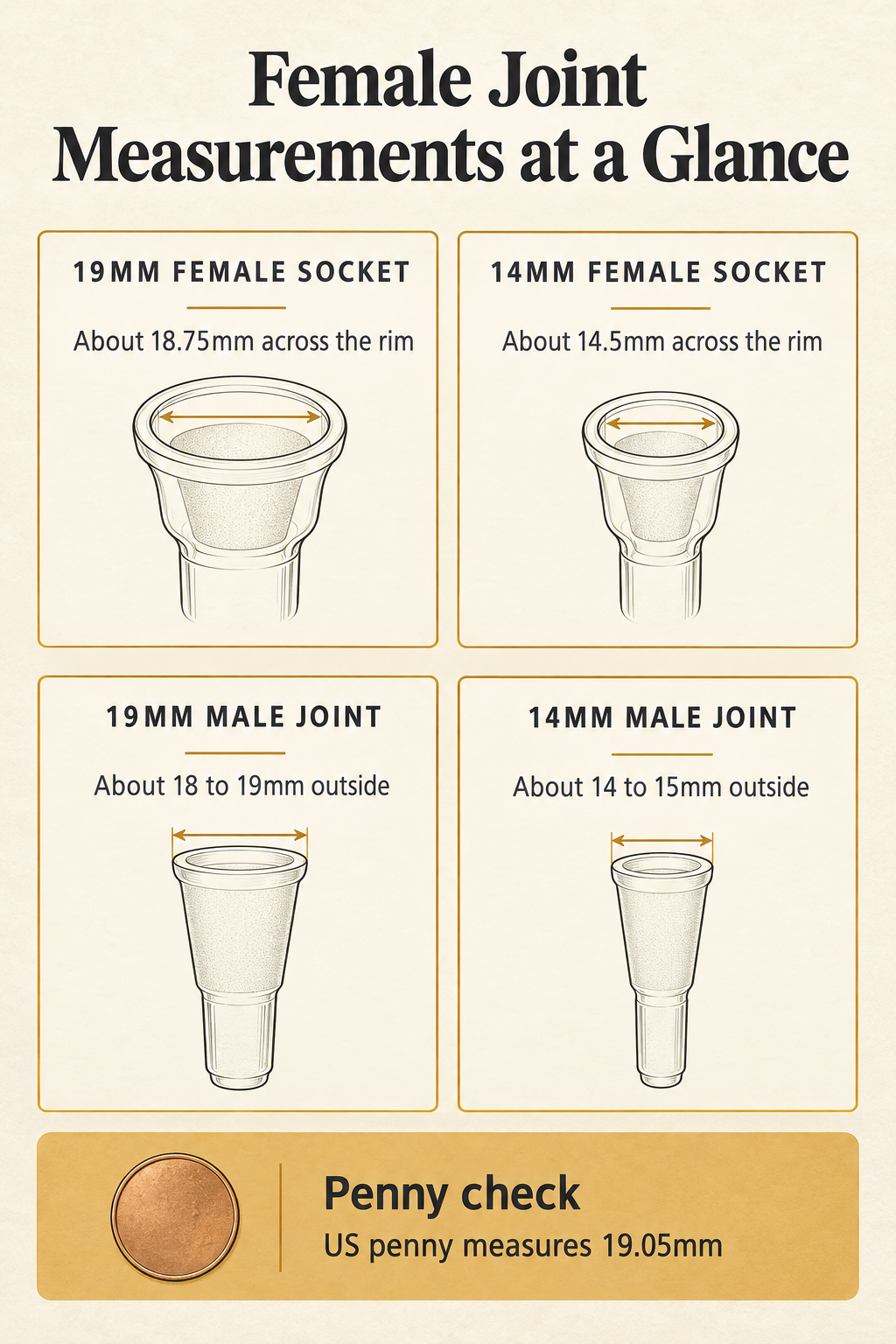
A female joint is a tapered cone, so it has to be measured across the inside of the opening at the rim, where it is widest. Measuring lower down the taper gives a smaller number and a wrong answer. [5]
Male joints are measured the other way, across the outside. An 18mm male joint measures about 18 to 19mm and a 14mm male joint about 14 to 15mm, which is why the male half reads one size up from its matching socket. [5]
Calipers give the cleanest answer, but a ruler and a steady hand will separate the two sizes. What you are really checking is whether the opening is close to 19mm or close to 14.5mm, because there is no ambiguity between those two numbers. [1]
Downstem shopping adds length to the list of measurements. How Do You Measure a Downstem Correctly Before Buying a Replacement? covers that side of the job.
- Clean the ground surface first. Wipe out any resin or grit so the caliper jaws sit against glass rather than debris.
- Open the calipers across the inside of the rim. Set the jaws at the widest point of the opening, level with the top edge.
- Read the widest point. A 19mm female socket measures about 18.75mm across the top and narrows toward 16.25mm at the bottom of the grind.
- Cross-check with a penny. A US penny measures 19.05mm across, so it nearly spans a 19mm socket and drops through a 14mm one without touching the sides. [2]
- Compare the reading. A 14mm female socket measures about 14.5mm across the top and narrows toward 12.25mm, so the two sizes are easy to tell apart once you have both numbers.
What Fits a 19mm Female Joint?
Gender is a mechanical description, not a grade. A female joint holds the frosted ground surface on the inside and receives another piece. A male joint carries the ground surface on the outside and slides in. Neither is better than the other; the gender only says which part goes inside which. [4]
Most water pipes present a female socket at the joint, which is why the accessories that drop into them are usually male. That is the pattern to check first when you are matching a part to a pipe. [3]
If you are putting together a kit rather than replacing a single part, browse Accessories with the gender of your socket in mind. Treehouse Lifestyle offers free shipping on orders $150+.
- Bowls and slides — usually male, ground on the outside, seating directly into the socket.
- Quartz bangers — usually male at the stem, so they fit a female joint of the matching size.
- Ash catchers — often male on top and female at the bottom, so one part changes both the gender and the direction of the connection.
- Downstems — male at the base where they meet the tube, with a female opening at the top where the bowl goes.
- Adapters — made in both genders, and the fix when a part presents the wrong end for your socket.
Why Does My 19mm Female Bong Take a 14mm Bowl?
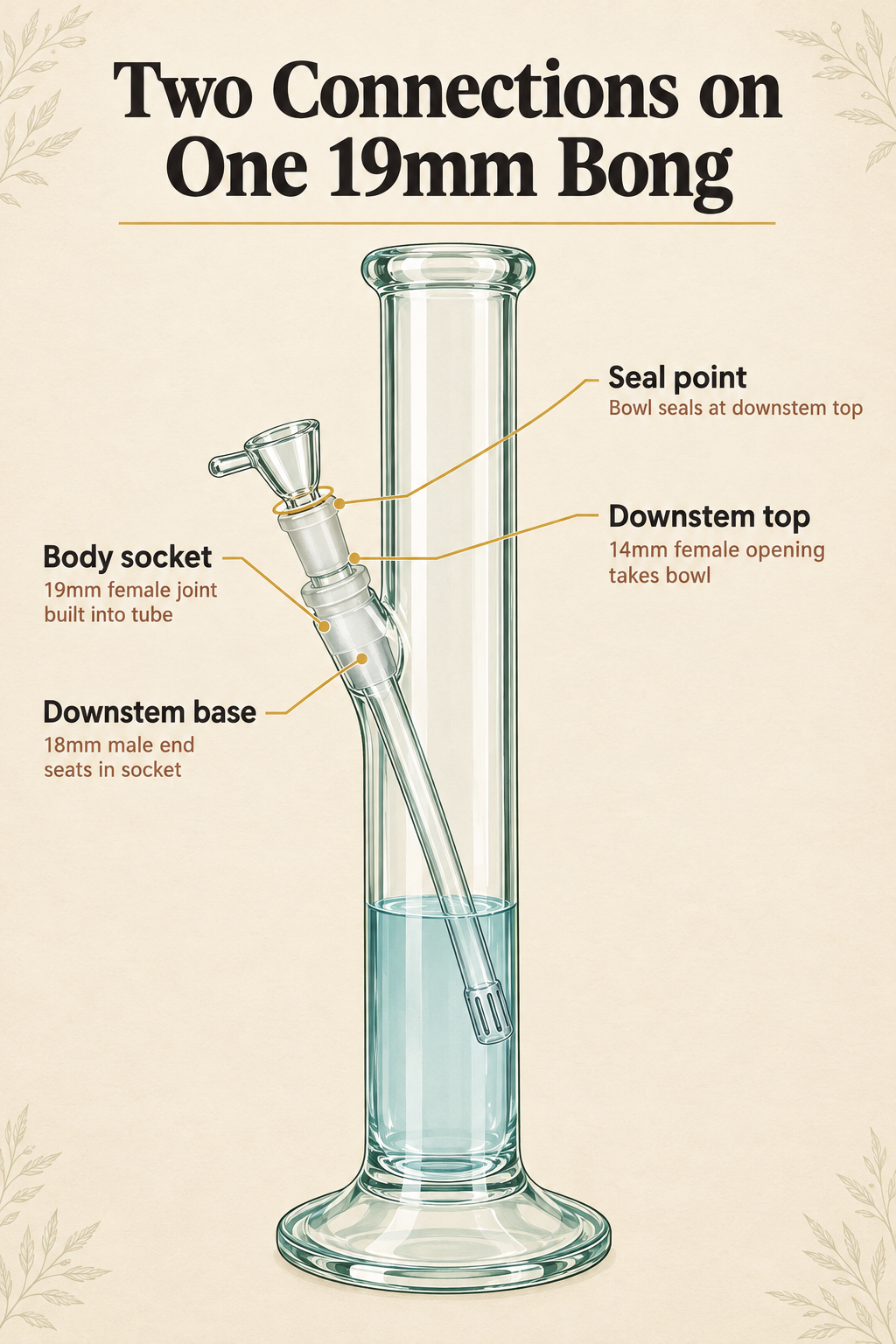
This is the question that stops most shoppers, and the answer is simple once you see the two connections. Many larger flower tubes have a 19mm (18mm) female joint built into the body, then ship with a removable reduction downstem that steps the size down. [4]
The larger connection joins the tube to the downstem. The reduced opening at the top of the downstem accepts the far more widely stocked 14mm bowl. The bowl only cares about the top of the downstem, so the number printed on the bong and the bowl you actually load are two different specs. [4]
This setup is common because it keeps the larger, sturdier connection at the tube while letting the piece use the small accessories most people already own. It also means a 19mm bong can be a 14mm bowl bong at the same time, with no adapter and no contradiction. [2]
- Body socket — the 19mm (18mm) female opening built into the tube, which takes the downstem.
- Downstem base — the 18mm male end that seats in that socket, and the place where the seal begins.
- Downstem top — the 14mm female opening that accepts the bowl.
- Bowl — a 14mm male slide, matched to the downstem top rather than to the label on the bong.
- Replacement rule — measure the top of the downstem, not the socket in the tube, when you buy a new bowl.
Will a 14mm Bowl Work in a 19mm Female Joint Without an Adapter?
Not on its own. A male part fits a female joint of the same size, and sizes do not swap without help. A 14mm male slide will sit loose and leak in an 18mm female joint, and an 18mm male joint will not seat in a 14mm female socket at all. [5]
The failure is easy to recognize. A part that wobbles, rocks, or lets air past the joint is the wrong size, not a part that needs more force. Pushing glass into a joint that feels tight is how chips start. [3]
Adapters solve both size and gender mismatches, and they add height, so check clearance before you commit. A short adapter is usually enough for a bowl; a drop-down adds length as well as a size change. [4]
- 14mm male into 19mm female — sits loose and leaks; fix it with a 14mm female to 19mm male size adapter.
- 19mm male into 14mm female — will not go in; fix it with a 19mm female to 14mm male reducer.
- Male into male — two female joints facing each other need a male-to-male adapter.
- Female into female — two male joints facing each other need a female-to-female adapter.
- Angle mismatch — a part that fits but sits at a tilt is the wrong angle, not the wrong size.
What Joint Angle Do You Need: 45 Degrees or 90 Degrees?
Size and gender are not the whole story. Joints are made in two common angles, 45 degrees and 90 degrees, and the angle describes the direction the joint points relative to the chamber. [4]
Angle problems look like fit problems. A banger that leans or a bowl that crowds the tube is usually the right size at the wrong angle, and no adapter resolves a direction issue as neatly as buying the correct part. [4]
The habit worth building is to write all three specs down before you shop: the diameter, the gender of the socket, and the angle. Most product pages list at least two of them, and the third is easy to confirm with a photo of your own piece.
- 45 degrees — angles upward, common on beaker bongs and straight tubes with removable downstems.
- 90 degrees — extends straight out, common on dab rigs, recyclers, and scientific-style flower tubes.
- Cross-check — a 90 degree accessory in a 45 degree rig sits at an awkward tilt and can load the glass unevenly.
- Three-part check — confirm size, gender, and angle together before ordering, because two out of three still leaves a bad fit.
How Do You Keep a 19mm Ground Joint Sealing Properly?
Conical ground joints rely on a fine taper and a clean surface to seat and seal. The 1:10 taper and the finely ground finish are what let two pieces lock together with a light twist, and a smooth grind is what keeps a joint from seizing or leaking. [1]
A stiff joint is information rather than an obstacle. Ground glass that has seized usually needs a soak and a gentle wiggle, not a stronger grip, and a piece that seats with a light twist is doing exactly what the taper was designed to do. [5]
Keep the same routine for the socket and the accessory. The joint wears as a pair, so cleaning one side and leaving the other dirty just moves the grit around.
- Clean the taper. Wipe the ground surfaces with isopropyl alcohol and a soft cloth, and let them dry before seating anything.
- Seat gently. Drop the accessory in straight and give it a small twist; the taper does the work, and pressure does not.
- Keep grit out. A grain of debris ground into the joint scores the surface, so rinse the piece if it has been sitting out.
- Never force a stiff joint. If a part will not seat, check the size instead of adding force, because a mismatched part feels tight before it chips.
- Re-check the fit. A joint that used to seat and now rocks has either debris in the taper or a part that is not the size you thought.
Frequently Asked Questions
Is a 19mm joint the same as an 18mm joint?
Yes. Both labels describe the same connection. The real measurement is about 18.8mm, and manufacturers round it down to 18mm or up to 19mm, so pieces and accessories sold under either number are cross-compatible with no adapter.
How do I measure a 19mm female joint at home?
Measure across the inside of the opening at the rim, where the taper is widest. A 19mm female socket reads about 18.75mm at the top and narrows toward 16.25mm lower down. A US penny measures 19.05mm across, which makes it a quick visual check for the large size.
Why does my 19mm female bong take a 14mm bowl?
Most large flower tubes join the body to the downstem with an 18mm (19mm) connection, then reduce to 14mm at the top of the downstem. The bowl only cares about the top of the downstem, so a 14mm bowl is the correct part even though the bong is labelled 19mm.
What is the difference between a 19mm male and a 19mm female joint?
A female joint has the frosted ground surface inside the opening and receives another piece. A male joint has the ground surface on the outside and slides into a female socket. One is not better than the other; the gender only describes which piece goes inside which.
Does a bigger joint mean a bigger bowl?
No. The joint number describes the ground-glass connection, not the capacity of the bowl cup, so a 14mm and an 18mm slide can hold similar amounts. Size is a design choice tied to the piece, not a ranking of bowl volume.
What Should You Check Before You Buy a 19mm Accessory?
Start with the label. A 19mm female joint and an 18mm female joint are one connection, so an 18mm male bowl is the correct part for a 19mm socket and needs no adapter. If a listing offers both numbers, either one will work. [2]
Then check the connection you are actually matching. On a bong with a reduction downstem, the bowl matches the 14mm top of the downstem rather than the 19mm socket in the tube. Measure the rim, confirm the gender, and note the angle before you order.
Finally, buy for the size you have rather than the size you assume. A five-minute measurement with calipers saves a return, and it tells you immediately whether you need a part or an adapter. [5]
Sources
- DWK Life Sciences: Jointed Glassware: Ground Glass Joints Technical Information
- Tako Glass: Glass Joints 101: Understanding 10mm, 14mm & 18mm Joint Sizes
- Grasscity: The Complete Guide to Glass on Glass Joint Sizes and Connections
- Tako Glass: Glass Joints 102: Genders, Angles & Compatibility Explained
- Thick Ass Glass (TAG): 18mm vs 14mm Bowl Pieces: Which Slide Fits Your Bong