
A clear guide to the three standard bong joint sizes, how to measure yours at home, and how to mix sizes with the right adapter.
There are three standard glass joint sizes used on bongs, dab rigs, and bubblers: 10mm, 14mm, and 18mm [1] [2]. The number refers to the outer diameter of a male joint at the widest point of the taper, and the sizes are interchangeable across brands. 14mm is the most common on bongs between 8 and 16 inches tall.
What Are the Three Standard Glass Joint Sizes?
Three glass joint sizes cover almost every bong, dab rig, and bubbler on the market today: 10mm, 14mm, and 18mm [1] [2]. The number tells you the diameter of the joint at its widest point of the taper, and the same number is used across every brand. A 14mm bowl from one maker fits a 14mm bong from another.
- 10mm: the smallest standard size, used on mini bongs, dab rigs, and bubblers under 8 inches tall.
- 14mm: the most common and most widely stocked size, used on bongs between 8 and 16 inches tall.
- 18mm: the largest standard size, used on large bongs over 16 inches tall.
- What the number means: the outer diameter of a male joint, or the inner diameter of a female joint, measured at the widest point of the taper [1] [2].
Ground glass joints like these started as standardized laboratory connections before they were adopted for water pipes. They are cut to a precise 1:10 taper, so the diameter changes by 1mm for every 10mm of joint length [3] [4]. That shared taper is what makes parts interchangeable across manufacturers.
Each size lines up with a typical piece height. Smaller pieces lean 10mm, mid-size pieces lean 14mm, and the biggest pieces lean 18mm [1].
Browse Bowl Pieces to explore related options.
Read What Is a Bong and How Does It Work? for more detail.
How Do You Measure a Bong Joint Size at Home?
You do not need lab tools to figure out your joint size. Two quick checks work at home: the dime test and a ruler cross-check. They take under a minute, and you already have what you need in a kitchen drawer [5].
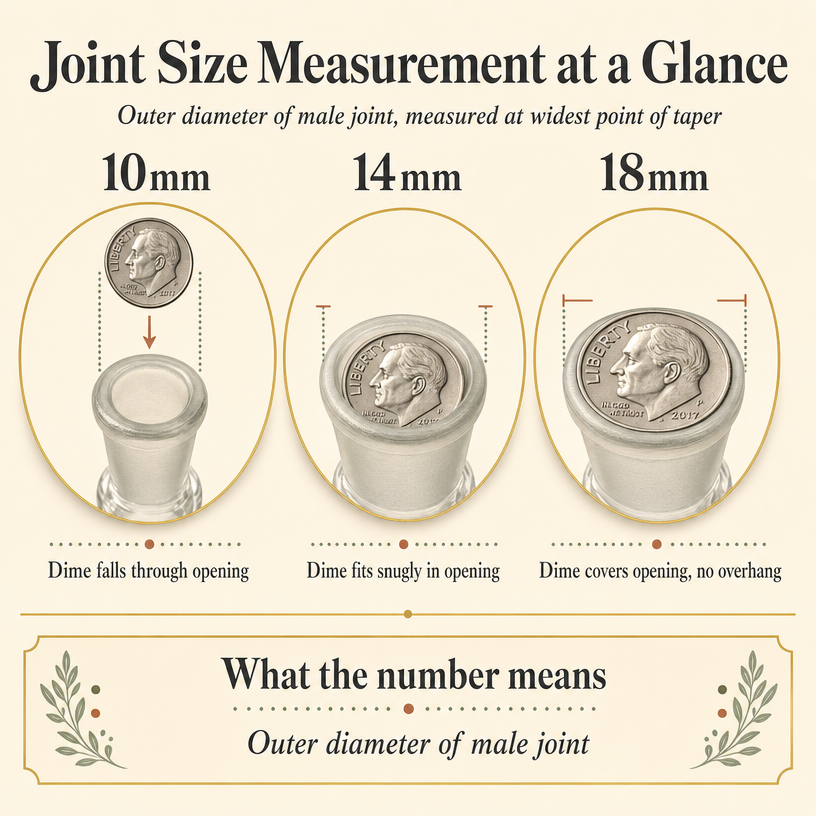
- Step 1: do the dime test first. Dime falls through = 10mm, dime fits snugly = 14mm, dime covers with no overhang = 18mm [5].
- Step 2: confirm with a ruler at the widest point of the taper. 13.5 to 14.5mm means 14mm, and 17.5 to 18.5mm means 18mm [1].
- Step 3: read the result by rounding to the nearest standard size, since a tenth of a millimeter of slop is normal in mass-produced glass.
- Step 4: note the gender. The bong joint is usually female, and the bowl or downstem is usually male, so you know which side of the pair to shop for.
Start with the dime test because it is the fastest. A US dime is about 17.91mm across. Hold it flat over the female opening of the joint. If the dime covers the opening with no overhang, the joint is 18mm. If the dime fits snugly so the edge of the opening just touches the edge of the dime, it is 14mm. If the dime falls through the opening, the joint is 10mm [5].
Cross-check with a ruler because glass can drift a hair from the exact spec. Measure the widest part of the taper. Anything between 13.5mm and 14.5mm reads as 14mm. Anything between 17.5mm and 18.5mm reads as 18mm. Anything under 12mm reads as 10mm [1]. A small amount of slop is normal, so when in doubt round to the closest standard size.
The joint on your bong is almost always female, while the bottom of a bowl or a downstem is almost always male. That single fact guides everything you buy next, because gender decides what fits.
Read What Are the Parts of a Bong, Rig, or Pipe and How Do They Work? for more detail.
Read What Is the Difference Between a Bubbler and a Bong? for more detail.
How Do Male and Female Joints Work Together?
Every glass joint is either male or female, and the two types only seal when they are opposite genders. A male joint has the taper on the outside, so it slides into something. A female joint has the taper on the inside, so it receives something. Put them together the right way and they form an airtight seal [1].
- Male joint: the taper is on the outside, the joint inserts into a matching opening, and the opening on the bottom of a typical bowl is male.
- Female joint: the taper is on the inside, the joint receives a male piece, and the joint on a typical bong is female.
- How they seal: a male taper slides into a female taper of the same size, and the 1:10 grind makes the contact airtight across brands [1] [3].
- What will not work: same-gender pairings, even at the same diameter. A male-to-male or female-to-female connection leaves a gap and will not seal.
- Quick gender check: if the opening looks like a cup, it is female. If the opening looks like a plug, it is male.
On most bongs, the joint that holds the bowl or downstem is female. The bowl and the downstem itself carry matching male tapers, so they drop into the bong by default.
Same-gender parts will not seal. A male bowl pressed into a male bong opening leaves a ring of gap, and a female bowl dropped over a female opening wobbles and leaks air. The quick way to tell what you have is to look at the joint opening: a female joint looks like a small cup, while a male joint looks like a small plug.
Which Joint Size Goes With Which Bong Size?
Joint size and bong height tend to move together. Smaller pieces run 10mm, mid-size pieces run 14mm, and the largest pieces run 18mm. The match is not a hard rule, but it is what you will see most often on store shelves, so it is the easiest thing to shop for [1].
- 10mm: paired with mini bongs, bubblers under 8 inches, and most dab rigs. Smallest accessory inventory of the three.
- 14mm: paired with bongs 8 to 16 inches tall. By far the largest accessory inventory, so replacement parts are easy to find.
- 18mm: paired with bongs over 16 inches tall. Smaller inventory than 14mm, but most major part types are still easy to find.
- Pairing rule of thumb: short piece plus small joint, tall piece plus larger joint, mid-size piece plus 14mm as the default.
14mm is dominant because it pairs with the most popular piece size, the 8 to 16 inch bong. Manufacturers stock the widest range of 14mm bowls, downstems, and Ash Catchers for that range [1]. When you replace a part on a typical bong, the part you want is almost always 14mm.
18mm is worth choosing when you want a taller piece or a wider airflow at the joint. 18mm parts are still common, just less common than 14mm. 10mm shows up on mini bongs, on most dab rigs, and on bubblers under 8 inches, where a smaller joint keeps the piece proportional.
| Joint size | Typical piece height | Accessory availability |
|---|---|---|
| 10mm | Under 8 inches | Limited but covers bowls and basic parts |
| 14mm | 8 to 16 inches | Widest selection of any size |
| 18mm | Over 16 inches | Wider part range than 10mm, smaller than 14mm |
Can You Mix Joint Sizes With Adapters and Reducers?
Adapters and reducers are how you mix sizes without replacing the whole bong. They are small pieces of ground glass with a different size or gender on each end, and they drop straight into your existing setup [1].
- Step 1: figure out both your joint sizes and genders before you buy anything, then match the adapter to the bong’s joint first.
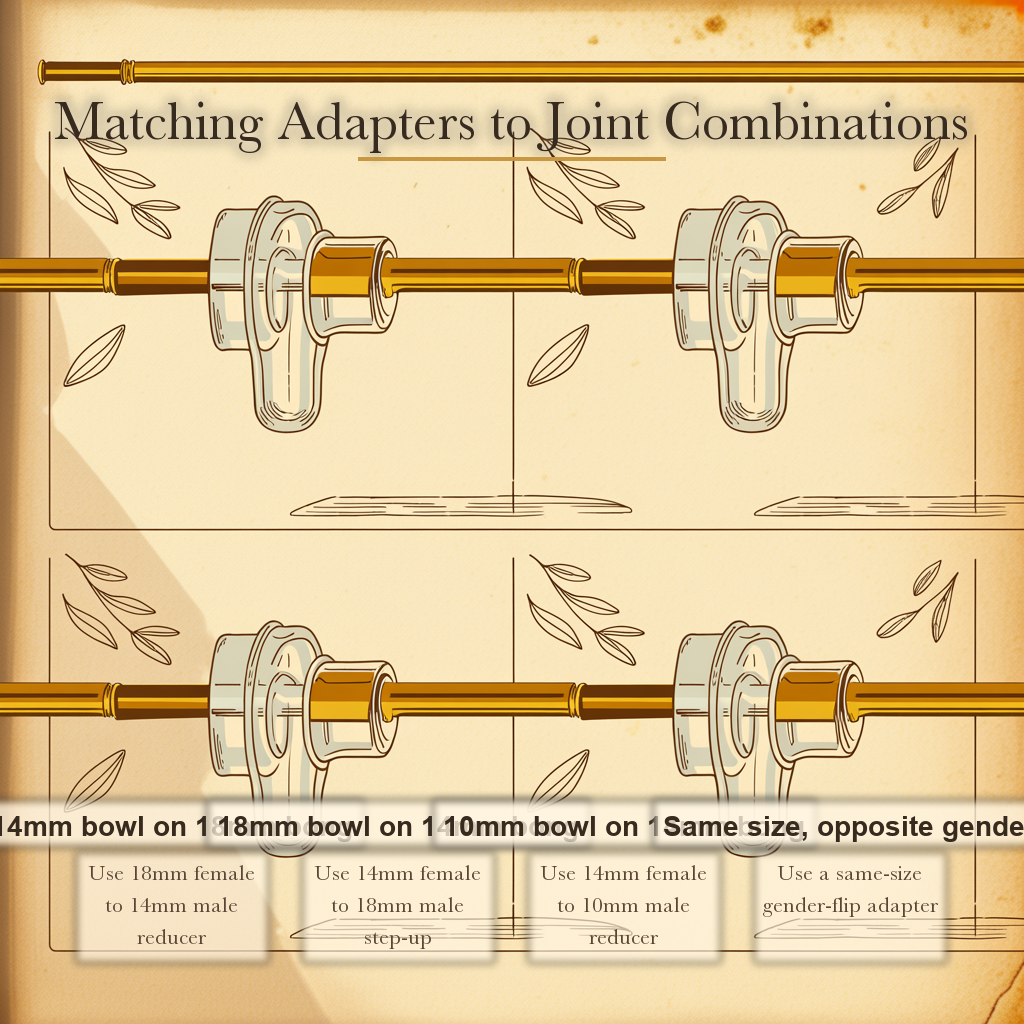
- Step 2: most common mismatch, a 14mm bowl on an 18mm bong, needs an 18mm female to 14mm male reducer [1].
- Step 3: the reverse setup, an 18mm bowl on a 14mm bong, needs a 14mm female to 18mm male step-up adapter.
- Step 4: small reductions like a 10mm bowl on a 14mm bong use a 14mm female to 10mm male reducer.
- Step 5: same-size opposite-gender fixes call for a gender-flip adapter that keeps the diameter identical.
The most common mismatch is a 14mm bowl on an 18mm bong, since most people have a few 14mm bowls around before they buy an 18mm piece. The fix is an 18mm female to 14mm male reducer, which sits in the 18mm female joint of the bong and gives the 14mm bowl something to seal into.
Less common but still regular, you will see an 18mm bowl on a 14mm bong. That needs the reverse, a 14mm female to 18mm male step-up adapter that widens the joint to accept the bigger bowl. Smaller reductions, like a 10mm bowl on a 14mm bong, take a 14mm female to 10mm male reducer.
Same-size, opposite-gender combos also come up. A small gender-flip adapter handles those cases without changing the diameter.
How Do You Pick the Right Bowl, Downstem, or Ash Catcher for Your Joint?
The purchase checklist for any bowl, downstem, or ash catcher comes down to four checks: diameter, gender, piece size, and the label. Run the four checks in order and you will not end up with a part that does not fit your bong.
- Step 1: confirm the diameter. The number on the part has to match the number on your bong joint: 10mm, 14mm, or 18mm [1].
- Step 2: confirm the gender. Male bowl into female bong is the default for most setups.
- Step 3: match the part to your piece height. Smaller bowls for shorter pieces, larger bowls for taller pieces.
- Step 4: verify the label on the product page or packaging before checkout to make sure both size and gender match what you ordered.
Diameter is first because it is the dealbreaker. If the diameter on the new part does not match the diameter on your bong joint, nothing else matters. Even a perfect taper and gender will not save a size mismatch [1].
Gender is second and usually flips with the diameter. A 14mm male bowl drops into a 14mm female bong. If you need the opposite, you will need a reducer or step-up adapter instead of buying a different bowl.
Piece size and label come last. Match the part to the height of your bong for airflow and proportion, and read the label on the product page or packaging for the size and gender printed on it. A quick double-check before checkout saves a return.
See test yeeet as one current product example.
What Should You Look for in a Compatible Upgrade?
Once you know your joint size, the same number unlocks the rest of the Parts and Upgrades category. The joint-size standard is what lets you swap in a quartz banger, a percolator downstem, an ash catcher, or an adapter without remeasuring the bong [1] [2].
- Quartz bangers: a heat-tolerant bucket for rigs in 10mm and 14mm.
- Percolator downstems: extra diffusion through the joint, available in 14mm and 18mm.
- Ash catchers: an add-on joint that catches debris before it hits the main piece, in 14mm and 18mm.
- Adapters and reducers: every common size and gender combination, used when an upgrade does not match the original joint.
- Treehouse Lifestyle ships in-stock upgrades and parts with free shipping on orders $150+.
Look for upgrades that share the standard taper, since those will drop straight in. The same diameter and gender rules apply, and an adapter can bridge almost any leftover mismatch.
Treehouse Lifestyle stocks the main upgrade types in the matching sizes: bowls, Downstems, ash catchers, and adapters built to the standard taper. Pick the upgrade by what you want to add to the piece, and then let the joint size decide which listing to buy.
What Are Common Questions About Smoking Accessories?
What are the three standard glass joint sizes and which is most common?
The three standard sizes are 10mm, 14mm, and 18mm. 14mm is the most common, used on most bongs between 8 and 16 inches tall, so 14mm bowls and downstems are the most widely stocked [1].
How do I measure my bong’s joint size at home?
Use the dime test. Cover the female joint opening with a US dime, which is about 17.91mm across. If the dime covers the opening with no overhang, the joint is 18mm. If the dime fits snugly, the joint is 14mm. If the dime falls through, the joint is 10mm. Cross-check with a ruler at the widest point of the taper: 13.5 to 14.5mm means 14mm, 17.5 to 18.5mm means 18mm [1] [5].
What is the difference between male and female joints?
A male joint has the taper on the outside, so it inserts into a matching opening. A female joint has the taper on the inside, so it receives the male piece. A male bowl fits into a female downstem or bong opening. A same-gender pairing will not seal [1].
Can I use a 14mm bowl on an 18mm bong?
Yes. A glass adapter or reducer bushing stepped from 18mm female to 14mm male lets a 14mm bowl sit in an 18mm female joint. Make sure the adapter gender matches the bong joint so the seal is airtight [1].
Why is 14mm the most widely available joint size?
14mm is the standard size for the most popular bong height range, roughly 8 to 16 inches, so manufacturers stock the largest selection of 14mm bowls, downstems, and accessories. That wider inventory is why most replacement parts you find will be 14mm [1].
Where Do You Go From Here on Glass Joint Sizes?
The three standard glass joint sizes, 10mm, 14mm, and 18mm, cover nearly every bong, dab rig, and bubbler you will run into [1] [2]. Pick up a dime and a ruler, run the test on your joint, and you will know both the size and the gender in under a minute [5].
Once you know the diameter and the gender, the rest of the choice is straightforward. Match the part to the diameter, match the gender, and add a reducer or adapter if you want to mix sizes. With that in hand you can drop in a new bowl, swap a downstem, or add an ash catcher without remeasuring anything.
Treehouse Lifestyle carries the bowls, downstems, ash catchers, and adapters that match each standard size, with free shipping on orders $150+. Browse the parts that fit your joint and you will find an upgrade that drops straight in.
Where Does This Smoking Accessory Information Come From?
- DankStop: Bong Bowl Sizes: 10mm vs 14mm vs 18mm
- Wikipedia: Ground glass joint
- Bacto Laboratories: Glassware, Conical Joint Sizes Explained
- Laboratory Supply Network: Guide to Glass Joint Sizes & Nomenclature
- 420 Science: Measuring your Bowl or Downstem