

A bong not pulling is almost always restricted between the bowl and mouthpiece: water too high, a clogged downstem or percolator, an over-packed bowl, a downstem that is too long, or a joint leaking pressure [1]. Pull with the bowl out. Easy means the bowl, tight means water or a clog, airy means a seal [5]. Drag that never changed is design, not a fault [2].
Why Is My Bong Suddenly Not Pulling Like It Used To?
Weak suction is a symptom, not a verdict on the piece. Air travels from the open bowl, down through the stem, out through the water, and up the neck to your mouth. Anything that narrows that path adds resistance, and anything that opens a second path lets pressure escape before it reaches you [1]. Both failures feel like a bong that will not pull, but they behave differently the moment you test them.
The reason it feels sudden is that build-up is gradual. Resin and debris narrow the smallest openings first, so the pull degrades over weeks without a single moment of failure [5]. You notice it the day a piece that used to clear in one breath suddenly does not.
There are also two opposite failure directions, and mixing them up sends people after the wrong part. Too much resistance feels heavy and blocked. Too little water feels empty and airy, with weak bubbling [4]. Decide which of those two you are feeling before you assume the glass is broken.
Most of these are part problems, not piece problems. The Downstems category is where to compare length and joint size, because those two numbers decide how deep the stem sits. For a wider look at chamber designs, browse Bongs, and for the diffusion question specifically, read What Is a Percolator Bong and How Does It Work?.
- Water sitting too high above the downstem openings, which forces smoke through a taller water column
- Clogged openings in the downstem ports, percolator holes, ash catcher, or bowl
- An over-packed or caked bowl blocking airflow at the very start of the system
- A downstem that is too long or badly fitted for the chamber, so it sits deeper than it needs to
- A loose or mismatched joint that bleeds pressure before smoke reaches the water
- A pull that feels empty rather than heavy usually means the water is too low, not that something is clogged
- Gradual resin build-up hides the cause, so the restriction often sits in the part with the tightest passages rather than the part that looks dirtiest
Should You Pull Through an Empty Bowl First to Find the Blockage?
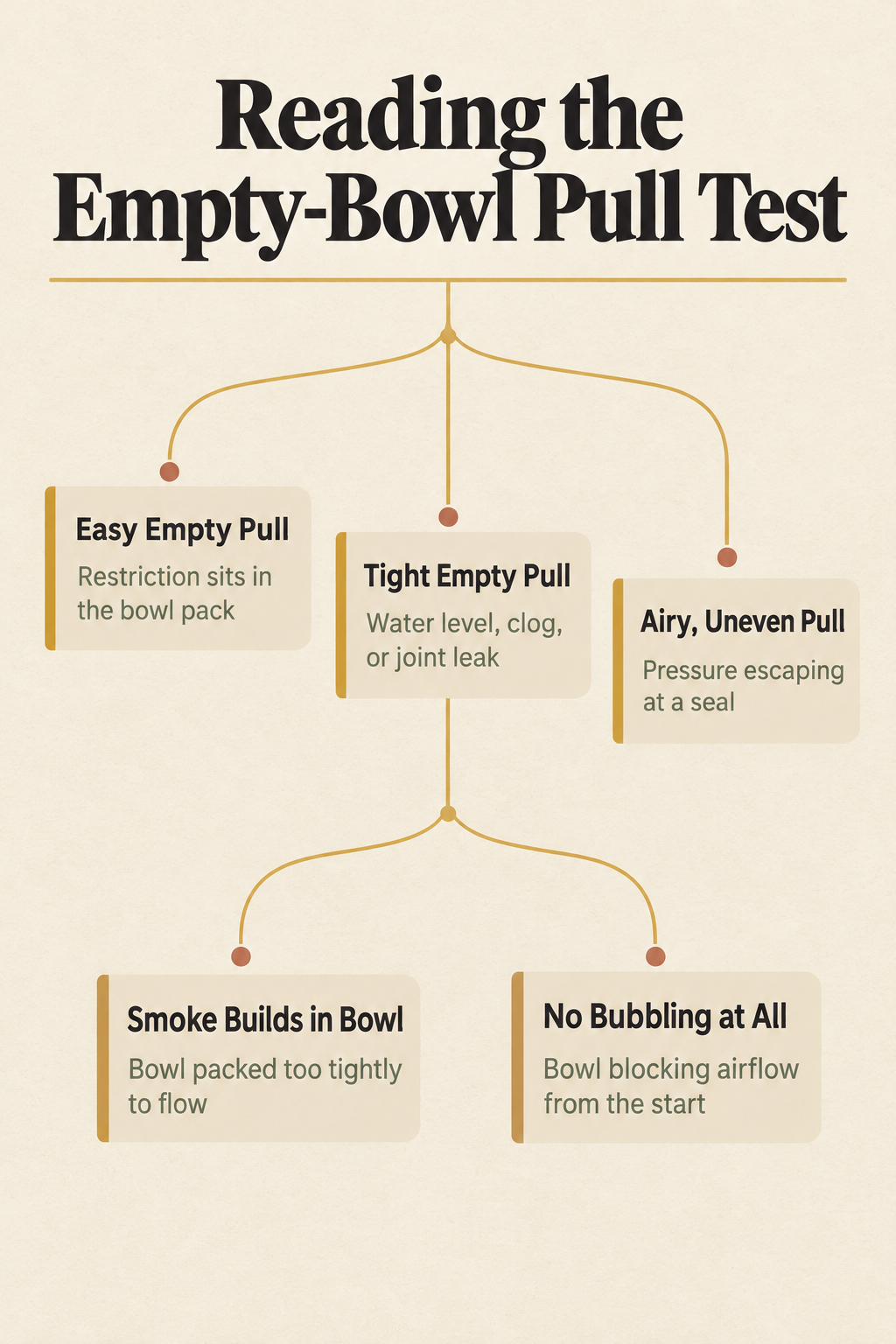
Yes, and it should be the first thing you do. Lifting the bowl splits the whole system in two at the joint: everything upstream of that joint, and everything downstream. One pull tells you which half to work on [1].
An easy empty pull points at the bowl pack or the grind. An empty pull that still feels tight points downstream, at the water level, a blocked downstem or percolator, or a leaking joint. An inconsistent, airy pull points at a seal [5]. Run the sequence below and you will have a specific suspect in under a minute.
If you want the full part-by-part tour before you start testing, What Are the Parts of a Bong, Rig, or Pipe and How Do They Work? names every piece and what it does, and What Are the Parts of a Bong and What Does Each One Do? is a shorter version of the same walkthrough. When the empty pull points at the stem, How Do You Choose the Right Downstem for Your Bong? covers sizing, and if the stem will not come out at all, How Do You Remove a Stuck Downstem Without Breaking the Glass? covers the removal method that does not end in broken glass.
Write down what you felt, even roughly. Tight with the bowl in but easy with it out leads somewhere completely different from tight either way, and guessing between the two is how people buy parts they did not need [4].
- Remove the bowl completely so the joint is wide open
- Pull through the open joint at normal strength and listen
- Repack the bowl normally and repeat the pull for comparison
- Note whether smoke appears in the water, in the bowl, or nowhere
- Listen for a whistle or hiss that suggests escaping pressure
- Press the parts together firmly and pull again to see whether bubbling changes
How Much Water Should Be in a Bong for a Normal Pull?
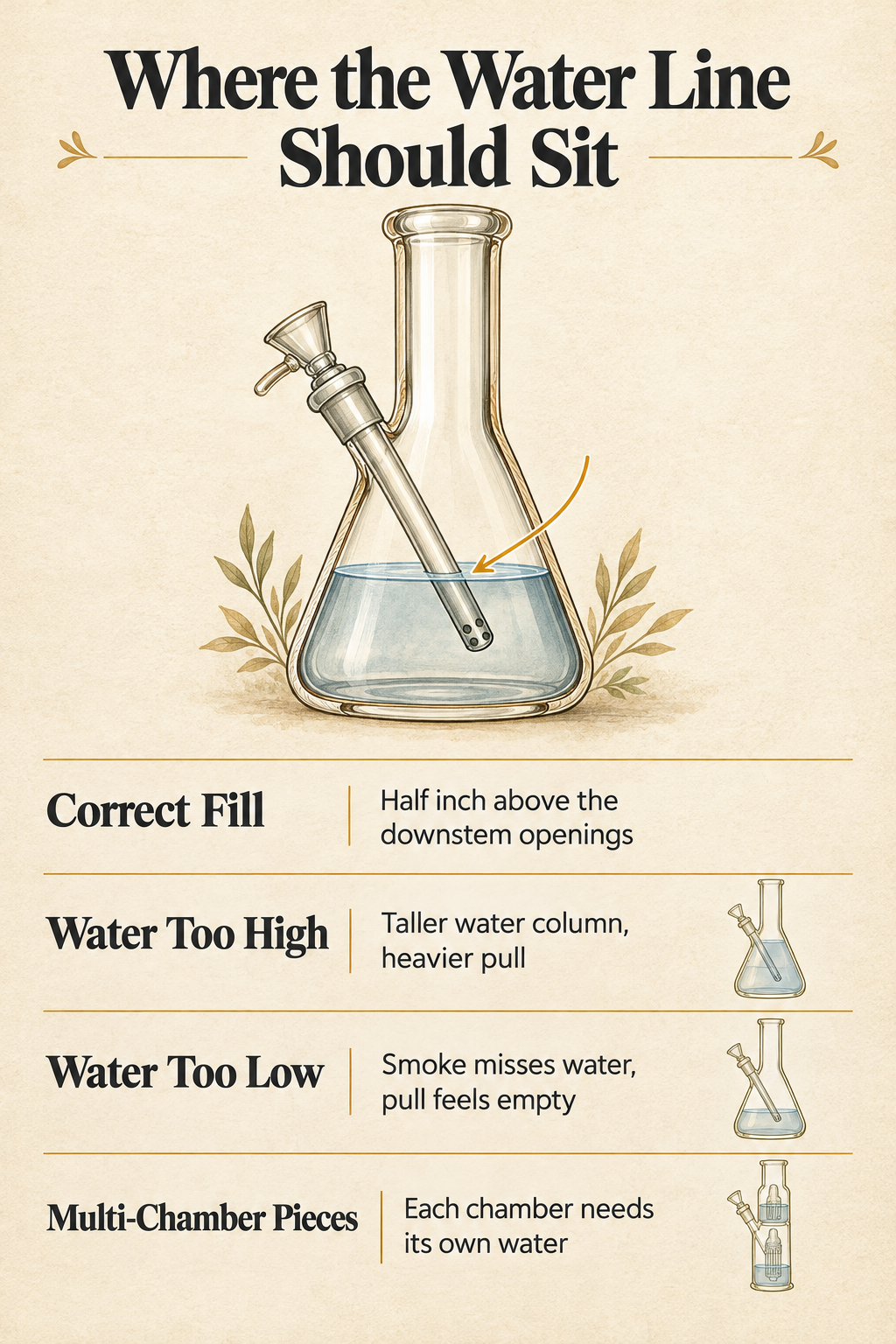
Fill so the water sits roughly half an inch above the downstem openings. One-half to one inch above the openings is the range most guides describe as workable [1]. That level covers the openings so smoke passes through water without making it climb a tall column.
Water sitting too high is the most common and quickest-to-fix cause of a hard pull. Every extra inch of water above the openings lengthens the path the smoke has to travel, and that shows up as a heavy, dragging pull [5].
Water sitting too low is the opposite failure. If the level drops below the openings, smoke never passes through water at all, so you get little or no bubbling and the pull feels empty rather than blocked [4]. People often read that as no suction when the piece is actually wide open.
Multi-chamber and percolator pieces need water in more than one place. Fill the base chamber first, then add water to the upper chamber or percolator section until it just covers the internal openings. A new percolator piece that feels wrong on its first fill is usually underfilled in the second chamber rather than defective [2].
Fill with the stem seated and look through the glass from the side. The water line should sit just above the openings, not halfway up the chamber. Pour a little out and pull again before you take anything apart, because this is the cheapest test in the guide.
- Fill about half an inch above the downstem openings, and keep one inch as the outer edge of normal
- Overfilled: heavy, dragging pull with sluggish bubbling
- Underfilled: empty, airy pull with little or no bubbling
- Multi-chamber pieces: water in each chamber, not just the base
- Percolator pieces: cover the internal openings without drowning them
- Recheck the level after every water change, because small pieces shift a lot per ounce
Is It the Bowl, the Downstem, or the Percolator That Is Blocked?
All three present as a hard pull, and they need different fixes. The one test that separates them is the empty-bowl pull from the section above: if removing the bowl fixes the pull, the restriction is in the bowl. If it does not, the restriction is downstream [1].
A bowl packed too tightly, or caked with resin and ash, blocks airflow at the very start of the system. The tell is that little or no bubbling appears until you lift the bowl, and smoke may build up in the bowl without moving anywhere [4].
A partially clogged downstem narrows the openings the smoke actually uses. The remaining holes have to carry more of the airflow, so resistance rises across the whole piece even though the stem still looks mostly clear [3].
A blocked percolator or internal chamber does the same thing one stage further in. An ash catcher adds a fourth restriction ahead of the main chamber, and it is easy to overlook because it sits below the bowl and collects residue first [5].
Because resin and debris narrow the smallest openings first, the restriction is often in whichever part has the tightest passages, not the part that looks dirtiest. That is why a visual check alone misleads people into replacing the wrong component.
Work from the bowl backward: bowl, then ash catcher if you run one, then downstem, then percolator. The first part whose removal restores an easy empty pull is the part to clean or replace.
- Bowl: pull is blocked with the bowl in and normal with it out, and smoke collects in the bowl instead of moving
- Downstem: tight pull either way, bubbling is weaker than usual, and the openings look narrowed or filmed
- Percolator: tight pull either way, and only some of the internal openings bubble
- Ash catcher: tight pull with everything assembled, easier once the catcher is removed
- Resin and debris narrow the smallest passages first, so the restriction is often not in the part that looks dirtiest
- One test separates them: an empty-bowl pull that clears easily points to the bowl, and one that stays tight points downstream
| Part | What you feel | What actually fixes it |
|---|---|---|
| Bowl | Blocked with the bowl in, normal with it out; smoke gathers in the bowl | Loosen the pack, clear the screen, clean the bowl |
| Ash catcher | Tight with everything assembled, easier once the catcher is off | Soak the catcher, or run the piece without it |
| Downstem | Tight either way, weaker bubbling, openings look narrowed or filmed | Soak in isopropyl with coarse salt, then re-test |
| Percolator | Tight either way, and only some internal openings bubble | Longer soak, then confirm the downstem is seated |
How Do You Know If Your Bong Is Leaking Air at the Joint?
A seal failure mimics a clog but behaves differently. A loose or mismatched joint at the bowl or downstem connection bleeds pressure before smoke reaches the water, so the pull feels weak and uneven rather than heavy [4].
The signature signs are a whistling sound, bubbling that only appears when you hold the parts tightly together, and a pull that changes depending on how the bowl happens to sit. Hairline cracks show up the same way: lost pressure with no visible clog anywhere [2].
If the pull changes when you press or hold a part, you have found a seal problem rather than a clog. A mismatch between joint sizes causes the same symptom, so check that the bowl and stem seat flush. Replacement Parts is the fastest way to compare joint sizes and gaskets when you need to match a part. Replace the worn part rather than tightening your grip on a joint that cannot seal [1].
- Seat the bowl firmly and re-pull at the same strength
- Listen for a whistle or hiss at the joint
- Seal the joint by hand and compare the two pulls
- Inspect the joint for chips, cracks, or a worn gasket
- Wiggle the bowl while pulling to see whether airflow changes
- Swap in a known-good bowl or stem to isolate the part from the piece
Can a Downstem That Is the Wrong Length Make the Pull Harder?
Yes, and this is the fit problem readers rarely suspect. A downstem that is too long for the piece reaches deeper into the chamber, so it sits further under water and lengthens the water column the smoke has to travel through [1].
The correct fit places the downstem openings just below the water surface rather than down near the chamber floor. That is why the same water level can feel fine in one piece and heavy in another: the inches of water above the openings matter, not the inches of water in the glass [2].
A short downstem changes bubbling instead of resistance. If the openings sit above the water line no matter how you fill it, smoke skips the water entirely and the pull feels empty rather than tight. That is a fit problem too, just in the other direction.
Check fit with the stem seated and the piece filled to its normal level. If the openings are near the floor of the chamber, the stem is longer than the piece wants, and a shorter replacement is the fix rather than a new bong. Joint diameters and sizing by piece are covered in How Do You Choose the Right Downstem for Your Bong? rather than here.
If the openings sit exactly right but the pull is still heavy, length is not your problem and you should go back to the clog and seal checks. Fit explains a consistent heavy pull, not one that changes from day to day.
- Seat the stem fully, fill to normal level, and look at where the openings sit relative to the water line
- Openings a half inch to an inch under the surface is a normal fit
- Openings near the chamber floor mean the stem is too long for the piece
- Openings above the water line, with no bubbling, mean the stem is too short
- A length problem keeps the pull consistent rather than changing day to day
- A clog problem usually gets worse over weeks, which is how you tell the two apart
How Do You Clean a Clogged Downstem or Percolator Without Breaking the Glass?
Most restricted pulls resolve with a proper clean, and borosilicate glass tolerates a standard isopropyl alcohol soak without damage. Coarse salt added to the soak acts as a gentle abrasive that reaches into slits a brush cannot [3].
A hot water and coarse salt soak can clear a sluggish draw in a round or two. Heavily clogged pieces sometimes need a 30-minute soak, and a badly caked percolator may need to sit overnight [3].
Handle the alcohol with care. Isopropyl alcohol is a Class IB flammable liquid with a flash point of 53 degrees Fahrenheit, and NIOSH lists inhalation, ingestion, and skin or eye contact as exposure routes, with irritation of the eyes, nose, and throat among the symptoms [6]. Keep it away from flame, work in a ventilated space, and never soak a piece while it is hot.
If the downstem is stuck, do not pull straight. Soak just the joint area in isopropyl alcohol for 15 to 20 minutes, then twist gently, because twisting shears the resin bond gradually while a straight pull concentrates force on one point of the glass. Metal tools and boiling water are specifically discouraged [3].
Between deep cleans, change the water after each session, rinse with hot water, and clean every few uses rather than waiting for a full clog. A screen in the bowl keeps ash and plant matter from reaching the downstem in the first place [5].
- Remove the bowl and any stem that comes out freely
- Rinse with hot water to loosen the top layer of residue
- Submerge the part in isopropyl alcohol and add coarse salt
- Cap the openings and shake gently, or soak 15 to 30 minutes
- Rinse with hot water until the water runs clear and no salt remains
- Reassemble, refill correctly, and confirm airflow with an empty bowl
What Should You Check Before Replacing a Bong That Will Not Pull?
Run the checks in order of cost, because the expensive answer is rarely the right one. Each item below takes about a minute and rules out a cause permanently [4].
If all six come back clean and the pull is still hard, the piece may simply be built that way. Bongs with heavy percolation or more diffusion naturally add drag, so a percolator piece that pulls harder than a simple straight tube is behaving as built rather than failing [2].
When a part is the confirmed cause, replace the part. A bowl fixes a bowl restriction, a downstem fixes a length or fit problem, and an ash catcher moves the collection point ahead of the main chamber so the stem stays clearer between cleans [1]. If you are stocking a couple of spares at once, free shipping on orders $150+ applies.
- Confirm the water level sits about half an inch above the downstem openings
- Pull with an empty bowl to locate the restriction
- Clean the downstem and percolator, then re-test
- Seat every joint firmly and listen for a whistle or hiss
- Check that the downstem openings sit just under the water line
- Inspect for hairline cracks near the joint and the base of the neck
Frequently Asked Questions
Why does my bong pull fine without the bowl but feel blocked once I pack one?
That points at the bowl itself. A bowl packed too tightly, or caked with resin and ash, restricts airflow at the very start of the system, so the pull feels blocked with the bowl in place and normal the moment you lift it out. Loosen the pack, clear the bowl screen, and re-test at the same water level.
How much water should I put in my bong so it pulls normally?
Fill so the water sits roughly half an inch above the downstem openings, with about one-half to one inch above the openings described as the working range. If the water sits higher than that, the smoke has to travel through a taller water column and the pull gets heavier.
Can too much water make a bong hard to pull?
Yes, and it is the most common quick fix. Water sitting too high above the downstem openings adds resistance because the smoke travels through a taller column of water. Pour a little out until the level is just above the openings and pull again before you suspect any part of being clogged.
How do I know if the downstem is the problem and not the bowl?
Pull through the piece with the bowl removed. If that empty pull is easy, the bowl was your restriction. If it is still tight, the problem is downstream of the bowl, which means water level, a clogged downstem or percolator, or a leaking joint, and the downstem is the next thing to inspect and clean.
Is my bong broken if it has always pulled harder than other pieces?
Not necessarily. Pieces with heavy percolation or more diffusion naturally add drag, so a percolator bong can pull harder than a simple straight tube by design rather than from a fault. If the pull has never changed, check water level and cleanliness first, then read the extra drag as the character of the piece.
What Is the Fastest Way to Fix a Bong That Will Not Pull?
Pull with the bowl out first, because that single test sends you to the right half of the piece. An easy empty pull means the bowl pack is the problem. A tight empty pull means water level, a clog, or a leaking joint. An airy and uneven pull means a seal.
Then fix in order of cost: adjust the water to about half an inch above the openings, clean the downstem and percolator, reseat the joints, and confirm the stem length suits the chamber. Most pieces come back to a normal pull somewhere in that list.
Replace a part only after the checks point at it, and read heavy percolation drag as design rather than damage. The goal is not a bong that pulls with no effort. It is one that pulls the way it was built to.
Sources
- Thick Ass Glass: Bong Drag: What It Means and How to Fix It
- Stoked Progressive Smoke Shop & Glass Gallery: Why is My Bong Not Pulling?
- Grasscity USA: How to Unclog a Bong & Remove a Stuck Downstem Safely
- Bongs Canada: Why Is My Bong Not Bubbling? Common Fixes
- Encore Collection: Why Won’t My Bong Hit? Airflow Fixes
- National Institute for Occupational Safety and Health (NIOSH), CDC: NIOSH Pocket Guide to Chemical Hazards: Isopropyl alcohol