

Choose a downstem by matching three fit details first: the bong joint size, the bowl joint size, and the insert length. Then confirm the joint gender and pick between a simple open-end stem or a diffused design. Material matters too, but a durable downstem is useless if its dimensions do not seal inside the piece. This guide walks through each decision in the order a shopper should make it.
A downstem is the small tube that connects the bowl joint to the water chamber of a bong. Getting the right one is mostly about measuring carefully before you buy, not about spending more. Once the three fit details are correct, the rest of the choice is a matter of style and material preference.
What Does a Downstem Do in a Bong?
A downstem is the bridge between the bowl slide and the water inside a bong. One end sits in the bong’s joint, and the other end holds the bowl. When the bowl is in place, the downstem channels smoke down into the water chamber so it can pass through the water before rising up the mouthpiece.
Most downstems are simple open-end tubes, but a diffused downstem has slits or small holes at the submerged tip [1]. Those openings break the smoke into smaller bubbles, which increases the amount of contact between the smoke and the water. The position of the downstem also matters: it should sit low enough that the tip is fully submerged, but high enough to leave a small gap above the bottom of the bong so the bubbles have room to form.
If you are new to the parts of a bong, the related guide How Do I Measure My Bong’s Joint Size? explains how to identify the joint on your piece and what each part is called. Knowing the names of the pieces makes shopping for a replacement much easier.
- Connects the bowl joint to the water chamber through the side of the bong.
- Carries smoke down into the water so it can pass through before rising.
- Comes in two main styles: open-end (straight) and diffused (slits or holes at the tip).
- Must match the bong’s joint size, the bowl’s joint size, and the chamber’s insert length.
What Downstem Joint Size Does Your Bong Need?
Standard bong joint sizes are 10mm, 14mm, and 18mm. On full-sized bongs, 14mm and 18mm are the most common sizes, while 10mm usually appears on mini pieces [1]. The number on the label is an approximate diameter of the joint opening. A 14mm joint opening measures about 14.5mm across, and an 18mm joint opening measures about 18.8mm, with the industry rounding to the labeled size [3].
A quick field test uses a US dime, which is about 17.9mm across. A dime slides into an 18mm joint but not a 14mm one [1] — a handy way to tell the two common sizes apart without a ruler. For a deeper walkthrough of the labels, the piece on What Are the Parts of a Bong, Rig, or Pipe and How Do They Work? shows how every part of a bong fits together, and the related guide What Are 10mm, 14mm, and 18mm Glass Joint Sizes? explains the 10mm, 14mm, and 18mm sizes in more detail.
Downstems carry two joint sizes, not one. The first number is the joint that fits into the bong, and the second number is the joint that accepts the bowl slide. A label such as 18/14mm means the downstem fits an 18mm bong joint and accepts a 14mm male slide [4]. Reading both numbers before you order is the single most common way to avoid a sizing mistake.
- Confirm the joint size on your bong first — 14mm and 18mm are most common on full-sized pieces.
- Use the dime test if unsure: a US dime fits inside an 18mm joint but not a 14mm one.
- Read the two-number label on the downstem: first number is the bong joint, second is the bowl joint.
- If the bong joint is 18mm and the bowl is 14mm, look for an 18/14mm downstem.
- Buy a matching bowl at the same time so the second number on the downstem has a slide that fits.
How Do You Measure the Correct Downstem Length?
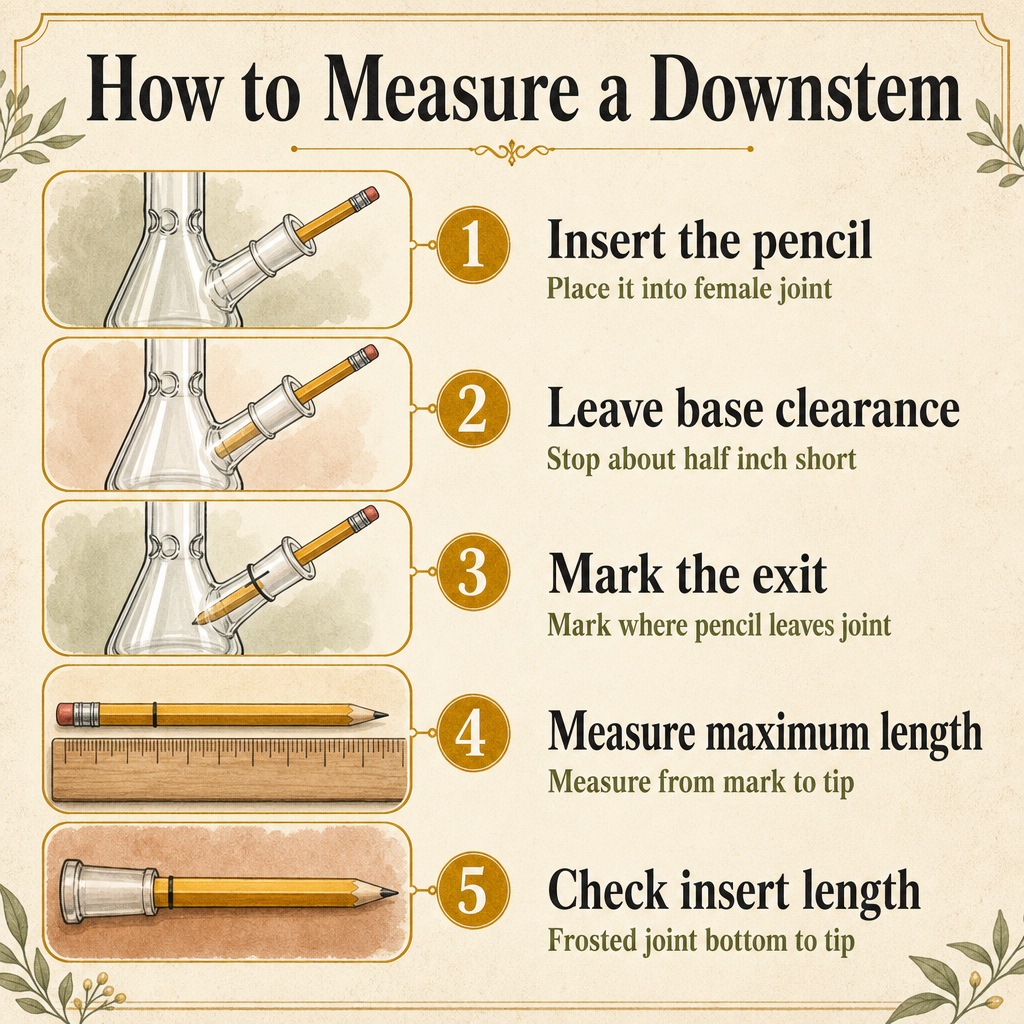
Downstem length is measured as the insert length, which is the distance from the bottom of the frosted joint to the tip of the stem [4]. This is not the same as the overall length of the part, because the joint itself adds extra glass above the insert. When a listing says a downstem is 4 inches long, it almost always means the insert length is 4 inches, not the total part.
The pencil method is the easiest way to estimate the right insert length at home. Insert a pencil (or any straight rod) into the female joint of the bong until it sits about half an inch from the bottom of the base. Mark where the pencil exits the joint, then remove it and measure the distance from the mark to the tip [1]. That measurement is the maximum insert length you should buy.
Standard taper joints use a 1:10 ratio, meaning 1mm of diameter change per 10mm of length [5]. The taper is what creates the wedged seal, so the joint must seat fully to seal properly. For most bongs, common insert lengths run in roughly 1-inch steps from about 2 inches up to about 6 inches. Pick the length closest to but not longer than your pencil measurement, then check the bong’s specs to confirm the catalog number matches.
- Insert length is measured from the bottom of the frosted joint to the tip of the stem.
- The pencil method gives a reliable estimate for the maximum safe insert length.
- Most bongs accept insert lengths in roughly 1-inch steps from 2 to 6 inches.
- Always leave a small gap (about half an inch) between the downstem tip and the bong’s base.
How Do Male and Female Downstem Joints Fit Together?
Joint gender must match in the opposite direction. A bong with a female joint accepts a male accessory, and a bong with a male joint accepts a female accessory [3]. If the gender is wrong, the pieces will not seat, and the seal will not form. This is true for both the joint that goes into the bong and the joint that accepts the bowl, so both ends of the downstem have to match the gender of the part they connect to.
Bong joints follow the standard ground-glass taper convention used in laboratory glassware, which is 1mm of diameter change for every 10mm of length [5]. This standardized taper is what makes parts from different makers interchangeable within the same size and gender. The taper, the size, and the gender all have to match for a proper seal.
A related accessory that uses the same joint rules is the ash catcher. An ash catcher drops into the bong’s joint and adds an extra water chamber, and Ash Catchers shows the range of joint sizes and styles available. Choosing an ash catcher follows the same joint logic as choosing a downstem, so the steps below apply to both.
- Female joint on the bong takes a male downstem and a male bowl slide.
- Male joint on the bong takes a female downstem and a female bowl slide.
- A size mismatch or a gender mismatch will both prevent a proper seal.
- The standard 1: 10 ground-glass taper is what creates the wedged seal between matching parts.
- When in doubt, look at the joint on the bong and count the male versus female connection points.
Should You Choose a Diffused or Straight Downstem?
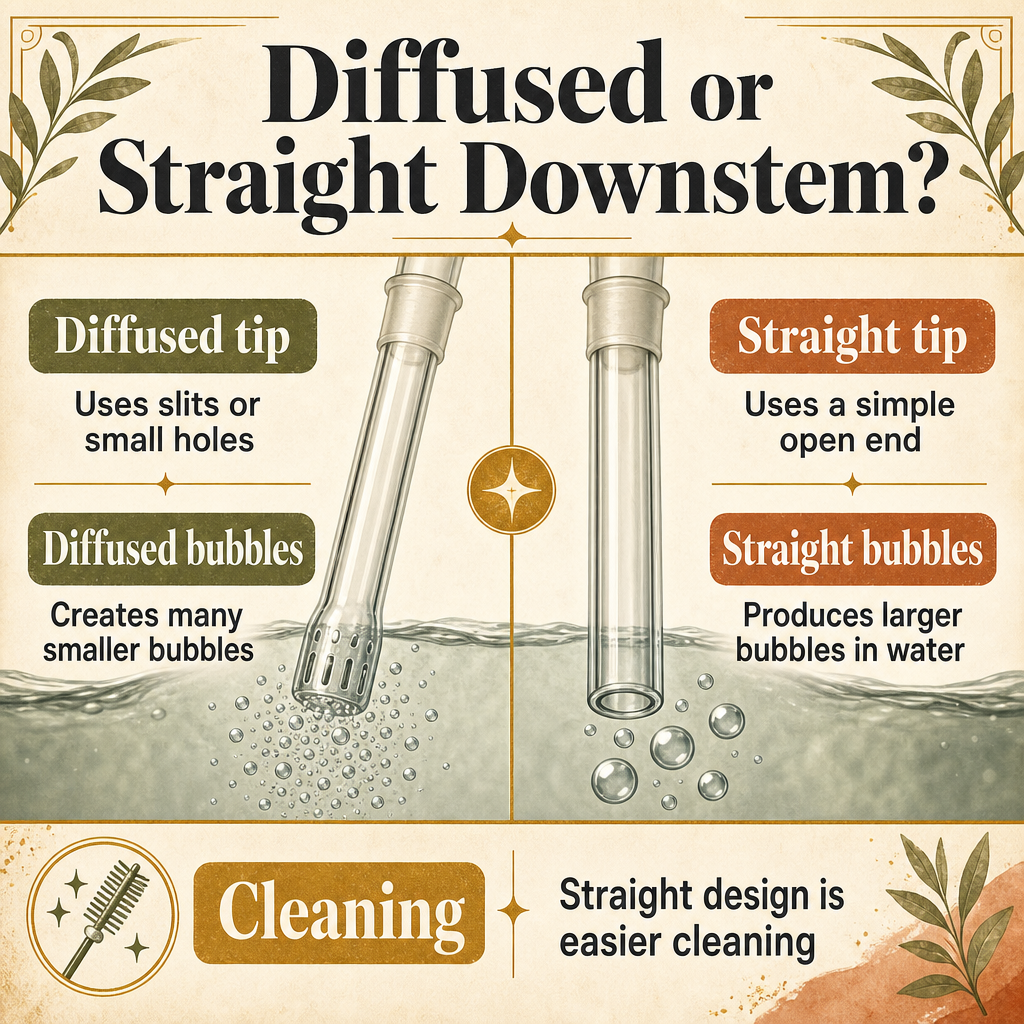
A diffused downstem has slits or small holes at the submerged tip that split the smoke into many smaller bubbles [1]. Each smaller bubble has more surface area in contact with the water, which is the basic mechanical reason diffusion is described as a baseline in the percolator hierarchy [7]. A straight open-end downstem produces larger bubbles and does not have any slits or holes to clean around.
The tradeoff is mostly about cleaning and bubble pattern. A straight stem has a single open end, so it is easier to rinse out and less likely to clog. A diffused stem has more surface area to scrub, but it produces the smaller bubbles that many bong owners prefer. Both styles work in the same bong as long as the joint size and insert length match.
If you want to see the difference in action on a simple piece, the Straight Tube Bongs category features straight tube bongs that are commonly paired with diffused downstems. Trying both styles on the same piece is the clearest way to decide which bubble pattern you prefer.
- Diffused tips use slits or small holes to break smoke into smaller bubbles.
- Smaller bubbles increase the amount of contact between the smoke and the water.
- Straight open-end stems produce larger bubbles and have a simpler shape to clean.
- Diffused stems have more surface area to scrub and can clog if residue is allowed to build up.
- Both styles work in the same bong as long as the joint size and insert length match.
| Feature | Diffused Downstem | Straight Downstem |
|---|---|---|
| Tip design | Slits or small holes under water | Single open end |
| Bubble size | Many smaller bubbles | Larger bubbles |
| Water contact | More surface area per bubble | Less surface area per bubble |
| Cleaning | More crevices to scrub | Simple shape, easier to rinse |
| Best for | Smoother, smaller bubbles | Quick cleaning and simple setup |
Which Downstem Material Should You Choose?
Downstem materials include glass, titanium, and ceramic. Glass is the most common choice, and borosilicate glass is the standard because it resists thermal shock better than ordinary glass [6]. Titanium downstems have the highest durability of the three options, and ceramic sits in the middle for durability while keeping a neutral flavor profile [1].
Flavor neutrality is a key reason glass and ceramic are both common. Glass does not add any taste of its own, and ceramic is similarly neutral. Titanium is favored for toughness rather than flavor, and it is the most common pick for heavy daily use where breakage is the main concern. None of these materials change the way a properly fitting downstem seats against the joint, so the choice is about feel and durability once the fit is locked in.
If you are shopping for a replacement that matches the rest of your glassware, the Downstems category is the place to start. Glass downstems in this category match the look of most bongs, and the listings include the joint size, insert length, and diffusion style so you can pick a direct match.
- Borosilicate glass is the standard for glass downstems because it resists thermal shock.
- Glass is the most common choice and has a clean, neutral flavor profile.
- Titanium has the highest durability of the three materials and is a common pick for heavy use.
- Ceramic is mid-range for durability and also has a neutral flavor profile.
- Material choice is about feel and durability once the size, gender, and length are confirmed.
| Material | Durability | Flavor | Common Use |
|---|---|---|---|
| Borosilicate glass | Standard thermal-shock resistance | Neutral | Most common, matches most bongs |
| Titanium | Highest durability | Neutral to metallic | Heavy daily use where breakage is the main concern |
| Ceramic | Mid-range durability | Neutral | Mid-range option with a clean flavor profile |
What Should You Check Before Buying a Replacement Downstem?
Before clicking checkout, run through this compatibility checklist. Each item is a separate detail that can make or break the fit, and skipping any one of them is the most common reason a replacement downstem does not work in the bong. The order below mirrors the order you should verify them at the product page.
Compare what you found against the downstem product page. Many listings show the joint size, insert length, joint gender, and diffusion style in the title and the first bullet point. If any of those numbers do not match your bong, move on to the next listing rather than guessing.
For ready-made picks that match the bong checklist above, the Replacement Parts category lists replacement parts grouped by joint size and style. If you need more detail on the measuring step itself, the bridge topic on measuring downstems walks through the pencil method with extra examples for unusually shaped bongs.
- Verify the first number on the downstem matches the bong joint size (10mm, 14mm, or 18mm).
- Verify the second number matches the bowl you plan to use.
- Verify the insert length is at or below the maximum pencil measurement for your bong.
- Verify the joint gender (male or female) matches the bong’s joint.
- Verify the diffusion style (straight or diffused) matches your cleaning preference.
- Verify the material (glass, titanium, or ceramic) fits how and where you plan to use it.
Frequently Asked Questions
What size downstem do I need for my bong?
Match the joint that enters the bong, the joint that accepts the bowl, and the insert length. A label such as 18/14mm means the downstem fits an 18mm bong joint and accepts a 14mm male slide.
How do I measure downstem length?
Measure the insert length from the bottom of the frosted joint to the tip, not the part’s overall length. You can also insert a pencil until it sits about half an inch from the base, mark the joint exit point, and measure from the mark to the pencil tip.
What is the difference between 14mm and 18mm downstems?
The labels identify approximate joint-opening diameters. A 14mm joint measures about 14.5mm and an 18mm joint about 18.8mm. A US dime slides into an 18mm joint but not a 14mm joint.
What does a diffused downstem do?
Slits or small holes at its submerged tip split smoke into smaller bubbles and increase water contact. A straight open-end stem creates larger bubbles and has a simpler design that is easier to clean.
Do downstem joint gender and size both matter?
Yes. A female-joint bong takes a male accessory, while a male-joint bong takes a female accessory. Either a size mismatch or a gender mismatch prevents a proper seal.
Ready to Pick the Right Downstem for Your Bong?
A downstem is small, but the choice is mostly about measurement. Start with the bong’s joint size, then confirm the bowl joint size, then measure the insert length, then check joint gender, then pick a diffusion style, and finally choose a material. Treating each step as a separate check is the easiest way to avoid a mismatch and the easiest way to find a replacement that fits the first time.
Once the fit details are right, the rest of the decision is just taste. The Pieces & Upgrades range below makes it easy to compare downstems by joint size, insert length, and style so the order is the last step, not the first. With free shipping on orders $150+, it is easy to bundle a downstem with a matching bowl or an ash catcher and have everything you need shipped together.
Sources
- DankStop: How to Measure and Buy a Downstem: Simple Sizing Guide
- Wikipedia: Ground glass joint
- Badass Glass: 14mm vs 18mm Bong: Explaining the Difference and How to Tell Which You Have
- Thick Ass Glass: Downstem Sizing & Measurement Guide
- University of Wisconsin-Madison Chemistry Department: Connecting Glassware (PDF)
- Thick Ass Glass: Showerhead vs Tree Perc | A Practical Comparison
- Hemper: Understanding Different Types of Bong Percs