

Find your bong’s joint size in minutes using a ruler or caliper — and match the right bowls, downstems, and accessories every time.
Glass joint size is measured as the inner diameter (ID) of the female (socket) component, expressed in millimeters. A "14mm joint" means the female opening is 14mm across at its widest point. To find yours, insert a ruler or caliper into the female joint and measure straight across the inside. That number — 10mm, 14mm, or 18mm — determines every accessory you buy for your bong.
What Is Bong Joint Size and Why Does It Matter?
The joint is the connection point on your bong where accessories like bowls, Downstems, and Ash Catchers attach. Joint size tells you exactly how big that connection point is — and more importantly, whether a given accessory will fit. [1]
- Joint size is the inner diameter (ID) of the female (socket) component, measured in millimeters
- All accessories — bowls, downstems, ash catchers, adapters — share the same joint size system
- A mismatched size means a poor seal, rattling, or cracked glass
- Knowing your joint size before you shop prevents wrong purchases and return shipping hassles
Joint size is expressed as a number in millimeters (mm). That number is the inner diameter of the female (socket) part of your bong. [1] All accessories use the same sizing system, so a 14mm bowl fits a 14mm joint, a 14mm downstem fits a 14mm joint, and so on. The mm number is the universal compatibility language across the entire smoking accessory market. [1]
If the numbers do not match, the accessory will not fit. A 14mm bowl inserted into an 18mm joint will rattle around and create a poor seal. A 10mm accessory forced onto a 14mm joint risks cracking the glass. Knowing your joint size before you shop saves you from wrong purchases, return shipping, and potential damage to your bong. [1]
Treehouse Lifestyle carries a wide range of accessories built around the three most common joint sizes. Whether you need a replacement downstem, a fresh bowl, or an ash catcher to keep your bong cleaner longer, matching the joint size is the first and most important step.
What Are the Standard Bong Joint Sizes?
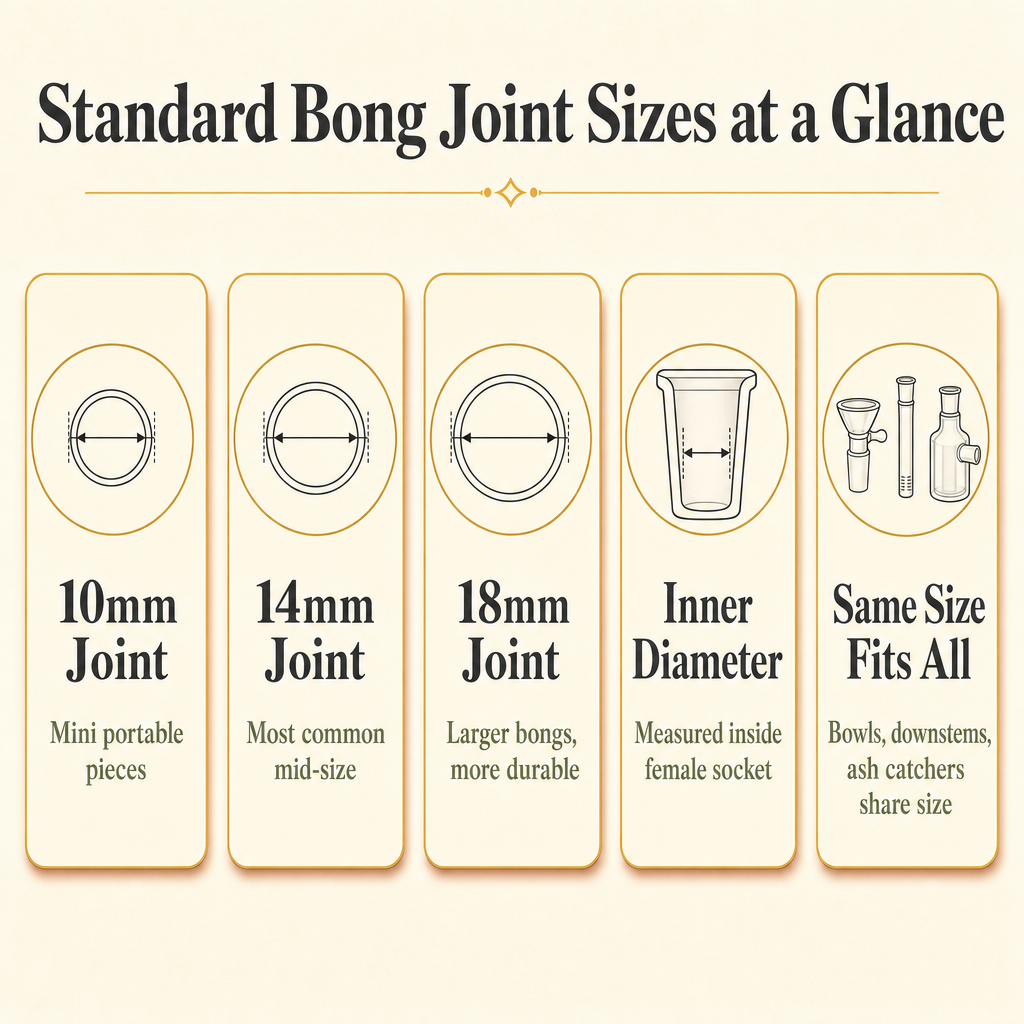
Three numbers cover nearly every bong on the market: 10mm, 14mm, and 18mm. [1] These are not arbitrary — they refer to the inner diameter in millimeters of the female opening. The larger the number, the wider the opening. [2]
- 10mm — Mini portable pieces; lightweight and compact but limited accessory options
- 14mm — The most common mid-size joint; widely supported by all accessory manufacturers
- 18mm — Larger bongs; thicker walls offer greater durability and stability
- 24mm and larger — Specialty and large-volume pieces; less common in consumer market
10mm joints are found almost exclusively on small, portable pieces such as mini rigs and travel-sized bongs. Their small diameter makes them lightweight and compact, but they are less common and offer fewer accessory options. [2]
14mm is the most widely used joint size for mid-size bongs and rigs. It strikes a balance between airflow, durability, and accessory availability. The majority of consumer-grade bongs and water pipes sold in the United States use 14mm joints. [1]
18mm joints appear on larger bongs and are valued for their increased durability and stability. The wider joint wall thickness makes it more resistant to accidental cracks compared to smaller sizes. Larger pieces also tend to use 18mm or even 24mm joints. [2]
You may also see older lab-glass equipment labeled with two numbers such as 14/20 or 19/22. The first number is the inner diameter in mm; the second is the taper length per 10cm of length. [2] Consumer bong joints use only the first number for simplicity, so a 14mm bong joint is roughly equivalent to a 14/20 lab joint.
Read What Are the Parts of a Bong, Rig, or Pipe and How Do They Work? for more detail.
Read What Are 10mm, 14mm, and 18mm Glass Joint Sizes? for more detail.
How Do You Measure a Bong Joint Size?
Measuring a joint takes less than two minutes with a ruler or caliper. The key is measuring the inner diameter of the female (socket) opening, which is where the accessory actually inserts. [1]
- Locate the female (socket) joint on your bong — the inner opening that receives accessories
- Insert a ruler or caliper straight across the inner diameter at the widest point
- Read the measurement in millimeters — that number is your joint size
- Alternative method: measure the outer diameter of a male plug and subtract 2mm for an approximate inner diameter
Start by locating the female joint on your bong. This is the opening with an inner wall — the part that receives the male accessory. It is usually on the main body of the bong near the stem. The female joint looks like a short glass tube with a visible inner surface. [1]
Insert a ruler or digital caliper straight across the opening, keeping it level with the ground (not tilted). Measure the widest point you can see — the inner diameter of that opening. Read the number in millimeters. That is your joint size. [1]
If you only have a caliper and the joint is female, open the caliper jaws and place them against the inner walls of the socket. The reading on the caliper display is your inner diameter. If the joint is male (an outer taper rather than a socket), measure the outer diameter of the widest part of the taper and subtract approximately 2mm to estimate the inner diameter. [1]
For most people, a simple plastic ruler from any office supply store is enough. Place it across the opening as shown in the diagram below, read the mm marking that lines up with the inside edge of the glass wall on both sides, and you have your joint size.
Read How Do You Clean a Bong the Right Way? for more detail.
Male Joints vs. Female Joints: What’s the Difference?
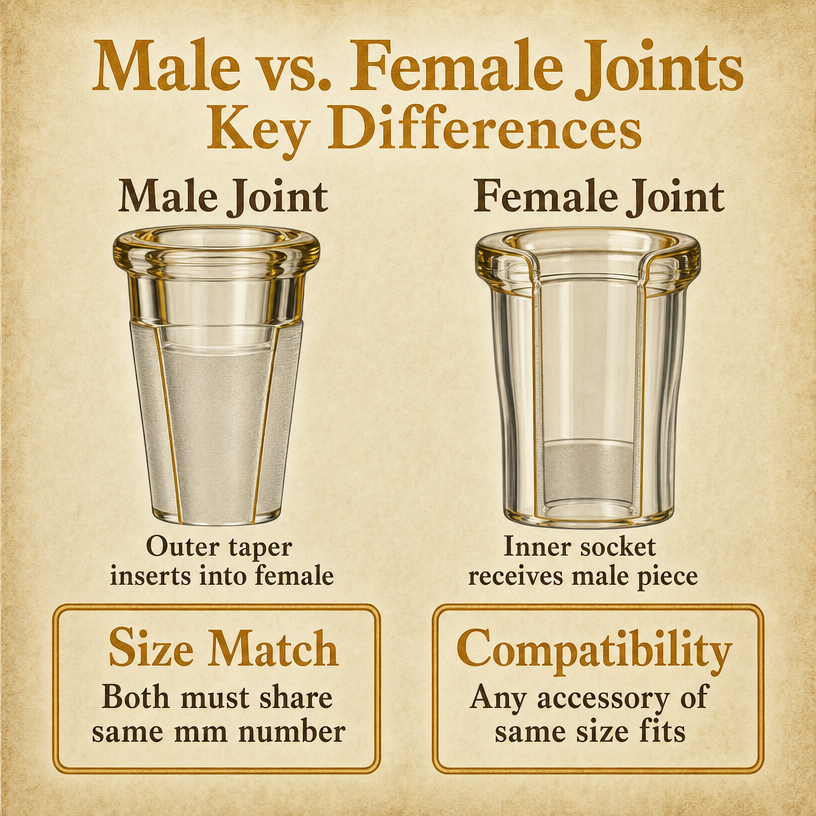
Every joint has a gender. This refers to whether the piece has an outer taper that inserts (male) or an inner socket that receives (female). [1] Both the bong and the accessory you attach to it each have their own gender and size. For a connection to work, the male piece must fit into the female piece — and both must share the same mm number. [1]
- Female joint (socket) — inner opening on the bong that receives male accessories; has an inner wall you can see and measure
- Male joint (taper) — outer taper on an accessory that inserts into the female socket; widens toward the base
- Both genders must share the same mm size for a proper fit
- Always confirm gender and size together — a 14mm female accessory will not fit a 14mm female joint
The bong itself typically has a female joint — an inner socket. The Accessories you buy (bowls, downstems, ash catchers) usually have male joints — outer tapers that insert into the bong’s female socket. [1] This is not a hard rule, however. Some bongs have male joints, and some accessories are female. When shopping, always confirm both the gender and the size before purchasing. [1]
A male 14mm downstem has an outer taper measuring 14mm at its widest point and inserts into a female 14mm socket on the bong. A female 14mm bowl has an inner socket sized to receive a male 14mm downstem. The genders are opposite and complementary. [1]
If you ever see an accessory described as "14mm female," that means it has an inner socket measuring 14mm — and it will only accept a male 14mm accessory. This is one of the most common sources of confusion when buying bong accessories online.
Glass-on-Glass vs. Gasketed Joints: Which Do You Have?
Beyond the mm size and gender, bong joints also differ in how they create a seal. The two main types are glass-on-glass and gasketed (ground-glass with an O-ring). [3] Both systems use the same mm sizing, but they look and feel different in practice. [3]
- Glass-on-glass — tapered glass surfaces grind together directly for a tight friction seal; no rubber part; glass surfaces are in direct contact with no movement-absorbing layer
- Gasketed (O-ring) — a rubber or silicone ring sits between the male and female glass; absorbs movement and minor impacts; more forgiving in transit
- The mm size system applies to both types equally; a 14mm accessory fits a 14mm joint regardless of glass-on-glass or gasketed construction
- Look for a visible rubber ring inside the female socket to confirm a gasketed joint; bare glass means glass-on-glass
Glass-on-glass joints use two matching tapered glass surfaces. The male glass taper inserts directly into the female glass socket with no intermediate part. When properly seated, the two glass surfaces grind together and create a tight, friction-held seal. [3] This method produces a very reliable seal and is the preferred connection type for serious glass collectors. The trade-off is that the glass surfaces are in direct contact with no gasket to absorb movement. [3]
Gasketed joints use a rubber or silicone O-ring (the gasket) placed between the male and female glass surfaces. The gasket absorbs small movements and impacts, making the connection more forgiving. If the two pieces are knocked together, the gasket takes the hit rather than the glass. [3] Gasketed joints are common on mass-produced bongs and on pieces that travel or get handled frequently.
Both joint types use the same mm sizing system. A 14mm glass-on-glass bowl and a 14mm gasketed bowl will both fit a 14mm female glass-on-glass joint. The difference is only in how the seal is formed, not in the size standard. [3]
To identify which type you have, look inside the female socket. If you see a small rubber or silicone ring sitting in a groove, you have a gasketed joint. If the socket is bare glass with no ring, you have a glass-on-glass joint. [3]
Read What Is the Difference Between a Bubbler and a Bong? for more detail.
| Feature | Glass-on-Glass | Gasketed (O-Ring) |
|---|---|---|
| Seal type | Tight friction seal via tapered glass | Seal via rubber or silicone O-ring |
| Glass contact | Direct glass-to-glass contact | Rubber gasket separates glass surfaces |
| Durability | Glass surfaces in direct contact | Gasket absorbs movement and shock |
| Maintenance | Clean surfaces regularly for best seal | Replace O-rings periodically |
| Common on | Collector and enthusiast pieces | Mass-produced and travel-friendly pieces |
What Accessories Can You Use With Your Joint Size?
Once you know your joint size and gender, a wide range of accessories opens up to you. Every accessory with a matching joint size will physically connect to your bong, regardless of brand. [1] This universal compatibility is one of the practical benefits of the standardized sizing system. [2]
- Bowls — hold smoking material; most frequently replaced accessory; labeled with joint size and gender
- Downstems (slides) — direct smoke through water; available in male and female configurations to match your bong
- Ash catchers — trap ash before it enters the bong; reduce water discoloration and cleanup frequency
- Adapters — bridge mismatched sizes (e.g., 14mm-to-18mm) so you can use accessories across different joint sizes
Bowls are the most frequently replaced accessory. The bowl holds the smoking material and connects to the downstem inside the joint. Every bowl on the market is labeled with its joint size (and gender), so matching is straightforward. [1] If you are looking to upgrade or replace your current bowl, Treehouse Lifestyle offers free shipping on orders over $150.
Downstems (also called slides) are the glass tubes that pass from the joint into the water chamber. They direct smoke through the water for cooling. Downstems come in both male and female configurations and must match your bong’s joint size and gender. [1] Replacement downstems are one of the most common reasons customers need to know their joint size.
Ash catchers attach to the joint between the bowl and the downstem (or between the bowl and the bong) and trap ash before it enters the water chamber. They extend the life of your bong’s water and reduce cleanup. Ash catchers use the same joint sizing — a 14mm ash catcher fits a 14mm bong joint. [1]
Adapters are the solution when you have a mismatched size. A 14mm-to-18mm adapter lets you use 14mm accessories in an 18mm joint, or vice versa. They are especially useful if you have multiple pieces with different joint sizes and want to consolidate your accessory collection.
What Are the Most Common Joint Size Mistakes?
Even experienced buyers make joint sizing mistakes. Here are the most frequent errors and how to avoid them.
- Measuring outer diameter instead of inner diameter on a female joint — always insert the ruler or caliper inside the socket
- Swapping 14mm and 18mm due to carelessness — always double-check product listings against your actual measurement
- Ignoring gender — a male accessory only fits a female joint; confirm both size and gender before purchasing
- Measuring male plug outer diameter without subtracting ~2mm for taper — the outer number overstates the inner diameter
- Buying accessories without first measuring your own bong — product descriptions tell you the accessory size, not your bong’s size
The most common mistake is confusing the inner diameter with the outer diameter. The mm size refers to the inner opening of the female socket. If you measure the outer glass wall of a female joint, you will get a number that is larger than the actual joint size. Always measure the inside of the socket, not the glass thickness around it. [1]
Mixing up 14mm and 18mm is another frequent error. These two sizes are close enough in everyday language that they get swapped, especially when buyers are purchasing in a hurry. Double-check the number on the product listing against what you measured. [1]
Forgetting about gender is a close third. A 14mm male accessory will not fit a 14mm female accessory. Both must have complementary genders — one male, one female — as well as matching mm sizes. Always read the full product description to confirm both size and gender before adding to cart. [1]
Using a caliper on a male plug without accounting for the taper gives an inaccurate reading. The male taper is wider at the base than at the tip. If you measure the widest base diameter, you will overestimate the size. Subtract approximately 2mm from the male plug’s widest outer diameter to estimate the inner diameter of the matching female socket. [1]
Finally, buying accessories without first confirming your joint size in hand — not just from a product listing — leads to returns. Product pages describe what size the accessory is, not what size your bong is. Physically measure your bong before you shop.
Browse Torches & Lighters to explore related options.
What Are Common Questions About Smoking Accessories?
Can I use a 14mm bowl in an 18mm joint?
No — a 14mm bowl is too small for an 18mm joint and will not seal properly. Joint size refers to the inner diameter of the female opening, and the male accessory must match exactly. Use a size adapter to bridge between mismatched joints.
Is my joint size printed on the bong?
Rarely. Most bongs do not have the joint size printed or engraved. The most reliable method is to measure directly with a ruler or caliper as described in this guide.
What is the difference between 10mm, 14mm, and 18mm joints?
The numbers refer to the inner diameter in millimeters of the female (socket) component. 10mm joints are found on small, portable pieces. 14mm is the most common mid-size joint. 18mm and larger are typically on larger bongs and offer greater durability due to thicker glass walls.
What happens if I force a mismatched accessory into my joint?
Forcing a mismatched size can crack the glass, damage the joint seal, or break the accessory. Always confirm sizes before purchasing or inserting any accessory.
Do all brands use the same joint size standard?
Yes — the joint size system (10mm, 14mm, 18mm) is a universal standard across all manufacturers. A 14mm bowl from any brand will fit a 14mm joint on any other brand’s bong, assuming both use standard glass-on-glass or ground-glass fittings.
How Do I Know Which Joint Size My Bong Has?
Measuring your bong’s joint size takes less than two minutes. Insert a ruler or caliper into the female (socket) opening, measure the widest inner diameter in millimeters, and you have your answer. That single number — 10mm, 14mm, or 18mm — governs every accessory purchase you will ever make for that bong.
Once you know your size and gender, shopping for bowls, downstems, ash catchers, and adapters becomes straightforward. Every product is labeled with its joint size and gender, and any accessory with matching specs will fit regardless of brand. If your collection includes pieces with different joint sizes, adapters let you share accessories across multiple bongs.
If you are ready to browse accessories that match your bong’s joint size, Treehouse Lifestyle has a full selection of bowls, downstems, and ash catchers. Orders over $150 qualify for free shipping.
Where Does This Smoking Accessory Information Come From?
- Bong Outlet: Bong Joint Size Guide
- Ace Glass Incorporated: Standard Taper Joints — ASTM E676 Standard
- RooR: Understanding Glass Joint Sizes