

Here is how to remove a stuck downstem: confirm the glass is intact and removable, empty the piece, and dry the outside. Grip near the joint and try gentle alternating turns. Slightly warm water or a manufacturer-approved, unheated alcohol soak may loosen residue. Never combine alcohol with heat. Stop for damage or continued resistance; no method guarantees removal without breakage. [1] [3] [4]
Is your downstem removable, or is a different joint stuck?
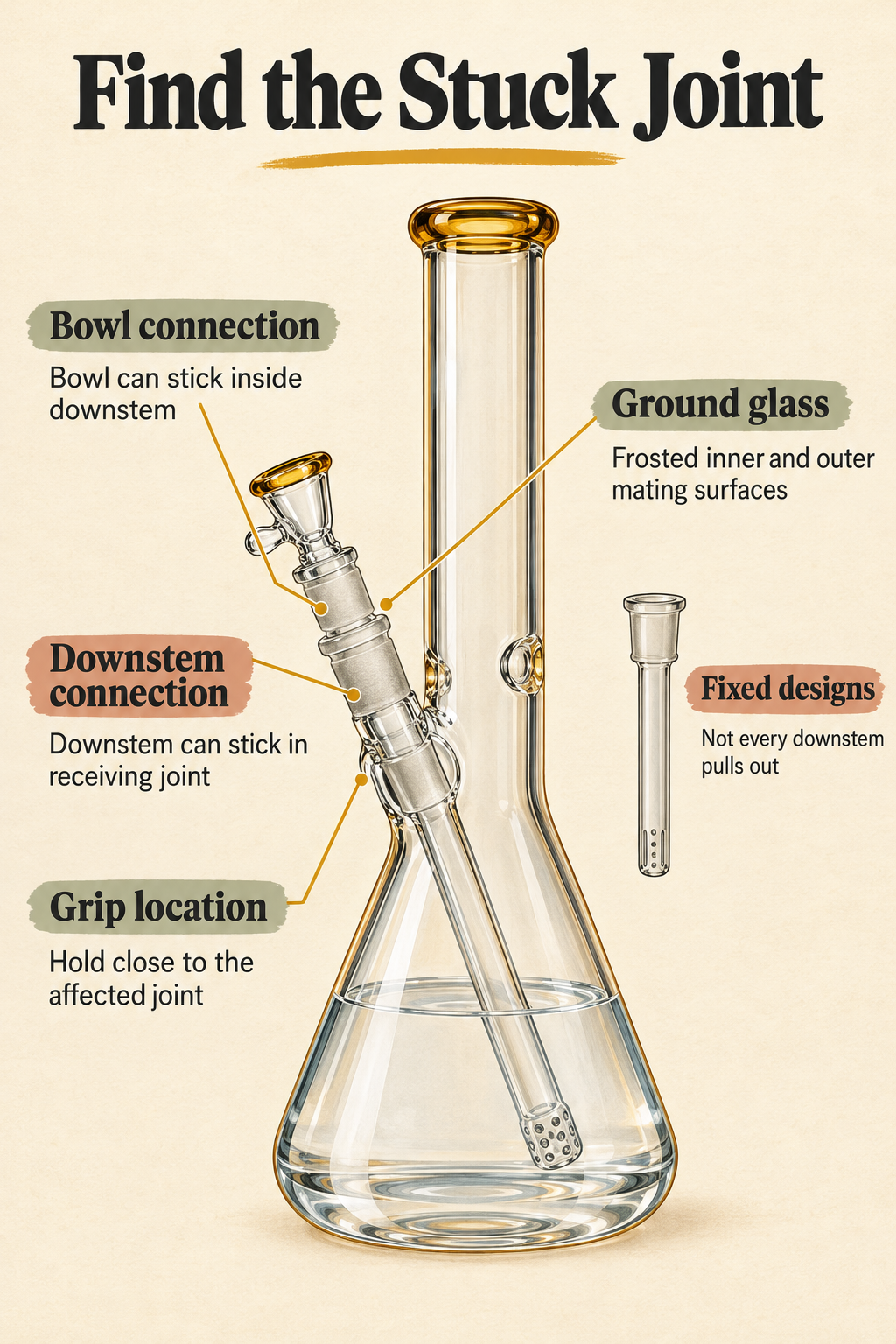
A downstem is the tube that leads from the bowl connection into the body of a water pipe. The joint is where two parts meet. Before trying to move anything, trace those connections and check which one is stuck: the bowl inside the downstem, or the downstem inside the body.
On a ground-glass joint, the fitted surfaces often look frosted rather than clear. One surface fits inside the other. A seized connection is sometimes called a frozen joint, but that does not mean the glass is cold. The term describes parts that will not separate. [2]
Not every visible tube comes out. For example, the Shelly water-pipe listing describes a fixed downstem and a rubber-grommet joint. That is a reason to check your own product instructions, not a reason to pull harder on an unfamiliar design. [7]
Use product information to identify parts before shopping for them. Treehouse Lifestyle lists Downstems and Replacement Parts separately, but a category name does not prove fit. If you own a named model such as LA Pipes "The Chong-Bong" Classic Straight, start with its specific design and care instructions rather than a similar-looking photo.
- Removable ground glass: look for a separate fitted connection, then confirm removal in the maker’s instructions.
- Fixed downstem: leave the attached tube in place; this removal procedure does not apply.
- Grommet connection: a rubber ring holds the part, so follow that design’s own removal and cleaning directions.
- Bowl connection: if the bowl is stuck in the downstem, focus on that joint rather than pulling the whole assembly.
| Connection | What to check before removal |
|---|---|
| Removable ground glass | Confirm the fitted glass part is designed to come out. |
| Fixed downstem | Leave the attached tube in place. |
| Rubber-grommet connection | Follow the maker’s directions for the ring and tube. |
| Bowl inside downstem | Identify the bowl joint rather than pulling the whole assembly. |
What should you check before trying to loosen a stuck downstem?
Inspect before you grip. Look at the exposed tube, the rim, and the glass around the receiving joint under good light. A small nick is not a reason to rush through removal. University of Wisconsin–Madison guidance says glassware with cracks, chips, nicks, or breaks should be removed from service because small defects can become larger cracks. [3]
Hardened resin between the fitted surfaces is one documented cause of sticking. Still, you cannot diagnose every stuck joint by looking at it. Do not assume yours is vacuum-locked, cross-threaded, or permanently fused. First confirm the design and inspect what you can see. [1] [2]
A rubber pad, silicone mat, or thick gloves may improve grip. They do not make glass unbreakable, and ordinary grip gloves are not cut-proof equipment. Better grip should reduce slipping, not let you twist harder. [1]
Need help naming the connection? Start with What Are the Parts of a Bong, Rig, or Pipe and How Do They Work?. For broader cleaning steps, see How Do You Clean a Bong the Right Way?. The inspection points in How Can You Tell If a Glass Smoking Piece Is Well Made? can also help you look closely at the piece, but an earlier quality check does not rule out damage today.
- Check the downstem and surrounding glass for cracks, chips, nicks, or broken edges before making an attempt.
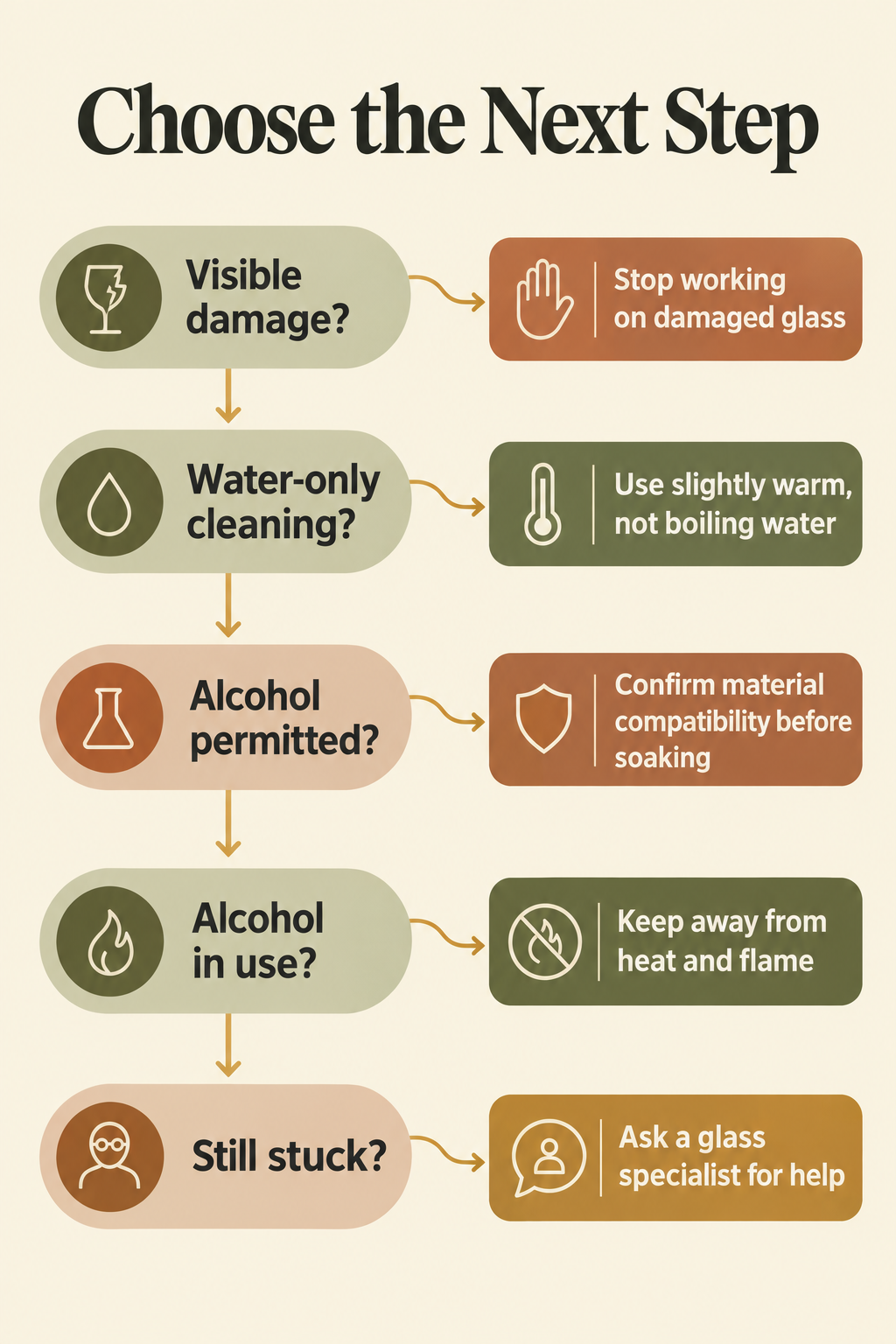
- Stop if you see damage. A cracked or snapped tube is outside this intact-joint procedure.
- Empty the water and any loose contents so you are not handling a full piece.
- Set up a stable work area with a rubber mat beneath the glass, including in a sink used for cleaning. [3]
- Dry the exterior gripping areas. Keep the piece supported rather than holding it over a hard surface.
Should you twist a stuck downstem or pull it straight out?
Start with small, gentle turns in alternating directions, not a straight yank. Thick Ass Glass recommends gripping near the joint and warns against using the length of the downstem as a lever. LibreTexts also describes gentle twisting as an initial step for seized ground-glass joints. Neither source gives a force limit that works for every piece. [1] [2]
The grip location matters because the free end of a tube invites sideways movement. Do not rock the downstem back and forth, bend it away from the opening, or keep turning harder when it does not move. If your grip slips, pause and dry the exterior again instead of squeezing more tightly.
A bowl stuck inside a downstem is a separate problem. Do not pull on the bowl handle to move both parts at once. Supporting nearby glass follows the same near-joint grip principle, but it is not a tested extraction method for every bowl shape. If the shape leaves no sensible place to grip, stop and ask the maker. [1]
Once the fitted surfaces begin to move, keep the parts aligned with the connection as they separate. Do not turn a little movement into a sudden yank. For later questions about the part itself, How Do You Choose the Right Downstem for Your Bong? covers choosing a downstem; it is not a reason to force a tight one into or out of a joint.
- Identify the exact stuck connection before touching the bowl or tube.
- Support the adjacent glass and hold the removable part close to that joint, not at its far end.
- Try a small turn one way, then the other, using gentle movement rather than a hard twist.
- If the connection starts to release, keep the pieces aligned and separate them without sideways leverage.
- If it does not move, pause for a compatible cleaning method rather than increasing force.
Can warm water help loosen a downstem stuck in a bong?
Slightly warm water may help soften resin on intact glass. Think of it as a cleaning aid, not a guaranteed release method. Thick Ass Glass recommends warm water for residue, while Purr warns against hot or boiling water and large temperature differences between the glass and the liquid. [1] [6]
Keep this a water-only approach. Do not add alcohol and then place the piece in warm water. If you have already used a solvent, follow its removal and rinsing instructions instead of switching straight into a warming step.
Very cold glass should not go straight into warm water. Skip freezer-to-hot-water tricks and methods that put ice on one part while heating another. Thermal shock means stress from a sudden temperature change, and Purr notes that it can cause breakage. There is no universal water temperature or soak time that applies to every downstem. [6]
After water-only cleaning, dry the outside before another gentle attempt. A wet joint may still be stuck even when residue elsewhere has washed away. Do not read that as a signal to pull harder. For care of a different glass accessory, see How Do You Clean a Glass Pipe Without Breaking It? rather than assuming the same handling steps fit every shape.
- Confirm that the accessory’s materials and care instructions permit the water-cleaning method.
- Avoid sudden temperature changes; do not move chilled glass directly into warm water.
- Use slightly warm water, not hot or boiling water, as the permitted cleaning aid.
- Keep alcohol and other solvent methods separate from this water-only step.
- Dry the exterior, inspect again, and reassess with gentle near-joint movement. Stop if it still resists.
Can alcohol loosen residue around a stuck glass downstem?
An unheated isopropyl-alcohol soak may help dissolve resin when the accessory maker permits alcohol cleaning. Limit this option to compatible plain glass and follow the relevant product directions. A glass tube does not make the whole assembled piece alcohol-compatible: the liquid may also touch a seal, decoration, adhesive, or another material. [1] [5]
Thick Ass Glass suggests 90%+ isopropyl alcohol and a 30–45 minute soak for a stuck downstem. That is one manufacturer’s suggestion, not a promised release time. Purr lists 91% alcohol for glass cleaning and says stubborn buildup may need longer soaking. Those separate recommendations do not create a universal recipe for your piece. [1] [5]
Choose the cleaning product based on the accessory maker’s directions. Do not assume an antiseptic product with fragrance or other additives is a recommended glass cleaner. The DailyMed label cited here supplies alcohol hazard warnings only, not a recommendation to clean with its wintergreen formula. [4]
Keep alcohol away from heat, sparks, electrical ignition sources, fire, and flame, and use it with ventilation. Never heat an alcohol-filled piece or an alcohol-wet joint with a hair dryer, hot-water bath, microwave, stove, or torch. Heating a closed system that contains a volatile solvent is also a specific warning in the university glassware guidance. [4] [3]
If the cleaner cannot reach the stuck surfaces, that does not justify opening a gap with a blade or screwdriver. If material compatibility is unclear, omit this method and contact the manufacturer. After any approved soak, follow the cleaner’s removal directions and reassess gently; elapsed time is not permission to add force.
- Plain glass: use an unheated alcohol soak only when its manufacturer allows the product and method.
- Plastic, acrylic, and silicone: do not transfer plain-glass alcohol directions to these materials. Purr advises against alcohol on these bongs. [5]
- Rubber grommets, adhesives, paint, and coatings: verify each contacted material separately; the glass instructions do not establish compatibility.
- Unknown materials: skip the soak until the maker confirms what can contact the cleaner.
- Alcohol handling: keep it unheated, use ventilation, and keep it away from ignition sources throughout cleaning.
| Material or finish | Does the plain-glass alcohol method apply? |
|---|---|
| Plain glass | Only if the accessory maker permits the cleaner and unheated soak. |
| Plastic, acrylic, or silicone | No; Purr advises against alcohol on these bongs. [5] |
| Rubber, adhesive, paint, or coating | Not without separate confirmation for every contacted material. |
| Unknown materials | Skip the alcohol soak until the maker confirms compatibility. |
When should you stop trying to remove a stuck downstem?
Stop at visible damage or continued resistance after gentle handling and compatible cleaning. You do not need to keep trying a set number of times. If you are about to squeeze harder, brace the piece with your body, or reach for a tool, the home attempt has reached its limit.
Joint strain can crack connected glass. A grip aid does not change that limit, and a thick-looking base does not tell you how much strain the receiving joint can take. University of Wisconsin–Madison guidance points unresolved frozen joints toward a glass shop rather than endless force. [3]
Laboratory texts describe methods used with specialist equipment and supervision. Their existence is not an instruction to heat, tap, or pry an unknown water pipe at home. This guide does not include impact, pliers, screwdrivers, drilling, or deliberate breakage. It also excludes torch, heat-gun, and hair-dryer routines. [2] [3]
If a tube cracks or snaps, stop using the damaged piece. Do not twist an exposed broken edge or try to finish the job with pliers. Ask the manufacturer or a glass-repair specialist what to do next. Share the model name, the joint that is stuck, visible damage, and the cleaners already used.
A replacement downstem alone does not solve a damaged receiving joint in the body. Both sides need inspection before you decide what, if anything, can be reused. Describe any damage to the manufacturer or glass specialist before choosing a replacement part.
- Stop for cracks, chips, nicks, broken edges, or a newly snapped tube.
- Stop when gentle movement and approved cleaning do not release the joint.
- Skip impacts, prying, gripping tools, drilling, and planned breakage rather than escalating the attempt.
- Skip specialist-heating tricks; never heat alcohol or an alcohol-wet connection.
- Ask the manufacturer or a glass specialist about the whole connection, including the receiving glass.
What should you do after the downstem comes out?
Set the separated parts down on the mat rather than fitting them right back together. The joint has opened, but residue may still be on the mating surfaces. Clean those surfaces separately using instructions for each material. LibreTexts recommends removing residue from ground-glass joints before assembly. [2]
Look at both sides of the connection while they are apart. Check the downstem’s fitted surface and the body opening, not just the long tube. Follow the same stop rule for any crack, chip, nick, or break you find now. A part that came out in one piece still needs inspection. [3]
Purr recommends repeated slightly warm water rinses to remove cleaning solution and complete drying before use. Follow the cleaning product’s rinse directions as well. Neither a fixed waiting period nor the absence of an odor proves that solvent has been removed. Do not replace rinsing with a quick sniff or a guess about drying time. [6]
If a removable part needs replacement, use the exact model information and fit requirements before buying. Do not guess from the old part’s general shape. A downstem that appears similar may not match the receiving connection, and changing the removable part does not address damage in the body.
- Clean the separated mating surfaces with a method approved for their materials.
- Inspect the downstem and receiving joint in good light before considering reassembly.
- Rinse repeatedly as directed to remove the cleaning solution; do not rely on odor alone.
- Allow the parts to dry completely before use, following the applicable care instructions.
- Set damaged parts aside and confirm any replacement requirements with the maker instead of assuming a universal fit.
How can you keep a glass downstem from sticking again?
Focus on the surfaces that fit together, not only the visible chamber. Residue between those surfaces is a documented sticking factor. Cleaning the body while leaving buildup on the joint misses the area that needs attention. Wipe residue from the fitted surfaces before assembly and follow a regular, material-specific cleaning routine. [1] [2]
Do not push harder to solve a tight fit. If a clean part does not seat as expected, pause and check the maker’s fit information. Thick Ass Glass advises against forcing a tight downstem into place. Repeatedly jamming the same part back into the connection is not a maintenance plan. [1]
Keep cleaner choices tied to the whole accessory. A method you used on plain glass may not suit a piece with a rubber grommet, painted finish, acrylic body, or silicone section. Follow material-specific directions rather than carrying one soaking recipe across the collection. [5]
Do not automatically borrow laboratory joint-grease advice or add household oil. Without approval for your specific accessory, a lubricant is not the next step. Clean mating surfaces and an unforced fit address the documented issues without introducing an unapproved product. These habits may reduce sticking problems, but they cannot guarantee that a joint will never seize.
- Remove residue from both mating surfaces before putting the parts together.
- Include the joint in regular cleaning instead of focusing only on the chamber.
- Check fit rather than forcing a part that feels unusually tight.
- Follow care directions for every material, seal, and finish that cleaner may touch.
- Skip oils, joint grease, and other lubricants unless the accessory maker specifically approves them.
Frequently Asked Questions
Why does my downstem keep getting stuck?
Hardened residue between the fitted surfaces is one documented cause. Clean both surfaces before assembly and avoid forcing a tight fit. Repeated sticking still calls for checking the actual design and maker’s instructions; it does not prove every connection has the same problem. Stop using any part that shows cracks, chips, or other damage. [1] [2] [3]
How long should you soak a stuck glass downstem?
Thick Ass Glass suggests 30–45 minutes with 90%+ isopropyl alcohol. This is one maker’s suggestion for compatible glass, not a guaranteed release time. Purr allows longer soaking for stubborn glass buildup. Follow your accessory’s instructions, keep alcohol unheated, and confirm every contacted material permits the cleaner. More soaking time does not justify more pulling force. [1] [5] [4]
Can you use a freezer or hair dryer to free a stuck downstem?
Skip both in this home procedure, including combinations of ice and heat. Extreme temperature differences between glass and liquid can cause breakage. Alcohol also must stay away from heat and ignition sources. Do not heat an alcohol-wet joint, even if you have emptied the rest of the piece. Ask the maker about a joint that stays stuck. [6] [4]
What if the bowl is stuck inside the downstem?
Identify the bowl connection as the stuck joint instead of pulling the whole assembly. Do not use the bowl handle or long tube as a lever. Supporting nearby glass follows the general near-joint grip advice, but it is not a proven removal technique for every bowl design. Stop if you cannot grip sensibly or gentle movement does not help. [1] [2]
What should you do if the downstem cracks during removal?
Stop the attempt and stop using the damaged glass. Do not twist exposed broken glass, pry at the joint, or try to finish with pliers. Ask the manufacturer or a glass-repair specialist for advice. The receiving joint needs inspection too; replacing the tube alone does not address damage to the body opening. [3]
What should you try next if your downstem is still stuck?
Confirm that you are working with an intact, removable joint, then keep any attempt gentle and close to the connection. Use only compatible cleaning methods, keep water-only warming separate from alcohol, and never escalate into prying, impact, or heated-solvent tricks.
If the connection still resists, stop and contact the manufacturer or a glass specialist. Visible damage means stopping sooner. Once the parts separate, clean, rinse, dry, and inspect both sides before reassembly or replacement. The goal is not to win a tug-of-war with glass; it is to recognize when home handling has reached its limit. [3]
Sources
- Thick Ass Glass: How to Remove a Stuck Downstem Without Breaking Glass
- Chemistry LibreTexts — Organic Chemistry Lab Techniques (Nichols): 1.2B: Ground Glass Joints
- University of Wisconsin–Madison, College of Engineering and Environment Health and Safety: A Guide to Safe Handling of Laboratory Glassware
- U.S. National Library of Medicine, DailyMed — Good Neighbor Pharmacy product label: ISOPROPYL ALCOHOL liquid
- Purr Glass: How to Clean a Glass Bong
- Purr Glass: How To Clean A Dab Rig
- DankStop — My Bud Vase product listing: "Shelly" Water Pipe