

To fix a chipped bong, first stop using the damaged glass. Replace a broken removable bowl or downstem only if the vessel and receiving joint are intact. Mouthpiece, joint, base, or chamber damage needs a glass specialist’s assessment or whole-piece replacement. Household glue, sanding, and home torch work do not establish that the piece is ready to use again.
What should you do first when your bong chips or cracks?
The University of Vermont advises removing flawed glass from service and not heating chipped or cracked glass. This is laboratory glass-handling guidance, not a bong certification. Use it as a starting point: set damaged glass aside and identify the affected part without forcing anything. [1]
Stop using it rather than taking another draw to see whether it still works. Do not add heat, shake it, or pull hard on a connected part. A piece that still holds water has not passed a repair assessment.
A chip means some glass is missing. A crack is a split in the glass that may extend beyond the spot you first noticed. These words help you describe the damage, but they do not tell you whether the piece can return to use. UVM notes that scratches can grow into cracks and advises against heating glass with chips, nicks, scratches, or cracks. [1]
Look from a distance that lets you see the whole piece. Note whether the damage is on a removable part, the rim, a receiving joint, the base, or the main chamber. Do not run a finger along an edge or move loose fragments around to get a better view.
Loose glass needs its own cleanup step, separate from any repair decision. UVM recommends tools such as tongs, tweezers, or forceps for larger pieces and cut-resistant gloves when handling broken glass. Disposable latex or nitrile gloves are not protection against glass cuts. [1]
Only after you know which route applies should you browse Replacement Parts for an isolated part failure or Bongs for a whole-piece replacement. Even an option such as SILICONE BEAKER BONG WITH REMOVABLE GLASS BOWL still has a glass component to inspect; a different body material does not make a broken bowl usable.
- Stop use and keep other people and pets away from the damaged piece and loose fragments.
- Avoid heat, hard twisting, and forced joints while the glass is damaged.
- Locate visible damage without touching sharp edges or shifting unstable parts.
- Address loose fragments with appropriate pickup tools and cut protection, not bare hands.
- Choose an isolated part replacement, a specialist assessment, or whole-piece replacement.
Which broken bong parts can you replace instead of repairing the whole piece?
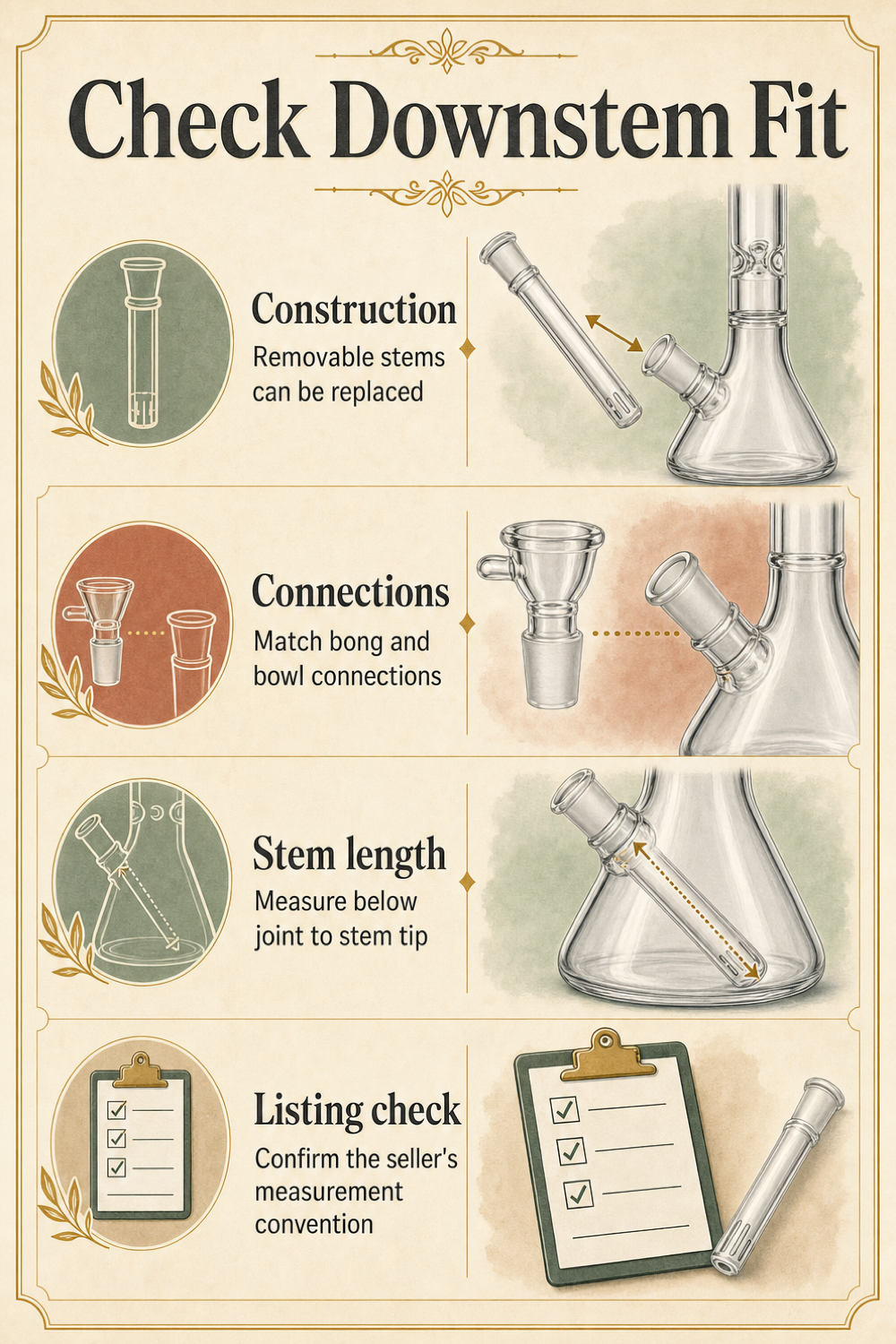
The key question is whether the damaged part comes off by design. Purr separates removable downstems from fixed downstems, which are permanently attached. A removable stem can be replaced; a broken fixed stem is not the same shopping task. [6]
When a removable component alone is damaged, an intact vessel may not need to be replaced. Check the receiving joint as part of that decision. If it is also chipped or cracked, buying a new downstem does not address the damage to the bong itself.
A detachable bowl is another part-replacement scenario. Identify the connection before ordering, and do not assume that every bowl or stem on every design is removable. If a part is stuck, leave it alone rather than forcing it out to prove how the setup was built.
Our guide, When Should You Replace Bowls, Downstems, Screens, and Seals?, can help you separate ordinary part replacement from a whole-piece decision. The goal is to replace the failed component when that is appropriate, not to buy a complete setup because one small part broke.
If the vessel does need replacement, a listing such as Glass Beaker Bong | 10 Inch | 9mm Thick is a starting point for comparing designs, not a promise that thicker glass cannot break. Before choosing a new piece, review How Do You Prevent Glass Pieces from Breaking at Home? and think about where your current setup was bumped, dropped, stored, or washed. That may help you choose a better spot for the next one.
- Removable downstem: consider a matching replacement if the main vessel and receiving joint are intact.
- Detachable bowl: identify its fitting and replace the damaged component rather than bonding its broken edges.
- Fixed downstem: ask a specialist because the attached stem is not a routine removable-part swap.
- Receiving joint: seek assessment or replace the vessel if the connection itself is damaged.
- Main vessel: mouthpiece, base, and chamber damage belong in a glass-repair or whole-piece decision.
How do you choose a replacement downstem that fits your bong?
Start with the original product details, not a guess based on how the opening looks. A downstem has to match the bong connection, the bowl connection, and the required length. Getting one of those right does not settle the other two.
Purr names 14 mm and 18 mm as common joint sizes. They are different fittings, not labels you can swap freely, and they are not the only sizes you may encounter. Write down the bong-side size and the bowl-side size separately so you do not confuse them when comparing listings. [6]
Length is a separate measurement. Purr measures from the bottom of the ground joint to the end of the stem, excluding the joint itself. A seller who describes total length may be using a different convention. Confirm what the listed dimension includes before you place an order. [6]
Do not handle broken fragments to rebuild the old stem for a measurement. Use your order history, the maker’s specifications, or a seller’s reply instead. If those details are missing, send photos and ask what information is needed. A rough estimate is not a confirmed fit.
Product names can also contain several numbers. For example, SeshGear Jellyfish Double Chamber Glass Beaker Water Pipe – 17" / 14mm F / Colors Vary includes both an overall height and a fitting label. The height of a complete piece is not its downstem length. Read the actual part specifications rather than treating every dimension in a title as interchangeable.
Once the correct replacement arrives, do not force it into place. UVM warns that forcing a ground-glass joint free can shatter glass; hard twisting or levering is not a fit-check method. If the old component is stuck or the new one does not seat normally, stop and ask the maker. [1]
- Confirm the stem is removable and that the receiving joint has no visible damage.
- Find the specified bong-side connection size in the original listing or maker’s information.
- Find the bowl-side connection size and check it against the bowl you plan to use.
- Confirm the needed stem length from reliable specifications rather than broken fragments.
- Ask whether the seller measures below the ground joint or includes the joint before ordering.
Can super glue, epoxy, sanding, or a home torch fix a cracked bong?
Do not regard glue, sanding, or home torch work as proof that damaged glass is ready to use again. Making broken edges stick together is different from confirming that a repaired accessory is suitable for its intended use. The sources cited here do not establish a home repair procedure for that purpose.
Loctite describes its Glass Glue as water resistant and dishwasher compatible, yet explicitly says it is not food safe. Those household-glass claims do not approve use in a heated bong or its air path. A waterproof label answers a narrow question about the bond, not every question about the finished object. [2]
Loctite also notes that ordinary household super glues may have low resistance to moisture and ultraviolet light. On glass, a bond may separate during cleaning or general use. That is another reason not to confuse a temporary attachment with qualified glass repair. It does not establish that every adhesive fails in exactly the same way. [2]
The same limit applies to epoxy and silicone. The sources cited here do not establish that every formula is unsuitable, nor do they approve a formula because it worked on another household item. A material name, product label, or online anecdote does not establish suitability for this repair.
Sanding a rim is not a supported home fix here. Even if an edge looks less rough afterward, that does not show whether the surrounding glass has cracks or whether the piece can return to use. Home flame polishing is also not recommended: UVM specifically advises against heating damaged glass. [1]
If you are considering a different material for a replacement, Glass vs Silicone Smoking Accessories: Which Should You Choose? covers that broader buying choice. Comparing accessory materials is separate from approving an adhesive patch on the damaged piece you already own.
- Waterproof adhesive: water resistance alone does not establish suitability for bong use.
- Dishwasher claims: cleaning compatibility is not approval for a heated accessory or its air path.
- Epoxy or silicone: do not infer application approval from the material name or another household use.
- Sanding: changing the edge’s appearance does not confirm that the damaged glass is restored.
- Home torch work: do not heat chipped or cracked glass in an attempt to repair it.
Can a glassblower repair a broken mouthpiece, joint, base, or percolator?
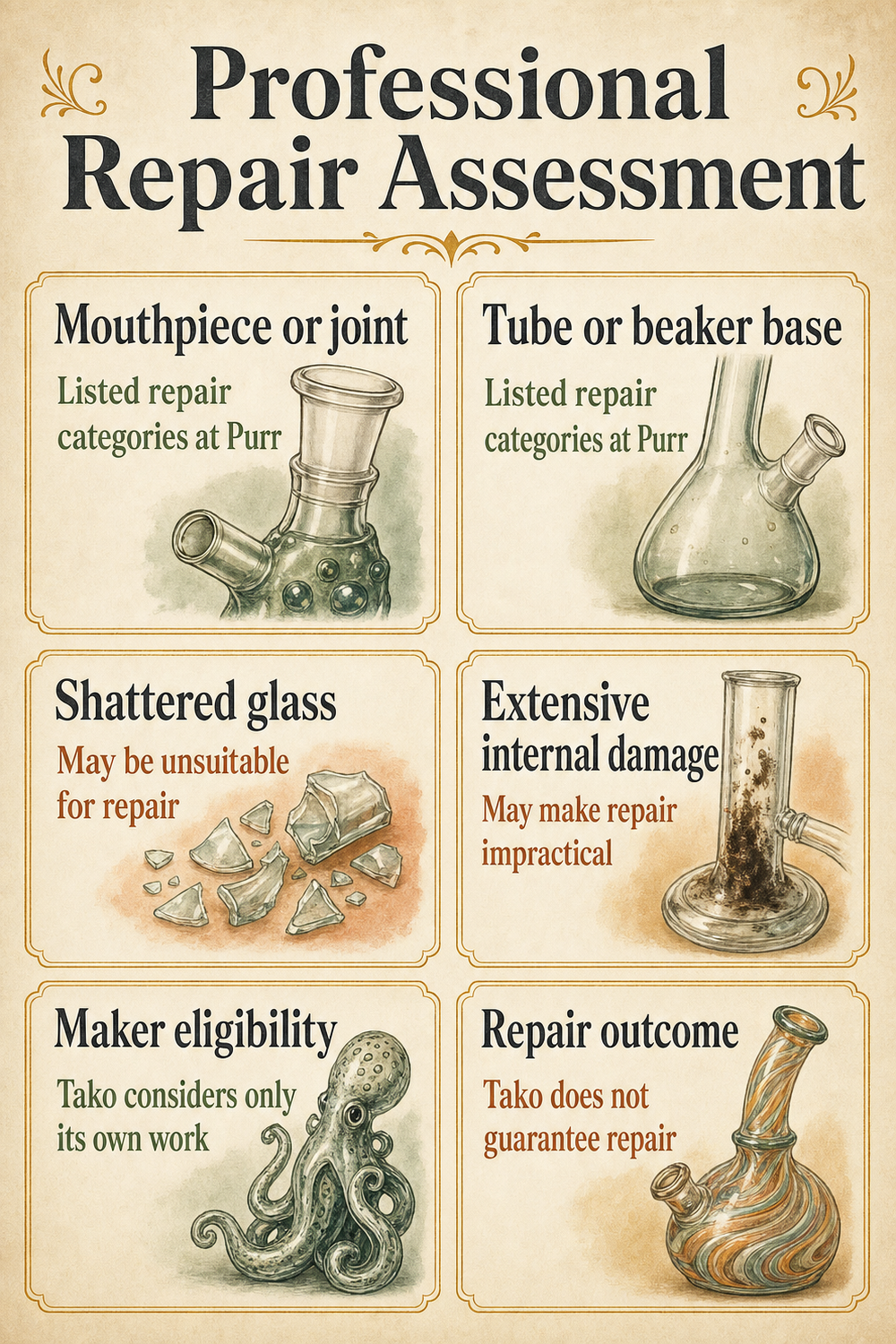
Some pieces can be considered for professional glass repair. Purr lists mouthpiece, joint, tube-base, beaker-base, and miscellaneous repair services. These categories show that damage to a main piece is not always the end of the decision, but they do not guarantee acceptance of your bong. Ask about your exact break and current service availability. [3]
Where the break goes matters as much as the part name. A damaged joint that can be assessed on its own is a different job from a break that reaches into the main chamber. A photo of the outside may also fail to show the full extent of internal damage.
Purr identifies shattered pieces, complicated assemblies with many percolators and welds, extensive internal-percolator damage, and breaks extending into the main chamber as examples that may be unsuitable or impractical for repair. Its guidance separates work that cannot be salvaged from work that is too lengthy or intensive to make sense. [4]
That distinction is important if a percolator broke inside an otherwise recognizable piece. Do not assume every internal break is repairable, but do not turn one shop’s examples into a rule that all broken percolators are beyond repair. Let a specialist assess the particular design.
The maker’s policy matters too. Tako considers only its own work and asks for photographs first. It also warns that repair is not guaranteed and that further breakage can happen in the kiln or during the work. Professional service should not be described as an invisible fix, a promise of original strength, or a guaranteed return to the original form. [5]
- Mouthpiece: a listed professional repair category, subject to the specialist’s review of the actual damage.
- Joint: a possible repair inquiry, with attention to whether the break extends into the chamber.
- Base: tube and beaker base work appears among Purr’s listed services, not as a blanket guarantee.
- Main chamber: extensive damage or shattered glass may make repair unsuitable or impractical.
- Internal percolator: complexity and damage extent require a case-specific assessment.
What should you send a glass repair shop before mailing your bong?
Contact the original maker or a repair specialist before sending anything. A shop that sells work by several artists may not repair all of it. Tako, for example, considers only pieces it made, even when another artist’s piece was sold in its shop. It requires photographs before agreeing to work. [5]
A useful first message names the maker, describes where the damage is, and explains whether any part is loose or missing. Suggest a whole-piece photo plus clear close views of the break. These are inquiry tips, not a claim that every shop requires the same photo set. Do not manipulate unstable glass just to get a better angle.
Ask for acceptance and preparation instructions before cleaning or packing. Tako requires accepted pieces to be completely clean and says it will not handle dirty pipes or bongs. That requirement is not a reason to shake or scrub damaged glass. If preparation would mean handling sharp edges or unstable parts, explain the problem and ask how to proceed. [5]
Get a quote and ask what it includes. Confirm shipping arrangements, expected timing, and what happens if the shop cannot complete the work. Tako’s stated policy makes the customer responsible for shipping both ways; do not assume that every other specialist has the same policy. [5]
Wait for the shop’s own packing instructions. Do not mail a damaged piece without acceptance or send loose shards because you think they might be useful. Ask the specialist which parts, if any, should be included with the shipment.
- Identify the maker and confirm whether the shop accepts that maker’s work.
- Send photos and a short description of the visible damage without moving unstable glass.
- Obtain acceptance before doing shipping preparation or booking a repair shipment.
- Clarify cleaning, packing, and loose-fragment instructions, including any preparation limits.
- Confirm the quoted work, shipping responsibilities, and expected timing before mailing.
When does replacing a bong make more sense than professional repair?
Compare three routes rather than treating all damage as the same problem: replace an isolated removable part, seek professional glasswork, or replace the complete vessel. The first route only applies when the remaining glass and connections are intact. The second depends on a specialist accepting the piece.
Replacement becomes the clearer choice when the specialist declines the repair or explains that the damage is too extensive for its service. Purr’s guidance includes jobs that may be technically possible but too lengthy and intensive to be practical. That is not the same as saying that every crack means the whole piece must be discarded. [4]
If a repair is accepted, compare the actual quote with the cost of the replacement you would choose. Include the quoted work and any shipping costs. There is no universal repair-price range, percentage-of-value rule, or turnaround time established by these sources.
Personal attachment can be part of your decision. A piece made by an artist you follow may mean more to you than a basic replacement, but attachment does not change the shop’s ability to repair it. Ask whether the work may change the shape or appearance and what happens if repair fails.
Do not spend money on a new bowl or stem as a workaround for damage elsewhere. The receiving joint, base, or chamber still needs its own decision. Likewise, an attractive repair quote does not guarantee success: Tako warns that a piece can break further during the work. [5]
- Removable-part replacement: choose this route for an isolated component failure with an intact vessel and joint.
- Professional glass repair: consider it when a specialist accepts the piece and the quoted work suits your goals.
- Whole-piece replacement: consider it when repair is declined, damage is extensive, or the accepted quote does not make sense for you.
- Costs and uncertainty: compare stated work and shipping, then account for the shop’s limits and lack of a guaranteed outcome.
| Route | When to consider it | What to confirm |
|---|---|---|
| Replace a removable part | Only the detachable bowl or downstem is damaged | Intact vessel and joint; matching connections and length |
| Professional glass repair | The main piece is damaged and a specialist accepts it | Repair scope, quoted work, shipping, and possible failure |
| Replace the whole piece | Repair is declined or the work and cost do not suit your goals | Replacement specifications and a better storage or washing setup |
How can you reduce bong breakage during cleaning and storage?
Apply prevention habits to an intact replacement or a piece returned with professional guidance. They are not cleaning instructions for the chipped or cracked glass waiting for assessment. First, give the piece a stable home away from counter and shelf edges.
UVM recommends keeping glass away from work-surface edges, supporting it with two hands, and using rubber sink or counter mats during washing. These general handling practices can guide how you move and clean an intact bong. A mat may reduce breakage during washing, but it does not make glass unbreakable. [1]
Make room before you start. Move other hard objects out of the immediate washing area and set out a clear resting spot. Carry the piece with support rather than trying to balance it while opening a cupboard or moving supplies with your other hand.
Avoid abrupt temperature changes. UVM warns against placing hot glass on cold or wet surfaces and recommends slow cooling. That supports a general handling habit, not a universal water-temperature setting. Do not assume a borosilicate label means a piece cannot break. [1]
Finally, do not force a stuck ground-glass connection. If a removable part stops moving normally, pause and ask the maker for guidance. Extra force is not a maintenance shortcut. Inspect the piece before its next use and set it aside if you find fresh damage. [1]
- Store glass on a stable surface away from shelf and counter edges.
- Support the piece with two hands when moving it, with a clear destination ready.
- Use rubber sink or counter mats during washing rather than resting glass directly against hard surfaces.
- Avoid sudden temperature changes and let hot glass cool gradually.
- Stop when a ground-glass joint is stuck instead of twisting harder or levering with tools.
Frequently Asked Questions
Can you keep using a bong with a tiny chip in the mouthpiece?
Do not use chip size as proof that the piece is usable. Stop use pending replacement or a specialist’s assessment. UVM advises removing flawed glass from service, but its laboratory guidance does not certify bongs or define a harmless-chip threshold. A small missing edge is still damage, not a reason to skip the decision. [1]
Does waterproof glass glue mean a repaired bong is ready to use?
No. Water resistance describes a bond’s performance in one respect, not approval for this use. Loctite lists water resistance and dishwasher compatibility while stating that its Glass Glue is not food safe. That page does not approve a heated bong or its air path, so its household instructions are not a bong-repair endorsement. [2]
Can every glass repair shop work on any brand of bong?
No. Repair eligibility depends on the shop and maker. Tako considers only its own work and requests photos first, even if it sold another artist’s piece. Ask the original maker or a specialist whether it accepts your piece before shipping. A shop’s sales catalog and its repair policy are separate things. [5]
Does a broken internal percolator always mean the whole bong must be replaced?
Not as a universal rule. Purr identifies extensive internal-percolator damage and complicated assemblies as examples that may be unsuitable or impractical for its service. A specialist must assess the particular piece. Do not assume that an intact-looking exterior makes an internal break minor, or that every internal break has the same outcome. [4]
Can you pull out a stuck downstem to replace it?
Do not force a stuck ground-glass joint free. UVM warns that force can shatter glass. Ask the maker or specialist for guidance instead of twisting hard or levering with tools. If the receiving joint is chipped or cracked, the problem also goes beyond replacing a removable stem; that damaged connection needs its own assessment. [1]
What is the next step for your chipped or cracked bong?
Set the damaged glass aside and identify the failed part without forcing joints or touching broken edges. An isolated removable component may call for a matching replacement. Damage to the mouthpiece, joint, base, or chamber calls for a specialist’s assessment or a complete-piece replacement.
If a repair shop accepts the piece, compare its actual quote and shipping terms with your replacement options. Follow its preparation instructions and ask about any step that would require handling unstable glass. Do not mistake a household glue bond, a sanded edge, or home torch work for a confirmed restoration.
Once you have an intact setup again, give it a stable storage spot and use careful washing and handling habits. The useful fix is the route that addresses the actual damage, not the quickest way to hide it.
Sources
- University of Vermont, Department of Environmental Health and Safety: Safe Handling of Glassware
- Loctite / Henkel: Glass glue: The best products and when to use them
- Purr Glass: Glass Bong and Pipe Repairs
- Purr Glass: Unrepairable
- Tako Glass: Glass Pipe Repairs
- Purr Glass: Guide To Downstem Sizes And Types