

Replace a bong part the moment it shows mechanical wear that cleaning cannot fix: a cracked bowl or downstem, a bent or clogged screen that no longer blocks debris, or a grommet that has lost its seal at the joint. The four parts worth tracking on any rig are bowls, downstems, screens, and the rubber or silicone seals that hold the joint together.
Each part has its own replacement trigger. Most modern bongs accept standard 10mm, 14mm, or 18mm joint sizes with matching bowl slides. Glass screens are made of heat-resistant borosilicate and last through many uses; brass and stainless steel screens are reusable but should be swapped once they bend or clog. Always measure a replacement downstem from the bottom of the frosted joint to the tip, because handmade bongs can vary by a quarter to half inch between identical models. A downstem that sits too long can press against the base and crack it; one that sits too short leaves the tip above the waterline and skips water filtration. A cracked grommet lets unfiltered air slip past the joint.
How Often Should You Replace a Glass Bowl Piece?
A glass bowl piece takes the most direct heat stress and ash contact on any bong, which is also why it is the most swapped component on the rig. Cleaning extends the life of a bowl, but visible damage is always the line. A bowl with a crack should be stopped from use right away, because cracks can spread under heat stress and small fragments can break off during a session [1].
Residue buildup on uncleaned glass can cause stress cracks over time. A bowl that looks clean on the surface but shows hairline fractures around the joint or screen area is no longer safe to keep in rotation. Chips around the rim, scorch marks that have etched into the glass, and a bowl that no longer sits flat on a level surface are all signs the piece has reached the end of its run. Once any of those signs appear, even a bowl that still pulls smoothly should be retired.
Most modern bongs use 10mm, 14mm, or 18mm bowl slides, so finding a fresh slide is straightforward once the joint size is confirmed. A bowl that has outlasted its bong is not a reason to retire the bong itself; it is a reason to order a replacement. The What Bong Adapter Do I Actually Need? walks through the adapter setups that show up when a leftover bowl does not match a new bong’s joint size, which is a separate sizing issue from wear but follows the same replacement-first logic.
- Visible crack anywhere on the bowl, even a hairline fracture near the joint or screen area.
- Chips or rough edges around the rim where glass has flaked off from heat cycling.
- Stress fractures around the screen area that catch residue and cannot be cleaned out.
- A bowl that no longer sits flat on a level surface, meaning the base has warped from heat.
- A frosted joint that has worn smooth so the bowl no longer seats snugly into the downstem.
What Are the Signs That a Downstem Needs to Be Swapped Out?
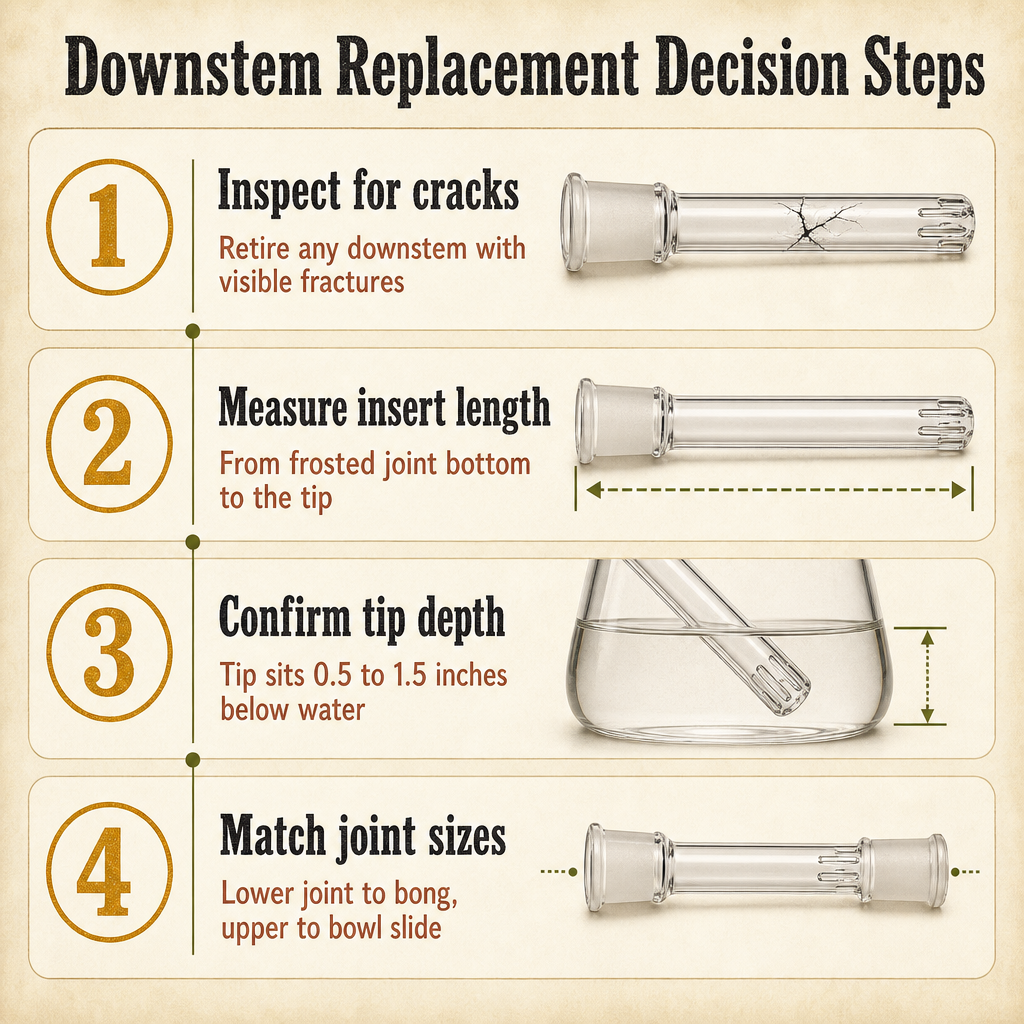
Downstems fail in three recognizable ways: physical damage to the glass, an incorrect length for the bong, and a tip depth that no longer sits in the water. A downstem that is too long can press against and crack the base of the bong; one that is too short sits above the waterline and skips filtration entirely [4]. The correct tip depth is roughly half an inch to an inch and a half below the water surface, which is what produces the bubbling action that defines a working bong.
Standard removable downstems use industry-standard joint sizes of 10mm, 14mm, and 18mm, with 14mm and 18mm being the most common on modern bongs [4] [5]. The lower joint must match the bong’s female joint, and the upper joint must match the bowl slide. A downstem that fits too tightly can crack the glass, while one that fits too loosely leaves the tip above the waterline and skips water filtration. This sizing logic is covered in the parent guide What Are the Parts of a Bong, Rig, or Pipe and How Do They Work? and in the broader parts breakdown What Are the Parts of a Bong and What Does Each One Do?, both of which explain how each piece of the rig is supposed to seat together.
Handmade glass water pipes can vary in downstem fit by up to a quarter to half inch between units of the same model, so the existing downstem should always be measured (insert length, from the bottom of the frosted joint to the tip) before ordering a replacement [5]. A loose or worn grommet at the joint makes the same problem worse by letting unfiltered air slip in around the downstem, which is why a fresh downstem often pulls better even when the old one looks intact. Browse the full Downstems catalog to compare the standard lengths and joint sizes that fit a specific bong, and pair any new downstem with a routine deep clean of the joint area as outlined in the The Complete Guide to Cleaning Smoking Accessories cleaning guide so the new seal seats into a clean socket.
- Inspect for cracks anywhere along the downstem, especially at the joint and the diffuser tip, and retire any piece with visible fractures.
- Measure insert length from the bottom of the frosted joint to the very tip of the downstem and write that number down before ordering.
- Confirm tip depth by filling the bong to the normal waterline and checking that the tip sits roughly half an inch to an inch and a half below the surface.
- Verify the joint still seats with a snug seal; if the downstem rocks side to side or drops in without resistance, the grommet or the joint itself is worn.
How Do You Know If a Pipe Screen Should Be Replaced or Just Cleaned?
Screens are the smallest and cheapest part on a bong, but they are also the most often ignored until airflow suffers. A damaged screen stops blocking debris and starts restricting draw at the same time, which is why screens belong on the same check schedule as the bowl itself. How Often Should You Clean Smoking Accessories? covers the broader cleaning rhythm that should include a screen swap whenever a deep clean is overdue.
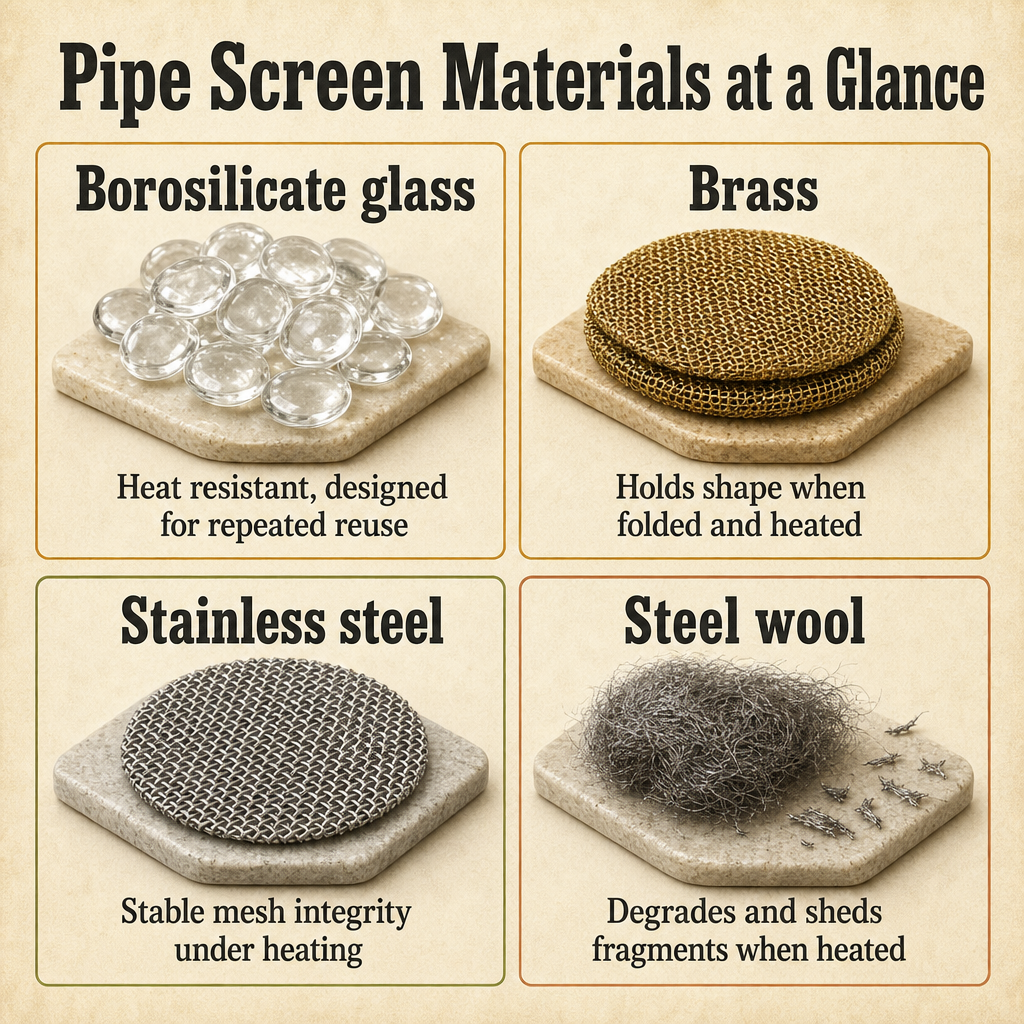
Glass pipe screens are made from heat-resistant borosilicate and are designed for repeated reuse, while metal screens (brass or stainless steel) are reusable but must be replaced once they bend, clog, or lose shape [3]. Brass and stainless steel screens hold their shape and mesh integrity when folded and heated with a butane lighter, while steel wool alternatives degrade and shed fragments that can be inhaled [2]. Steel wool is the one material that should be replaced on contact rather than on a schedule, because every heating cycle sheds more fragments.
On a hand pipe, screens should be replaced when they are bent, clogged with resin that cannot be cleared with a toothpick and a rinse, or visibly misshapen, because a damaged screen no longer blocks debris and restricts airflow [3]. Bong screens added as a separate component into a bowl that was not designed for them often shift during use, cause inconsistent airflow, and require constant replacement; bowls with a built-in or pinched screen avoid those issues [7]. The rule is simple: if the screen no longer seats flat, can no longer be cleared with a toothpick, or shows any rust or fuzz, it is time for a new one.
- Borosilicate glass screens: heat resistant, designed for repeated reuse, and the longest-lasting screen material when handled carefully.
- Brass screens: hold their shape when folded and heated, can be refreshed with a lighter pass, and should be replaced once the mesh bends out of round.
- Stainless steel screens: stable mesh integrity under heating and a step up from brass for long-term reuse, but should still be swapped if they clog or warp.
- Steel wool screens: degrade and shed fragments when folded and heated, and should be replaced on contact rather than cleaned and reused.
- Aftermarket screens dropped into a non-screened bowl: tend to shift during use, cause inconsistent airflow, and need constant replacement compared to bowls with built-in or pinched screens.
| Material | Heat behavior | Reuse pattern | Replace when |
|---|---|---|---|
| Borosilicate glass | Heat resistant; tolerates repeated reheats | Designed for many uses | Cracks, chips, or mesh breaks |
| Brass | Holds shape when folded and heated | Reusable with a lighter pass | Mesh bends out of round or clogs past cleaning |
| Stainless steel | Stable mesh integrity under heating | Reusable across many sessions | Clogs, warps, or no longer seats flat |
| Steel wool | Degrades and sheds fragments when heated | Not recommended for reuse | Immediately, on contact |
When Should a Rubber Grommet or Seal at the Joint Be Replaced?
The rubber or silicone grommet at the downstem joint is the part nobody notices until pulls go weak. Once it cracks, tears, or loses elasticity, unfiltered air slips in around the seal and the bong pulls as if it had no downstem at all. A fresh seal restores tight joint fit and turns a sluggish rig back into one that pulls smoothly on the first draw.
A rubber or silicone grommet at the downstem joint should be replaced when it shows cracks, tears, loss of elasticity, or a loose fit, because a broken seal lets unfiltered air in and weakens pulls [6]. Grommets are inexpensive, and the swap is the simplest job on a bong: pull the old grommet out with a fingernail or a small pick, drop the new one into the joint socket, and seat the downstem back in. Most glass shops stock replacement grommets in the three standard sizes (10mm, 14mm, and 18mm) for the same reason that bowls and downstems come in those sizes.
Grommets also age fastest on a bong because they sit in the joint socket and absorb heat cycle after heat cycle. A grommet that feels sticky, shiny, or flattened at the opening has lost its grip even if there is no visible crack yet, and it is worth replacing on the same schedule as a deep clean. Pairing a fresh grommet with a deep clean of the joint area keeps the downstem seated firmly and stops the slow leak that drags down airflow over time.
- Visible cracks anywhere on the grommet rim, including hairline fractures that only show up when the grommet is flexed.
- Tears or chunks missing from the inner or outer edge of the seal where the downstem presses against it.
- Loss of elasticity where the grommet stays compressed after the downstem is removed instead of springing back into shape.
- A loose fit where the downstem rocks or sits crooked in the joint without the grommet holding it centered.
- Visible shrinkage, stickiness, or shine around the joint that signals the rubber or silicone has hardened past its usable life.
What Joint Size and Length Do You Need for a Replacement Downstem?
Every removable downstem follows an industry-standard two-number sizing system, and getting those two numbers right is the difference between a downstem that seats and one that rattles. Downstem connection sizes follow a two-number system (for example, 18/14mm) where the first number is the joint that fits into the bong and the second is the joint that accepts the slide [5]. The standard joint sizes for modern bongs are 10mm, 14mm, and 18mm, with 14mm and 18mm being the most common on the current market.
A downstem that is too long can press against the bottom of the bong and crack the glass, while one that is too short leaves the tip above the waterline and skips water filtration entirely [4]. The tip of a properly sized downstem should sit roughly half an inch to an inch and a half below the water surface for effective bubble filtration [4]. Skipping that step is the most common reason a replacement downstem pulls worse than the original, even when the joint sizes match.
Handmade glass water pipes can vary in downstem fit by up to a quarter to half inch between units of the same model, so the existing downstem should always be measured before ordering a replacement [5]. Measure from the bottom of the frosted joint to the very tip of the downstem, and write that number down before ordering. A quick cross-check on the Bongs catalog shows the standard lengths that fit each bong style, which makes it easier to spot when a handmade piece needs a non-standard length.
- Identify the bong’s female joint size (10mm, 14mm, or 18mm) by reading any markings on the joint or by measuring the socket opening with calipers.
- Identify the bowl slide’s male joint size by reading the markings on the bowl or by measuring the slide with calipers.
- Measure insert length from the bottom of the frosted joint to the very tip of the downstem and write that number down before ordering.
- Account for handmade variation of a quarter to half inch by ordering a length that matches the existing downstem rather than the published spec sheet.
- Confirm tip depth by filling the bong to the normal waterline and checking that the new downstem’s tip sits roughly half an inch to an inch and a half below the surface.
How Do Aftermarket Bowl Screens Compare to Bowls With Built-In Screens?
Aftermarket screens dropped into a bowl that was not designed for them behave differently than bowls that ship with a pinched or integrated screen. The SILICONE BEAKER BONG WITH REMOVABLE GLASS BOWL is a good example of a bowl designed around a removable glass slide and a dedicated screen area, which is why it pulls consistently out of the box without needing aftermarket parts.
Aftermarket bong screens added into bowls not designed for them tend to shift during use, cause fit issues, and require constant replacement; bowls with integrated or pinched screens avoid these problems [7]. A screen that moves during a session changes how much debris gets blocked and how much air gets through, which is the opposite of what a screen is supposed to do. Bowls that ship with a screen built into the glass keep the screen in place through heat cycling and cleaning, which is why they tend to last longer than aftermarket setups.
The replacement-frequency difference is what usually decides the choice. An aftermarket screen can be swapped in seconds and costs almost nothing, but it has to be swapped often. A bowl with a built-in or pinched screen costs more up front and rarely needs the screen replaced, which makes it the better long-term option for shoppers who do not want to fiddle with small parts between sessions. Either approach works, but the right answer depends on how often the bowl is used and how much maintenance the owner wants to take on.
- Fit stability during use: built-in or pinched screens stay seated through heat cycles, while aftermarket screens tend to shift and need to be reseated.
- Airflow consistency: bowls designed around a screen keep the mesh in the airflow path, while aftermarket setups can partially block or open gaps depending on placement.
- Replacement frequency: aftermarket screens need to be swapped often, while bowls with integrated screens rarely need a screen swap at all.
- Cleaning ease: built-in screens clean in place with a soak and a rinse, while aftermarket screens have to be removed and reinserted each time.
- Long-term cost: aftermarket screens cost less per swap but add up over time, while bowls with integrated screens cost more up front and save on replacement parts.
Frequently Asked Questions
Can a cracked glass piece still be used?
A glass piece with any visible crack should be retired from use, because cracks can spread under heat stress and small fragments can break off during a session. Stress cracks can also develop over time from residue buildup on uncleaned glass, so a piece that has hairline fractures around the joint or screen area is no longer safe to keep in rotation.
Do brass or stainless steel screens last longer than glass screens?
Glass screens are made from heat-resistant borosilicate and are designed for repeated reuse, while brass and stainless steel screens are reusable but should be replaced once they bend, clog, or lose their shape. Steel wool alternatives are not recommended, because they degrade and shed fragments when folded and heated. A metal screen that no longer seats flat in the bowl or that resists cleaning with a toothpick and a rinse has reached the end of its usable life.
Why does a downstem that fits too tightly or too loosely cause problems?
A downstem that fits too tightly can press against the bottom of the bong and crack the glass, while one that fits too loosely leaves the tip above the waterline and skips water filtration entirely. The correct tip depth for a properly sized downstem is roughly half an inch to an inch and a half below the water surface, which is what produces the bubbling action that defines a working bong. A loose or worn grommet at the joint makes the same problem worse by letting unfiltered air slip in around the downstem.
How do you measure the insert length of a downstem for replacement?
Measure from the bottom of the frosted joint to the very tip of the downstem, and write that number down before ordering. Handmade glass water pipes can vary in downstem fit by up to a quarter to half inch between units of the same model, so the existing downstem is always the most reliable reference. Standard joint sizes for modern bongs are 10mm, 14mm, and 18mm, with 14mm and 18mm being the most common, and the downstem’s lower joint must match the bong’s female joint while the upper joint must match the bowl slide.
When Is It Time to Replace Each Part of the Rig?
The four parts that wear out fastest on any bong are the bowl, the downstem, the screen, and the rubber or silicone seal at the joint, and each one has its own replacement trigger. Bowls go when they crack, chip, or no longer seat flat. Downstems go when they crack, sit at the wrong depth, or no longer match the bong’s joint size. Screens go when they bend, clog past cleaning, or stop blocking debris. Grommets go when they crack, tear, or lose their grip on the downstem.
A simple routine keeps all four parts in working order: inspect the bowl and downstem for cracks after every deep clean, swap screens whenever a clean no longer clears the resin, and replace grommets at the first sign of stickiness or looseness. Standard joint sizes (10mm, 14mm, and 18mm) and standard insert lengths make every replacement a measurable part rather than a guessing game, especially when the old part is still on hand to measure against. Shop the downstems, bongs, and replacement parts in the parts-and-upgrades catalog to keep the rig pulling the way it was designed to.
Sources
- Stoked Progressive Smoke Shop & Glass Gallery: How to Clean and Maintain Your Glass Pipes
- Harm Reduction Journal (Queen’s University / Ontario Harm Reduction Distribution Program): Not all screens are created equal: examination of surface features and other physical properties of commonly used screen materials for smoking drugs
- Smoke Cartel: How to Use Pipe Screens
- DankStop (High Tide Inc.): How to Measure and Buy a Downstem: Simple Sizing Guide
- Thick Ass Glass (TAG): Downstem Sizing & Measurement Guide
- Bong Warehouse: What Is a Rubber Grommet Bong Used For?
- Thick Ass Glass (TAG): What Are Bong Screens? Types, Uses & Best Options