

Dab rigs commonly use 10mm, 14mm, or 18mm ground-glass joints [1] [3]. The size tells you the diameter at the widest point of the tapered connection, and gender tells you whether the rig has a male plug or a female socket. A banger needs the same size, the opposite gender, and the matching angle; an adapter can fill in any gap [2].
What Does Joint Size Mean on a Dab Rig?
A dab rig joint is the small tapered connection at the top of the rig where a banger, terp slurper, or reclaim catcher drops in. The same design has been used in laboratory glassware for many years, and the cannabis industry borrowed it because the cone-and-socket shape holds itself together with friction. There is no clamp or threading needed for a good seal.
The size label on a joint is a short code written like "14/20" or "18/14". The first number is the diameter in millimeters at the widest point of the cone, and the second number is the length of the tapered section, also in millimeters. When you shop, you usually only see the first number because most dab-rig joints use a standard taper [1].
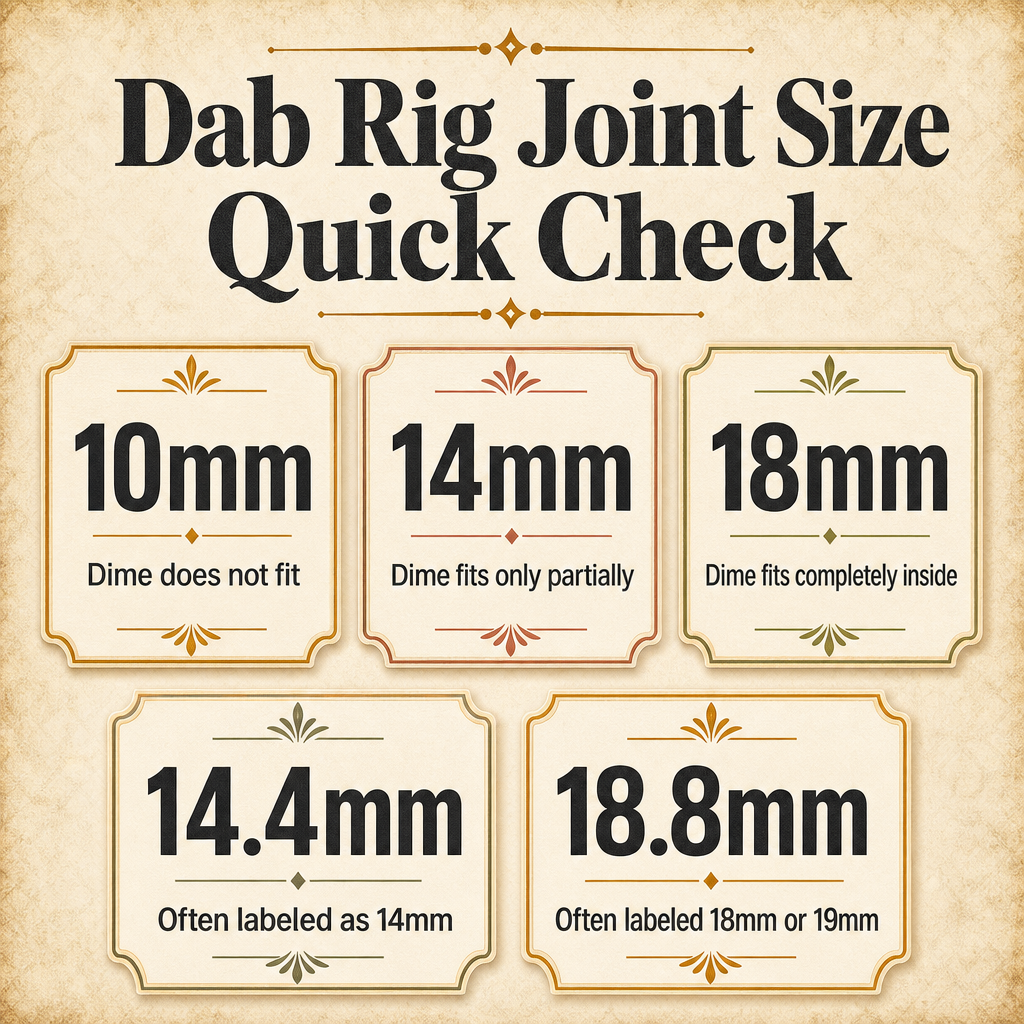
Shops often round that first number. A real 14mm joint is closer to 14.4 millimeters, and an 18mm joint is closer to 18.8 millimeters. The technical name comes from the 1:10 standard taper used in lab glassware [1]. Retail labels simplify those decimals to 14mm, 18mm, or sometimes 19mm [3]. The rounded labels are close enough that parts from different makers still fit each other.
You can also spot the taper on sight. Look at the open end of the connection. A dab rig joint widens slightly from the narrow tip to the wide base. That small wedge shape is what grips the matching socket on the banger. You can see the same shape on beakers, recyclers, and mini rigs because the taper is the same across all of them.
When you understand the size code, the rest of dab-rig shopping gets easier. You stop guessing whether a banger will fit, and you can read product pages with more confidence. You can also browse the related Dab Tools category to see how the same size code shows up across carb caps, inserts, and other concentrate accessories.
- Diameter in millimeters: the first number in a joint code, such as 14 or 18, is the outer width of the male cone or the inner width of the female socket at the widest end.
- Length in millimeters: the second number, such as 20 or 14, is the length of the tapered section, and most dab-rig parts share the same standard taper length.
- Standard taper ratio: the joint narrows along a 1:10 ratio, which is why parts labeled with the same size code fit across different brands [1].
- Friction seal: the cone and socket press together with hand pressure, and a properly seated joint will hold itself in place without a clamp.
- Rounded retail labels: 14.4mm is sold as 14mm, and 18.8mm is sold as 18mm or 19mm, so check the product specs if a label looks unclear [3].
How Do 10mm, 14mm, and 18mm Dab Rig Joints Compare?
The three sizes you will see on modern dab rigs are 10mm, 14mm, and 18mm. Each one shows up on different rig formats, and each one matches a different pool of bangers and accessories. Choosing between them is mostly about what kind of rig you want and how easy you want it to be to find parts.
10mm joints are the smallest of the three and are most often found on compact and portable rigs. Because the opening is narrow, the rig has more draw resistance. That tighter draw is a design choice rather than a problem, and many small rigs are built around it. 10mm parts are also less common on the market, so your banger options are more limited.
14mm joints are by far the most common size on dab rigs and bongs today [2]. Industry surveys put 14mm at roughly 70 percent of bong and dab-rig joints, which means most bangers, terp slurpers, reclaim catchers, and carb caps are made in 14mm first [2] [3]. The opening balances draw resistance with airflow, and most personal rigs use this size.
18mm joints sit at the wide end of the scale. They are usually found on larger rigs, beakers, and setups designed for group sessions. The wider opening means less draw resistance and more room for airflow. 18mm parts are widely available, but not as universal as 14mm, so a few specialty pieces may only be made in 14mm.
If you want a simple buying rule, pick 14mm if you are starting from scratch. You will have the widest selection of bangers, inserts, and accessories, and most replacement parts you find later will fit. You can read more about the rigs themselves in our guide What Is a Dab Rig and How Do You Use One?, and you can dig into the size story in What Are 10mm, 14mm, and 18mm Glass Joint Sizes?. For an example of a 14mm setup, the Human Grade 6.25" Bent Neck Dab Rig shows a typical bent-neck format with that mid-size joint.
- 10mm: smallest standard size, common on mini and portable rigs, narrowest airflow, smallest catalog of matching parts.
- 14mm: most common size on modern dab rigs and bongs, balanced airflow, largest catalog of matching bangers and accessories [2] [3].
- 18mm: largest standard size, common on beakers and group rigs, lowest draw resistance, broad but smaller-than-14mm accessory selection.
- Technical note: the rounded 14mm label covers a true 14.4mm measurement, and the rounded 18mm label covers a true 18.8mm measurement [3].
- Buying hint: when in doubt, choose 14mm because most replacement parts and adapters are produced in that size first.
| Size | Typical rig format | Draw resistance | Accessory availability |
|---|---|---|---|
| 10mm | Mini and portable rigs | Highest draw resistance | Smaller catalog, specialty parts |
| 14mm | Most modern dab rigs and bongs | Balanced airflow | Largest catalog of bangers and parts |
| 18mm | Beakers and group rigs | Lowest draw resistance | Wide selection, fewer than 14mm |
How Can You Tell Whether a Dab Rig Joint Is 10mm, 14mm, or 18mm?
You do not need a caliper to figure out the size of a dab rig joint. A short checklist of inspection steps will tell you which of the three standard sizes you are looking at, and whether the rig has a male plug or a female socket. Run through the steps before you buy a banger so you do not end up with a part that will not seat.
Step one is to look at the label. Many dab rigs have the size stamped or printed near the joint. The label may read "14mm" or "14/20" on a male joint, or "14F" for female. If you see a number on the glass, trust it and move on. If the glass is blank, you can still get a confident answer with the next steps.
Step two is to identify the widest point of the connection. That is where the size is measured. On a male joint, it is the wide base of the cone. On a female joint, it is the wide rim of the socket. The taper narrows toward the open tip of a male, or toward the bottom of a female socket.
Step three is to do a rough diameter check. A dime is about 17.9 millimeters across, which is close to 18mm at the wide end of a female joint [2]. If the dime drops all the way into a female socket without sticking, the joint is about 18mm. If the dime catches partway in, the joint is around 14mm. If the dime will not enter at all, the joint is 10mm.
Step four is to remember that the rounded retail sizes hide small decimal differences. A 14mm joint is closer to 14.4mm, and an 18mm joint is closer to 18.8mm [1] [3]. Because handmade glass varies a little from piece to piece, handle the dime test as a rough field check rather than a calibrated measurement [2].
Step five is to confirm before you buy. Cross-check the size with the product page of the banger or accessory you plan to use. If the page lists 14mm male and your rig has a 14mm female socket, you are good. If anything is unclear, our guide How Do I Measure My Bong’s Joint Size? walks through more sizing scenarios for tricky pieces.
- Inspect any stamp or label on the joint, such as 14mm or 14/20, and use that number as your starting point.
- Identify the widest end of the connection because that is where the size measurement is taken.
- Measure or eyeball the diameter at the widest point and compare it to a known reference such as a US dime.
- Use the dime test as a rough field check: full fit suggests 18mm, partial fit suggests 14mm, no fit suggests 10mm [2].
- Confirm the result with the product page of the banger or accessory before completing the purchase.
What Is the Difference Between Male and Female Dab Rig Joints?
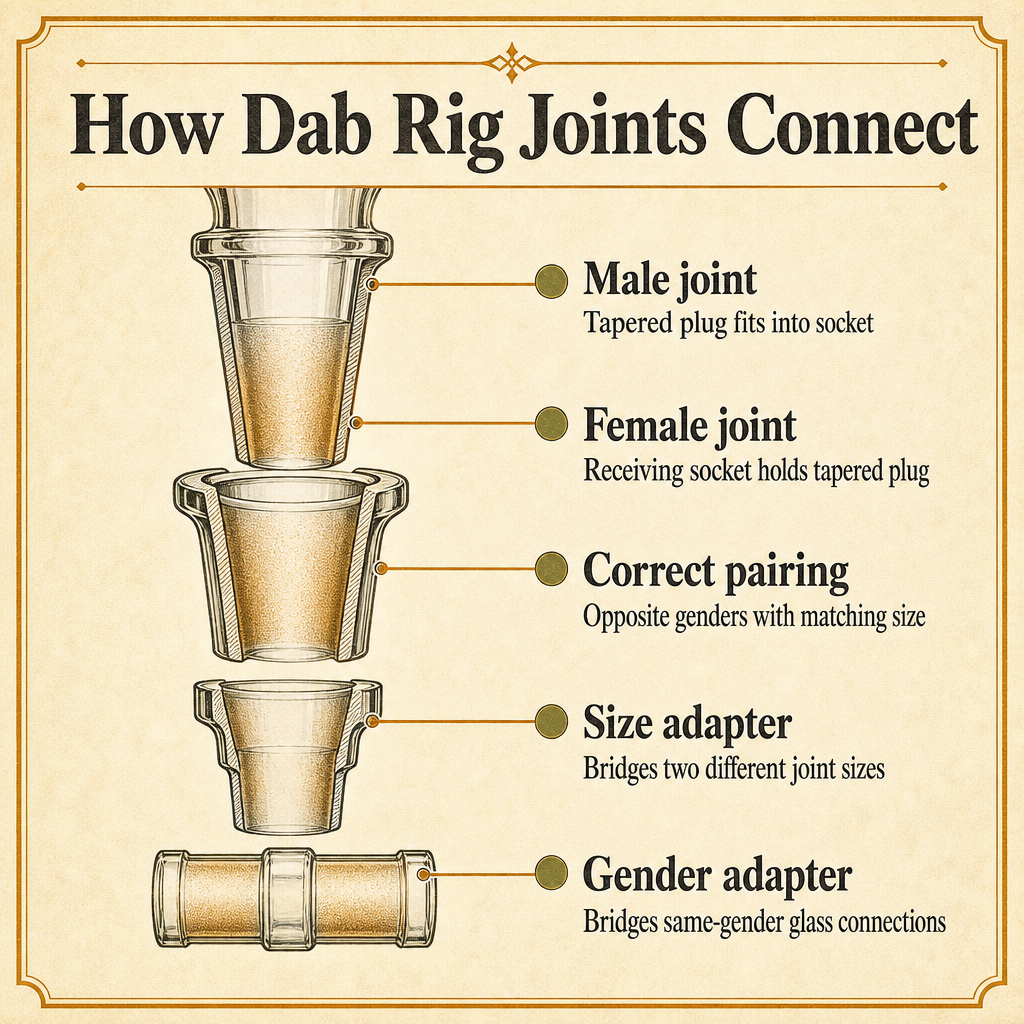
Gender is the other half of every dab rig joint. A male joint is a tapered plug, and a female joint is the matching socket. The two are designed to mate with each other, and they always have to be opposite genders. A male rig needs a female banger. A female rig needs a male banger. Same-gender parts will not fit together even when the size number matches.
You can spot the difference by looking at the shape. A male joint sticks outward from the rig like a small cone. A female joint is an opening that goes into the glass like a small cup. If you can drop the joint into your palm and see a hollow inside, it is female. If it tapers to a closed point, it is male.
The reason opposite genders have to match is the friction seal. The cone presses into the socket and the two tapered surfaces press against each other along the 1:10 standard taper [1]. That press-fit is what keeps the seal airtight when the banger is heated and loaded. If two male parts are pressed together, there is no socket to receive the cone. If two female parts are pressed together, you have two sockets facing each other with nothing to seal.
When you read product listings, gender is often written into the size label. "14mm male" means a tapered plug with a 14mm wide base. "14mm female" means a socket with a 14mm wide opening. That shorthand helps you match parts at a glance.
When you buy a banger or a reclaim catcher, match the gender of the banger to the opposite gender on your rig. If your rig has a 14mm male, look for a 14mm female banger. If your rig has a 14mm female, look for a 14mm male banger. The same rule applies to terp slurpers, inserts, and carb-cap adapters. For help picking the right overall rig size, see our guide What Bong Size Should You Get?.
- Male joint: a tapered plug that sticks out from the rig and fits into a female socket.
- Female joint: a tapered opening that goes into the rig and fits around a male plug.
- Required pairing: the rig and the banger or accessory must always be opposite genders, even when the size numbers match [2] [3].
- Same-gender mismatch: two male parts cannot seal together, and two female parts cannot seal together, because there is no matching surface to press against.
- Label shorthand: "14mm M" or "14mm male" describes a tapered plug, and "14mm F" or "14mm female" describes a socket.
Why Does a Dab Rig Joint Angle Matter?
Beyond size and gender, dab rig joints also have an angle. The two angles you will see most often are 90 degrees and 45 degrees. The angle controls which way the banger points when it is seated, and it has to match the angle on your rig or the banger will not sit straight.
A 90 degree joint points straight up. It is the most common angle on recycler rigs, straight-tube rigs, and many mini rigs. When you drop a 90 degree banger into a 90 degree joint, the banger sits vertically with the bucket facing up.
A 45 degree joint is angled away from vertical. It is the most common angle on beaker-base rigs, round-base rigs, and most rigs with a wider body. A 45 degree banger dropped into a 45 degree joint angles slightly toward you, which makes the bucket easier to reach when the rig is sitting on a table.
If the angles do not match, the banger can still drop in but it will sit at a wrong angle. The bucket may point at the wall or at your lap rather than up and away. More importantly, an off-angle seat can weaken the seal and leave a small gap that lets vapor escape.
You can browse the Dab Accessories category to see how bangers and adapters are labeled by angle. Most product pages list the angle next to the size, so a quick look is usually enough to confirm a match. If you want a single rule for buying new pieces, choose the same angle as the joint already on your rig.
- Step 1: identify your rig shape, such as straight tube, recycler, beaker, or round base.
- Step 2: look at the direction the joint points, either straight up or angled toward the user.
- Step 3: read the banger or accessory listing for the angle, often labeled 90 or 45 degrees.
- Step 4: confirm the banger sits straight and the bucket faces up before heating anything.
- Step 5: if the angle does not match, use an angled drop-down adapter or buy a banger with the correct angle.
Can You Connect Mismatched Dab Rig Joints With an Adapter?
If your rig and your banger do not match in size, gender, or angle, you do not always need to replace one of them. Ground-glass adapters exist for every common mismatch. An adapter is a small glass piece with a male end and a female end. Each end can be a different size, a different gender, or even a different angle, and the piece drops between your rig and your accessory.
Adapters are useful in three situations. The first is a size mismatch, such as a 14mm banger on an 18mm rig. The second is a gender mismatch, such as a male banger on a male rig. The third is an angle mismatch, where a drop-down or angled adapter changes the direction of the joint.
The most common adapter is a size converter. A 14mm-to-18mm adapter has a 14mm female end on one side and an 18mm male end on the other. You drop the female end onto your 18mm male rig joint, and your 14mm male banger drops into the female end. The adapter turns one size into the other in a single piece [1] [2] [3].
Gender changers are similar but do not change the size. A 14mm male-to-male adapter has two male ends and lets you connect two female pieces together. A 14mm female-to-female adapter has two female ends and lets you connect two male pieces together. These are the right choice when the size is correct but the genders are flipped.
Angle adapters, also called drop-downs, change the direction of the joint by 90 degrees or 45 degrees. They are useful when you have a 90 degree joint on the rig and want to use a 45 degree banger, or when you want the bucket to sit lower on the rig for easier reach.
When you buy an adapter, name both ends out loud before you check out. Read the size and gender of your rig joint, read the size and gender of your banger or accessory, then match each end of the adapter to one of those. Treehouse Lifestyle offers free shipping on orders $150+ so you can pick up an adapter alongside a new banger without paying extra freight.
- Step 1: identify the size of your rig joint by reading the label or using the dime test.
- Step 2: identify the gender of your rig joint by looking for a male cone or a female socket.
- Step 3: identify the size and gender printed on the banger or accessory you want to use.
- Step 4: choose an adapter whose two ends match each of the two connections, one end to the rig and one end to the accessory.
- Step 5: verify the angle on both pieces and confirm the banger sits straight when the adapter is in place.
How Do You Choose a Compatible Banger or Dab Rig Accessory?
Once you understand size, gender, and angle, choosing a banger or accessory becomes a short checklist. Work through each item before you add a part to your cart. If any item fails, swap in an adapter or pick a different piece.
First, confirm the size. The banger or accessory must carry the same size number as the joint on your rig. If your rig is 14mm, the banger should be 14mm. Do not mix 14mm and 18mm parts without an adapter.
Second, confirm the opposite gender. If your rig has a male joint, buy a female banger. If your rig has a female joint, buy a male banger. Same-gender pairs will not seal.
Third, confirm the angle. A 90 degree rig wants a 90 degree banger, and a 45 degree rig wants a 45 degree banger. If the banger sits crooked, the angle is wrong.
Fourth, watch for the rounded label quirk. A piece labeled 14mm is technically 14.4mm, and a piece labeled 18mm is technically 18.8mm [3]. As long as both the rig and the banger use the same rounded label, they will fit.
Fifth, decide whether you need an adapter. If you want a banger in a size, gender, or angle that does not match your rig, plan to add the right adapter to the order. Treehouse Lifestyle offers free shipping on orders $150+, so you can bundle a banger, an adapter, and a carb cap into one shipment.
Sixth, browse the Dab Rigs category to see the current selection of rigs and matching accessories in one place. Looking at rigs and parts side by side is the fastest way to confirm which sizes and angles a particular brand favors.
- Step 1: confirm the size label, such as 10mm, 14mm, or 18mm, matches the joint on your rig.
- Step 2: confirm the gender, and buy the opposite gender from your rig joint.
- Step 3: confirm the angle, and match 90 degree to 90 degree or 45 degree to 45 degree.
- Step 4: note the rounded-versus-technical label so you do not mix 14mm and 14.4mm pieces across brands [3].
- Step 5: add an adapter to the order if any of size, gender, or angle do not match.
- Step 6: cross-check the final setup by seating the banger dry before heating anything.
Frequently Asked Questions
What is the most common dab rig joint size?
The 14mm joint is the most common size on dab rigs and on most bongs in the current market. Because of that, the largest selection of bangers, terp slurpers, reclaim catchers, and other concentrate accessories is made in 14mm first.
Are 14mm and 14.4mm dab rig joints the same?
In retail language, yes. A real 14mm joint measures close to 14.4 millimeters at the wide end of the taper. Likewise, an 18mm joint measures closer to 18.8 millimeters and may be sold as 18mm or 19mm. Always check the product specifications if a label looks unclear.
Does a male dab rig need a female banger?
Yes. A male joint is a tapered plug and mates with a female socket. A female joint on the rig needs a male banger. Two parts of the same gender will not seal together even when the size numbers match.
Can a 14mm banger fit an 18mm dab rig?
Not directly. The 14mm and 18mm connections are different sizes. A ground-glass adapter with the right size and gender on each end can bridge the mismatch so a 14mm banger can be used on an 18mm rig.
How can you check a dab rig joint size with a dime?
Use the dime as a rough field check for a female joint. A dime fitting all the way inside suggests 18mm, a partial fit suggests 14mm, and no fit at all suggests 10mm. Handmade glass varies a little, so confirm the result with a closer look before you buy.
Are 45-degree and 90-degree bangers interchangeable?
The size and gender may match, but the angle should also match the rig. A 90 degree joint points straight up and is common on recycler and straight-tube rigs. A 45 degree joint is angled toward the user and is common on beaker and round-base rigs.
Is Everything About Dab Rig Joints Easier Once You Know the System?
Joint sizes and genders follow a simple system once you learn the parts. Every modern dab rig uses a 10mm, 14mm, or 18mm ground-glass connection. The size is the width at the wide end of the taper, the gender is whether the rig has a plug or a socket, and the angle controls which way the banger points. Match all three details and your banger will seat cleanly.
If a banger does not match in size, gender, or angle, you do not have to start over. A small ground-glass adapter can bridge almost any combination. Read the size and gender printed on both the rig and the accessory, then pick an adapter whose two ends match each of those. Treehouse Lifestyle offers free shipping on orders $150+, so it is easy to bundle a banger, an adapter, and a matching accessory in one shipment.
When you shop, keep 14mm in mind as the most common size on the market. The widest range of bangers, terp slurpers, reclaim catchers, and other parts is made in 14mm first, and most replacement pieces you find later will fit. With size, gender, and angle checked off, the rest of dab-rig shopping becomes a matter of choosing the design you actually enjoy.
Sources
- Wikipedia (citing ASTM E 676 and ISO 383): Ground glass joint
- Smoke Cartel Inc.: How To Choose The Right Bong Bowl Size: A Guide For Beginners
- Grasscity: The Complete Guide to Glass on Glass Joint Sizes and Connections