

To load a dab rig, you need three things in order: a banger that actually fits your rig, enough heat on the bucket, and a small amount of concentrate placed with a dab tool instead of your fingers. Manufacturers describe two valid loading orders, hot start and cold start, and both finish with a wipe of the bucket [2].
The same steps cover how to load a dab rig with wax, shatter, or live resin, and the cap goes over the bucket once the concentrate is in. Amount matters too: published guidance is to start with a piece about the size of a grain of rice [2]. None of this is expensive or complicated. The two things that trip people up are fit and timing, and both get easier when you set your parts out before you light anything.
What Do You Need to Have Ready Before You Load a Dab Rig?
Most bad loading sessions are missing-parts problems, not technique problems. If the cap or the tool is still in a drawer when the bucket comes off the torch, the quartz keeps cooling while you search, and you end up loading onto a surface that is no longer at the temperature you planned. Stage everything first, then light the torch.
The banger has to seat on your rig before anything else happens, which means matching joint size, joint gender, and neck angle [1]. If you do not own a rig yet, the Dab Rigs collection is the starting point, and the Quartz Bangers collection sorts buckets by the three fit checks. You will find tools, caps, and swabs under Dab Accessories.
A butane microtorch belongs on its own stand, not lying on the table. The maker’s warnings say to keep it away from flammable fumes, liquids, and materials, to ignite it away from your face, hands, and clothing, and to let it cool before storing or refuelling [4].
A timer or phone stopwatch matters more than people expect. Torch heating gives you no temperature readout, so counting seconds and watching the colour of the quartz are the only two controls you have [3]. If you would rather not handle a torch at all, see What Is an E-Nail and How Do You Choose the Right One?.
One more piece of prep is easy to skip: set the rig down on a stable surface with room around the joint. Loading happens with a hot part in one hand and a sticky tool in the other, and a crowded table is how parts get knocked over.
- A rig with water filled to the level the maker marks
- A banger matched to your joint size, joint gender, and neck angle
- A dab tool, so concentrate never touches your fingers
- A carb cap within reach of your loading hand
- A butane microtorch resting on its own stand
- A timer or stopwatch for repeatable heat and cool counts
- Swabs and 99% isopropyl alcohol for the wipe afterward
What Are the Steps to Load a Dab Rig With Concentrate?
This is the hot start, which is the order most people picture when they ask how to load a dab rig. Each step depends on the one before it. The banger has to be seated before it gets heat, the torch has to be off the bucket before concentrate goes on, and the cap has to be in your hand before the first draw [2].
The counts below are a starting point, not a rule. Bucket size and wall thickness change how much heat the quartz holds, so a 25mm bucket and a 20mm bucket need different counts even from the same torch [3]. Loading concentrate onto a banger is also the one step where speed matters, because the quartz keeps cooling while your tool is in the air.
For the parts involved in this sequence, see What Is a Quartz Banger and How Do You Choose One? for buckets, What Are Dab Tools and How Do You Choose the Right One? for tools, and What Are Carb Caps and How Do They Work? for caps. If you would rather load cold, see What Is a Cold Start Dab and How Do You Do One?.
The first draw is where the cap earns its place. Closed off, the bucket sits under slight negative pressure, so air enters through the cap’s opening instead of across the open top [2]. Community harm-reduction advice also points at a wait of roughly 15 to 60 seconds between heating the nail and inhaling, and at keeping the load small [7].
Then take the cap off and swab the bucket while it is still warm. That single habit does more for the next load than any accessory you can buy.
- Seat the banger in the rig joint and check that the bucket sits level.
- Fill the rig with water and check the level before any heat goes on.
- Set the torch on its stand and light it away from your face and hands.
- Heat the bucket, moving the flame around the walls and floor instead of holding it in one spot.
- Rest the torch back on its stand, never on its side.
- Start your timer, or watch the quartz change colour as it cools.
- Wait out the cool-down for your bucket size before you load anything.
- Pick up concentrate with the dab tool and place it on the bucket floor.
- Set the carb cap over the bucket before the first draw.
- Draw, then remove the cap and swab the bucket while it is still warm.
What Is the Difference Between a Hot Start and a Cold Start Dab?
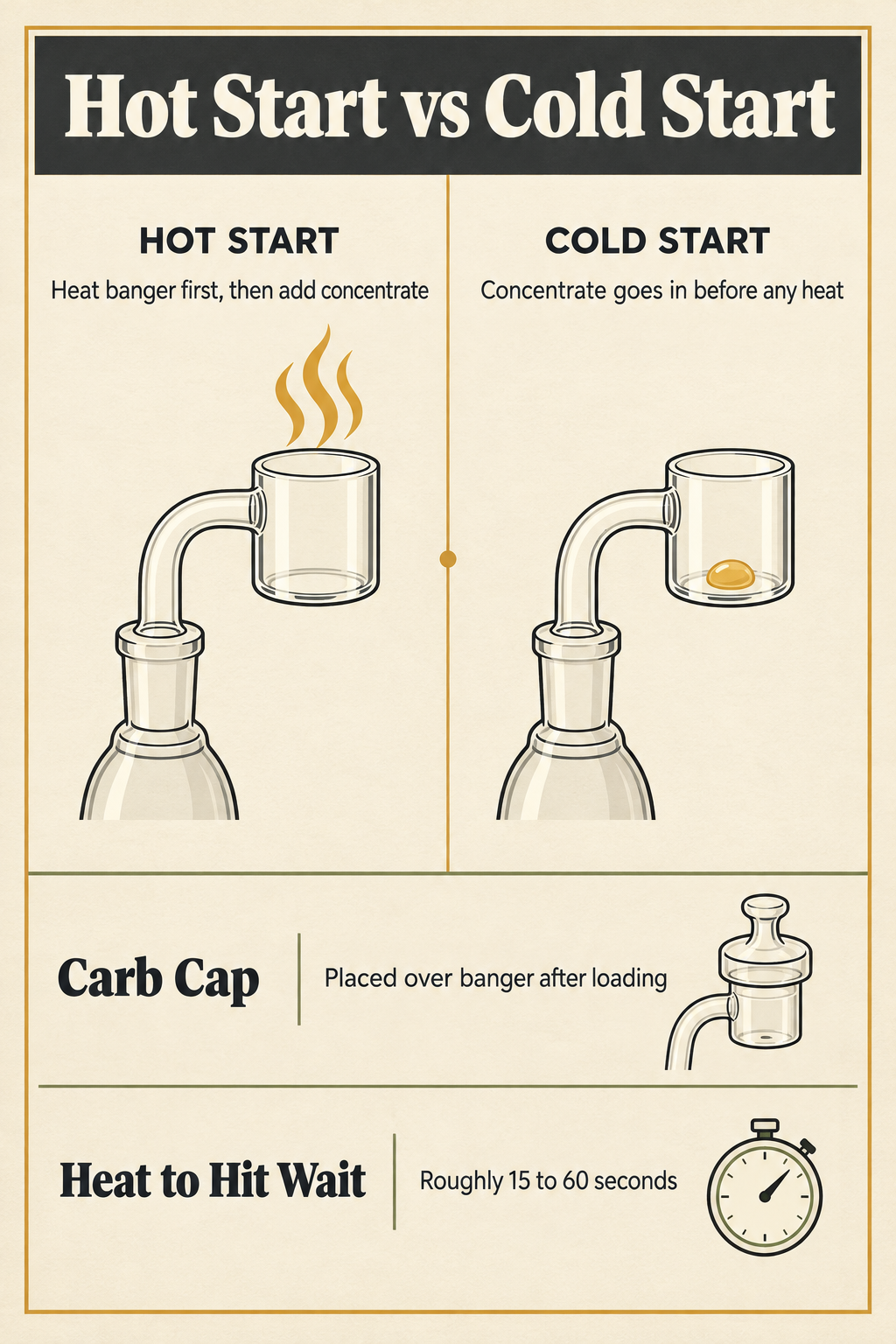
The two loading orders are both documented, and manufacturers describe them as valid methods rather than one being the correct way [2]. The difference is simply what goes into the bucket first.
A hot start heats the quartz and then applies concentrate to a surface that is already hot. That gives you a fast load and a short window. If you are slow with the tool, the bucket is cooler than you planned by the time the concentrate lands, and you end up chasing a moving target.
A cold start puts concentrate on room-temperature quartz and then applies heat until vapor forms [2]. You can watch the load melt and start to bubble, which makes the timing visible instead of guessed. The trade-off is that you are heating a bucket with product already inside it, so the flame stays on the outside walls and never goes into the bucket.
Either way, the cap goes on after the concentrate is in, and a wait of roughly 15 to 60 seconds between heating the nail and inhaling is the range community harm-reduction advice points at [7]. Both orders also end with the same wipe.
Which one to learn first is a matter of temperament. If you like a repeatable routine, time the hot start on your own bucket and write the counts down. If you want to see what is happening, the cold start shows you.
- Hot start: heat the bucket first, then apply concentrate to the hot surface.
- Cold start: place concentrate first, then apply heat until vapor forms.
- Hot start suits a routine you have already timed on your own bucket.
- Cold start makes the melt visible, which helps when you are learning a new banger.
- Both orders end with the carb cap over the bucket.
- Both orders use a wait of roughly 15 to 60 seconds between heating and inhaling.
- Both orders should finish with a swab of the bucket.
| Loading order | What goes in first | What you watch | Best for |
|---|---|---|---|
| Hot start | Heat, then concentrate | Your timer and the quartz colour | A routine you have already timed |
| Cold start | Concentrate, then heat | The load melting and bubbling | Learning a new banger |
Which Banger Fits Your Rig?
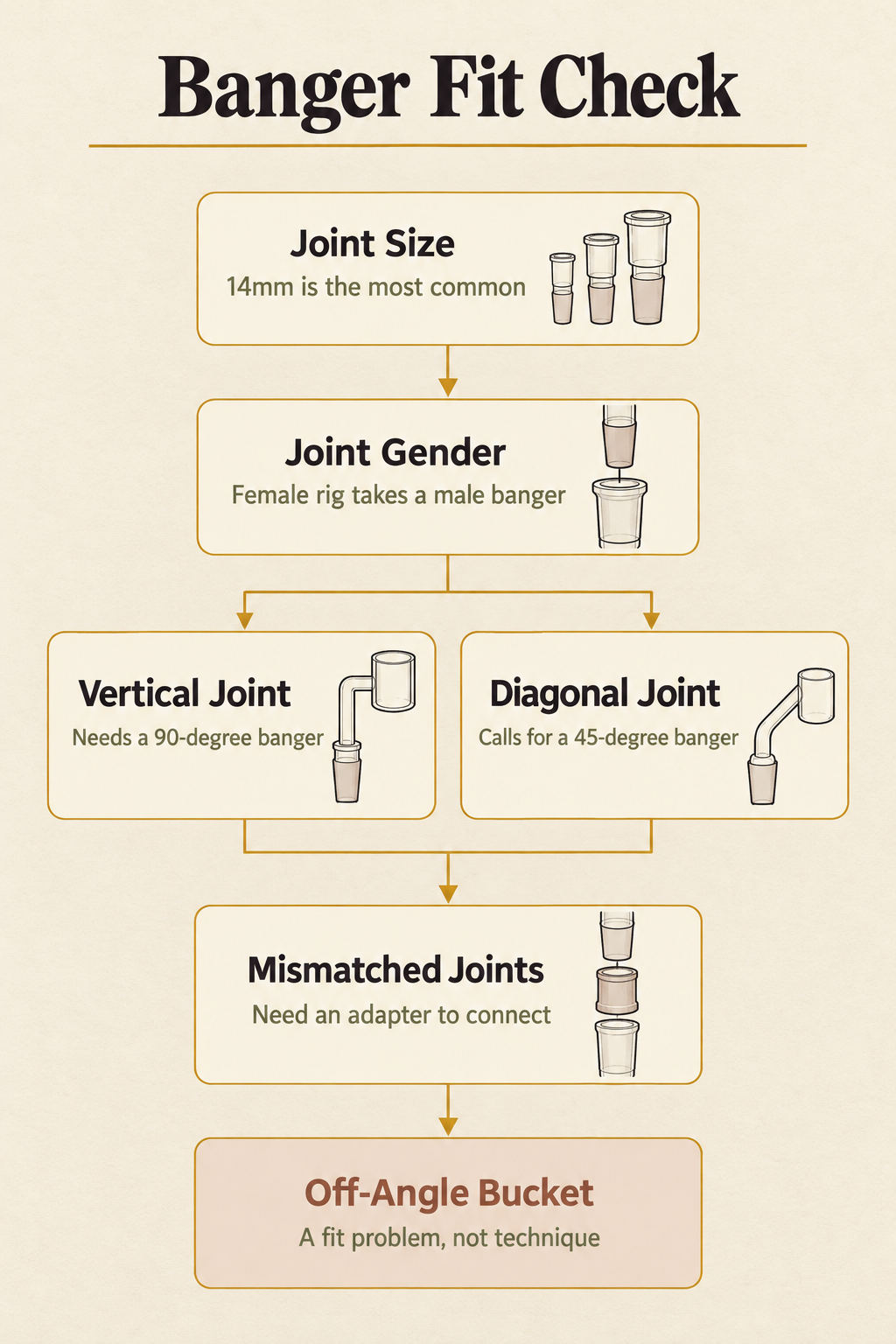
A banger has to match your rig on three things at the same time: joint size, joint gender, and neck angle. Get two right and one wrong and the part will not seat, no matter how carefully you load [1].
Joint size is the measurement you will see on every product page. Standard sizes are 10mm, 14mm, and 18mm, and 18mm is also sold as 18.8mm or 19mm. 14mm is the most common on rigs, so it is the one to check first when you are unsure.
Joint gender is the second check. A female rig joint takes a male banger, and two joints of the same gender do not connect without an adapter [1].
Neck angle is the check people skip. A vertical rig joint calls for a 90-degree banger, and a diagonal joint calls for a 45-degree banger. If the bucket hangs off at an angle, that is a fit problem rather than a technique problem, and no amount of practice will level it [1].
Quartz is the usual material for the bucket. Fused quartz has a very low coefficient of thermal expansion, about 5.5 x 10^-7 per degree C between 20 and 300C, which is what lets a quartz banger take repeated torch-and-cool cycles [10].
Vocabulary shifts between brands and regions, so expect the same part to be listed under more than one name. The heated surface is a nail or a banger, the airflow cover is a carb cap, and that 18mm joint may appear as 18.8mm or 19mm on the same page you were just reading.
- Joint size: 10mm, 14mm, or 18mm, also listed as 18.8mm or 19mm.
- Joint gender: a female rig joint takes a male banger.
- Neck angle: a vertical joint calls for a 90-degree banger.
- Neck angle: a diagonal joint calls for a 45-degree banger.
- Mismatched genders need an adapter to connect.
- 14mm is the most common joint size on rigs.
- An off-angle bucket is a fit problem, not a technique problem.
How Long Should You Heat and Then Cool a Banger?
There is no single published timing that covers every banger. Bucket size and wall thickness change how much heat the quartz holds, so a banger maker publishes a different heat-up and cool-down pair for each style [3].
Because a torch has no temperature readout, you are working from two things: a count, and the colour of the quartz. The same source notes that a faint red glow corresponds to roughly 930F and a fuller red glow to roughly 1075F, both well above the range most cool-down guidance aims at. Use the glow as a starting reference, not a finish line [3].
Temperature also matters for what ends up in the vapor. In laboratory dabbing simulations, terpene breakdown products were not detected on the coolest nail setting tested and rose as the setting went up, with benzene appearing only at the hottest one [5]. That is one more reason to load on a bucket you have let come down rather than one still glowing.
The practical approach is to pick the pair that matches your bucket, run it once, and adjust from what you see. If the load sizzles the moment it lands, add cool-down seconds. If it leaves a puddle and stops bubbling early, take a few seconds off.
If you are still working out how much concentrate belongs on a nail, hold the load at rice-grain size while you dial in temperature; changing two things at once tells you nothing. Write the numbers somewhere you will find them. Your torch, your bucket, and your room temperature all shift the result, so a count that works in your own space is worth more than a chart.
- 20mm flat-top: about 30 seconds of heat and 30 seconds of cool.
- 25mm flat-top: about 40 seconds of heat and 45 seconds of cool.
- 30mm flat-top: about 40 seconds of heat and 45 seconds of cool.
- Opaque-bottom 25mm: about 30 seconds of heat and 45 seconds of cool.
- Core banger: about 40 seconds of heat and 60 seconds of cool.
- Faint red glow: roughly 930F.
- Fuller red glow: roughly 1075F.
Why Did Your Dab Burn, Sizzle, or Leave a Puddle Behind?
The failure modes people search for usually trace back to one of four things: too much heat, no cap, too large a load, or a bucket that never got wiped. Each symptom points at a specific adjustment, which is the good news.
Sizzling and instant darkening point at a bucket that is still too hot. Quartz holds heat longer than most people expect, and a bucket that looks like it has come down can still be well above the range you wanted [3].
A puddle left behind usually means the load was too large for the surface, or the cap was never seated, so your draw pulled air straight across an open bucket [2]. Load size matters for more than tidiness. In one dabbing study, the vapor stream captured up to 40% of the theoretically available material, so a bigger load is not automatically a load you get through [6].
Uneven melting points at a banger that is not sitting level. That is the joint angle check from earlier in this guide, not a loading habit you can fix with better hand speed.
A lingering taste from the last load points at a bucket that was not swabbed between loads. Product source matters too: in a screen of 57 concentrate samples, more than 80% showed some contamination with residual solvents or pesticides [6]. Public health agencies note that concentrates used in dabbing may contain additives or be contaminated with other substances [8].
It is also worth knowing where the whole routine sits in a wider picture. Public health reporting describes dabbing as a distinct route of use and flags the torch itself as a burn risk alongside product-related concerns [9].
- Sizzle or instant darkening: the bucket was too hot, so add cool-down seconds.
- A puddle left behind: the load was too large, or the cap was never seated.
- Vapor that stops early: check that the cap is on and the joint is sealed.
- Uneven melting: the banger is off-angle for your joint.
- A lingering taste: the bucket was not swabbed between loads.
- Repeat failures on the same bucket: write down your heat and cool counts and change one number at a time.
How Do You Clean the Banger Between Loads?
Swabbing the bucket after each load is maintenance, not cosmetics. Manufacturers recommend wiping residual material out after every dab and using 99% isopropyl alcohol, with 90% or higher acceptable if 99% is not on hand [2].
The routine takes less time than heating the bucket again, so it fits between loads without breaking the session. Doing it every time is what keeps the next load tasting like the concentrate instead of the last one.
One caution is worth stating plainly. Do not flood a hot bucket with liquid. Let the quartz come down off heat first, then wipe, so you are not splashing alcohol near an open flame or sending a puddle across a hot surface.
Cotton swabs work because they reach the corners where residue collects. A single swab used on a warm bucket usually picks up most of what is left, and a second damp one finishes the job.
- Let the bucket come down off heat before you touch it.
- Wipe residual material out with a dry swab while the bucket is still warm.
- Follow with a swab dampened with 99% isopropyl alcohol.
- Use 90% or higher if 99% is not available.
- Let the banger dry completely before the next load.
- Use a fresh swab rather than reusing a dirty one.
Which Accessories Make Loading a Dab Rig Easier?
Loading is a small set of parts working together, and each part removes one specific friction point. Read this as a map from accessory to step, rather than a shopping list in search of a reason.
The bucket is the heated surface and the part that has to fit, so it is the one to get right first [1]. Tools and caps cost far less and are the two that most often go missing mid-session. A torch on its own stand, plus isopropyl alcohol and a pack of swabs, completes the kit.
If you are stocking up in one order, that is the point where free shipping on orders $150+ matters. Otherwise, buy the part that is actually failing you. Most people do not need a new rig; they need a banger that seats and a cap that stays in reach.
- Quartz banger: the heated surface, matched to joint size, gender, and neck angle.
- Dab tool: places concentrate without your fingers touching the bucket.
- Carb cap: closes the bucket after loading so the draw pulls through a restricted opening.
- Butane microtorch on a stand: repeatable heat with a stable resting place.
- Timer: turns a guessed cool-down into a count you can repeat.
- Swabs and 99% isopropyl alcohol: the between-load wipe.
Frequently Asked Questions
How much concentrate should you load into a dab rig?
Published manufacturer guidance is to start with an amount about the size of a grain of rice [2]. Load it with a dab tool rather than your fingers, since the bucket is hot enough to burn on contact. Load size also affects how much of the material actually gets used, so starting small is both easier to control and less wasteful.
Do you heat the banger before or after adding concentrate?
Both orders are documented and both are described as valid methods [2]. A hot start heats the banger first and then applies concentrate to the heated surface. A cold start places concentrate in the bucket first and then applies heat until vapor forms. The carb cap goes on after the concentrate is in, whichever order you use.
Do you really need a carb cap to load a dab rig?
Yes. A carb cap is placed over the banger after the concentrate goes in, and it closes off the bucket so your draw pulls air through a restricted opening instead of straight across an open top [2]. Manufacturers describe it as part of loading rather than an optional extra, which is why it belongs in the setup before you heat anything.
How long should you wait between heating the banger and inhaling?
Community harm-reduction advice for dabbing centres on a wait of roughly 15 to 60 seconds between heating the nail and inhaling [7]. Manufacturer heat-up and cool-down tables vary by banger style, so use any single number as a starting point for your own bucket rather than a universal rule.
What size banger do you need for your rig?
Three things have to match at once: joint size, joint gender, and neck angle [1]. Standard joint sizes are 10mm, 14mm, and 18mm, also listed as 18.8mm or 19mm, and 14mm is the most common on rigs. A female rig joint takes a male banger, a vertical joint calls for a 90-degree banger, and a diagonal joint calls for a 45-degree banger.
What Should You Get Right First When You Load a Dab Rig?
If you take one thing from this guide, take the fit check. A banger that matches on joint size, joint gender, and neck angle removes most of the problems people blame on technique, because a level bucket is the only surface you can load consistently [1].
The second thing is the count. Time your heat and cool-down, write the numbers down, and change one value at a time. Torch heating has no temperature readout, so your own recorded counts are the closest thing you have to a dial [3].
After that, the rest is small habits: a rice-grain load placed with a tool [2], a carb cap that stays within reach, a wipe between loads, and a torch that always goes back on its stand [4].
None of it requires expensive gear. A matched bucket, a tool, a cap, a steady count, and a clean surface will do more for your results than adding parts to the shelf.
Sources
- GRAV: Can You Use a Bong as a Dab Rig?
- Puffco: How to Properly Take A Dab
- Yo Dabba Dabba: Dabbing Temperature Guide: What’s The Best Dab Temp?
- Bernzomatic (Worthington Cylinders): Bernzomatic ST2200 Butane Microtorch Instruction Manual
- Chemical Research in Toxicology (Meehan-Atrash, Luo & Strongin): Toxicant Formation in Dabbing: The Terpene Story
- Journal of Toxicological Sciences (Raber, Elzinga & Kaplan): Understanding dabs: contamination concerns of cannabis concentrates and cannabinoid transfer during the act of dabbing
- International Journal of Drug Policy (content analysis of dabbing forums): Frequently asked questions about dabbing concentrates in online cannabis community discussion forums
- U.S. Centers for Disease Control and Prevention: Cannabis Frequently Asked Questions
- U.S. Centers for Disease Control and Prevention, MMWR: Routes of Marijuana Use — Behavioral Risk Factor Surveillance System, 22 U.S. States and Two Territories, 2022
- FG Quartz: Quartz Glass Properties: Technical Specifications