
A dab tools guide starts with two choices: the material the tool is made from and the shape of its tip [2] [3] [4] [5]. The five common materials are titanium, stainless steel, quartz, ceramic, and glass; the five common tip shapes are paddle, scoop, pick, blade, and ball [2] [3] [5]. Pick the material that fits how often you dab, then pick the tip that fits the consistency you keep.
What Is a Dab Tool and Why Do You Need One?
A dab tool is the small handheld piece that sits between a storage jar and a heated banger or nail. It picks up a bit of sticky cannabis concentrate, carries it across the gap, and drops it onto the hot surface. Most tools run three to five inches long, with a handle on one end and a working tip on the other. Some have a tip on both ends, and some use a handle that swaps tips in and out.
During a session, a dab tool does three jobs. It moves concentrate from a container to a heated surface so your fingers never touch either. It helps you measure a steady dose from one dab to the next. It also keeps your hand well away from the heated banger or nail [1] [2] [5].
Tools differ along two axes. Material decides how the tool feels in your hand, how hot it can get, and how it holds up after many uses. Tip shape decides which kinds of concentrate the tool can pick up cleanly. Once you know the difference, you can match a tool to the concentrates you actually keep on your shelf. The What Do Terp Pearls Do, and How Do You Choose the Right Ones? guide covers another small piece that often sits next to a tool on a banger.
- Moves sticky concentrate from a jar to a heated banger or nail without touching either with your fingers.
- Helps you measure a steady dose so each session uses the same amount of concentrate.
- Keeps your hand away from the hot surface during a session.
- Comes in five materials (titanium, stainless steel, quartz, ceramic, glass) and five tip shapes (paddle, scoop, pick, blade, ball).
What Materials Are Dab Tools Made From?
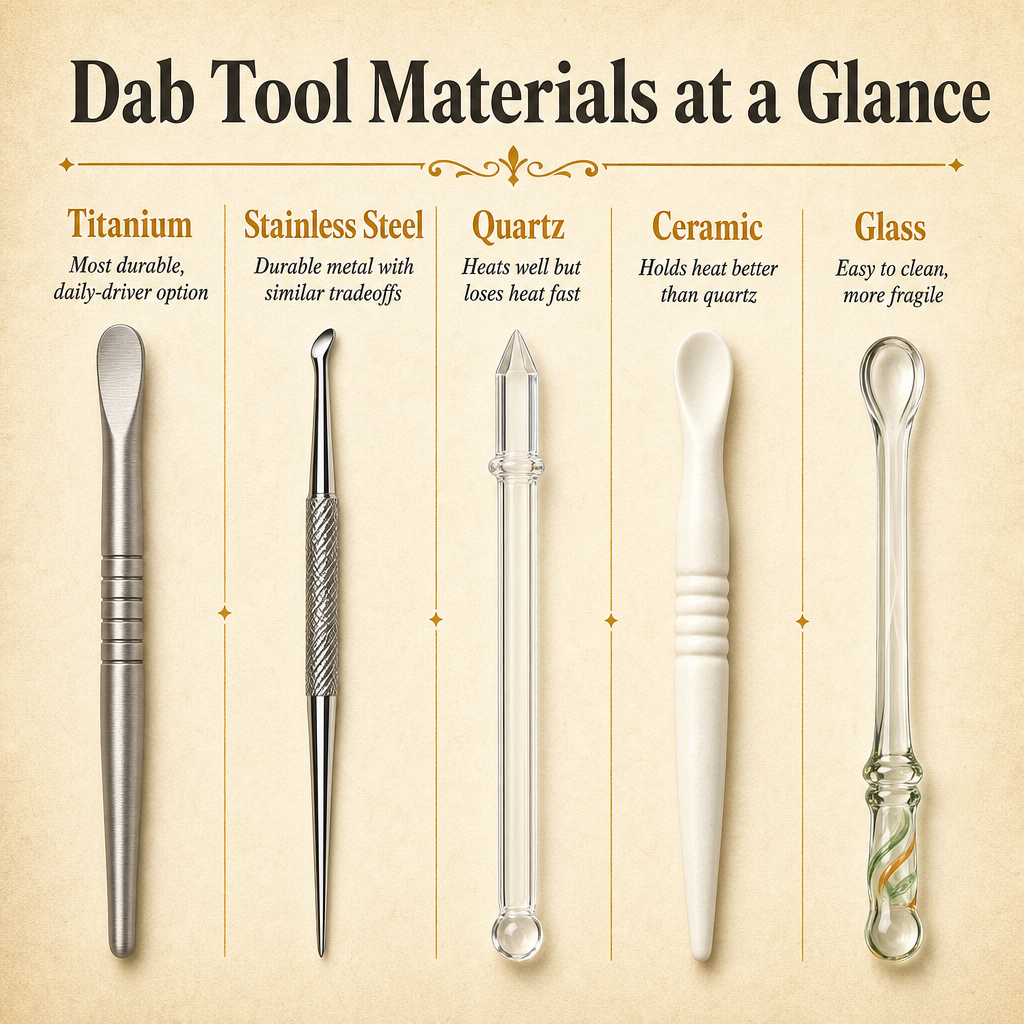
Most retailers carry dab tools in five materials: titanium, stainless steel, quartz, ceramic, and glass [2] [3] [4] [5]. Each one trades off durability, heat retention, weight, and ease of cleaning. There is no single winner — the right material is the one that matches how often you dab and what you care about most.
Titanium is the most durable option and is often called a daily-driver material [3] [4] [5]. It takes drops and hard use without chipping. It also holds heat, so the tip can stay warm for a few seconds after you set it down. Stainless steel is the other common metal and is described as a durable option with similar tradeoffs.
Quartz and ceramic sit in the middle of the pack. Quartz heats well but loses heat fast [3] [4] [5]. Ceramic holds heat better than quartz and breaks less easily than glass. Both are popular with buyers who use a tool, set it down between dabs, and pick it up again.
Glass is the fifth option. Glass tools are often hand-blown, easy to clean, and come in many shapes and colors [2] [4] [5]. The trade is that glass breaks more easily than metal, so it is rarely the first pick for a daily-driver tool. Many buyers keep a glass tool as a backup or as a display piece on a tray.
To see how an actual tool sits in a kit, the MJ Arsenal Time Turner Mini Dab Rig is one example of a small dab rig you can pair with a tool. For a wider look at the materials we currently stock, the Dab Tools subcategory collects the tools themselves. The two pieces that always sit next to a dab tool are the banger and the carb cap, both covered in the What Is a Dab Rig and How Do You Use One? primer and the What Are the Parts of a Bong, Rig, or Pipe and How Do They Work? parts guide.
- Titanium — most durable; a daily-driver option that holds heat after a dab.
- Stainless steel — durable metal with similar tradeoffs to titanium.
- Quartz — heats well but loses heat fast; middle of the pack for weight and heat behavior.
- Ceramic — holds heat better than quartz; breaks less easily than glass.
- Glass — easy to clean and often hand-blown; the most fragile of the five materials.
| Material | Durability | Heat behavior | Cleaning note |
|---|---|---|---|
| Titanium | Most durable | Holds heat | Soak residue off or torch-flash |
| Stainless steel | Durable | Holds heat | Soak residue off or torch-flash |
| Quartz | Moderate | Loses heat fast | Wipes clean with isopropyl alcohol |
| Ceramic | Moderate | Holds heat better than quartz | Wipes clean; avoid metal scrapers |
| Glass | Most fragile | Loses heat fast | Wipes clean; handle gently |
What Tip Shapes Are Used on Dab Tools?
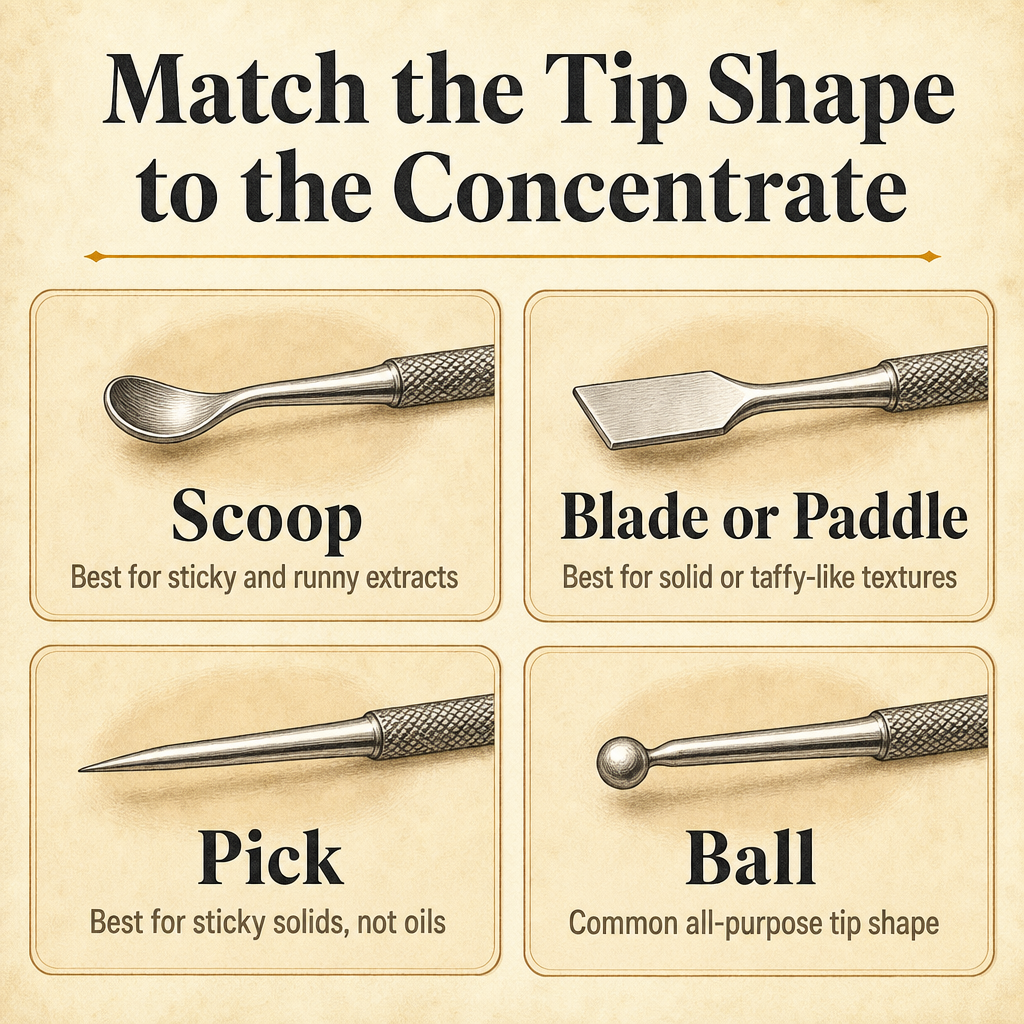
Tip shape is the second big choice. The five common shapes are paddle, scoop, pick, blade, and ball [2] [3] [5]. Each one is built to grab a different kind of concentrate. The names are not universal, though — one store might call a flat tip a paddle while another calls the same shape a blade or a knife. Read the names as common conventions rather than fixed terms when you compare tools.
A paddle is a flat, wide end that pushes under a soft piece of concentrate and lifts it. A scoop is a small cup shape that holds runny or sticky material. A pick is a thin point that pries into a sticky solid. A blade is a flat edge that slides under a hard piece and pops it off the container. A ball is a round end that is sometimes used as an all-purpose tip.
Shape is what lets a tool do its job. A paddle that works well on a soft shatter will not pick up a runny sauce. A pick that works well on a sticky wax will slide right off a hard shatter. If you dab more than one consistency, you either need more than one tool or one tool that swaps tips. The Puffco New Hot Knife Electronic Heated Loading Tool heated loading tool is a different style of loading device some buyers use instead of a standard wand.
- Paddle — flat, wide end that pushes under a soft piece of concentrate.
- Scoop — small cup that holds runny or sticky material.
- Pick — thin point that pries into a sticky solid.
- Blade — flat edge that slides under a hard piece and pops it off the container.
- Ball — round end used as a general all-purpose tip.
How Do You Match a Dab Tool Tip to a Concentrate Consistency?
Concentrate consistency is the main thing tip shape is built around. A runny extract behaves differently than a sticky extract, and a sticky extract behaves differently than a solid one. Once you can tell the three textures apart, you can pick the tip that handles each one cleanly [2] [3] [5].
Runny consistencies like sauce, badder, and certain sugars are best picked up with a scoop. The cup shape holds the liquid in place until you drop it onto the banger. A scoop also works for sticky wax that clings to whatever it touches.
Sticky solids like wax and certain rosins are also a good match for a scoop, and a pick can pry into the same texture when you want a smaller dose. A pick is not a good match for runny oils, since the thin point will not hold much liquid.
Solid consistencies like shatter and hard rosin patties are best picked up with a blade or a paddle. The flat edge slides under the piece and lifts it off the container without breaking it. A ball can work as a middle ground if you keep your dabs small and stick to one consistency.
If you want one tool that handles more than one consistency, a heated loading tool is another option. The Yocan Dirk Hot Knife Electric Heated Dab Tool – 400mAh / 9ct is one example of a battery-powered tool that melts a small amount of concentrate so it can be dropped onto a banger without any picking at all.
- Runny extracts (sauce, badder, sugar) — a scoop holds the liquid in place during the move.
- Sticky wax — scoop and pick both work; pick is not a good match for oils.
- Stickier rosins — paddle or scoop handle the soft, tacky texture.
- Solid shatter or hard rosin patties — blade or paddle slides under without breaking the piece.
- Mixed jars — a kit with multiple wand tips covers the most textures with one handle.
What Are Combo Tools and Interchangeable Dab Tool Kits?
Not every tool is a single tip on a single handle. Two common multi-tip formats are combo tools and interchangeable kits. Both cover more than one job in a session, but they do it in different ways.
A combo tool puts a dabber on one end and a carb cap on the other [2]. The user can scoop, drop, and cap without switching pieces between steps, which is a good fit for a small kit where bench space is limited. The trade is that both ends share the same handle, so you cannot pick the perfect dabber tip and the perfect carb cap for each session.
An interchangeable kit uses a single handle with tips that screw or snap on and off. The wand can be a paddle one minute, a scoop the next, and a pick the minute after that. Kits are a common choice for buyers who keep more than one consistency on the shelf [2] [3]. The trade is that kits cost more than a single tool and the tips are small enough to lose between sessions.
To dig into the carb cap side of a combo tool, the What Are Carb Caps and How Do They Work? post covers what carb caps do and how they fit on a banger. For most readers, the choice between a combo tool and a kit comes down to whether you want one piece that handles two jobs or one handle that handles many.
- Single-tip tool — one handle, one tip shape, lowest cost, best for one consistency.
- Combo tool — dabber on one end and carb cap on the other; fewer pieces in the kit.
- Interchangeable kit — one handle with three or more wand attachments; covers every consistency you keep.
| Format | Tip count | Best for | Trade-off |
|---|---|---|---|
| Single-tip tool | One | One consistency | New tool needed to change texture |
| Combo tool | Two fixed ends | Small kits | Both ends share one handle |
| Interchangeable kit | Three or more | Multiple consistencies | Higher cost and small tips to keep track of |
What Should You Look for When Buying a Dab Tool?
Once you have a sense of material and tip shape, the rest of the buying decision is a short checklist. The order matters — start with the biggest choice and end with the small ones, so you can stop the moment a tool fits.
Material comes first. Pick the material that matches how often you dab and how much heat retention you want. Titanium and stainless steel are the most durable options. Quartz, ceramic, and glass are the lower-weight and easier-to-clean choices [2] [3] [4] [5].
Tip shape comes second. Pick the shape that matches the consistency you actually keep. A scoop for runny and sticky extracts. A blade or paddle for solid shatter. A pick for sticky solids. A ball if you keep only one consistency and want a general tool.
Handle length, weight, and grip come third. A short handle is easier to pack. A longer handle keeps your hand further from the heat. A heavier tool can feel solid in the hand but can tire you out during long sessions. A textured grip helps if you use the tool with sticky fingers.
Cleaning and storage come last. Some materials clean up faster than others. Glass and quartz wipe clean with isopropyl alcohol. Ceramic and metal may need a longer soak. A sleeve, a case, or a dedicated pocket keeps the tip from touching other pieces in your kit.
- Pick the material first — titanium or stainless steel for daily use, quartz or ceramic for the middle, glass for a backup or display piece.
- Pick the tip shape second — scoop for sticky and runny, blade or paddle for solid, pick for sticky solids, ball for a general tool.
- Pick the handle length and weight third — short for travel, long for distance from heat, heavier for a solid feel.
- Check the grip fourth — texture helps if you use the tool with sticky fingers.
- Plan cleaning and storage fifth — glass and quartz wipe clean, metal and ceramic may need a soak, and a sleeve or case keeps the tip covered.
How Do You Clean and Store a Dab Tool?
Most dab tools clean up with isopropyl alcohol, a small swab, and a minute of patience. The exact steps change a little by material, so it helps to know what you are working with before you start [2] [4] [5].
Glass and quartz tools are the easiest to clean. A short soak in isopropyl alcohol loosens leftover concentrate, and a cotton swab wipes the tip clean. Let the tool dry fully before you put it away.
Ceramic tools can take the same alcohol soak as glass and quartz. The tip is a little more porous than glass, so a second wipe is sometimes helpful. Avoid scraping ceramic with a metal tool, since the material can chip.
Titanium and stainless steel tools also clean with isopropyl alcohol, but heavier buildup may need a longer soak or a small brush. A torch can heat residue off a metal tip, though a soak is gentler on the handle finish.
Storage is the simpler side. A padded sleeve, a small case, or a dedicated pocket keeps the tip from touching other pieces. If you own a kit with multiple wand attachments, the case that came with the kit is the easiest way to keep every tip in one place. A clean, dry tool is also easier to pick up next time, since a sticky tip is the fastest way to lose concentrate on the way to the banger.
- Glass or quartz — soak in isopropyl alcohol, wipe with a cotton swab, let dry fully.
- Ceramic — same alcohol soak, wipe a second time if needed, avoid scraping with metal.
- Titanium or stainless steel — soak for heavier buildup, brush the tip, or torch-flash residue for a quick clean.
- Storage — use a sleeve, a case, or a kit pouch so the tip does not touch other pieces between sessions.
Frequently Asked Questions
What is the most common dab tool material?
Titanium and stainless steel are the most commonly sold dab tool materials and are described as the most durable options [3] [4] [5]. Quartz, ceramic, and glass round out the five materials most retailers carry. The tradeoffs between them center on durability, heat retention, weight, and ease of cleaning rather than on any single winner.
What dab tool tip shape is best for sticky wax?
Can you use one dab tool for every concentrate?
Are glass dab tools fragile?
What is a combo dab tool?
A combo tool pairs a dabber on one end with a carb cap on the other, letting the user scoop, drop, and cap without switching pieces between steps [2]. It is a common option for buyers who want to keep their kit small.
Do dab tool tip names mean the same thing at every retailer?
So Which Dab Tool Should You Pick?
Start with material. Titanium and stainless steel are the most durable options and are the most common pick for a daily tool. Quartz and ceramic sit in the middle for weight and heat behavior. Glass is the easiest to clean and the most fragile, which makes it a strong backup or display piece. Then pick the tip shape that matches the consistency you actually use — scoop for sticky and runny, blade or paddle for solid, pick for sticky solids, ball for a general tool.
If you keep more than one consistency, a kit with interchangeable wand tips or a combo tool with a dabber on one end and a carb cap on the other covers more ground with fewer pieces. Short handles pack easily, longer handles keep your hand further from the heat, and a sleeve or case keeps the tip from touching other pieces between sessions.
Pick the tool that fits the concentrate you reach for most, and you can always add a second tip or a second tool later. The job of a dab tool is to make the move from jar to banger clean and steady, and the right combination of material and tip shape is what does it.
Sources
- Puffco: Finding The Best Dab Tools & Accessories
- Leafly: How to choose the best dab tool
- Oil Slick: Dab Tools Breakdown: Materials, Shapes, Best Picks
- GreenState: Dab tool: pick the right piece for your kit
- Badass Glass: Dab Tools Beginner’s Guide