

A torchless dab rig is any device that heats the surface your concentrate sits on with electricity instead of an open flame. The nail, banger, or cup still gets hot. What changes is where the heat comes from and that the device can hold a set temperature rather than relying on a timer and a flame.[1]
What Does "Torchless Dab Rig" Actually Mean?
The name on the box is the first thing to untangle. "Torchless dab rig" is a retail phrase, not a defined standard, and the industry has no single term for this hardware. Shops and manufacturers swap between e-rig, electric dab rig, smart rig, e-nail, and torchless dab rig, and those labels overlap without meaning the same thing.[9]
Strip the marketing away and the definition is simple. A torchless rig is any device that heats the surface your concentrate sits on with electricity rather than a flame. The surface itself has not changed — it is still a nail, a banger, or a cup.[1]
That means the useful question is not whether a product is torchless but what is in the box. Two devices using the same label can differ on whether they include a bubbler, whether they run on a battery or a cord, and whether the part that gets hot is replaceable.
If you want to see how the category is actually merchandised, browse the Electric Rigs collection or start wider at Dab Rigs. A concrete example is the Cloud V Electro 4 eRig – 6000mAh, which is a battery-powered unit rather than a corded controller.
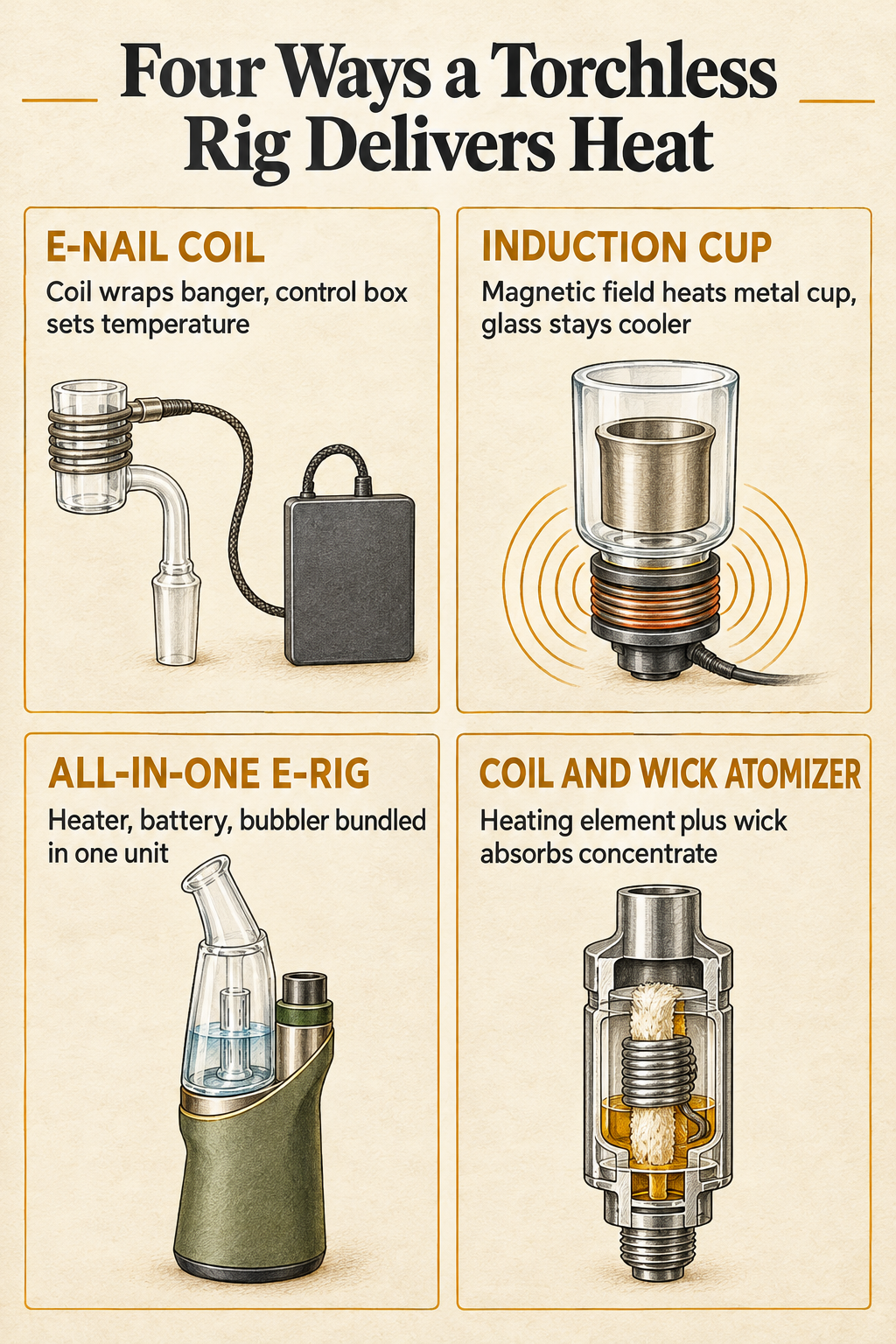
- All-in-one electric rigs. Heater, battery, and usually a water bubbler arrive as one body.
- E-nail systems. A control box plus a coil that wraps a banger, set to a target temperature.[2]
- Induction devices. A metal cup heats from a magnetic field while the glass around it stays comparatively cooler.[3]
- Pen-style devices. An atomizer packed into a small body, built for one small load at a time.[1]
- Listings that use the word torchless in the title but ship a torch in the box, which is why the included-items list matters more than the label.
How Does an Electric Dab Rig Heat Concentrate Without a Flame?
Every dab device does the same basic job. It moves heat from a source to a surface, and the concentrate sits on that surface. Dabbing heats concentrate to the point of vaporization rather than burning plant material.[1] What separates torchless designs is how the heat travels.
There are three routes, and they behave differently in the hand. A coil-wrapped banger has an element physically touching the banger. An atomizer puts a coil and a wicking material inside a chamber with the concentrate. An induction cup never touches anything, because the metal heats itself.
If you are new to the hardware underneath, see What Is a Dab Rig and How Do You Use One? for the base components. For the side-by-side of powered versus flame, see E-Rig vs Traditional Dab Rig: Which Should You Choose?, and for controllers specifically, see What Is an E-Nail and How Do You Choose the Right One?. Small chamber accessories change how heat spreads too, which What Do Terp Pearls Do, and How Do You Choose the Right Ones? covers.
Here is the path in order, from power source to heated surface:
- Power enters. An e-nail draws from a wall outlet; an all-in-one rig draws from an internal battery.[1]
- The element converts that power to heat. That is a coil, an atomizer coil, or the induction winding inside the device.
- On a coil system, heat crosses into the banger the coil is wrapped around. On an atomizer, it crosses into the wick and the chamber floor.[6]
- On an induction device the step is different. The coil generates an alternating magnetic field, and eddy currents heat the metal inside the cup.[4]
- Because induction is a non-contact method, heat is produced inside the conductive material itself rather than transferred from a flame or a touching element.[4]
- The concentrate sits on that heated surface, and the device holds the temperature it was set to instead of cooling on a timer.[5]
What Is the Difference Between an E-Rig, an E-Nail, and a Dab Pen?
These three names get used as if they were interchangeable, and they are not. The difference is what each one bundles and what it attaches to.
An all-in-one electric rig is the closest thing to a torch setup with the flame removed. The heater, the battery, and usually a water bubbler are one unit, so the device sets and holds its own temperature without a torch, butane, or a separate controller.[5]
An e-nail is a two-part system. A control box drives a coil that wraps the banger on a rig you already own, and you enter a target temperature on the box.[6] It is an upgrade to existing glass rather than a new rig.
A dab pen is built around an atomizer. The heating element and the wicking material sit inside a small chamber, and the whole device is sized for one small load.[1]
Because the labels are loose, read the included-items list rather than trusting the category name. A listing filed under e-rig may be a pen with a bubbler attachment, and a listing filed under e-nail may ship a banger and a coil as a set.[9] Here is how the three compare on the things that decide the purchase:
- E-rig: heater, battery, and usually a bubbler in one body, so nothing else is needed to start.
- E-nail: control box and coil only, and it needs a banger and a rig that already exist.
- Dab pen: an atomizer in a small body, with no bubbler and no separate controller.
- Power: the e-rig and the pen run on internal batteries, while an e-nail runs on a cord from a wall outlet.[2]
- Temperature: an e-nail takes a typed target, an e-rig takes presets or heat profiles, and a pen usually runs simpler settings.[9]
- Where it lives: an e-nail stays near its outlet, while the other two travel.
| Feature | E-Rig | E-Nail | Dab Pen |
|---|---|---|---|
| What ships in the box | Heater, battery, and usually a bubbler | Control box plus a coil | Atomizer in a small body |
| Power source | Internal battery | Wall outlet and cord | Internal battery |
| Water filtration | Usually built in | Comes from the rig you already own | None |
| Temperature | Presets or heat profiles | Typed target on the box | Simpler built-in settings |
| Where it can live | Anywhere it travels | Near an outlet | Anywhere it travels |
Can You Add an E-Nail Coil to the Rig You Already Own?
If you already own a glass rig and a quartz banger, you can keep both and add electric heat. An e-nail replaces the torch, not the rig — the coil wraps the banger and a control box drives it.[6]
The constraint to plan around is electricity. An e-nail has to sit near an outlet, so the rig’s home becomes a question about cords rather than shelf space. The manufacturer also notes that an e-nail holds high temperatures for long stretches, which is worth knowing before you handle a banger that stays hot between loads.[2]
One thing a coil cannot fix is a joint mismatch. If your banger and your rig do not share a standard, sort that out first — see What Bong Adapter Do I Actually Need? for the adapter sizing.
The fitment sequence is short, and doing it in order keeps you from buying a coil that will not seat:
- Confirm your banger is shaped to accept a coil. A banger with no place for the coil to wrap will not work with one.
- Match the coil to the banger’s size and form. An oversized coil sits loose, and an undersized one will not close.
- Seat the coil on the banger so it makes even contact around the wall instead of at a single point.
- Connect the coil to the control box, then plug the box in.
- Enter a target temperature on the box — this is the step a torch cannot do at all.[6]
- Let the reading settle before you load, and check it again after the first cycle.
How Long Does a Torchless Device Take to Heat, and How Is Temperature Set?
The rhythm of a powered device is different from a torch, and most of the difference is that less is left to judgment. Heat-up time, temperature setting, load size, and battery endurance are the four variables that shape a session.
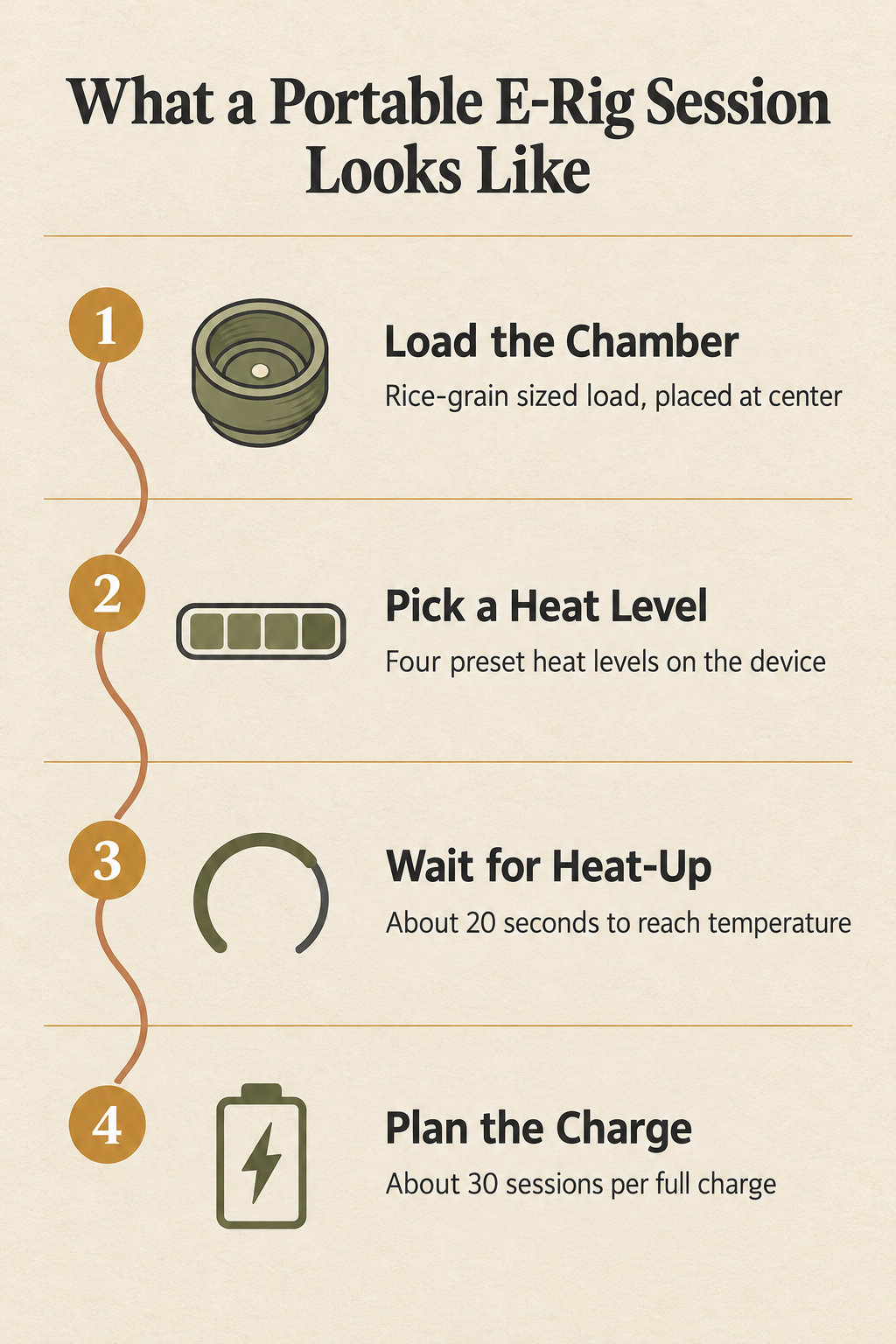
A portable e-rig is the clearest reference point, because it turns temperature into a setting rather than a technique. You pick a level, the device climbs to it, and it signals when it is ready instead of leaving you to count seconds with a flame in your hand.[5]
Load size is smaller than most first-time buyers expect, and where the material sits matters as much as how much goes in. Material packed against the chamber walls heats unevenly, so the load belongs in the middle rather than smeared around the sides.[5]
- Heat-up time: roughly twenty seconds to reach temperature on a portable rig, against a torch you heat by eye and time yourself.[5]
- Temperature setting: a typed target on a control box, a handful of presets on a portable, or custom heat profiles on higher-end models.[9]
- Load size: a rice-grain sized amount at the center of the chamber, not up the walls.[5]
- Endurance: about thirty sessions per charge, with roughly two and a half hours to refill the battery.[5]
- Cord versus battery: an e-nail holds temperature for as long as it stays plugged in, while a portable runs until the charge drops.[2]
What Does a Torchless Setup Cost Compared With a Torch?
Cost is where the two approaches look furthest apart, and where the first number misleads. The gap between a torch setup and an e-nail system is real, but a sticker price is not the whole comparison.[6]
That gap is real, but the running costs decide the total over a year rather than a week. Powered hardware has parts that wear, and an e-nail draws electricity while it sits holding temperature.[2]
One more line item depends on the seller. Treehouse Lifestyle lists free shipping on orders $150+, which matters more when a single device is the whole order than when you are buying a twenty dollar torch.
Here are the lines that actually decide the total:
- Torch entry point: roughly twenty dollars, plus butane you keep buying.[6]
- E-nail entry point: commonly a hundred to five hundred dollars, before replacement parts.[6]
- Replacement atomizers and cups: a recurring cost that scales with how often the device is cleaned and how hard it runs.[9]
- Batteries: cells age and lose capacity, so a portable rig has a finite service life.
- Electricity: an e-nail stays powered to hold temperature, so it is always drawing something.[2]
What Parts Wear Out, and How Do You Maintain an Electric Rig?
A powered device shifts the maintenance burden. You stop buying fuel and start watching chamber hygiene and wear parts. Atomizers, induction cups, coils, and batteries are the four items that eventually need replacing.
The routine part is simple, and it is what protects the life of an atomizer. Swabbing residue out of the chamber after each session slows the buildup that makes a deep clean necessary.[5]
Do it in this order:
- Swab the chamber after each session, while the residue is still soft.
- Keep water out of the electronic base, because the water section and the electronics are separate for a reason.[5]
- Deep clean only when a swab stops keeping up, rather than on a fixed calendar.
- Inspect the atomizer or cup for the wear that signals replacement, instead of waiting for a session to fail.[9]
- Store the device at a moderate charge rather than empty or full, and look over the cells for swelling.
Which Torchless Device Fits a First-Time Buyer Versus a Daily User?
The right answer depends on where the device will live and how often it gets used, not on which one looks best in a photo.
A first-time buyer is usually best served by an all-in-one rig. The heater, battery, and bubbler arrive together, and the presets remove the guesswork of timing a flame.[5]
A daily desktop user is usually better served by an e-nail on glass they already like. It stays powered, holds a target temperature across a long session, and does not depend on a charge level.[6]
Match your situation to one of these:
- First-time buyer: an all-in-one e-rig, because everything needed ships in one box with presets.
- Daily desktop user with glass they like: an e-nail and coil, because it holds temperature without a battery.
- Someone who moves between rooms or travels: a portable e-rig, accepting battery dependence and about thirty sessions per charge.[5]
- Someone who wants the lowest entry cost: a torch and a quartz banger, at roughly twenty dollars plus fuel.[6]
- Someone who wants fewer fuel purchases and more repeatable temperature: any torchless form factor, with replacement parts budgeted in.[9]
Frequently Asked Questions
Do you still need butane with a torchless dab rig?
No. The point of the category is that the heat comes from electricity rather than a flame, so there is no torch and no fuel to buy. An e-nail draws power from a wall outlet, and a portable rig runs from an internal battery you recharge between sessions.
Can a torchless rig use the banger you already own?
Often, yes — but only if the banger is shaped to accept a coil. An e-nail works by wrapping a heating coil around the banger and driving it from a control box, so the coil has to match the banger’s size and form. Check compatibility before buying a coil on its own.[6]
How is temperature controlled without a torch?
The device sets it. An e-nail has a control box where you enter a target temperature and the coil holds it. Portable rigs usually offer a small set of preset heat levels or custom heat profiles. A torch has no temperature setting at all, because you judge heat by timing and by how the banger looks.[6]
How much concentrate goes into an electric rig?
Less than most people expect. Portable e-rig chambers are typically loaded with a rice-grain sized amount, placed at the center of the chamber rather than smeared on the walls, so the material makes even contact with the heated surface.[5]
What needs replacing on a torchless setup over time?
Atomizers, induction cups, coils, and batteries are the parts that wear. Swabbing residue out of the chamber after each session is the habit that extends atomizer life and pushes back how often you need a deep clean or a replacement.[5]
Are torchless dab rigs safer than using a torch?
Neither route is free of risk, and they are not the same risks. A torch brings an open flame plus a fuel with a flash point near minus seventy-six degrees Fahrenheit and an explosive range of roughly 1.6% to 8.4% in air.[8] A powered device brings a rechargeable lithium-ion battery and a surface that stays hot after the session ends, and federal safety data on those batteries documents overheating, fire, and ejected components during use, storage, and charging.[7] Which set of hazards you can manage comes down to your space and habits, not to the hardware category.
What Should You Do Next If You Want to Go Torchless?
Start with what you already own. If you have glass and a quartz banger that takes a coil, an e-nail is the smallest step — you keep the rig and change only the heat source. If you are starting from nothing and want one box that works out of the gate, an all-in-one e-rig removes the most decisions.
Then read the included-items list rather than the category name. Confirm the heater type, the power source, and which replacement parts the seller stocks, because atomizers, cups, and batteries are what you will be buying again later.
Finally, budget for the whole cycle rather than the sticker. A torch is the cheapest way in and the fuel keeps costing. A powered device costs more up front and adds replacement parts, in exchange for a temperature you set instead of a flame you time. Neither is the right answer for everyone, and both work perfectly well when you know what you are buying.
Sources
- Puffco: Dab Technology: How Do Dab Rigs & Dab Pens Work?
- Puffco: What is an E-Nail
- Dr. Dabber: How Does Induction Heating Work in Vaporizers?
- RDO Induction: Induction Heating: What Is It & How Does It Work?
- Planet of the Vapes: How to Use the Puffco Peak Vaporizer
- Yo Dabba Dabba: eNail vs Torch: Weighing the Pros and Cons
- U.S. Consumer Product Safety Commission: Batteries
- Occupational Safety and Health Administration: Butane — OSHA Occupational Chemical Database
- Vaping360: Best Electric Dab Rigs (E-Rigs & E-Nails) 2026