

Terp pearls are small, heat-resistant spheres placed inside a banger or dab chamber. When a carb cap controls the airflow, the pearls spin and spread concentrate across the heated surface instead of pooling in one spot. [1] [2] Choosing the right pearl means checking the chamber, material, loading method, and device guidance: a single pearl is often the best starting point, and Puffco uses a 4mm ceramic pearl in the Proxy Core. [1]
What Are Terp Pearls, and What Do They Do?
Terp pearls go by a few names. You may see them called dab pearls, banger beads, or dab beads. They are tiny spheres made from heat-tolerant materials that sit at the bottom of a banger or chamber. [2]
Their job is simple. When a session is running, the pearls move around the heated surface and drag concentrate with them. That motion keeps the material from pooling in one corner of the banger and helps more of the heated area get used during a single draw. [1] [2]
Pearls do not change the temperature of your setup. They also do not filter anything out of the air. They are a mechanical helper: their motion is what spreads the concentrate, and the airflow that drives them comes from the carb cap placed on top.
If you are shopping for pearls, the Terp Pearls subcategory is a good place to compare options side by side. The rest of this guide explains what to look for so the choice matches the banger or chamber you already own.
- Spread concentrate across the heated surface of the banger so it does not pool in one spot. [1] [2]
- Move around inside the chamber, driven by the airflow created when a carb cap is in place. [2]
- Add only a small amount of mass inside the chamber, so loading and cleaning stay simple.
- Work with several different materials, each with its own heat tolerance and feel. [2]
How Do Terp Pearls Spin Inside a Banger?
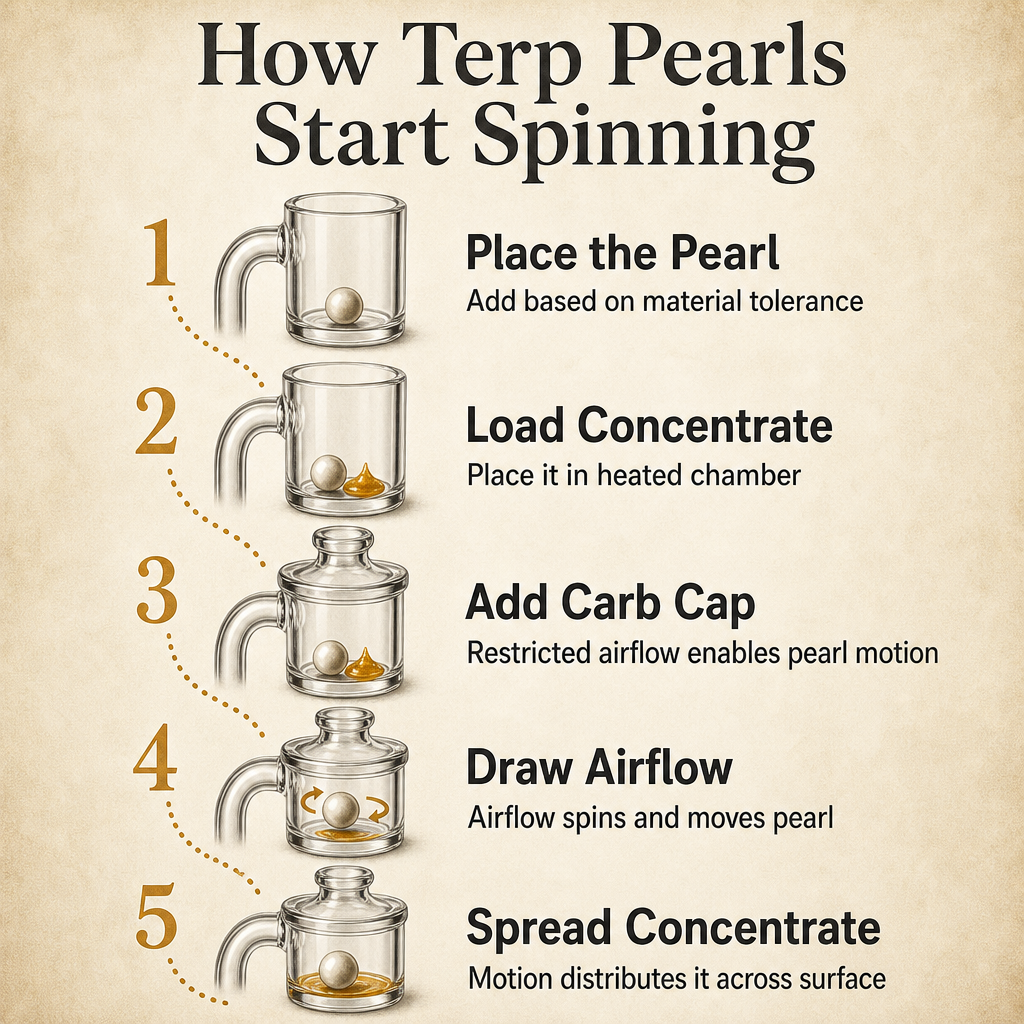
The spinning motion of a terp pearl is not magic. It comes from a specific sequence of steps that ends with a controlled stream of air moving across the chamber. Skip a step and the pearl sits still while concentrate pools where you dropped it. [2]
Before you light a torch or press a button, decide when the pearl goes in. Higher-tolerance materials can be dropped into a cold banger and heated with it. Lower-tolerance materials should wait until the banger is at temperature. [2]
Once the banger is at the heat you want, the concentrate goes in next, then the carb cap goes on top. The cap is the part that turns a still pearl into a moving one, because it restricts and directs the airflow as you inhale.
Pearls also appear in electronic chambers. The mechanics are the same on a basic level: a controlled airstream drives the pearl so the concentrate spreads across the heated surface. Our broader look at dabbing setups, including how a chamber compares to a torch-and-banger routine, is in What Is a Dab Rig and How Do You Use One?. The role of the cap is covered in more detail in What Are Carb Caps and How Do They Work?.
- Place the pearl in the banger, choosing cold-in or warm-in based on the pearl material. [2]
- Heat the banger to your target temperature with a torch or with the electronic chamber’s heating element.
- Load the concentrate into the heated chamber. [1] [2]
- Seat the carb cap on top to restrict airflow through the banger. [2]
- Inhale slowly so the airstream spins the pearl and moves concentrate across the surface. [1]
Which Terp Pearl Material Should You Choose?
Pearls come in several materials, and each one has tradeoffs. The most common choices are borosilicate glass, quartz, ceramic, ruby, sapphire, and silicon carbide. The right pick depends on how you heat, how often you dab, and what feel you prefer. [2]
Borosilicate glass is the entry-level option many people try first. It is the same family of glass used for laboratory glassware and most bangers. Its coefficient of thermal expansion is very low, about 3 × 10⁻⁶ K⁻¹, and it can handle temperature swings of roughly 330 °F (166 °C) without cracking. [3]
Quartz shares a lot of behavior with borosilicate but tends to handle repeated heat cycles a little better. Ceramic pearls hold heat well and are presented as a flavor-neutral choice. Puffco’s Proxy Core ships with a 4mm ceramic pearl. [1]
Ruby and sapphire are gemstone options with high density and a smooth surface. Silicon carbide is on the other end of the heat-tolerance spectrum. It melts at around 2,830 °C (5,130 °F) and is widely used as an abrasive and ceramic, which is why it tolerates extreme heat without trouble. [3]
Loading order follows from the material. Higher-tolerance pearls, like silicon carbide, can sit in a cold banger and heat up with it. Lower-tolerance pearls, like glass, should wait until the banger is already at temperature. [2]
If you want more background on how different rigs and glass pieces feel in the hand, our guide on What Are Specialty Pipes and How Do You Choose the Right One? compares a few specialty pipe styles that share the same idea of pairing the right material with the right setup.
- Borosilicate glass: low cost, smooth feel, and a thermal-shock tolerance around 330 °F (166 °C). Add after heating. [3]
- Quartz: similar feel to boro glass but tends to handle repeated heat cycles a little better.
- Ceramic: holds heat, presents a neutral surface, and ships as a 4mm option on the Puffco Proxy Core. [1]
- Ruby and sapphire: dense, smooth gemstone pearls with a premium feel and good durability.
- Silicon carbide: melting point around 2,830 °C (5,130 °F), so it can go in cold and heat up with the banger. [2] [3]
| Material | Heat tolerance | Loading guidance | Typical feel |
|---|---|---|---|
| Borosilicate glass | Thermal-shock tolerance around 330 °F (166 °C) | Add after the banger is heated | Light, low-cost, neutral |
| Quartz | High, similar to boro | Usually added after heating | Smooth, familiar to banger users |
| Ceramic | High heat retention | Follow chamber guidance | Neutral surface, ships with Proxy Core |
| Ruby / sapphire | Very high | Tolerant of heating with the banger | Dense, smooth, premium |
| Silicon carbide | Melts at 2,830 °C (5,130 °F) | Can go in cold and heat with the banger | Hard, dense, very heat-tolerant |
What Terp Pearl Size and Quantity Should You Use?
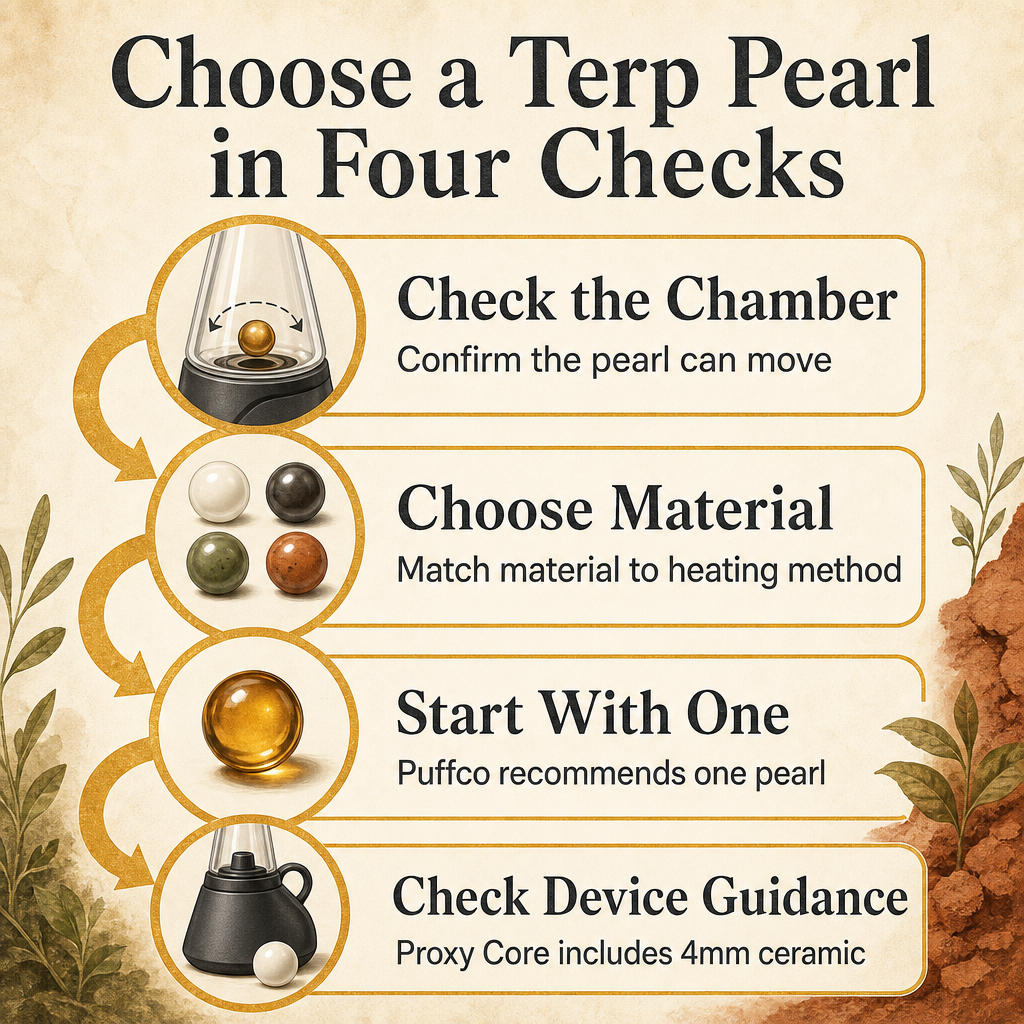
The reliable answer on size and quantity is to follow the chamber you are using. Banger widths, chamber depths, and pearl diameters all vary, so the only universal rule is to check what fits and what the maker recommends before you drop a pearl in. [1]
On the quantity side, the published guidance is simple. Puffco recommends a single terp pearl per banger or chamber rather than several. That keeps the motion predictable and leaves room for concentrate to spread rather than getting batted around by multiple spheres. [1]
Size examples come from specific products, not from a universal chart. Puffco’s Proxy Core ships with a 4mm ceramic terp pearl. [1] That 4mm number is a useful reference, but it does not mean every banger accepts 4mm, so always confirm with the maker of your chamber.
If you are pairing a pearl with a new banger, it helps to know the banger’s joint size and shape. Our listing for the GRAV® 10mm 45° Quartz Hourglass Banger Set shows what a quartz banger set looks like and gives you a sense of the chamber dimensions a pearl has to fit inside.
- Confirm the chamber can move a pearl at all before you buy one. Some flat-bottom designs and small chambers leave little room. [1]
- Match the pearl size to the chamber, not to a generic chart. The only verified size in the research is 4mm ceramic for the Puffco Proxy Core. [1]
- Start with one pearl so motion stays predictable and concentrate has room to spread. [1]
- Follow the maker’s compatibility notes for your specific device or banger before adding a second pearl.
Do You Need a Carb Cap for Terp Pearls to Work?
Yes. A carb cap is part of how terp pearls work, not an optional add-on. Without a cap, the airflow through an open banger is too loose to move the pearl. The pearl sits still, and concentrate tends to pool where it was dropped. [2]
The cap changes the picture because it restricts and redirects the airflow. As you inhale, the airstream has to pass through a smaller opening, which gives it enough force to push the pearl around the bottom of the chamber. That motion is what spreads the concentrate. [2]
Different cap styles do this job a little differently. Directional caps angle the airflow so the pearl tends to travel in a circle, while flat caps push more air straight down. Both work; the practical test is whether the pearl actually moves when you draw.
If you want a closer look at how cap design affects airflow, our carb cap guide covers the topic in more depth. For readers thinking about rig size more generally, the guide on What Bong Size Should You Get? walks through how chamber size and airflow relate across different setups.
- Restricted airflow is the mechanism that drives a terp pearl. Without a cap, the pearl stays still. [2]
- The cap also holds heat inside the banger by limiting how much cool air can rush in.
- Directional caps angle airflow so the pearl tends to spin in a circle.
- Flat caps push more air straight down, which still moves the pearl but with a different path.
- Whatever the cap style, the practical test is whether the pearl actually travels when you draw.
Can You Use Terp Pearls in Electronic Dab Rigs?
Yes, in some electronic chambers. The Puffco Proxy Core is a published example that ships with a 4mm ceramic terp pearl. [1] Other devices vary, so the right move is to check the maker’s compatibility notes before dropping a pearl into any e-rig chamber.
The mechanics are the same as a torch-and-banger setup. A pearl moves when controlled airflow passes over it, and the chamber surfaces that hold the pearl are similar in shape. What changes between a torch setup and a precision electronic chamber is how consistent the temperature is.
Puffco also notes that the impact of terp pearls can be subtler on high-quality devices with precise temperature control than on traditional torch setups. That does not mean pearls are useless in an e-rig; it means the difference a pearl makes is smaller when the chamber is already delivering even heat. [1]
If you are shopping for a chamber that supports pearls, our Dab Rigs category page is a good starting point for comparing dab rigs and concentrate gear.
- Confirm the specific chamber accepts a pearl before adding one. Not every e-rig chamber is designed for one. [1]
- Use the size the maker recommends. The Proxy Core ships with a 4mm ceramic pearl as a reference. [1]
- Expect a subtler effect in chambers with precise temperature control compared with a torch-and-banger setup. [1]
- Follow device-specific loading order. Some chambers want the pearl in cold, others want it added after heating.
How Do You Clean and Store Terp Pearls?
Terp pearls are small, so they are easy to lose and easy to clean. A short routine between sessions keeps them moving freely. The trick is consistency: once residue builds up, pearls get sticky and stop spinning the way they should. [1]
Puffco’s published cleaning method uses isopropyl alcohol at 90% concentration or higher. Pearls can be soaked in the alcohol between sessions, then rinsed and left to air-dry completely before the next use. [1] Lower concentrations of alcohol carry more water, which is why the stronger bottle is the standard.
Storage is mostly about not losing them. A dedicated container is a good idea. Anything from a small parts tray to a labeled jar works, as long as the pearls stay in one place and the container is heat-tolerant enough to sit near a rig.
If you also stash other small concentrate gear, our Storage category page has storage options that double as organizers for tiny parts like pearls.
- Soak pearls in isopropyl alcohol at 90% or higher between sessions. [1]
- Rinse the alcohol off with clean water after the soak.
- Air-dry the pearls completely before the next use so residue does not bake onto the surface. [1]
- Store pearls in a small, labeled container so they do not get lost between sessions.
- Re-clean promptly if a pearl starts sticking instead of sliding across the chamber.
Frequently Asked Questions
Will terp pearls spin without a carb cap?
No. The published research says terp pearls need a carb cap to restrict and direct airflow. Without the cap, the pearls stay still and concentrate can pool in one part of the banger. [2]
How many terp pearls should you use at once?
Start with one when your device or chamber allows it. Puffco recommends a single pearl per banger or chamber rather than using several, but you should still follow the instructions for your specific setup. [1]
What size terp pearl works with the Puffco Proxy Core?
Puffco states that the Proxy Core includes a 4mm ceramic terp pearl. That does not make 4mm universal, so check the chamber maker’s guidance before using the same size elsewhere. [1]
Should terp pearls go in before or after heating?
It depends on the pearl material. Materials with high heat tolerance may be placed in a cold banger and heated with it, while lower-tolerance materials should be added after the banger is heated. [2]
How often should you clean terp pearls?
Clean them regularly and whenever residue makes them sticky or slows their movement. Puffco recommends soaking pearls in 90% or higher isopropyl alcohol, then rinsing and air-drying them before use. [1]
Are Terp Pearls the Right Move for Your Setup?
Terp pearls are a small, mechanical upgrade that depends on the rest of your setup working with them. If your banger or chamber is the right size, your carb cap is in place, and your pearl material matches your heating method, the pearl will spin and spread concentrate the way it is designed to. [1] [2]
If you are shopping, start with one pearl, pick a material that matches how you heat, and follow the chamber maker’s guidance. The right pearl is the one that fits your chamber and moves with your airflow, not the one with the biggest number on the spec sheet.
For readers who want to keep going, the parent guide on dab rigs and the carb cap guide cover the full picture alongside this article.