

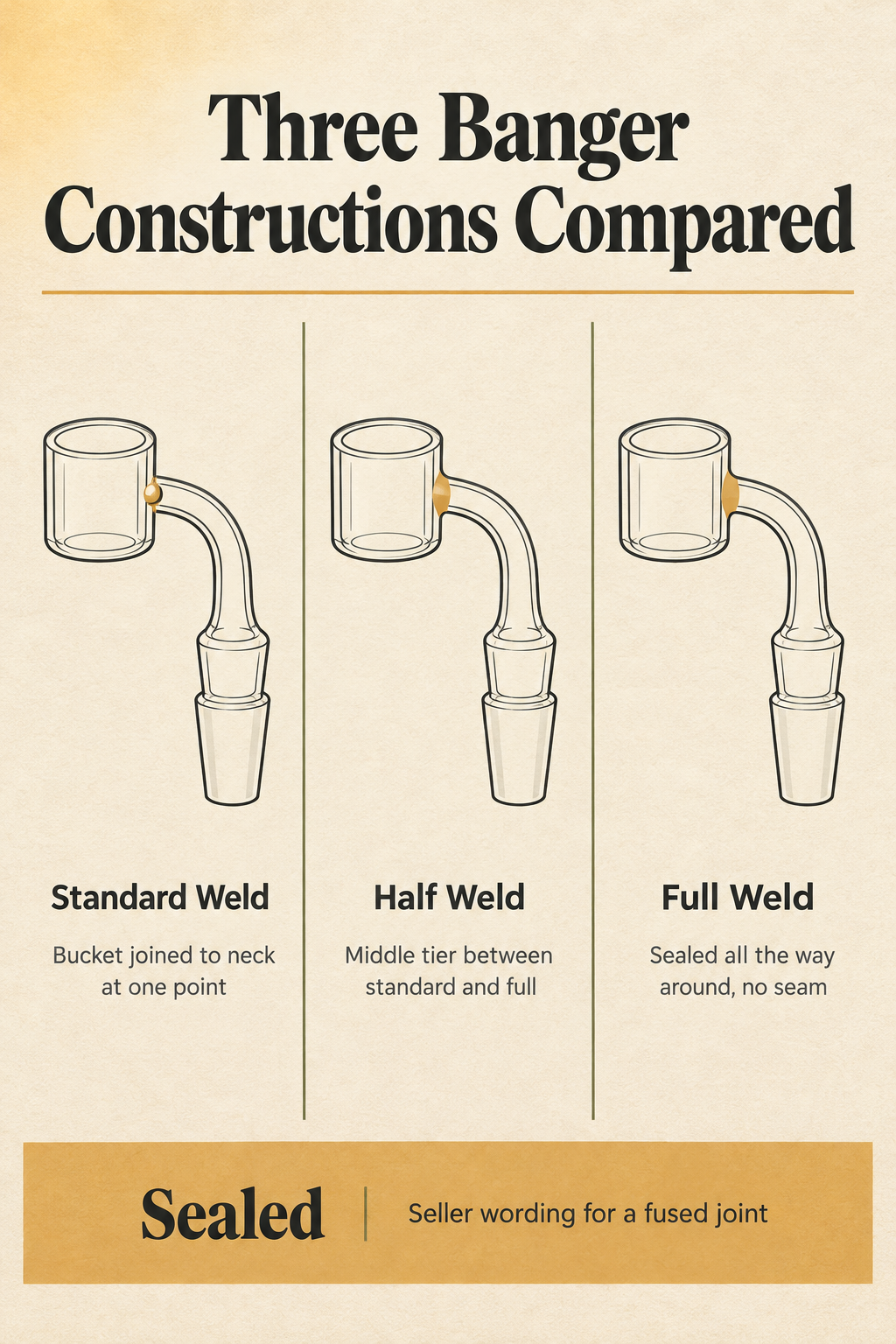
A full weld banger is a quartz banger where the bucket is fused to the neck all the way around, so the junction reads as one continuous surface with no visible seam. A standard weld joins those two parts at a single point, which leaves a seam right where the piece fails first.
Sellers do not share one naming convention. The same fully fused build gets called full weld, fully welded, fully fused, seamless, or simply sealed. The cheaper version gets called a standard weld or a regular weld. That overlap is the main reason buyers get confused.
The build itself is a real difference, and it lands in one place on the piece: the junction where the bucket meets the neck. It is also the spot that every care guide in this set names as the first thing to fail.
What does a full weld banger actually mean?
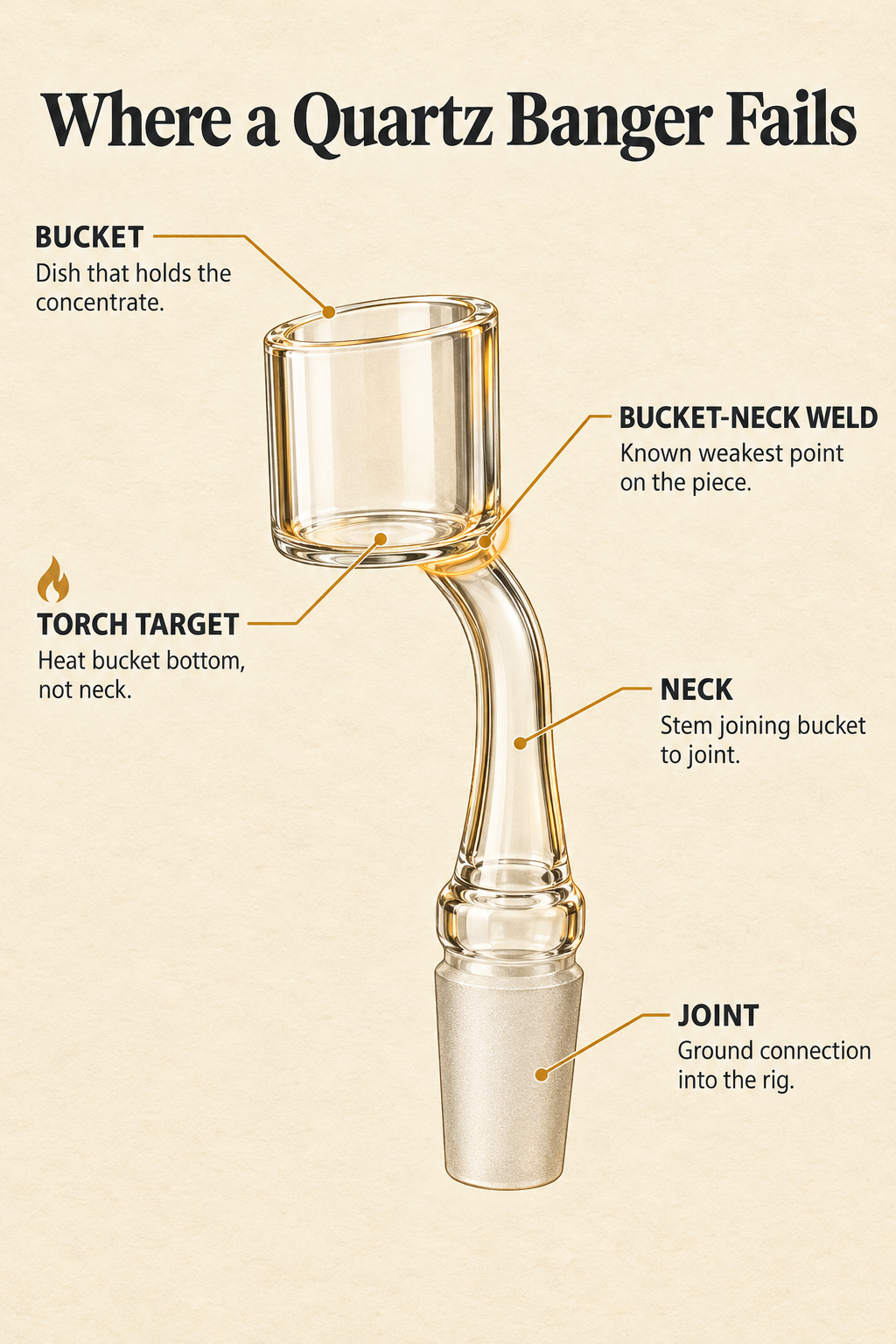
Before the word weld means anything, you need the parts it connects. Honeybee Herb breaks a banger into three parts that each do a separate job [14].
The bucket is the dish your concentrate goes into. The neck is the stem that lifts the bucket away from the rig. The joint is the ground taper that seats into the rig’s fitting. The weld tier is named after the junction between the bucket and the neck, which is why those two parts keep coming up in every description you read.
That junction is where the two builds split. Toker Supply describes a regular weld as the bucket joined to the neck at one point [3]. A full weld is sealed all the way around that same junction, so the piece reads as one continuous surface and residue has nowhere to sit.
Here is the correction most buyers need. A full weld is still usually a two-part build, not a single cast piece. MJ Arsenal says outright that its full weld joints look like single-cast bangers but are two pieces of quartz welded together [1]. Its own explainer describes a stem and a bucket formed separately and then fused until they read as one piece [2].
That matters, because single cast is the assumption many shoppers bring to the word seamless. Seamless describes the surface you can feel with a fingertip, not the number of parts that went into the piece.
One more bit of context: a banger is usually bought separately from the Dab Rigs section of a shop, and it ends up stored alongside the rest of your Accessories. It is a wear part, not a permanent fixture.
So the vocabulary works out to four words for one build. Fully welded, fully fused, seamless, and sealed all describe a joint that is closed all the way around. If a listing uses any of those, you are most likely looking at the top build.
- Bucket: the dish that holds the concentrate.
- Neck: the stem that connects the bucket to the joint.
- Joint: the ground taper that seats into the rig.
- Bucket-to-neck junction: the single spot the weld tiers are named after.
Sealed vs full weld vs standard weld: what is the difference?
This is the comparison the title promises, and the honest answer is that the vocabulary is not standard across the trade. Four sellers, four naming systems, and two or three real constructions underneath them.
Read the list and the confusion resolves. Sealed is not a fourth construction. It is an adjective describing the fully fused joint, which is the build other sellers call full weld. A listing that promises a sealed banger is normally selling you a joint that is closed all the way around.
The practical move is to stop shopping by label and start asking which build the piece is. Is the bucket joined at one point, or sealed all the way around? Is there a middle tier sitting between those two, as MJ Arsenal’s half weld does? Those questions cover every listing, whatever the seller chose to call it.
QuartzBanger.com frames the same split from the seller side. It describes a regular weld as showing a visible weld that can carry slight imperfections, and a full weld as having a seamless joint between bucket and neck [4]. That page is a seller describing its own price tiers, so use it for the distinction and not as a durability test.
Weld tier is only one of several decisions you are making at once. Our other guides cover the rest: What Is a Quartz Banger and How Do You Choose One? walks through material, size, and joint angle; Bucket Banger vs Hourglass Banger vs Control Tower: What’s the Difference? sorts out bowl form; What Is a Cold Start Dab and How Do You Do One? explains a different heating approach; What Is a Terp Slurper and How Is It Different From a Banger? covers the slurper style; and What Do Dab Rig Joint Sizes and Genders Mean? explains the connection end.
- MJ Arsenal sells three tiers it calls standard weld, half weld, and full weld, and frames the half weld as the compromise between the other two [1].
- Terporium writes about standard versus fully welded, and notes that fully fused means the same thing as fully welded [5].
- Toker Supply calls the cheap version a regular weld and the top version a full weld [3].
- Honeybee Herb labels its top line a full, or seamless, weld, and builds its lower line from two pieces welded together [14].
- Several sellers use sealed as a description of the finished joint rather than as a separate product tier, which is where most of the confusion starts.
| Label on the listing | How the bucket meets the neck | What to look for |
|---|---|---|
| Standard weld or regular weld | Joined at a single point | A visible seam at the junction |
| Half weld | Middle tier sold as a compromise | Partial seam, so ask the seller |
| Full weld | Sealed all the way around | No crease where the parts meet |
| Fully welded, fully fused, seamless, sealed | Same all-the-way-around build, different words | No crease, plus matching wording in the description |
How can you spot a full weld banger before you buy it?
You can run this check on a listing photo, on a shop shelf, or on a piece already in your hand. It takes about a minute, and almost all of it is about one junction.
One warning before you trust any of it. Construction can only be partly read from the outside. Volcanee notes that the cleanest seals are flame-worked into one solid surface with no visible line, but a photograph flatters small defects, and a polished lower tier can look tidy at a glance [6]. Read the check as supporting evidence rather than proof.
QuartzBanger.com’s own comparison is worth holding in mind while you look. It describes the regular weld as carrying slight imperfections or vulnerabilities under heat and stress, and the full weld as the seamless joint [4]. That is a seller’s framing, but it confirms which detail to put your eyes on.
- Find the junction first. Put your eyes on the spot where the bucket meets the neck, not on the rim and not on the joint.
- Look for a crease or a visible line. MJ Arsenal says the seam is what separates the tiers, and a full weld should show no crease at that junction [1].
- Check for sharp edges or a hole that does not line up. Volcanee describes makers who pre-drill a hole in the bucket and fuse the joint onto it, which can leave sharp edges at the seam [6].
- Identify the product line. Brands encode the weld in the line name, so a piece from a top line usually carries the top weld [14].
- Read the description for the words seamless, fully welded, or fully fused. Sellers are consistent about that language even when they disagree on the noun.
- Ask for a close photo of the bucket-to-neck junction. A thumbnail will not show a seam, and a seller who will not send a close-up is telling you something.
Do full weld bangers really last longer than standard welds?
Start with the part nobody in the trade argues about, which is where the piece fails. Azarius calls the weld between the bucket and the joint the weakest point on the banger, and says a hairline crack forming there is reason to retire the piece [7]. Terporium makes the same point from the other direction: cracks eventually appear in the seam of a standard weld, and a dropped standard-weld banger tends to break at the connection points [5].
So the weld is genuinely the failure site, and that part is settled. Whether the full weld lasts longer is a separate question, and the evidence for it is vendor argument rather than test data.
Read the claims as a set of positions rather than findings. Every durability statement here comes from someone selling bangers, and not one of them publishes a comparison. What the sources agree on is the location of the failure, and a full weld does put more quartz at that location.
- QuartzBanger.com calls the seamless joint more durable, with reduced breakage risk. That is a seller’s claim, and no test is published behind it [4].
- Terporium lists strength at the connection points as an advantage if the piece is dropped. Also unmeasured [5].
- Toker Supply’s version is practical rather than structural: a full weld leaves no gaps for residue, which is about cleaning more than breakage [3].
- MJ Arsenal’s counter-claim is that a reinforced weld can withstand more heat than a single-cast piece, because the added quartz supports the narrow stem [1]. That is the manufacturer’s assertion.
- Nothing in this set publishes a lifespan comparison between the two builds, so the honest answer is that a full weld addresses the known failure point and the size of the benefit is unquantified.
Does the weld change how a banger holds heat?
None of the sources in this set publishes heat-retention data, so everything in this section is an argument rather than a measurement. That is worth stating plainly, because heat is where the marketing gets loudest.
The material baseline is published, though, and it sets the limit on all of the above. Momentive Technologies gives fused quartz a coefficient of thermal expansion of 5.5 x 10^-7 per degree C over 20 to 320 C, about one seventh the value for borosilicate glass [10].
Heraeus adds the caveat that matters most here. Thermal shock resistance also depends on surface condition, which defines strength, and on geometry [11]. A scratched or chipped surface is weaker than a clean one, whatever the weld looks like from outside. So quartz tolerates steep temperature change well, and a banger is not immune to it, and the weld tier does not change either fact.
- MJ Arsenal argues that a non-fused connection between stem and dish cools too quickly and shortens the working window for a dab [2].
- The same explainer argues that removing air gaps makes temperature more consistent across the piece [2].
- Terporium argues heat spreads more evenly across seamless quartz than across a seam [5].
- Toker Supply’s version is about residue rather than temperature: no gaps means nowhere for buildup to sit [3].
- None of those three publishes a measured curve, a comparison table, or a test method, so the heat case stays a reasonable argument rather than a demonstrated result.
How much more do full weld bangers cost?
The price step is real, and it shows up at every tier of the market. QuartzBanger.com describes full weld bangers as typically considerably more expensive than regular weld [4], and Toker Supply says the same [3]. Here is what that looks like in actual listings rather than in adjectives.
Check prices against the live store before you buy, since the figures below come from a snapshot taken during research and stock moves. You get free shipping on orders $150+, which matters if you are buying a banger alongside a rig or a cap rather than on its own.
What the step actually buys is one change at one junction: more quartz where the bucket meets the neck. It does not buy a different material, a different bowl shape, or a different joint size. If you pay $54.99 for a full weld kit, most of that money goes into the kit contents rather than into the weld itself.
- Inside one Bear Quartz family, The HighBrid lists at $45.00 [13] and The HighBrid PRO lists at $55.00 [12]. The listed upgrades on the PRO are a full weld joint and a deeper bucket, so the weld is part of a $10 step.
- MJ Arsenal lists a premium half weld banger at $20 against full weld pieces at roughly $24 to $29 [1].
- Treehouse in-stock full weld pieces run $24.00 to $54.99: the MJ Arsenal Premium Full Weld Cold Start Quartz Banger (Drip) at $24.00, the MJ Arsenal Premium Full Weld Clear Quartz Banger at $24.99, the MJ Arsenal Full Weld Quartz Terp Slurper at $32.99, and the Jane West Full Weld Bucket Banger Kit at $54.99 [15].
- The gap is narrowest at the bottom of the range, where a full weld costs a few dollars more than a standard weld, and widest where the piece adds a longer neck or comes as a kit.
- The four Treehouse listings describe the bucket and neck as a seamless unit on the slurper, and a fully welded joint with a longer neck on the Jane West kit [15].
What wears a quartz banger out faster than the weld does?
Handling and cleaning drive lifespan more than the weld label does. Toker Supply answers the how-long question with years, conditioned on regular cleaning and no sudden temperature shocks [3]. Here are the causes ranked by how often they end a piece early.
The daily routine that avoids most of that takes under a minute. Let the banger cool slightly, wipe the bucket with a dry cotton swab while it is still warm but not hot, follow with a second swab lightly dampened with 99% isopropyl alcohol, and let it air dry completely [8].
That routine is identical whether the piece is a $24 standard weld or a $54.99 full weld kit, which is the whole point. The Quartz Bangers you keep in rotation all benefit from the same habit, and the expensive ones are not exempt.
- Letting residue bake onto the bucket. Thick Ass Glass defines chazzing as devitrification: white or gray clouding and a rough texture inside the bucket, followed by faster future buildup and reduced heat retention [8].
- Dunking hot quartz into alcohol or cold water. Thick Ass Glass names dunking hot quartz into alcohol as a cause of thermal shock and micro-scratching [8], and Azarius warns against cold water for the same reason [7].
- Torching the neck and the joint instead of the bucket. Thick Ass Glass advises heating the bottom of the bucket rather than the neck or the joint [9], which also keeps direct heat off the junction that care guides call the weak point.
- Storing or carrying the piece loose. Azarius notes that quartz bangers chip easily on hard surfaces and recommends wrapping or padding them [7].
- Cleaning with force instead of patience. Scrubbing a warm bucket hard is how you scratch a surface that will then hold residue.
How do you know when a quartz banger is past saving?
Three signals mean replace rather than keep cleaning, and one of them is a judgement call you should not make for yourself under a torch.
The through-line is that all of these are surface and structure problems, not cleanliness problems. You can soak a cloudy banger for a week and it will still be cloudy, and a cracked weld does not close back up.
That brings the whole comparison back to the buying decision. A full weld buys you time at the junction that fails first, and it puts more quartz where a drop normally breaks the piece. It does not buy a longer life if the piece gets heat-shocked, scoured, or rattled around loose in a drawer. Weld construction is one factor in how long a banger lasts, and it happens to be the one factor you can inspect before you pay.
- A hairline crack at the bucket-to-joint weld. Azarius names this as reason to retire the banger, because a failure while the piece is under torch heat is a burn risk [7].
- Chazzing: white or gray clouding and a rough texture inside the bucket. Thick Ass Glass says that once quartz begins to devitrify, the surface is permanently altered, which makes prevention far easier than restoration [8].
- Physical damage at the joint or the bucket rim. Chipped quartz no longer seats cleanly, and a joint that does not seat cleanly never gives you a steady connection.
- A ground joint that has lost its taper through a drop or through being forced. Volcanee’s inspection notes are useful here, since a joint fused on at an angle is the kind of piece that fails at the weld when it lands [6].
- Residue that comes back within a single session. When buildup returns immediately after a clean, the surface is holding it, and that points at devitrification rather than at dirt [8].
Frequently Asked Questions
Is a sealed banger the same as a full weld banger?
Usually yes. Several sellers use sealed as a description of the fully fused joint rather than as a separate tier, so a listing that promises a sealed banger is normally describing the all-the-way-around weld that other sellers call full weld. Because the vocabulary is not standardised, ask which of the two builds the piece is rather than relying on the label.
Can you tell a full weld banger from a product photo?
Partly. A full weld should show no crease or visible line where the bucket meets the neck, while a pre-drilled and fused joint can leave sharp edges or a hole that does not line up cleanly. Ask for a close photo of that junction instead of judging from a thumbnail, and read the photo as supporting evidence rather than proof.
Are full weld bangers worth it if you dab every day?
That depends on how you handle the piece. The weld sits at the junction that care guides name as the weakest point, so a full weld addresses the most common break location. But handling and cleaning drive lifespan more than the weld label does, so frequent use with poor habits will still shorten the life of a good piece.
Can you clean a full weld banger the same way as a cheaper one?
Yes, the routine does not change. Let the banger cool slightly, wipe the bucket with a dry cotton swab while it is still warm but not hot, follow with a second swab lightly dampened with 99% isopropyl alcohol, and air dry completely. Avoid dunking hot quartz into alcohol or cold water, which is where most avoidable damage happens.
What is the first sign that a quartz banger is failing?
A hairline crack at the weld between the bucket and the joint is the clearest early signal, and care guides name it as the point to retire the piece rather than keep using it. Clouding and a rough texture inside the bucket, known as chazzing, is the other common sign, and once the surface has changed that way it does not come back.
So which one holds up longer?
A full weld banger holds up longer at the junction where quartz bangers actually fail. Every care guide in this set points at the bucket-to-neck weld as the weak point, and the full weld is the build that puts material there instead of a single join. That is a real, inspectable difference, not just a word on a listing.
What the full weld does not do is override your habits. Residue left to bake into the bucket, hot quartz dunked into alcohol, a torch aimed at the neck, and a banger rattled loose in a bag will retire a $55 piece as quickly as a $24 one. The weld is one factor in lifespan, and it is the only factor you can check before money changes hands.
So buy the construction you can see. Ask which build the piece is rather than which label it carries, put your eyes on the junction, and confirm the price against the live store. Then spend the saved effort on a cotton swab and 99% isopropyl alcohol, because that is where the years actually come from.
If the label on the listing says seamless, fully welded, fully fused, or sealed, you are most likely looking at the same build. If it says standard weld, regular weld, or half weld, ask what the junction looks like before you pay a full weld price for it.
Sources
- MJ Arsenal: Quartz Bangers for Dab Rigs | Full Weld Dab Bangers
- MJ Arsenal: What is a fully fused banger and why should I care?
- Toker Supply: Quartz Banger Types: Which Banger Should You Buy?
- QuartzBanger.com (VapeBrat): 30mm Diameter Bucket Banger : 14mm Male 90 Degree – Regular Weld
- Terporium: Which Banger Is Right for You? | Quartz Banger Guide
- Volcanee: A Good Quartz Banger Checklist
- Azarius: Quartz Banger Temperature and Care Guide
- Thick Ass Glass (TAG): How to Clean a Quartz Banger Properly (No Chazzing)
- Thick Ass Glass (TAG): Quartz Bangers: 10mm, 14mm & 18mm Dab Bangers, 45 & 90 Degree
- Momentive Technologies: Quartz Properties 2024
- Heraeus Covantics: Properties of fused silica
- Bear Quartz: The HighBrid PRO
- Bear Quartz: The HighBrid
- Honeybee Herb: Quartz Bangers & Dab Nails | Honeybee Herb
- Treehouse Lifestyle: WooCommerce Store API product listing for "full weld"