

An egg dab rig is any concentrate piece built around a rounded, egg-shaped chamber instead of a straight tube. That definition is deliberately broad, because the shape is a family rather than a single product. A true fab egg hides two connected chambers and a built-in recycler. A budget mini egg is usually one spherical chamber with a perc and no recycle path at all.
Both get sold as egg rigs, and both look similar sitting on a shelf. The round form is not decoration, though. A wider chamber gives vapor more internal glass to travel across, and the closed curve keeps water from running straight at the mouthpiece. What the silhouette cannot tell you is what is inside it.
Before you buy, answer four questions: what the internals are, how much water the piece wants, what joint it takes, and how hard it will be to clean. This guide works through them in that order, because that is the order they change your decision.
What Is an Egg Dab Rig, and How Is It Different From a Regular Rig?
Start with the name. An egg dab rig describes a shape family: any glass piece built around a rounded chamber. The best-known member is the fab egg, short for Faberge egg. Mothership Glass credits the famous jeweled eggs made by Gustav Faberge as the inspiration for the design, and retailer guides date the original release to 2012. [1][2]
A regular straight-tube rig tells you most of what you need from the silhouette alone. Vapor travels up one column, the water level is easy to read, and the perc is usually visible through the glass. An egg rig does not work that way. The rounded body hides the plumbing, and the same outline can describe a two-chamber recycler, a single sphere with a crown perc, or a battery-powered device that simply happens to be egg-shaped. [7][8]
Naming is looser than the hardware. In the trade, fab egg, faberge egg rig, egg bong and fab bong all get used for the rounded chamber design. Some makers also borrow the word egg as a plain product name for pieces that share nothing but the silhouette. That is why two listings with almost identical photos can behave completely differently once water goes in. [5]
The practical takeaway is to read egg as a starting point for what a piece looks like, then read the spec sheet for what it actually is. In the Dab Rigs category that distinction matters more than usual, because the shape no longer does the describing for you. Smaller pieces cluster in Mini Dab Rigs, and the borosilicate work tends to collect in Glass Dab Rigs.
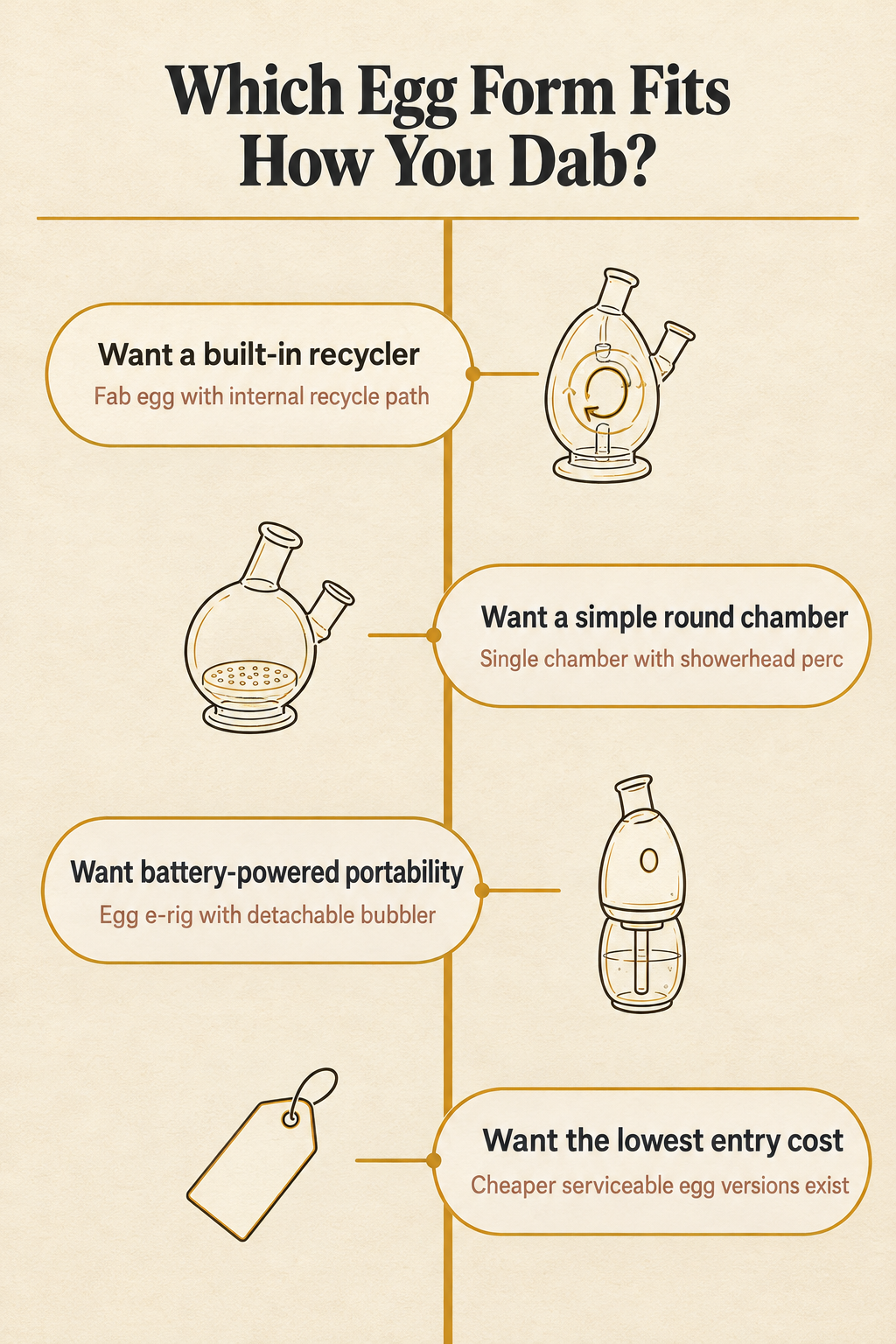
One more branch of the family is worth naming early, because it confuses shoppers constantly. Makers also use egg for battery-powered devices, where the rounded shell holds a coil and a battery instead of a recycler. If that side of the family interests you, the Dr Dabber XS e-Rig Portable Vaporizer is a portable comparison point.
- Fab egg: two connected chambers with a recycler formed into the body itself. This is the original meaning of the term, and the only variant where the shape predicts the internals.
- Faberge egg rig or fab bong: the same two-chamber design sold under a different trade name. The label changes by retailer; the plumbing does not.
- Egg bong: usually a rounded chamber sold for dry material with a bowl fitted, though many current fab eggs are sold as dual-purpose pieces that take a banger too.
- Mini egg: a compact single-chamber piece, often around 6 inches tall, with a showerhead perc and a splash guard but no recycle path described.
- Egg e-rig: a battery-powered unit in an egg-shaped shell. The name here is a product label, not a description of what is inside the glass.
What Makes a Fab Egg Different Inside the Chamber?
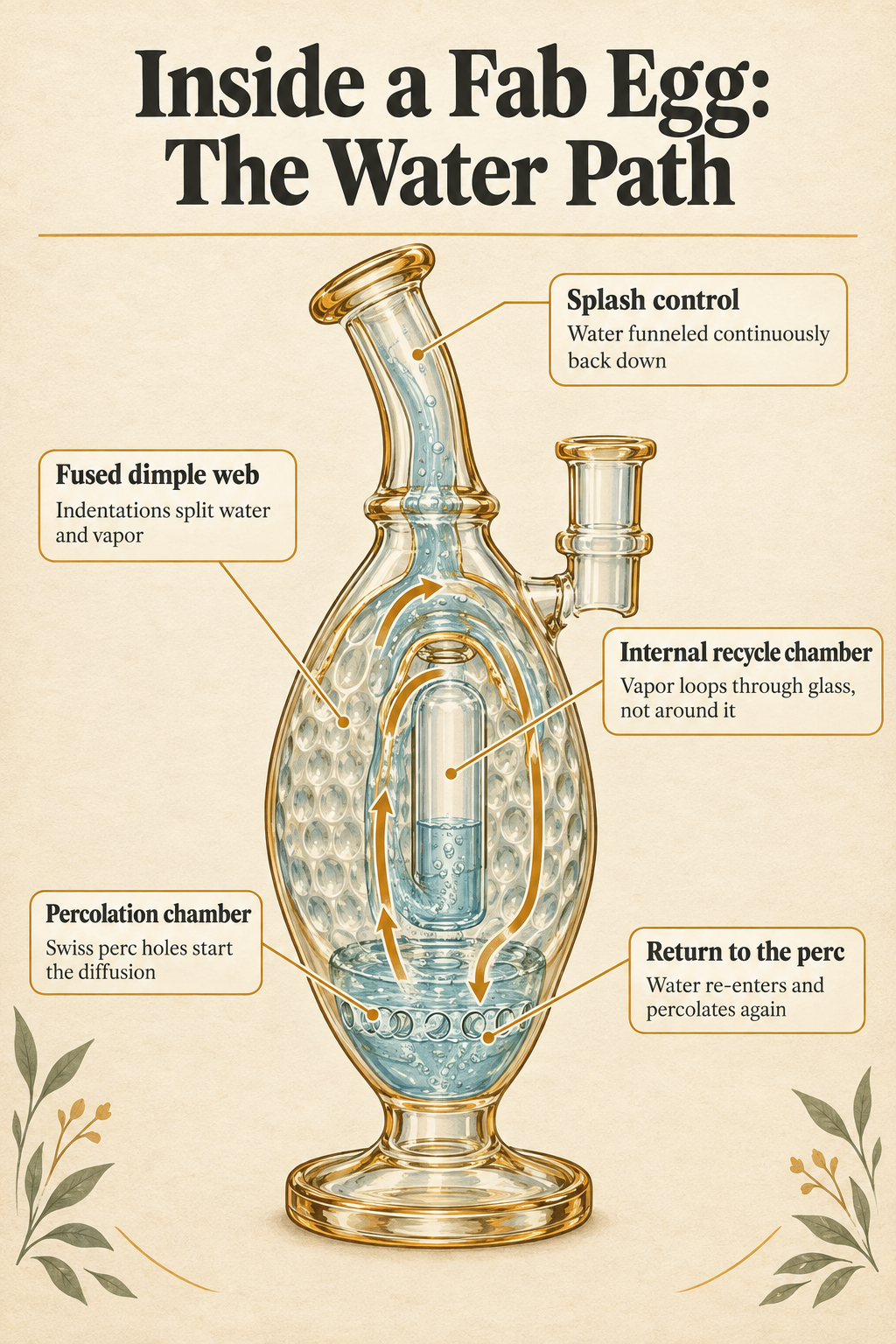
A true fab egg is built from two connected chambers: one for percolation and one for recycling. The recycler is formed into the body rather than hanging on an external loop, which is the structural feature that separates it from a standard recycler tube. Water and vapor bubble up through the percolation chamber, loop over the internal chamber, and return to percolate again. [3][4]
The percolation chamber is normally a Swiss-style perc, a ring of large circular holes rather than a cluster of slits. Producers point to the combination of that high-diffusion perc and the built-in recycler when explaining why fab eggs run with so little draw resistance. [3]
The egg body is a working chamber, not a decorative shell. The glass is indented and fused at multiple points, which creates a web of dimples through the center of the egg. Water and vapor cannot take a clear path through the middle. They are forced to split and travel around those indentations. That increases the internal surface area the vapor contacts on its way through. [5]
Spherical chambers with hollow centers reinforce the same idea. Water moves through an internal chamber and then back into the percolation chamber. It passes through two layers of glass instead of cutting straight up the middle of the piece the way it would in a tube. That is also why the round shape handles splash so well. Water is carried up the recycler path and funneled continuously back down instead of launching at the mouthpiece. [4][5]
Expect a draw tradeoff rather than a free upgrade. One published comparison rates a fab egg recycler as slightly chuggy but smooth. It calls a regular recycler airy and light. The same comparison scores the fab egg higher on diffusion, cooling and flavor retention. That is a fair description of the trade: more internal path, more resistance to pull through it. [5]
If you want the fundamentals before the variation, What Is a Dab Rig and How Do You Use One? covers the parts and the sequence from a standing start. The general mechanics of recycling loops get their own treatment in What Is a Recycler Bong and How Does It Work?, and because a recycler behaves differently as it shrinks, the size question is worth reading up on in Mini Dab Rig vs Full-Size Dab Rig: Which Should You Choose?. For a brand-by-brand view of how rounded and straight forms compare in practice, Which Calibear Bong or Rig Should You Choose? is the closest match.
- Vapor enters the joint and drops into the percolation chamber at the base of the piece.
- It passes through the Swiss perc, where a ring of large circular holes splits it into many smaller streams.
- The streams rise into the egg body and meet the fused dimple web, which forces them to divide and travel around the internal glass.
- Water and vapor loop over the internal recycle chamber, passing through a second layer of glass on the way.
- The water returns to the percolation chamber and goes through the perc again, while vapor continues up the neck to the mouthpiece.
Egg Dab Rig vs Straight Rig: Which One Fits the Way You Dab?
The most quoted difference is water volume. One retailer publishes straight-tube rigs at roughly 150 to 250 ml of water and fab eggs at roughly 75 to 125 ml, and argues the smaller volume keeps vapor from being over-diffused. Read those as that retailer’s figures rather than an industry standard, but the direction is useful, because it explains why a round chamber does not need to be filled like a tube. [2]
Path length is the second difference. A straight tube sends vapor up one column. A fab egg routes it through a perc, around an internal chamber, and back, which is why diffusion, cooling and flavor retention score higher for the fab egg in the same comparison. Splash behavior is the third, and it goes to the closed curve. Maintenance is the fourth, and it goes to the tube, because tight recycler pathways collect reclaim faster than an open chamber. [5]
The fifth is flexibility. Fab eggs started as dab-only pieces, but current versions are commonly sold as dual-purpose water pipes that can also run dry material once a bowl is swapped in for the banger. That is worth checking on the listing rather than assuming, since the older single-purpose format is still out there. [3]
Neither shape is better in the abstract. A straight tube suits someone who wants a simple fill line, a visible perc, and an easy rinse. An egg suits someone who wants more internal surface area in a shorter piece and is willing to clean it properly and refill it more carefully. The honest answer depends on which of those two people you are.
- Choose the egg if you want more internal surface area packed into a shorter piece, and you are willing to refill it carefully.
- Choose the tube if you want a fill line you can actually see and a perc you can watch bubbling through the glass.
- Choose the egg if splash has been your main complaint on hard pulls, since the closed curve sends water back down instead of up.
- Choose the tube if you would rather rinse than run a weekly deep clean on internal plumbing.
- Choose the egg if shelf space and overall height matter more to you than an easy water check.
- Whichever you pick, confirm on the listing whether it is sold as a dab-only piece or as a dual-purpose water pipe.
| What changes | Egg or fab egg rig | Straight tube rig |
|---|---|---|
| Water volume | About 75-125 ml | About 150-250 ml |
| Internal path | Perc, internal chamber, return loop | One straight column |
| Splash | Carried back down the recycle path | Droplets can reach the mouthpiece |
| Cleaning | Recycler pathways trap residue | Open chamber rinses out quickly |
| Flexibility | Often dual-purpose with a bowl swapped in | Usually concentrate-only |
What Size and Joint Should You Check Before Buying an Egg Rig?
Size first. Fab eggs run from compact 6-inch pieces up to roughly 10-inch rigs, and one manufacturer’s own Mini Fab Egg measures 7.2 inches tall with a 10mm joint and a 3-seed perc. Height is not just aesthetics: a short neck changes where the mouthpiece sits relative to your face and how much room water has to travel before it reaches you. [1][2]
Joint size is the more common mistake, and it is maker-specific rather than form-specific. Mothership lists a 10mm joint on its Mini Fab Egg, while a 6-inch mini egg from Croia is a 14mm female joint supplied with a 14mm male bowl. Two egg rigs of similar height can therefore take completely different bangers, and a great price on the wrong joint means buying an adapter or a new banger on day one. [1][7]
Attachments deserve the same scrutiny. Accessories sold as egg-form bubblers are built for a specific device, so confirm which device they fit before assuming they are universal. The Pulsar Fab Egg Bubbler, for example, is a mouthpiece built for the Puffco Pivot rather than a standalone rig. [10]
Then look at the details that are easy to skip in a product photo. How thick is the glass at the base? Is the neck angled away from the body? Does the listing describe a splash guard above the perc, and does it name the glass type at all? Those four lines of spec tell you more about how the piece will live on your shelf than any hero image does.
- Confirm overall height and decide whether you want a 6-inch piece or something closer to 10 inches.
- Read the joint size and gender off the listing: 10mm and 14mm both appear on egg rigs of similar height.
- Check whether a banger or bowl is included, and match its size to the joint before you order anything else.
- Verify the perc type in writing, whether Swiss-style holes, a crown showerhead, or a rib-shaped percolator.
- Look for a splash guard or splash guard description above the perc chamber.
- Confirm the glass type and base thickness, and check whether the neck is angled or straight.
- If it is an attachment rather than a full rig, confirm the exact device it is built to fit.
How Much Water Goes in an Egg Rig, and How Do You Stop Splash?
Round chambers punish overfilling more than tubes do, because the perc and the recycle path share a small volume. The published split is roughly 75 to 125 ml for fab eggs against 150 to 250 ml for straight tubes. That gives you the useful mental model: a fab egg wants a fraction of what a tube takes, and adding more water does not add more function. [2]
On the electric side of the family the manufacturer removes the guesswork entirely. Lookah instructs owners to unscrew the bubbler and fill it about one third full with water before use, which is a volume you can see rather than measure. The same device lists a tempered glass mouthpiece and a detachable bubbler and percolator, and retailer specs describe the bubbler sitting under the battery so water stays below the electronics. [8][9]
For glass pieces the procedure is the same regardless of the specific design. Fill below the perc so the holes still have air to pull, add water in small increments, and check by drawing gently rather than eyeballing a line on the glass. A round body hides the water line, so the draw is the more reliable gauge. [5]
Splash control is mostly a filling problem, but the hardware helps. A recycler carries water up its path and funnels it continuously back down instead of throwing it at the mouthpiece. Single-chamber eggs often add a disc-shaped splash guard above the perc as a physical barrier against droplets on hard pulls. If water reaches your mouth on a normal draw, the fill is too high rather than the piece defective. [5][7]
- Empty the piece completely before filling, so you are starting from a known level rather than an unknown one.
- Add water in small increments, roughly a tablespoon at a time, instead of pouring to a guessed line.
- Stop when the water sits below the perc holes, leaving them clear to pull air.
- Draw gently after each addition and listen for the perc bubbling evenly rather than gurgling wetly.
- Check the recycle path on a fab egg, since water should climb and return rather than pool in the internal chamber.
- Back the fill off a notch if droplets reach the mouthpiece, then re-test before your next session.
- Pour the water out after each session instead of leaving it to sit in the chamber.
How Do You Clean an Egg Rig Without Stressing the Internal Glass?
The internal plumbing that makes a fab egg interesting is also what makes it collect reclaim faster than an open-chamber rig. The recycler’s tight pathways trap residue that a straight tube would let you wipe away, and once that residue sets, it is harder to shift than it looks through the glass. [2]
The published routine is a hot-water rinse after each session and a weekly deep clean with 91% or higher isopropyl alcohol plus coarse salt. Shake it gently so the Swiss holes are not stressed. Gently is the operative word. The perc holes are the thinnest structure in the piece, and a hard shake drives salt crystals straight into them. That is exactly the failure you are trying to avoid. [2]
Material knowledge supports the care advice without turning it into a promise. Fab egg and mini egg bodies are commonly borosilicate. It has a very low coefficient of thermal expansion: about 3.3 x 10 to the minus six per K, roughly one third that of ordinary soda-lime glass. [6][7]
That low expansion is why borosilicate is the common glass most resistant to thermal shock, and it can take a temperature differential of about 166 degrees C before fracturing. Those figures describe the material, not a guarantee for a finished piece, so still avoid dumping boiling water into cold glass.
Two habits do most of the work over the life of the piece. Rinse while the residue is still soft, and let the alcohol do the dissolving instead of shaking harder. A piece that gets a fast rinse every session rarely needs the aggressive treatment that puts the perc at risk.
- Rinse with hot water immediately after a session, while the residue is still soft and the pathways are warm.
- Pour out the rinse water and let the piece drain rather than leaving water sitting in the internal chamber.
- Once a week, add 91% or higher isopropyl alcohol plus a spoonful of coarse salt through the joint.
- Seal the openings and swirl gently, letting the salt scrub the walls instead of shaking it into the perc holes.
- Let it sit for several minutes so the alcohol can dissolve residue in the recycle path before you agitate again.
- Rinse thoroughly with warm water until no salt remains, then drain and air dry before the next session.
- Avoid sudden temperature swings, and never pour boiling water into a cold piece.
What Does "Best Egg Dab Rig" Mean at Different Budgets?
Egg rigs span an unusually wide price ladder for one silhouette. Published guidance notes that elaborate fab eggs can run upwards of 1,000 dollars, while cheaper but still serviceable versions exist. A retailer reports authentic pieces at 5,000 dollars or more for clear glass alone. Manufacturer pricing tracks that: one clear mini fab egg was listed at 4,675 dollars against a 5,500 dollar list price on the day it was checked. [2][4][1]
At the other end of the ladder, egg-form pieces from smaller brands deliver the same silhouette and a real perc for a fraction of that. The live Treehouse Lifestyle catalog returns four in-stock egg-form SKUs from 40 to 100 dollars: a 6-inch mini egg with a crown perc at 48.99, a wig wag flower of life percolator egg at 99.00, and an egg-shaped e-rig at 100.00. The fourth is a fab egg bubbler mouthpiece built for a specific portable device at 40.00.
Counting SKUs is always worth re-checking against the live catalog before you quote a number, because availability moves week to week. [10]
Notice what changes as you move up that ladder. The silhouette stays the same. What improves is the glass quality, the fit and finish at the joints, and the consistency of the perc holes. Higher up the ladder you also start paying for a described splash guard, and eventually for the name attached to the fabrication. A 48 dollar mini egg and a 4,675 dollar artist piece are both egg-shaped; almost nothing else about them is comparable.
The honest answer to best is therefore tier-based rather than absolute. Decide which tier you are shopping in first, then compare pieces within it. Doing that also keeps you from paying artist-piece money for a design you could have had at entry level, or buying a budget piece expecting the finish of something handmade.
Buying the rig together with the banger and cleaning supplies you will need anyway also gets you free shipping on orders $150+, which is one less reason to split the order.
- Entry tier, roughly 40 to 60 dollars: you are buying the shape plus a working perc, usually in a compact single chamber with a showerhead or crown perc.
- Mid tier, roughly 60 to 100 dollars: better glass and finish, more consistent perc work, and often a described splash guard or a named perc pattern.
- Brand-adjacent tier: recognized production studios where you are paying for fabrication quality and consistency rather than a signature.
- Artist tier, into the thousands: hand-built two-chamber recyclers, where the price reflects the maker, the hours, and the collectability more than any performance step change.
Frequently Asked Questions
Is a fab egg rig the same thing as an egg dab rig?
No. Fab egg is one member of the egg family, and the name specifically describes a design with two connected chambers and a recycler built into the body. Plenty of pieces sold as egg rigs are a single spherical chamber with a perc and no recycling loop at all, so the rounded shape on its own does not tell you which one you are looking at.
Does the round shape actually change the hit, or is it just a look?
It changes the water path. In a fab egg, water and vapor split around a web of fused dimples and travel through two layers of glass, which increases the internal surface area the vapor contacts. That is also why round chambers need far less water than straight tubes, and why their recycler pathways collect residue faster.
How much water should I put in an egg rig?
Less than you would put in a tube. One retailer publishes roughly 75 to 125 ml for fab eggs against 150 to 250 ml for straight tubes, and an egg-shaped e-rig maker instructs filling the bubbler about one third full. Fill below the perc, add water in small increments, and stop when a gentle draw pulls without water reaching the mouthpiece.
What joint size do egg rigs use?
It depends on the maker, not the shape. One manufacturer lists a 10mm joint on its mini fab egg, while a 6-inch mini egg from another brand is a 14mm female joint supplied with a 14mm male bowl. Match your banger or bowl to the joint stated on the piece you are actually buying.
Can I use an egg rig for dry material as well as concentrate?
Often, yes. Fab eggs were originally dab-only pieces, but current versions are commonly sold as dual-purpose water pipes that can also run dry material once you swap a bowl in for the banger. Check the product listing rather than assuming, and keep in mind that residue from one use carries into the other.
So Which Egg Dab Rig Should You Actually Buy?
Buy the internals, not the silhouette. An egg shape is a starting point, and the questions that actually decide whether you will be happy with a piece are the ones this guide walked through: whether there is a recycling loop or just a perc, how much water the chamber wants, what joint it takes, and how much cleaning the internal path will demand of you.
If you want the full two-chamber experience, look for a described recycler, a Swiss-style perc, and a joint size you can match to a banger you already own or can buy at the same time. If you want the look and a simple routine, a single-chamber mini egg with a crown perc and a splash guard gives you the round body without the recycling maintenance. If you want portability, the e-rig branch of the family puts the water chamber under the battery and removes the fill guesswork.
Whatever tier you land in, fill it below the perc, rinse it while the residue is soft, and clean the internal path on a schedule instead of waiting for it to set. That routine matters more than the price tag. A modest egg rig kept clean and filled correctly will serve you better than an expensive one that never gets rinsed.
Sources
- Mothership Glass: Clear Mini Fab Egg
- Smoke Cartel: Fab Egg Dab Rigs: Why They’re the Gold Standard
- Thick Ass Glass: The Fabulous Fab Egg Dab Rig
- MJ Arsenal: Dab Rig Shapes For Dummies
- IC Glass: What is a Fab Egg Dab Rig? A Guide to Fab Egg Recycler Bongs
- Wikipedia: Borosilicate glass
- Smoke Cartel: Croia Glass 6" Mini Egg Dab Rig with Crown Perc
- Lookah: Lookah Dragon Egg Small Portable Handheld E-Rig
- VGEAR: Lookah Dragon Egg E-Rig | Quartz Coil, Water Bubbler
- Treehouse Lifestyle: WooCommerce Store API – product search for ‘egg’