

A cold start dab — also called a reverse dab, cold dab, or cold start dabbing — flips the usual order of a dab. Instead of heating an empty banger and waiting for it to cool down, you load your concentrate into a room-temperature quartz banger first, seat the carb cap, and then heat the whole assembly from the outside until the material melts and begins to vaporize. [1] [2]
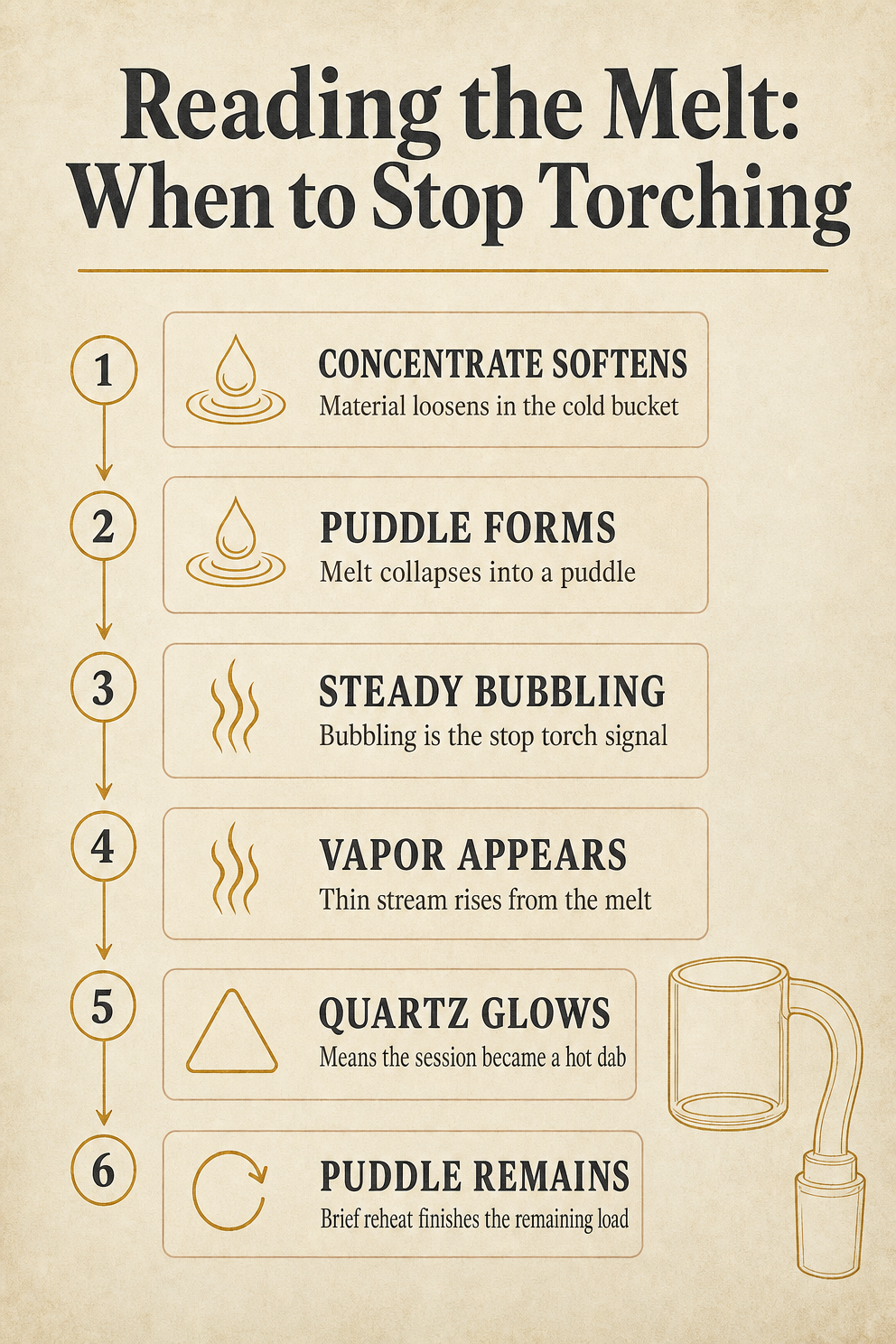
Because the concentrate sits in the bucket for the entire heat-up, the melt itself becomes the timer. You watch the material soften, collapse into a puddle, and start to bubble, and the moment a thin stream of vapor rises you stop torching and draw. That visible cue is the reason the method is easier to repeat than a hot start that depends on a stopwatch or a temperature reading. [3]
It also means the gear does a lot of the work for you. A simple banger with a flat top, a thick quartz floor, and a well-fitting carb cap makes the technique far more predictable than a fussy multi-chamber design. This guide walks the full sequence from a clean, cold banger to the last bit of vapor, the banger shapes that suit the method, how terp pearls and inserts change the timing, and the habits that keep quartz in good shape between sessions.
What Is a Cold Start Dab and How Is It Different?
Every dab comes down to one question: is the concentrate waiting for the heat, or is the heat waiting for the concentrate? A cold start puts the material in the bucket before any flame touches the quartz. A traditional hot start does the opposite. It heats the empty banger hot, waits for it to cool to a usable range, and only then loads concentrate onto the already-warm surface. [2] [6]
Low-temperature dabbing sits between the two, which is where most of the confusion comes from. A low-temp dab is still a hot start in its order of steps: heat first, cool-down wait, then load. The only difference from a standard hot start is how far it cools. A cold start removes the cool-down wait entirely by making the loaded material part of the heat-up itself. [1] [6]
The naming is not standardized either. Published guides use cold start dab, cold start dabbing, reverse dab, and cold dab for the same method, and no single convention has become universal. Even the cycle time is disputed: one banger maker calls the cold start the faster option because there is no cool-down wait, while a retailer comparison describes it as the slower overall cycle once heating and reheating are counted. Both are describing the same technique from different starting points. [1] [6]
Where you land depends on what you already own. If you are assembling a concentrate setup, the Dab Rigs collection is the place to compare chambers side by side, and readers who also keep a water piece for flower have a simple option in the SILICONE BEAKER BONG WITH REMOVABLE GLASS BOWL.
- Cold start: load concentrate into a room-temperature banger, seat the carb cap, then heat the whole assembly from outside until the melt begins to bubble.
- Traditional hot start: heat the empty banger first, wait for it to cool to a usable range, then load concentrate onto the warm surface.
- Low-temperature dab: the same order as a hot start, but the banger is allowed to cool further before material is loaded.
- Timing cue: a cold start is read from the melt itself, while a hot start is read from a clock, a timer, or a temperature reading.
- Cool-down wait: a cold start has none, which is why one banger maker calls it the faster cycle while another guide counts the reheat and calls the full cycle slower.
- Risk profile: the cold start trades precise heat control for a visible stop cue, so load size and even heat across the bucket decide the result.
| Step | Cold Start Dab | Traditional Hot Start | Low-Temp Dab |
|---|---|---|---|
| Order of steps | Load concentrate, then heat | Heat an empty banger, then load | Heat an empty banger, then load |
| Cool-down wait | None | Yes, before loading | Yes, roughly 30 to 60 seconds |
| Banger temperature at load | Room temperature | Cooled to a usable range | Cooled further than a standard hot start |
| Timing cue | The melt bubbles and vapor rises | A stopwatch or a temperature reading | A stopwatch or a temperature reading |
How Do You Do a Cold Start Dab Step by Step?
The routine below assumes a clean banger that is fully cool. Load size and even heat do most of the work. A small dab, about the size of a grain of rice, melts predictably, while a large one sits in the bucket long after the outside of the quartz is hot.
Start with the banger at room temperature. Quartz that is still warm from the last session changes the timing, because the material starts moving before your flame does. Load your concentrate into the cold bucket, and add any pearls, pillars, or insert at the same time so everything heats together. [2] [1]
Seat the carb cap next. Most cold-start walkthroughs cap the banger before heating so heat and vapor stay in the bucket, while some guides heat first and cap the moment the material starts to bubble. Both sequences appear in published instructions, so pick one and stay consistent — consistency is what makes the stop point repeatable from one session to the next. [2] [3]
Then bring in the torch. Hold a low flame a few inches below the base and sweep it in a slow circle beneath the bucket instead of parking it in one spot. A stationary flame concentrates heat in a single spot while the rest of the bucket lags behind, which makes the melt cue arrive late and unevenly. [3] [1]
An accessories guide describes applying heat for roughly 5 to 12 seconds, and one walkthrough uses about 10 seconds as a typical finish, but both are ranges rather than rules. Watch the melt rather than the clock. [4] [2]
Once vapor appears, stop heating and draw while you keep the carb cap moving. The cap is not decoration: it restricts and redirects incoming air, which lowers the pressure inside the bucket so concentrate vaporizes at a lower banger temperature than an open bucket allows. [5]
If material remains after the first draw, a short reheat of what is left in the bucket — just until it bubbles again — finishes the load without holding the quartz in high heat. Let the banger cool completely before loading a second dab. [3]
If you are still choosing parts, the differences between bucket shapes are covered in What Is a Quartz Banger and How Do You Choose One?, and the heat source itself gets its own walkthrough in How Do You Choose the Right Torch for a Dab Rig?. Pearls behave differently again — What Are Terp Pearls and How Do You Use Them? explains how size and count change what happens inside the bucket.
- Set up on a stable surface and confirm the banger is completely cool, since quartz that is still warm from a previous dab throws off the timing.
- Load a small dab, about the size of a grain of rice, into the room-temperature bucket.
- Add any terp pearls, pillar, or quartz insert at the same time so the whole assembly comes up to temperature together.
- Seat a well-fitting carb cap on the banger, because a cap that leaves a gap around the rim lets air bypass the bucket.
- Hold the torch so the flame sits a few inches below the base, then move it in a slow circle beneath the bucket.
- Watch the material as it softens and collapses into a puddle instead of counting seconds.
- Stop heating the moment the melt bubbles steadily and a thin stream of vapor starts to rise.
- Draw while keeping the carb cap moving slightly, which keeps air passing across the puddle.
- If concentrate remains, apply a short controlled reheat aimed at the tail end of the load until it bubbles again.
- Let the banger cool completely, then swab the bucket before you load the next dab.
How Do You Know When to Stop Heating the Banger?
A cold start replaces the stopwatch with something you can actually see. Because the concentrate is in the bucket for the whole heat-up, it reports its own progress: it softens, flattens into a puddle, begins to bubble, and then releases vapor. That last visible step is the signal to stop torching. [3] [2]
The mistake that causes most overshoots is heating through the pause. Quartz does not respond to a torch instantly — it takes a moment to absorb and spread heat across the bucket. If you keep the flame on the base while waiting for the material to react, you are stacking heat that has not shown up yet. By the time the melt catches up, the quartz is hotter than you intended. [1] [3]
Never let the quartz glow. A glowing banger is roughly 800°F or hotter, and at that point the session is no longer a cold start — it is a hot dab performed in the wrong order. Residue in the bucket also darkens quickly once temperatures climb past about 600°F, which is the beginning of permanent surface change. [4] [6] [7]
The temperature numbers published for cold starts do not agree with each other. One comparison puts the finish around 400 to 480°F, an accessories guide cites a 450 to 520°F sweet spot, and a glass shop describes a flavor band roughly between 400 and 500°F with a middle range near 500 to 545°F. Read any single figure as one guide’s starting reference, then dial in from the melt you are watching. [6] [4] [3]
A device that holds a set temperature for you, such as the G Pen Roam – Portable E-Rig Vaporizer, takes the torch out of the equation and removes the guesswork entirely.
- The concentrate softens and loses its shape in the cold bucket as heat reaches it from below.
- The material collapses into a flat puddle across the floor of the banger.
- Small bubbles appear at the edges of the puddle and grow steadily more active.
- Bubbling becomes steady and a thin stream of vapor starts to rise, which is the point to stop torching.
- If the quartz itself starts to glow, you have gone past the mark and the session has turned into a hot dab in the wrong order.
- If a puddle is still sitting there after your draw, heat the tail end of it briefly until it bubbles again.
Which Quartz Bangers Work Best for a Cold Start?
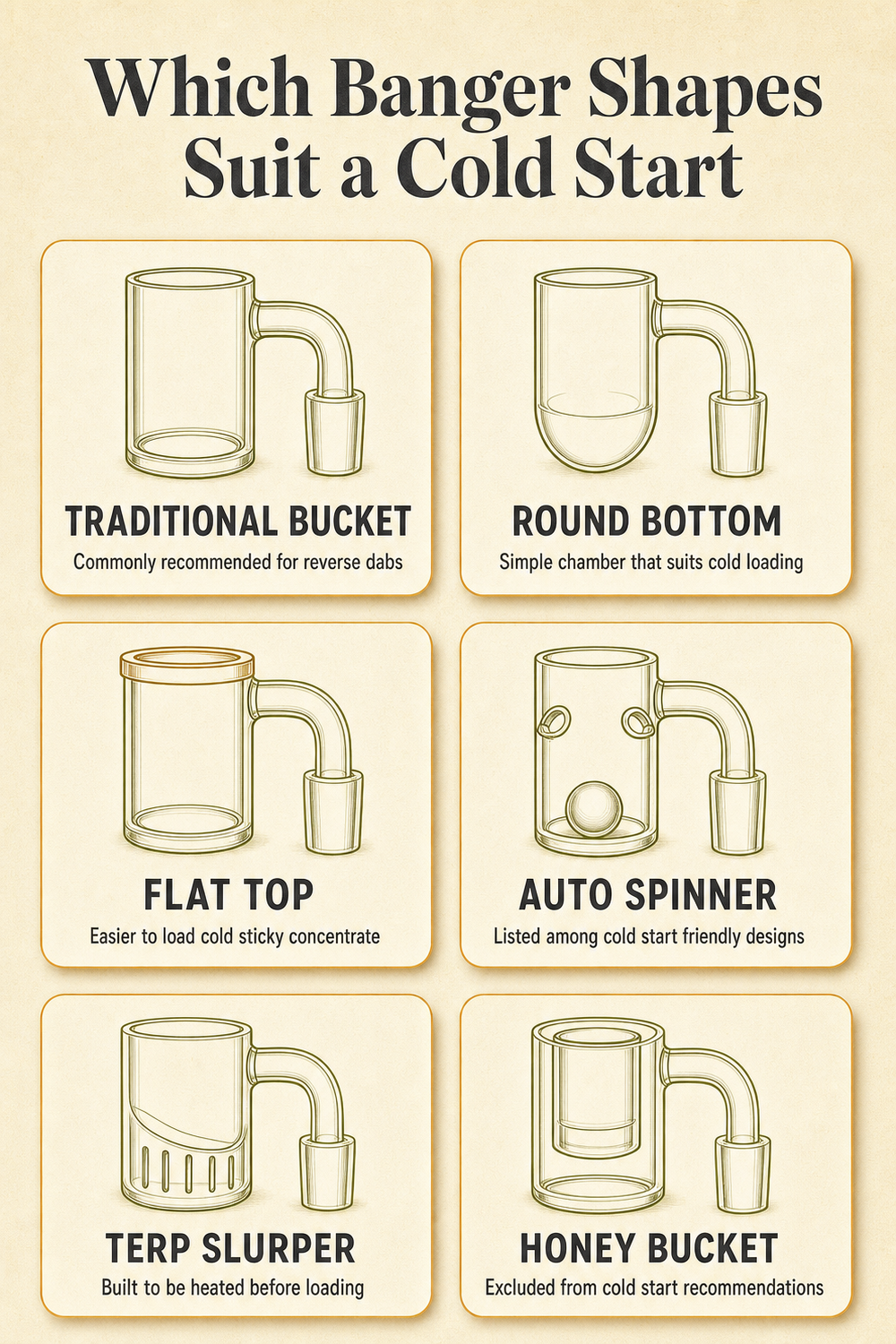
A cold start is most predictable in a simple chamber. Traditional bucket, round-bottom, auto-spinner, and diamond-knot bangers are the designs most guides recommend, and a flat top makes it easier to load cold, sticky concentrate into the bucket without smearing it up the walls. [1] [2]
Complex modern designs are built for the opposite workflow. Terp slurpers, towers, and honey buckets use dishes, intakes, restrictions, and multiple chambers that are designed to be heated first and read afterward through airflow across already-hot quartz. That does not make them poor tools — it makes them the wrong shape for a method where material is present from the first second of heating. If a slurper is what you already run, the Human Grade Terp Bubble Slurper Bangers are built around that preheated style of use.
Material and thickness matter as much as shape. Quartz is preferred over glass for this technique, and a thicker floor — roughly 3 to 4 mm — holds and distributes heat more evenly than a thin one. Very thin budget bangers overheat quickly and cool too fast to control, which makes the same technique feel different every session. [4]
Rig choice feeds into the same goal. A small, simple rig with a single perc, a 90-degree joint paired with a flat-top banger, and a wide stable base is commonly recommended, because more water volume and more percolation add drag and leave more reclaim behind in the glass. [4] When you are ready to compare chambers, the Quartz Bangers collection is the fastest place to see what is available, and Treehouse Lifestyle offers free shipping on orders $150+, which covers most banger-and-cap combinations.
- Traditional bucket: the baseline simple chamber, and the design most cold-start guides start with.
- Round bottom: a plain bucket shape that suits loading concentrate cold.
- Auto spinner: listed among the designs that work with a reverse dab.
- Diamond knot: another simple chamber that appears on cold-start-friendly lists.
- Flat top: easier to load cold, sticky concentrate without pushing it up the walls.
- Terp slurper, tower, or honey bucket: built to be heated first and read through airflow, so they are generally not recommended for this method.
- Thin budget banger: overheats quickly and cools too fast, which makes the stop point difficult to repeat.
| Banger Design | Suits a Cold Start? | Why |
|---|---|---|
| Traditional bucket | Yes | The baseline simple chamber most cold-start guides start with |
| Round bottom | Yes | Plain bucket shape that suits loading concentrate cold |
| Auto spinner | Yes | Appears on cold-start-friendly design lists |
| Diamond knot | Yes | Simple chamber that spreads heat evenly |
| Flat top | Yes | Easier to load cold, sticky concentrate without smearing the walls |
| Terp slurper, tower, or honey bucket | Generally no | Built to be heated first and read through airflow across hot quartz |
How Do Terp Pearls, Pillars, and Inserts Change a Cold Start?
Everything that goes into the bucket needs to go in cold. Terp pearls, pillars, and quartz inserts load at the same time as the concentrate so the whole assembly heats together. Dropping a pearl into an already-hot banger works against that and puts cold quartz against hot quartz, which is exactly the kind of sudden temperature difference the method is meant to avoid. [1] [5]
Sizing follows the bucket. Pearls of about 6 mm suit a 25 mm banger, while a 20 mm banger pairs with a single 4 mm pearl. More is not better here: too many pearls restrict airflow and stop them spinning, which is the opposite of what you added them for. [5]
An insert changes the timing rather than the sequence. It adds an extra barrier between the flame and the material, so the banger usually needs noticeably more heat than a direct-load cold start — one walkthrough puts an insert-based variant at 10 to 15 seconds or more of extra heating. Watch the melt in the insert rather than the banger floor, since the insert is the surface the material is actually sitting on. [2] [4]
The carb cap ties all of it together, and it is not optional for this method. It restricts and redirects incoming air, which lowers the internal pressure so concentrate vaporizes at a lower banger temperature than an open bucket would allow. A cap that leaves a gap around the rim lets air bypass the bucket and works against the effect you are relying on. [5]
- Confirm the banger is clean and at room temperature before anything goes into it.
- Place your concentrate in the bucket first, then add pearls, a pillar, or an insert beside or on top of it.
- Match the pearl size to the bucket — roughly 6 mm pearls for a 25 mm banger, or a single 4 mm pearl for a 20 mm banger.
- Use only as many pearls as the bucket can spin freely, since a crowded bucket stops moving air instead of helping it.
- Seat a carb cap that fits flush, since a loose cap lets air slip past the bucket and cancels the lower-pressure effect.
- Add extra heating time when you run an insert — 10 to 15 seconds or more beyond a direct-load cold start — and keep watching the melt inside the insert.
How Do You Keep a Cold-Start Banger From Chazzing?
Chazzing is the one kind of banger wear you cannot undo. It is not surface residue sitting on top of the glass; it is carbon bonding into the silica through devitrification. Once that happens, the haze or white patches will not come off with isopropyl alcohol or scrubbing, because the surface itself has changed. [7]
The practical cost is control. Chazzed patches create hot and cold zones, so the banger stops heating evenly and vaporization becomes inconsistent from one session to the next — precisely the precision a cold start depends on. Among people who chaz a banger in weeks instead of months, the usual causes are overheating and skipping the wipe between dabs. [7]
The habit that holds it off is small: swab the bucket with a cotton swab while it is still warm. Guides describe this as the single most effective step against chazzing, because residue left in the bucket gets reheated and carbonizes further with every cycle, and each pass makes it harder to remove. [7] [2]
A little materials context helps you decide when a banger is finished. Fused quartz has a very low coefficient of thermal expansion — about 5.5 x 10⁻⁷ per degree C, roughly one-seventh that of borosilicate glass — which is why thin sections handle extreme temperature swings without cracking. Devitrification still proceeds by surface nucleation, but the beta-cristobalite phase transformation generally does not occur below about 1000 C, far above any temperature a hand torch puts into a banger. [9]
- Swab the warm bucket with a dry cotton swab as soon as you finish a draw, before residue has a chance to set.
- Follow with a second swab and a small amount of isopropyl alcohol once the banger has cooled enough to handle safely.
- Never let the quartz glow, and stop heating as soon as the melt bubbles.
- Clean the bucket between loads so a fresh dab never lands on top of leftover residue.
- Give the banger a deeper clean once a week with isopropyl alcohol and a fresh swab.
- Retire the piece when the patches no longer come out, since a chazzed banger will not heat evenly again.
Which Torch Habits Keep a Cold Start Repeatable?
A standard lighter will not do this job. It is too slow to bring quartz up to temperature and it leaves black soot on the quartz, which is why published guides specify a butane torch. [1]
A hand torch is an open flame, so the handling rules matter as much as the technique. An institutional safety procedure for butane and propane torches requires an instant-off trigger on handheld models, forbids leaving a burning torch unattended, warns that tipping the fuel cylinder more than 60 degrees from upright can cause the torch to flare, and requires cylinders to be stored out of direct sunlight and never above 120°F (49°C). [8]
Flame motion is the other half of repeatability. A low flame held a few centimeters below the banger base and moved in small circles around the bottom and lower walls spreads heat evenly instead of concentrating it in one spot, and that slow sweep is what makes the stop point predictable. A stationary flame gives you a hot stripe and a cold edge, so the melt cue arrives late and the next session starts from a different baseline. [3] [1]
- Use a butane torch rather than a lighter, which is too slow to heat quartz and leaves soot behind.
- Choose a handheld torch with an instant-off trigger so the flame can be cut without fumbling.
- Keep the flame low and hold it a few centimeters below the base rather than driving it into the glass.
- Keep the flame moving in a slow circle under the bucket instead of parking it in one place.
- Never leave a burning torch unattended, and keep it upright, since tipping the cylinder past 60 degrees can cause a flare.
- Store fuel cylinders out of direct sunlight and never above 120°F (49°C).
- Let the banger cool completely before you handle it or move the rig.
Frequently Asked Questions
Is a cold start dab the same thing as a low-temp dab?
They are close but not identical, and guides describe them differently depending on who is writing. A low-temp dab heats the banger first and then lets it cool before loading, while a cold start loads the concentrate into a cold banger and heats the whole assembly from outside. They are sometimes described as the same technique and sometimes as separate ones, so the practical difference is where the concentrate is while the banger heats up. [6]
Do you put the carb cap on before or after heating the banger?
Both sequences appear in published instructions. Most cold-start walkthroughs have you seat the cap on the banger before heating so heat and vapor stay in the bucket. Other guides heat first and cap the moment the concentrate starts to bubble. Either way, the cap should fit well — a cap that leaves a gap around the rim lets air bypass the bucket and works against the lower-pressure effect the cap is there to create. [2] [5]
Can you cold start with terp pearls or an insert in the banger?
Yes. Terp pearls, pillars, and quartz inserts go into the banger cold, at the same time as the concentrate, so everything heats together. Size them to the bucket — roughly 6 mm pearls for a 25 mm banger, or a single 4 mm pearl for a 20 mm banger. An insert adds an extra barrier between the flame and the material, so expect the banger to need more heat than a direct-load cold start. [5]
Why does my cold start dab leave a puddle behind?
A puddle usually means the banger did not quite reach the temperature the load needed. The fix is a brief controlled reheat aimed at the tail end of the puddle, heating until it bubbles again, rather than keeping the banger in high heat. Timing is the other half: cold starts that stop too early leave more residue than a well-timed traditional dab, which is one of the tradeoffs guides list for the method. [3]
What kind of banger should I use for a cold start?
A simple chamber works best. Traditional bucket, round-bottom, auto-spinner, and diamond-knot bangers are the commonly recommended designs, and a flat top makes it easier to load cold, sticky concentrate. Quartz is preferred over glass, and a thicker floor of roughly 3 to 4 mm holds and distributes heat more evenly than a thin budget banger. Terp slurpers, towers, and honey buckets are generally not recommended for this method. [1] [4]
How long should you heat a banger for a cold start?
Read torch time as a range rather than a rule. One accessories guide describes applying heat for 5 to 12 seconds, while a full walkthrough has you stop when the concentrate bubbles and vaporizes, usually around 10 seconds. An insert-based cold start needs longer, roughly 10 to 15 seconds or more of extra heat. The melt itself is the better signal than a count: stop when it bubbles and vapor starts to rise. [2] [4]
What Should You Remember About Cold Start Dabbing?
Cold start dabbing is a sequencing change with a real payoff in control. Load the concentrate into a room-temperature banger, seat the cap, heat the outside with a low sweeping flame, and stop the moment the melt bubbles. No stopwatch, no guessing how far the quartz has cooled. [3]
The gear half of the equation matters just as much. A simple chamber with a flat top, a thick quartz floor, a carb cap that fits flush, and a torch you can control will make the technique repeatable. A thin banger, a leaky cap, or a flame parked in one spot will make the same technique feel random. [4] [5]
Then protect the setup. Swab the bucket while it is warm, never let the quartz glow, and clean on a schedule so residue never gets a second bake. A banger that heats evenly is what makes the next cold start as predictable as this one. If you are still assembling your rig, compare a few banger shapes side by side before you commit, and match the chamber to how you actually use it. [7]
Sources
- Terporium: Cold Start Banger Guide: Everything You Need to Know
- Yo Dabba Dabba: Cold Start Dabs: How to Do a Reverse Dab
- Thick Ass Glass: How To Cold Start A Dab Rig The Right Way | TAG
- Oil Slick: Cold Start Dabs: How to Do It + Gear That Makes It Work
- Azarius: Carb Caps & Terp Pearls Guide: How to Use Them
- Social Dispensary: Cold Start vs Low-Temp Dabs: Which Is Better?
- Oil Slick: What Is Chazzing? How to Prevent and Fix a Chazzed Banger
- University of Delaware Environmental Health & Safety: Standard Operating Procedure: Propane-style Torch Use (EHS-04-105)
- Machined Quartz (citing Momentive Performance Materials fused quartz data): Thermal Properties of Fused Quartz