

An e-nail is an electrically powered heating system that replaces the butane torch on a traditional dab rig. A desktop setup has four core parts: a controller box that sets and holds the temperature, a heating coil that wraps around or sits under a banger or nail, a cable linking coil to controller, and a power cord. The glass rig, and usually the banger, is bought separately [13] [14].
The coil heats by conductive contact, and a thermocouple reports temperature back to the controller, which uses a PID algorithm to modulate power and hold the coil near your set point. That closed loop is the whole point of the category: the dabbing surface stays at its setting through a session instead of being reheated between dabs [5] [8].
Two things decide whether a setup actually works. The coil’s internal diameter has to match your banger or nail’s outer diameter, and the coil has to match the controller’s voltage and wiring. An e-nail is also not the same product as an e-rig, even though guides frequently compare the two as if they were rivals [6] [1].
What Is an E-Nail and How Does It Work?
Start with what an e-nail is not: it is not a standalone device. It is a heating attachment that mounts on a dab rig you already own. The glass still provides the air path and the water; the e-nail only takes over the heat [13] [7].
A desktop system is four parts. First, the controller box — a PID unit with a display and temperature controls, and the part that decides how well the temperature holds. Second, the heating coil. Third, the cable that carries power out to the coil and the sensor signal back. Fourth, the power cord for the wall outlet [5] [10] [14].
The heating path is a closed loop. A resistive coil — commonly nichrome or kanthal wire inside a stainless steel housing — is pressed against the banger or nail, and heat transfers through that contact. A thermocouple embedded in or near the coil reports temperature to the controller, and a PID algorithm modulates power to hold the coil near the set point rather than switching on and off blindly [5].
Sensor type matters more than buyers expect. Most coils use a Type K thermocouple, and Type K carries its own tolerance: the standard limit of error is ±2.2°C or ±0.75%, whichever is greater, with a special limits-of-error grade of ±1.1°C or 0.4%. A control loop can hold perfectly steady and still be holding at a temperature the sensor misreports [16] [5].
No single name ever won. ‘e nail,’ ‘e-nail,’ ‘enail,’ ‘electric nail,’ and ‘electronic nail’ all appear for the same device across manufacturers and retailers, and the terms are used interchangeably rather than to signal different products [1] [7] [12].
If you are browsing by category, an e-nail belongs with the wider Dab Rigs, and coil-and-controller kits sit closest to Electric Rigs. A compact all-in-one device like the Dr Dabber XS e-Rig Portable Vaporizer is a different product class — more on that next.
- Controller box — sets and holds the temperature; the PID unit is the part that decides how well it holds [5].
- Heating coil — a resistive wire in a stainless steel housing that transfers heat by contact with the banger or nail [5].
- Coil cable — carries power out and the thermocouple signal back; most standard coils use a 5-pin XLR-style connector [2] [1].
- Power cord — desktop units run from a wall outlet; battery versions exist but give up temperature stability [13].
- Thermocouple — most often Type K, with its own accuracy tolerance that the controller inherits [16].
- The names — e nail, e-nail, enail, electric nail, and electronic nail all describe the same product [1].
Is an E-Nail the Same Thing as an E-Rig?
No. They are different products, and the confusion is largely manufactured. An e-nail is an attachment that heats a glass rig you already own; the glass, and often the banger, is bought separately. An e-rig is a self-contained electronic device with its own heating element and built-in water piece, and it is limited to its own replacement glass [13] [14].
One retailer makes the argument directly: most e-nail versus e-rig articles conflate the two because the search term is worth ranking for, not because the comparison helps anyone shop [13].
Where the two categories genuinely overlap is portability. Desktop e-nails plug into the wall and hold temperature more accurately; battery-powered portables trade that stability for freedom from an outlet, with the battery depleting and temperature fluctuating. A portable e-nail also still needs a rig or bong to run through, which limits how portable the whole setup really is [13] [12].
The practical fork is what you already own. If you have a rig with a compatible joint, an e-nail is an upgrade to equipment you have. If you are starting from nothing, an e-rig is one box instead of a stack of parts [14] [8].
If the torch side of that decision is still open, How Do You Choose the Right Torch for a Dab Rig? covers it from the beginning. On the all-in-one side of the spectrum, a device like the G Pen Roam – Portable E-Rig Vaporizer is the opposite approach to a separate coil and controller.
- E-nail — heating attachment only; controller, coil, and cable; no glass included [14].
- E-rig — a complete device with its own heating element, chamber, and water path in one body [13].
- Compatibility — an e-nail works with a wide range of glass rigs; an e-rig is tied to its own replacement glass [14].
- Desktop — wall power, more accurate and more consistent temperature, much less portable [13].
- Portable or wireless — battery power and a combined controller and heater; the trade-off is temperature stability [14].
- Best fit — an e-nail for someone who already owns a rig; an e-rig for a first-time buyer who wants one box [14] [13].
What Comes in an E-Nail Kit, and What Do You Still Need to Buy?
A kit is not a setup. Most desktop kits cover the electronics — the controller box, the coil, the connector, and the power cord — and stop there. Everything that touches your concentrate is usually a separate purchase, which is why two shoppers who both say they bought an e-nail can end up with very different totals [5] [10].
Here is the full checklist, in the order you would assemble it. If any one of these is missing, the setup either will not run or should not be run [5].
The glass piece is the item buyers most often forget. It needs a compatible 10mm, 14mm, or 18mm joint, male or female, and the nail or banger has to fit both that joint and the coil [5] [4].
Cost is where the surprise lives. Published ranges put a controller plus coil at $120 to $300 with a coil-compatible banger at $30 to $120 on top, or $100 to $300 for a solid desktop setup, or $150 to $700+ across one retailer’s own catalog. Because kits differ on whether a nail is included, those numbers are not directly comparable [12] [13] [10].
If you are assembling everything at once, note that a rig plus a coil-compatible banger typically clears the free shipping on orders $150+ threshold on its own.
- Dab rig — a glass piece with a compatible 10mm, 14mm, or 18mm joint, male or female. A workhorse option is the SILICONE BEAKER BONG WITH REMOVABLE GLASS BOWL [5].
- Nail or banger — has to fit both the rig joint and the coil’s internal diameter [5] [6].
- Heating coil — often included with a kit; confirm the shape and diameter match the banger you chose [2].
- PID controller box — often included, along with the power cord and the coil connector [10].
- Dabber tool — for placing concentrate; not part of the electronics [5].
- Carb cap — sits over the banger to direct airflow, and is used on e-nails too [8].
- Heat-resistant mat or silicone pad — the coil comes off hot and should not rest on bare wood [11].
- 90%+ isopropyl alcohol and cotton swabs — for swabbing the banger between sessions [5].
Which E-Nail Coil Shape Fits Your Banger?
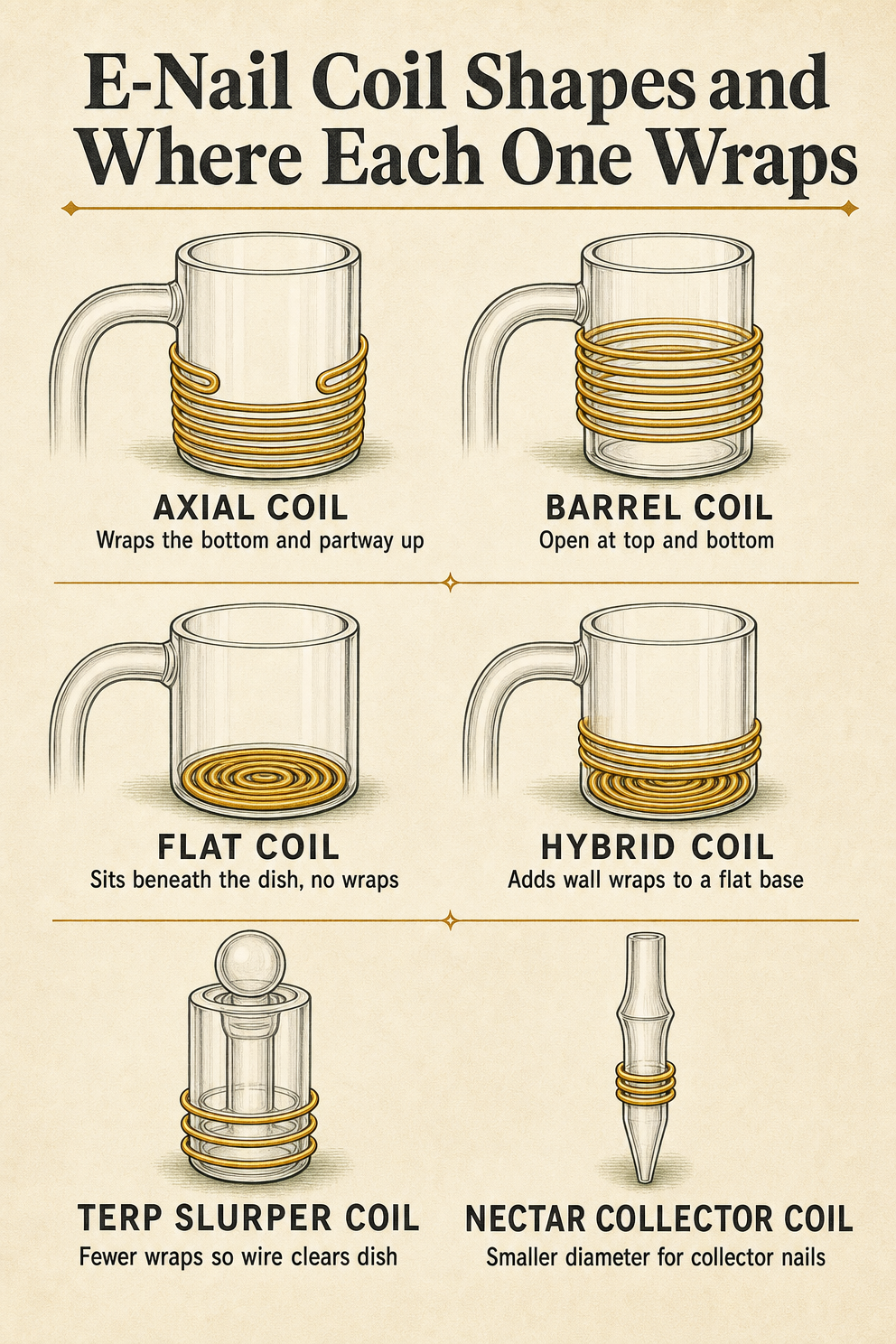
Coil shape decides where heat lands, so it matters more than the number on the controller. Two coils of the same diameter can put heat on completely different surfaces [2] [4].
Axial coils wrap the bottom and partway up the walls, like a bucket. They heat the piece faster than a barrel coil of the same size because the bottom is covered too, and they need a flat-bottomed banger with a stem to secure to [2] [4].
Barrel coils are a circle open at both ends, wrapping only the walls. That is the older standard and still the common pairing with titanium nails and bangers that have a built-in arm [2] [5].
Flat coils have no upward wraps at all and sit beneath the dish. They suit shorter dishes and flat titanium or titanium-and-quartz hybrid nails [2] [4].
Hybrid coils split the difference: a flat base plus a couple of wall wraps, heating the bottom and the sidewalls together [2] [6].
Terp slurper coils use three or four wraps instead of roughly six, so the wire does not rise above the dish. Nectar collector coils are a smaller-diameter variant that only fits nectar collector nails [2].
Axial versus barrel is also the clearest mechanical split between an e-nail and a torch. A torch is aimed at the bottom of the banger; a wrapped coil heats the sides of the bucket [4] [9].
Material interacts with shape. Quartz, titanium, silicon carbide, and ceramic have different thermal conductivity, so each heats and holds differently and the same set point does not produce the same result across materials. Quartz is the common choice for pairing with flat coils, titanium heats quickly and works with a barrel coil, and ceramic sits between the two but is slower to heat and slower to stabilize [5] [13] [3].
Quartz also ages. Clouding, or devitrification, is the visible sign, and sustained use above 700°F is said to accelerate it. Materials references describe it as a two-step process: crystals start forming at the surface and then grow, and the reaction usually begins where the glass picked up surface contamination [5] [17].
For anyone weighing quartz against other banger materials, Why Do Dabbers Prefer Quartz Pipes and Bangers? covers why quartz became the default.
- Axial — wraps the bottom and partway up the walls; the fastest of the wrap styles; needs a flat-bottom banger with a stem [2] [4].
- Barrel — open at top and bottom, walls only; pairs with titanium nails and bangers that have a built-in arm [2].
- Flat — no wall wraps, sits beneath the dish; pairs with flat titanium and hybrid nails [4].
- Hybrid — a flat base plus a few wall wraps; heats the bottom and sides together [6].
- Terp slurper — three or four wraps so the wire stays below the dish rim [2].
- Nectar collector — smaller diameter; fits nectar collector nails only [2].
- Quartz banger — the default pairing with flat coils; clouds over time with sustained high heat [5] [17].
How Do You Match Coil Size and Voltage to Your Banger or Nail?
Fit comes down to one measurement: the coil’s internal diameter has to match your banger or nail’s outer diameter. That is the rule that decides whether a coil works at all [6] [5].
Get it wrong in either direction and the symptoms are predictable. A coil that is too large loses contact and creates uneven heat and hot spots. One that is too tight stresses the nail and may not seat at all. A small gap is acceptable and is explained as clearance for thermal expansion so the banger does not crack [5] [6] [3].
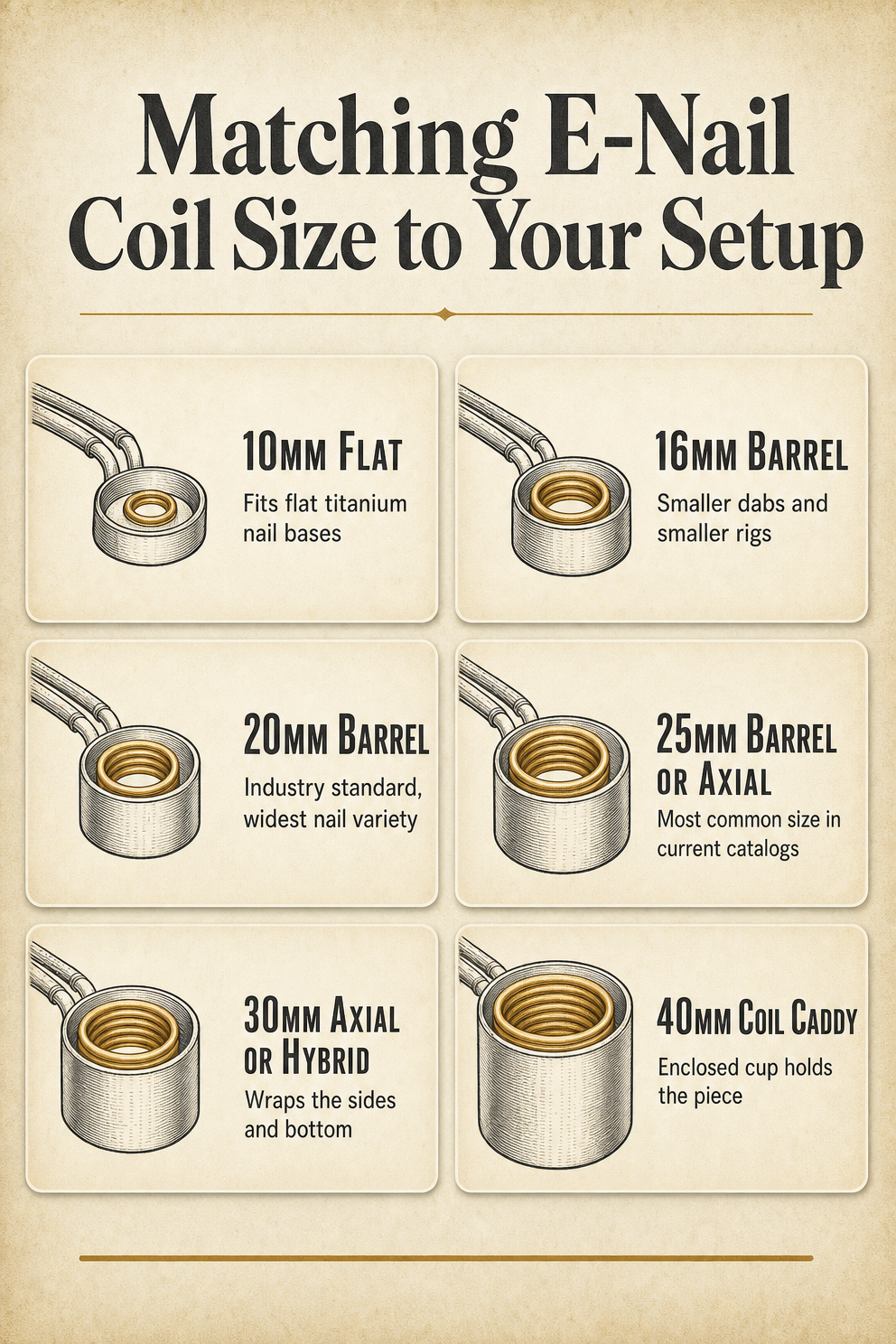
The common internal diameters run from 10mm flat through 16mm, 20mm, and 25mm barrels, up to 30mm axial and hybrid sizes, with larger 30.2mm and 40mm dock-style coils that form an enclosed cup you drop the piece into instead of wrapping it [4] [6].
The 20mm barrel is described as the long-standing industry standard with the widest variety of compatible nails, while the 25mm size is described by multiple sources as the most common today [4] [6] [3].
Size is not only about fit. A larger coil contains more metal to bring up to temperature, so it warms differently and recovers differently. A 20mm coil is compact and heats quickly; a 25mm coil is described as covering close to half a banger; 30mm and larger setups may need a longer wait after the set point is reached [3] [4].
Voltage is the other compatibility rule, and it has no workaround. Coils are built for either 120V, used in the US and Canada, or 230/240V, used in most of Europe, Australia, and elsewhere. They are not interchangeable, and the coil has to match the controller it plugs into [6].
The number on the controller is the coil’s temperature, not your dabbing surface’s. Because the thermocouple reads from the coil, surface temperature varies with how well the coil contacts the banger, banger thickness, banger material, airflow, and even room temperature. The way to find your real number is to compare the display against an infrared or surface thermometer and adjust the set point accordingly [3] [5] [11].
That gap can be substantial. One troubleshooting guide states some controllers run consistently 20 to 40 degrees hotter or cooler than the display, and points at a loose coil, a damaged thermocouple inside the coil, and switching banger material, quartz to titanium, without changing the set point as the usual causes [11].
Reaching the set point is not the same as being ready. Heat still has to soak from the coil into the quartz or metal. One vendor guide says to wait an extra 60 to 90 seconds after the controller reaches temperature; a retailer guide describes a one-to-five-minute wait, shorter for compact coils and longer for 30mm and larger setups [5] [3].
Published heat-up times disagree because sources are describing different things: the controller reaching set point, a small coil, or a whole assembly being ready. Figures in print include 30 seconds for one compact kit, 60 to 90 seconds for desktop units, 30 seconds to a few minutes from a device maker, and 3 to 5 minutes to operating temperature plus stabilization from a vendor guide [10] [13] [7] [5].
Controller set ranges are wide: roughly 200°F at the low end up to about 999 to 1,000°F at the top. That is the range the box can be dialed to, not a recommendation for any particular session, and published starting figures do not agree with each other either [13] [7] [3].
Rig size and coil size are separate decisions. What Size Dab Rig Should You Choose? covers the glass side of that question.
- 10mm flat — sits under a flat titanium nail base [4].
- 16mm barrel — smaller dabs and smaller rigs [4].
- 20mm barrel — the long-standing industry standard, with the widest variety of compatible nails [4].
- 25mm barrel or axial — described by multiple sources as the most common size in current catalogs [6] [3].
- 30mm axial or hybrid — wraps the sides and bottom; larger setups may need a longer wait after set point [4] [3].
- 30.2mm and 40mm coil caddy — an enclosed dock that holds the piece so it can be lifted out with nothing attached [6].
- 120V versus 230/240V — coils are built for one or the other and are not interchangeable [6].
- Display versus surface — the controller reads the coil, so the surface number is usually different [3] [11].
Will Any Coil Work With Any Controller?
No, and this is the mistake that costs the most to fix. Many coils share the same 5-pin XLR-style quick-disconnect plug, but the internal pin assignments differ between brands. Whether a coil works with a controller is a wiring question, not a plug-shape question [1] [2].
Two pinout orders are documented. One puts power on pins 1 and 2, the thermocouple on pins 3 and 4, and ground on pin 5. The other reverses that arrangement, with the thermocouple on pins 1 and 2, ground on pin 3, and power on pins 4 and 5. A third 12V system pinout also exists. Plugging an incompatible coil into a controller can short it out and permanently destroy it [1] [2].
Brands do not resolve this for you. One manufacturer publishes explicit compatible and non-compatible brand lists for its own pinout instead of claiming universal fit, and advises requesting a wiring diagram from the controller maker before connecting third-party hardware. Wire color can vary even between two pinouts that do match [1].
A mismatch usually announces itself before any damage. Retailers report the typical symptom is an error code on the controller display, most often EEEE, because the pin carrying power is not reaching the pin the controller expects to read [2].
The connector and cord are a separate known wear point, and worth a look before each session [11] [5].
- Check the plug label first — most standard coils use a five-pin XLR plug with the pins labeled 1 through 5 [2].
- Open the plug and count the wires — the two thinner wires are the thermocouple pair, usually red and black or white and red [2].
- Identify the ground — it is thicker than the thermocouple pair [2].
- The two remaining wires are the AC power pair [2].
- Note which pin each wire lands on, then compare against the controller maker’s published pinout or ask them for a wiring diagram before connecting anything [1].
- Inspect the connector and cable — bent or missing pins, dark burnt marks inside the connector, kinks or a frayed jacket near the plug, and connectors that feel warm in use are all reasons to stop [5] [11].
- Stop immediately if a cord or connector gets warm at the controller end — that points to a short or bad contact that can take out the controller [11].
E-Nail vs Torch: How Do the Two Setups Compare?
The honest comparison is not power versus power. It is a heat source that holds a number against one that is portable, and the better answer depends on how and where you dab [8] [12].
Upfront, the torch wins easily. A torch runs about $20 to $80, plus $10 to $25 per butane can, plus an optional $20 to $100 timer or infrared thermometer. An e-nail runs $120 to $300 for a controller and coil, with a coil-compatible banger at $30 to $120 on top, or $100 to $500 as a general range. Electricity is negligible, but coils are a consumable, so the upfront figure is not the whole story [12] [9] [13].
Recurring cost flips the picture. Butane is a purchase that never ends, and a torch wears out; one retailer notes the lower long-term cost of an e-nail after the initial purchase. Another retailer reports its own shop data on butane spend avoided, which is a vendor’s estimate rather than an independent figure [9] [13].
The real difference is continuity of heat. Because the coil keeps heating for as long as the controller is on, the dabbing surface stays at its set point through a draw and between draws. That means no re-heating, no cooldown wait between dabs, and no timer or glow-reading step. Guides frame that repeatability, rather than raw power, as what an e-nail is actually for [9] [12] [8].
The torch still does two things well: it is portable, and a torch setup can be ready in about 20 to 30 seconds. Its drawbacks are the ones that pushed people toward regulated heat in the first place. Temperature is difficult to gauge without a thermometer, and there is an open flame to handle [8] [9].
The learning curve on the e-nail side is genuinely small. One guide describes it as nearly nothing beyond dialing in a personal set point, and warns that running 650°F constantly is not a sign of expertise. Another lists example starting figures of 480 to 540°F and 450 to 520°F, while a third reports its shop’s most common target at about 460°F. Published recommendations do not agree, so read any single figure as one guide’s starting reference [12] [13] [3].
Two physical annoyances recur. A banger can get stuck inside the coil, which makes thorough cleaning harder. And the coil is tethered by a cord, so on a busy table a sleeve can catch the cable and pull the coil off the rig [9] [12].
Accessories carry over, which softens the switch. A dabber and a carb cap work the same way either side of the decision, and a carb cap still helps direct airflow around the banger on an e-nail [8].
- Upfront cost — torch about $20 to $80 plus butane; e-nail $120 to $300 for controller and coil, with a coil-compatible banger at $30 to $120 [12].
- Recurring cost — butane and torch replacement versus negligible electricity plus an occasional coil [12] [9].
- Portability — the torch wins outright; a desktop e-nail wants a wall outlet and a stable surface [12] [8].
- Repeatability — the e-nail wins; the surface stays at its set point between dabs with no reheating step [12] [8].
- Group sessions — a setup that stays hot suits longer sessions with several people [9].
- Best fit — torch for travel and occasional use; e-nail for a fixed setup and a repeatable number [8] [12].
- Shared accessories — dabber, carb cap, and cleaning supplies work with both [8].
- Watch-outs — a banger stuck in the coil is harder to clean, and the cord can be snagged [9] [12].
| Factor | Torch setup | E-nail setup |
|---|---|---|
| Upfront cost | About $20 to $80 for the torch, plus $10 to $25 per butane can | $120 to $300 for the controller and coil, plus $30 to $120 for a compatible banger |
| Recurring cost | Butane refills and occasional torch replacement | Negligible electricity plus an occasional replacement coil |
| Portability | No outlet needed | Needs a wall outlet and a stable surface |
| Temperature control | Judged by feel, a timer, or an infrared thermometer | Set as a number on the controller and held there |
| Ready to dab | About 20 to 30 seconds after lighting | Controller reaches set point, then heat has to soak into the banger |
| Best fit | Travel and occasional sessions | A fixed setup where you want the same number each time |
How Do You Clean and Maintain an E-Nail?
Maintenance is mostly a short list of things not to do. The coil is a sealed electrical part that sits inches from liquid, and the care rules follow from that [11].
Before each session, check four things: that the coil is seated tight around the banger or nail, that the cord is not twisted around the rig, that the controller display is normal with no error codes, and that the connector and cable show no new damage [11].
After a session, let the coil cool on a heat-resistant surface — a dab pad or silicone mat rather than bare wood — and do a visual check for frayed cord and scorched plastic [11].
Cleaning the coil is a different job from cleaning the banger. Wipe only the outside of a cold coil with a lightly damp cloth, and use a small brush for burnt dust. Do not soak a coil in isopropyl alcohol, do not scrub it with steel wool, and do not bend or reshape it. Liquids inside the coil housing can short the heating element and in some cases take out the controller as well. The banger, once it is off the coil and fully cooled, can be soaked in isopropyl alcohol [11].
If the controller will not hold a set point, work through the cheap causes first: outlet, power strip, tripped breaker, the accessible rear fuse many controllers have, and a firm re-seat of the coil connector rather than wiggling it halfway in [11].
Some controllers need periodic recalibration. One retailer describes an auto-tune routine that has the unit sweep and settle over about five minutes, followed by a power cycle. Large room-temperature changes, more than 10°F, can require recalibration because the unit’s algorithm uses learned room temperature along with electrical resistance, and electrical noise from motors on the same circuit can confuse a PID’s logic [4].
Coils are a consumable, not a permanent part. Published estimates put budget coils at 6 to 12 months of regular use and premium coils at 12 to 24 months, with a vendor guide giving 6 to 18 months for well-maintained coils. Pricing runs about $20 to $35 for budget coils and $40 to $70 for premium ones [11] [5] [6].
One rule outranks the rest: turn it off when you are done, and do not leave it plugged in unattended. The flame is gone, but the coil and banger stay at temperature the entire time the controller is on [13] [12].
Institutional guidance for comparable handheld electric tools in the same temperature range — soldering irons operating around 600 to 800°F, with tips that can cause severe burns to unprotected skin — calls for a stable, heat-resistant work surface, never leaving a powered tool unattended, and unplugging it when it is not in active use. If a burn does happen, the first-aid guidance given is to cool the area under cold water for 15 minutes, not apply creams or ointments, and cover it with a bandage [18] [19].
The other rule is about outlets. A desktop e-nail is a mains-powered appliance sitting next to a water pipe [12].
The Electrical Safety Foundation International states that leakage currents usually occur when an appliance is damaged or its electrical parts are wet, and that a body providing a path to ground for that current could result in a burn, severe shock, or electrocution. GFCIs are designed for exactly that situation and are required by the National Electrical Code in kitchens, bathrooms, garages, basements, crawlspaces, and outdoors, and should be tested every month. Basic handling goes with it: use a decent power strip rather than a questionable one, and do not run the cord under a rug [15].
- Before every session — coil seated tight, cord not twisted around the rig, display normal with no error codes, connector and cable undamaged [11].
- After every session — let the coil cool on a heat-resistant surface and check for frayed cord or scorched plastic [11].
- Coil cleaning — outside of a cold coil only, lightly damp cloth, small brush for burnt dust; never soak it in isopropyl alcohol, never use steel wool, never bend or reshape it [11].
- Banger cleaning — off the coil, fully cooled, then an isopropyl alcohol soak [11].
- Controller troubleshooting — check the outlet, power strip, breaker, and rear fuse, then re-seat the coil connector firmly [11].
- Recalibration — run the auto-tune routine when room temperature shifts by more than 10°F [4].
- Replacement signals — readings that jump or never stabilize, controller errors, fraying at the cable near the connector, and a coil that no longer sits tight against the quartz [6] [11].
- Every time — power it down when you are done, and do not leave it plugged in unattended [13] [12].
Frequently Asked Questions
What is an e nail, and how is it different from dabbing with a torch?
An e nail is an electrically powered heating system that replaces the butane torch on a traditional dab rig. A controller box sets and holds the temperature, and a coil wrapped around or sitting under the banger heats it by contact. The practical difference is that the dabbing surface stays at its setting through a session instead of being reheated between dabs.
Is an e nail the same thing as an e-rig?
No. An e nail is an attachment that heats a glass rig you already own, and the glass, often along with the banger, is bought separately. An e-rig is a self-contained electronic device with its own heating element and built-in water piece. Guides that present the two as direct rivals are usually comparing different product categories [13].
What comes in an e nail kit, and what do I still need to buy?
A desktop kit typically covers the controller box and the heating coil, including the power cord and connectors. The dab rig, a banger or nail sized to both the joint and the coil, a dabber tool, a carb cap, a heat-resistant mat, and 90%+ isopropyl alcohol with cotton swabs are usually separate purchases [5].
How do I know which enail coil size fits my banger or nail?
Match the coil’s internal diameter to your banger or nail’s outer diameter. The 20mm barrel is the long-standing industry standard with the widest variety of compatible nails, and 25mm sizes are described by multiple sources as the most common today. A small gap is normal clearance for thermal expansion; a coil that is too large loses contact and creates hot spots [4] [5].
Will any enail coil work with any controller box?
Not necessarily. Many coils share a 5-pin XLR plug shape but use different internal pin assignments, and two documented pinout orders exist with power, thermocouple, and ground in different positions. Plugging an incompatible coil into a controller can short it out and permanently destroy the coil, and a pin mismatch usually shows up as an error code on the display. Ask the controller maker for a wiring diagram before mixing brands [1] [2].
How long do enail coils last, and when should you replace one?
Coils are a consumable rather than a permanent part. Published estimates put budget coils at 6 to 12 months of regular use and premium coils at 12 to 24 months, with one vendor guide giving 6 to 18 months for well-maintained coils. Readings that jump around, controller errors, fraying at the cable near the connector, and a coil that no longer sits tight against the quartz are the usual replacement signals [11] [5] [6].
Should You Buy an E-Nail or Keep Using a Torch?
Buy an e-nail if you already own a rig, you dab at a fixed table, and you want the same number every session without a timer or a glow to read. The coil keeps heating as long as the controller is on, so there is no reheating between dabs and no cooldown wait. That continuity is the actual product, not raw power [9] [12].
Keep the torch if portability matters more than repeatability, or if the upfront spend is the deciding factor. A torch is $20 to $80 and ready in about 20 to 30 seconds; the trade-offs are butane, temperature guessing, and an open flame [8] [12].
If you go the e-nail route, settle three things before you buy: what your banger’s outer diameter is, which coil shape puts heat where your banger needs it, and whether the coil’s voltage and pinout match the controller you are plugging into. Buying the controller and coil as a matched pair is the simplest way to avoid the wiring problem entirely [6] [1] [13].
Then think of the coil as a wear part, keep the electronics off when you are not using them, and put the whole thing on a heat-resistant surface rather than bare wood. Do those three things and the setup stays predictable for the life of the coil [11] [18] [15].
Sources
- Cannabis Hardware: Enail Pinouts, Connections and Compatibility
- E-Nail.com (VapeBrat): Enail Coil Pin Setup FAQ
- E-Nail.com (VapeBrat): How E-Nail Coil Size Affects Temperature and Heating
- Discount E-Nails: Enail Sizing Guide (Coil Sizes, Nail Fitment, Joint Sizes, Calibration)
- Camouflet: E-Nail Dab Rig Setup Guide: Everything You Need to Know
- MiniNail: Enail Heater Coils – 20mm to 40mm Replacements
- Puffco: What is an E-Nail
- Puffco: E-Nail vs Torch: Which Dabbing Tool Is Right for You?
- Yo Dabba Dabba: eNail vs Torch: Weighing the Pros and Cons
- Yo Dabba Dabba: Finding The Best eNail: What You Need To Know
- Oil Slick: E-Nail Maintenance & Troubleshooting Guide (2026)
- Oil Slick: Torch vs E-Nail vs E-Rig for Dabs in 2026
- Roots Glass: Enail Guide: What Is an E-Nail and Is It Worth It?
- Vaping360: Best Electric Dab Rigs (E-Rigs & E-Nails) 2026
- Electrical Safety Foundation International: Ground Fault Circuit Interrupters (GFCI)
- REOTEMP Instrument Corporation (thermocoupleinfo.com): Type K Thermocouple
- Machined Quartz (citing Momentive Performance Materials fused quartz data): Thermal Properties of Fused Quartz
- Rensselaer Polytechnic Institute, Environmental Health and Safety: Soldering Safety Guidelines
- Columbia University Environmental Health & Safety: Safely Handling Solder