
A silicone pipe is a smoking pipe molded from silicone rubber, a polymer built on a siloxane (Si–O–Si) backbone rather than the carbon–carbon backbone of most plastics [6] [2]. That inorganic backbone gives silicone a wide rated temperature range, no true melting point, and the same federal classification as kitchen-grade silicone [7] [1].
Silicone pipes are graded against FDA 21 CFR 177.2600, the same federal regulation that covers food-contact rubber articles, which is why the terms "food grade" and "higher-purity" show up so often in silicone product listings [1] [3].
This guide walks through what silicone is, how it handles heat, how it compares to glass and other materials, and how to spot a quality pipe — grounded in the underlying material science rather than marketing claims.
What Is a Silicone Pipe Made Of?
Silicone is its own family of materials, not a flavor of plastic. Commercial silicone rubber is built on a repeating siloxane unit (Si–O–Si), with organic side groups — usually methyl, sometimes vinyl or phenyl — attached to the silicon atoms [6]. The Si–O bond energy sits around 433 kJ/mol, well above the roughly 355 kJ/mol of a typical carbon–carbon bond, and that single number explains most of the day-to-day differences people notice between silicone and ordinary plastic [2].
Because the backbone is inorganic, silicone rubber does not behave like a thermoplastic. It does not have a true melting point, and it stays solid as temperatures rise right up to the point of combustion [7]. That is a striking contrast to a plastic like polyethylene, which softens well below the boiling point of water.
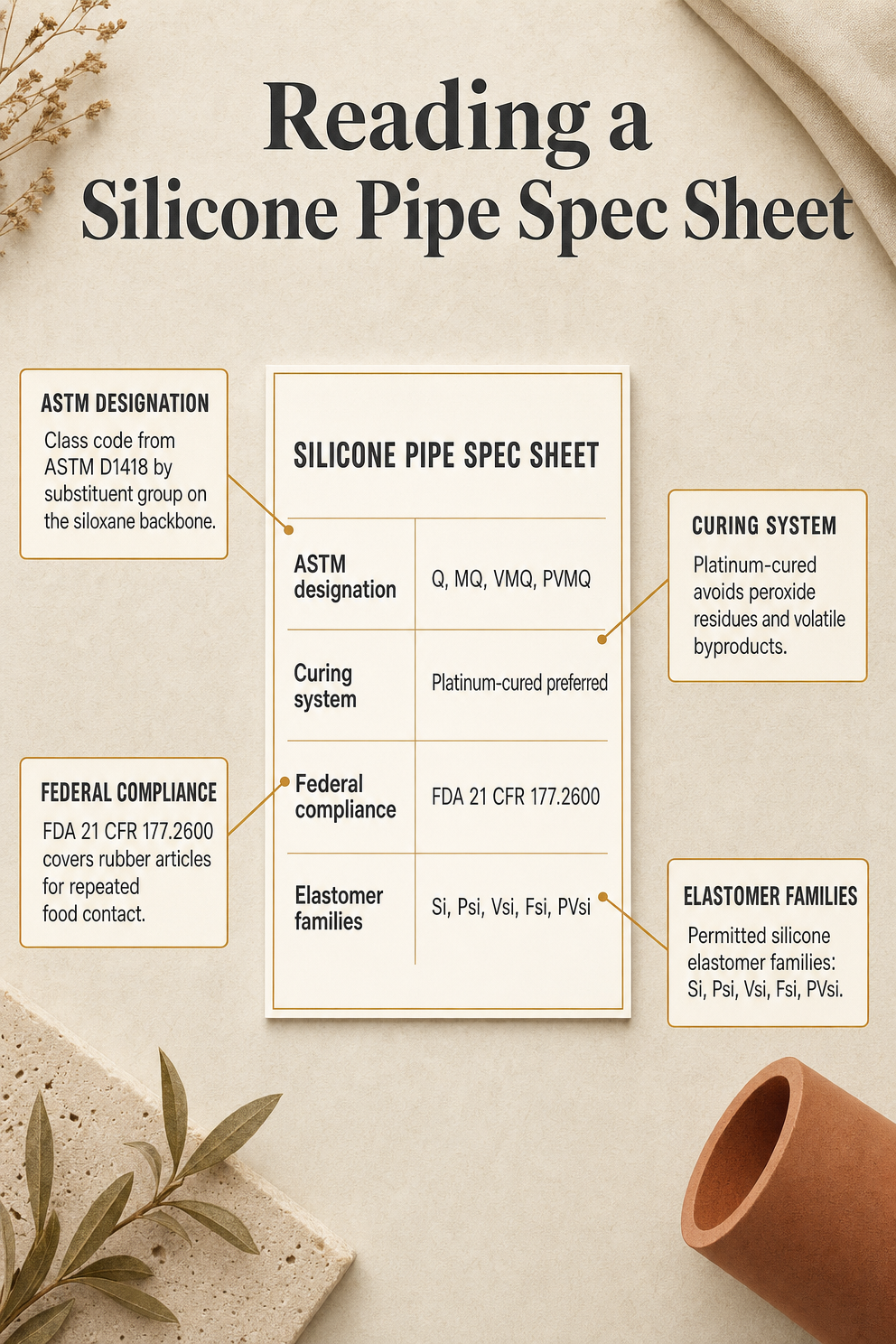
Manufacturers and material scientists classify silicone rubber under ASTM D1418 with codes such as Q, MQ, VMQ, and PVMQ. Those letters describe which substituents sit on the backbone: Q is the generic family, MQ adds methyl groups, VMQ adds vinyl, and PVMQ adds phenyl [8]. For pipe buyers, the exact code matters less than understanding that "silicone" describes a chemically distinct family, not a kind of soft plastic.
If you want a quick primer on how a pipe is actually built, our walkthrough of What Are the Parts of a Bong, Rig, or Pipe and How Do They Work? breaks down the parts and what each one does.
- Silicone rubber uses a siloxane (Si–O–Si) backbone instead of a carbon–carbon backbone [6].
- The Si–O bond is stronger than a C–C bond (~433 vs ~355 kJ/mol), which is the structural reason for silicone’s high heat and chemical stability [2].
- ASTM D1418 groups silicone rubbers into Q, MQ, VMQ, and PVMQ based on the substituents attached to the backbone [8].
- Unlike most plastics, silicone has no melting point and stays solid until it combusts [7].
What Does "Food Grade" Silicone Actually Mean?
"Food grade" is not a marketing phrase — it points to a specific U.S. federal regulation. FDA 21 CFR 177.2600 is the section of the Code of Federal Regulations that lists rubber articles intended for repeated use in contact with food, and it names several silicone elastomer families — Si, Psi, Vsi, Fsi, and PVsi — as permitted materials [1]. A silicone pipe described as food grade should be traceable to that section and to the extractables testing the rule requires.
The same regulation also frames the temperature range you can expect a compliant silicone to handle. Material data sheets published for FDA 21 CFR 177.2600 silicone typically rate the material from about −80°F to +450°F (−62°C to +232°C) for continuous use, with intermittent heat resistance up to roughly 500°F (260°C) [3]. Those numbers are part of the standard, not a guess by any one manufacturer.
"higher-purity" overlaps heavily with "food grade" because both pull from the same federal rule, but higher-purity silicone adds tighter limits on extractables and almost always uses a platinum-cured reaction. Platinum curing is an addition reaction that leaves no peroxide residues and very few volatile byproducts, which is exactly why the same platinum-cured material is preferred for hospital tubing, pharmaceutical equipment, and food-contact products [5].
If you want a wider look at how silicone compares with other pipe materials, our guide on Glass vs Silicone vs Wood vs Metal Pipes: Which Material Is Best? covers the trade-offs in plain language.
- FDA 21 CFR 177.2600 is the U.S. federal regulation that defines "food grade" silicone rubber for repeated food contact [1].
- The rule lists specific silicone elastomer families — Si, Psi, Vsi, Fsi, and PVsi — as permitted materials [1].
- Higher-purity silicone pulls from the same CFR section but usually adds tighter extractables limits and is platinum-cured [5].
- A food-grade silicone part is rated for roughly −80°F to +450°F continuous use, with intermittent peaks around 500°F [3].
How Hot Can a Silicone Pipe Get Before It Breaks Down?
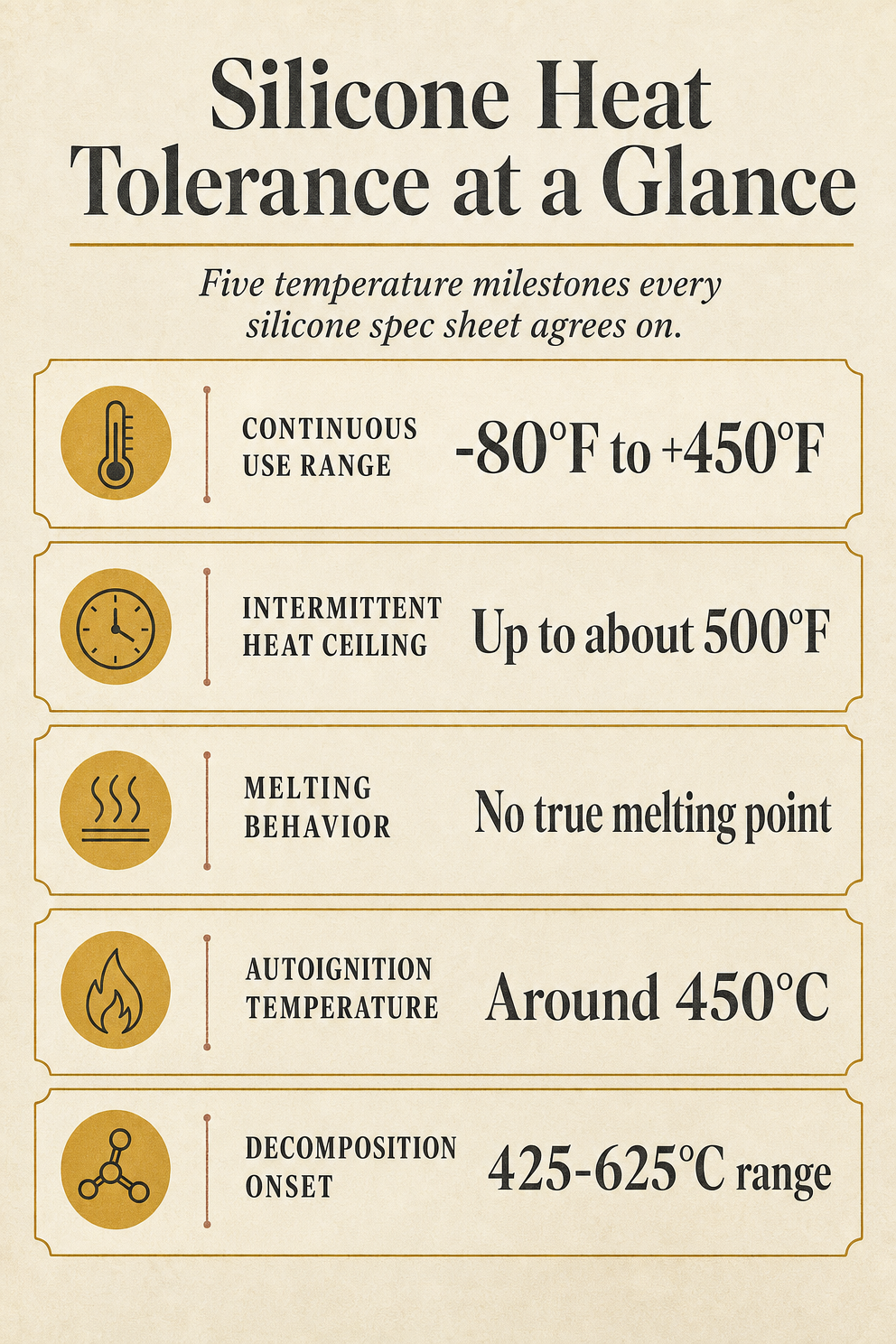
Two different temperatures matter here: the continuous-use ceiling and the point at which the material starts to break down chemically. For general-purpose food-grade silicone, the continuous-use range stretches from roughly −80°F up to about +450°F (−62°C to +232°C) [3]. Brief spikes above that — up to about 500°F (260°C) — are within the intermittent rating of most food-grade formulations [2] [3].
Above those ranges, silicone does not melt. It stays solid and eventually ignites. The standard autoignition temperature for silicone rubber is around 450°C, give or take, depending on hardness, the curing system, and any flame-retardant additives in the formulation [7]. That is the upper end of normal use, not the lower end.
Beyond autoignition, the siloxane backbone itself begins to break down. Peer-reviewed thermal analysis puts the main decomposition range of silicone rubber at 425–625°C, producing silica (SiO2), water (H2O), and carbon dioxide (CO2) above about 400°C as the siloxane chain comes apart [4]. None of that is happening during ordinary use of a pipe — a butane lighter flame sits well below these thresholds.
For background on how a different but related accessory handles heat, our explainer on What Is a Hookah and How Does It Work? is a useful comparison.
- Continuous-use range for food-grade silicone: about −80°F to +450°F (−62°C to +232°C) [3].
- Intermittent heat ceiling: up to roughly 500°F (260°C) for short exposures [2] [3].
- Autoignition temperature of silicone rubber: approximately 450°C, varying with formulation [7].
- Main thermal decomposition occurs between 425–625°C, yielding SiO2, H2O, and CO2 from the siloxane backbone [4].
- Silicone does not have a true melting point; it remains solid until combustion [7].
How Does Silicone Compare to Glass, Metal, and Wood?
Glass is the reference point most pipe buyers start from. Borosilicate glass has a very high softening temperature, does not interact chemically with anything burning in the bowl, and delivers a flavor profile that is widely treated as neutral. Its downside is mechanical: glass breaks on impact, and a drop onto a hard floor usually ends the pipe.
Metal pipes, typically stainless steel or titanium, handle heat far beyond what any lighter can produce and are nearly impossible to crack. They are heavier than silicone, can give the bowl a faint metallic taste for some users, and conduct heat fast enough that the body of the pipe warms up during a long session.
Wood sits at the other end of the spectrum from silicone in some respects. It is a natural insulator, which means the outside of the pipe stays cool, but it is also combustible, swells and shrinks with humidity, and typically needs more careful maintenance than silicone or glass. Wood is a material chosen for feel and ritual more than for thermal headroom.
Silicone’s distinctive combination is the wide temperature headroom plus mechanical forgiveness. It can take the heat a normal lighter delivers, will not shatter if it slides off a couch, and is light enough to carry in a bag without noticing it. Our Silicone Hand Pipes category page collects the silicone hand pipes currently in our catalog if you want to compare shapes and sizes side by side.
- Borosilicate glass: very high heat tolerance, neutral taste, but shatters on impact.
- Stainless steel and titanium: extreme heat tolerance, durable, heavier, and can run hot in the hand.
- Wood: cool to the touch, but combustible and humidity-sensitive, so it needs more care.
- Silicone: wide rated temperature range, no melting point, and forgiving on drops [3] [7].
- All four materials fall under the same ASTM-style classification logic that distinguishes silicone as its own elastomer family rather than a plastic [8].
| Material | Heat tolerance | Failure mode | Weight | Taste neutrality |
|---|---|---|---|---|
| Silicone | Continuous to ~450°F; intermittent ~500°F | Will not shatter; surface can mark | Light | Neutral to most users |
| Borosilicate glass | Very high softening point | Shatters on hard impact | Medium | Widely treated as neutral |
| Stainless steel / titanium | Far above any lighter flame | Dents rather than cracks | Heavier | Can read faintly metallic to some users |
| Wood | Combustible at lower temperatures | Swells, cracks, chars with neglect | Light to medium | Adds wood flavor to the bowl |
How Can You Tell If a Silicone Pipe Is High Quality?
The single biggest quality signal is the curing system. Platinum-cured silicone uses an addition reaction that produces no peroxide residues and very few volatile byproducts, and that is the same family of silicone preferred for hospital tubing, pharmaceutical equipment, and food-contact products [5]. Peroxide-cured silicone uses a free-radical reaction that can leave small peroxide residues, and it shows up more often in general industrial grades than in pipes you want near heat.
The second signal is paperwork. A genuinely food-grade silicone pipe should reference FDA 21 CFR 177.2600 somewhere on the packaging or product page, and that reference should match the silicone elastomer family the part is actually molded from — typically one of Si, Psi, Vsi, Fsi, or PVsi [1]. If a product cannot point to the CFR section, it is hard to verify the "food grade" label.
In-hand clues matter too. Quality silicone has a smooth, even finish with no tackiness, no strong chemical smell out of the package, and consistent hardness across the whole part. Lower-grade silicone often feels oily, smells sharp, and varies in thickness from one area of the pipe to the next. ASTM D1418 designations like MQ, VMQ, and PVMQ describe the chemistry behind that finish [8].
If you want a starting point for browsing, our Silicone Bongs category collects the silicone bongs in our current catalog.
- Look for platinum-cured silicone, the same curing system used in hospital and food-contact products [5].
- Confirm the product references FDA 21 CFR 177.2600 as the governing standard [1].
- Match the labeled standard to a recognized elastomer family: Si, Psi, Vsi, Fsi, or PVsi [1].
- Check the finish and feel: smooth, even, no strong odor, consistent hardness across the part.
- Look for ASTM D1418 chemistry cues such as MQ, VMQ, or PVMQ in any spec sheet you can find [8].
How Should You Clean and Store a Silicone Pipe?
Silicone is forgiving to clean because it tolerates a wide temperature range and does not react with most common cleaners. Warm water, mild dish soap, and a soft bottle brush handle routine residue. For tougher buildup, an isopropyl alcohol soak works well because silicone does not dissolve or swell in the same way some plastics do, and the part can be rinsed and air-dried afterward.
What you want to avoid is anything that pushes the pipe past its rated temperature ceiling. Dishwashers can run hotter than the roughly 500°F intermittent limit on some cycles, and leaving a silicone pipe on a stovetop or near a direct heating element is the kind of exposure that has no upside. Sticking to warm — not boiling — water and hand drying is the safer routine [3] [2].
Storage is simpler than people expect. The continuous-use ceiling of about +450°F is well above anything a closed car interior reaches on a normal summer day, so heat is rarely a real concern. Prolonged direct sunlight is a different matter: UV can degrade the surface of some silicone formulations over time, so a drawer, a pouch, or a small case is the conservative choice. Our Storage category has the storage options we carry if you want a dedicated spot for it.
Mechanical care is the easiest piece. Silicone does not shatter if it rolls off a table, and a quick rinse is usually enough to keep it in good shape for the next session.
- Clean with warm water, mild soap, and a soft brush for routine use.
- Use an isopropyl alcohol soak for heavier residue; silicone tolerates it without swelling.
- Avoid dishwashers and stovetop heat, which can exceed the intermittent ceiling of about 500°F [3].
- Store out of direct sunlight to limit long-term UV surface degradation [7].
- Keep the pipe away from open flames and heating elements to stay inside the continuous-use range of about −80°F to +450°F [3].
Frequently Asked Questions
Do silicone pipes contain plastic?
Silicone is technically a rubber, not a classic carbon-backbone plastic. It is built around a repeating siloxane (Si–O–Si) unit with organic side groups, which is why it is classified under ASTM D1418 as its own family of elastomers (Q, MQ, VMQ, PVMQ) rather than alongside polyethylene, polystyrene, or PVC [6] [8].
Is food grade silicone the same as higher-purity silicone?
Both are governed by FDA 21 CFR 177.2600 for food-contact rubber articles. Higher-purity silicone adds tighter limits on extractables and is typically platinum-cured so the addition reaction leaves no peroxide residues, which is why the same platinum-cured material is preferred for hospital, pharmaceutical, and food-contact uses [1] [5].
Can a silicone pipe melt?
Silicone rubber has no melting point and stays solid until combustion. General-purpose food-grade silicone is rated for continuous use from about −80°F to +450°F (−62°C to +232°C) with intermittent heat resistance up to roughly 500°F (260°C), and the standard autoignition temperature is around 450°C depending on the formulation [3] [7].
What is the difference between platinum-cured and peroxide-cured silicone?
Platinum-cured silicone uses an addition reaction that produces no peroxide residues and few volatile byproducts, which is why it is the standard for hospital, pharmaceutical, and food-contact products. Peroxide-cured silicone uses a free-radical reaction that can leave small peroxide residues, and is more common in general industrial grades [5].
Will a silicone pipe degrade in a hot car or in sunlight?
Silicone’s rated continuous-use ceiling of about +450°F (≈232°C) is well above anything a closed car interior reaches, so normal summer heat is not a melting concern. Prolonged UV exposure can, however, degrade the surface of some silicone formulations over time, which is why storing any silicone pipe out of direct sunlight is the conservative choice [3] [7].
So, Is a Silicone Pipe a Reasonable Choice?
Silicone pipes sit in an unusual spot among smoking accessories. The material is a real elastomer with its own backbone chemistry, its own federal regulation, and a temperature profile that leaves everyday lighter heat far behind. That is not the same as a guarantee about any specific product on a shelf, but it is the underlying reason silicone has earned a place in kitchens, hospitals, and pipe catalogs alike.
The practical checklist is short: look for a pipe that points to FDA 21 CFR 177.2600, names a recognized elastomer family, and notes a platinum-cured process. Handle it the way you would handle any heat-rated accessory — keep it within the rated temperature range, clean it with mild methods, and store it out of direct sunlight. Do those things and a quality silicone pipe should hold up for a long time.
Treehouse Lifestyle carries silicone hand pipes and bongs alongside glass, metal, and wood options, with free shipping on orders $150+ so you can compare materials without the rest of the math getting in the way.
Sources
- U.S. Food and Drug Administration / National Archives (Code of Federal Regulations): 21 CFR 177.2600 — Rubber articles intended for repeated use
- Shin-Etsu Chemical Co., Ltd.: Characteristic properties of Silicone Rubber Compounds (technical catalog)
- ElastaPro (silicone sheet and compound manufacturer): FDA 21 CFR 177.2600 Silicone Sheet & Compound — Material Capabilities
- National Institutes of Health — PubMed Central (peer-reviewed: Materials, MDPI): Thermal Decomposition and Ceramifying Process of Ceramifiable Silicone Rubber Composite with Hydrated Zinc Borate
- H.M. Royal (silicone materials distributor): Platinum Cured Silicone: Benefits & Applications
- Wikipedia (community-edited encyclopedia; cited reference-supported): Silicone — Structure and Properties
- Jehbco Silicones (silicone rubber manufacturer): Improving Extreme Temperature Degradation of Silicone Rubber Using Flame Retardant Additives
- AZoM — Materials science information network: Silicone Rubber (properties, classifications, ASTM D1418)