

A hookah is a single- or multi-stemmed water pipe used to heat flavored tobacco with charcoal, then pass the resulting smoke through a water-filled base before it reaches a hose and mouthpiece. The same instrument goes by many regional names — shisha, narghile, arghile, hubble-bubble, goza, qalyan, huqqa, and waterpipe all describe closely related devices, and a typical modern hookah is built from six primary parts: a bowl, stem, base, tray, hose, and the grommets that seal the joints.
Drawing on the mouthpiece pulls fresh air past the charcoal, through the tobacco, down the stem, and bubbles the smoke up through water before it reaches you. The basic mechanism has not changed much for centuries, even as the materials and finishes have gotten more polished.
This guide walks through every part, the step-by-step mechanics, the different types of hookahs on the market, the charcoal and heat-management options, and a short history of how the device ended up on the modern shelf.
What Is a Hookah and What Are Its Other Names?
At its simplest, a hookah is a water pipe. You put flavored tobacco in a bowl at the top, light charcoal over the bowl, draw on a hose, and the smoke travels down through the stem, bubbles up through water in the base, and reaches you through the hose and mouthpiece. The water step is what sets a hookah apart from a dry pipe — it cools the smoke and gives the device its characteristic bubbling sound.
Because the hookah traveled from India through Persia, the Ottoman Empire, and into the Middle East and North Africa, the same instrument picked up different names in each region. Most retailers today use a handful of these terms interchangeably, and the rest of this article will too. The CDC uses the umbrella term "waterpipe" to cover the whole family, which is a clean way to talk about the category without picking sides on regional vocabulary [1] [6]. If you want a broader look at how the wider smoking-accessory world talks about its own parts, the What Are the Names of All the Parts on a Bong? glossary is a useful companion read.
- Hookah — the most common English term, used widely in the United States and across South Asia.
- Shisha — popular in the Middle East and North Africa; the word also refers to the flavored tobacco that goes in the bowl.
- Narghile (or nargile) — common across Turkey, the Levant, and parts of the former Ottoman world.
- Arghile — a variant spelling of narghile found in Persian-influenced regions.
- Hubble-bubble — an English term inspired by the bubbling sound the water makes during a draw.
- Goza — the term used for a smaller, traditional form of the device in parts of South Asia.
- Qalyan and huqqa — older names still heard in India, Iran, and parts of Central Asia [1] [6].
What Are the Main Parts of a Hookah?
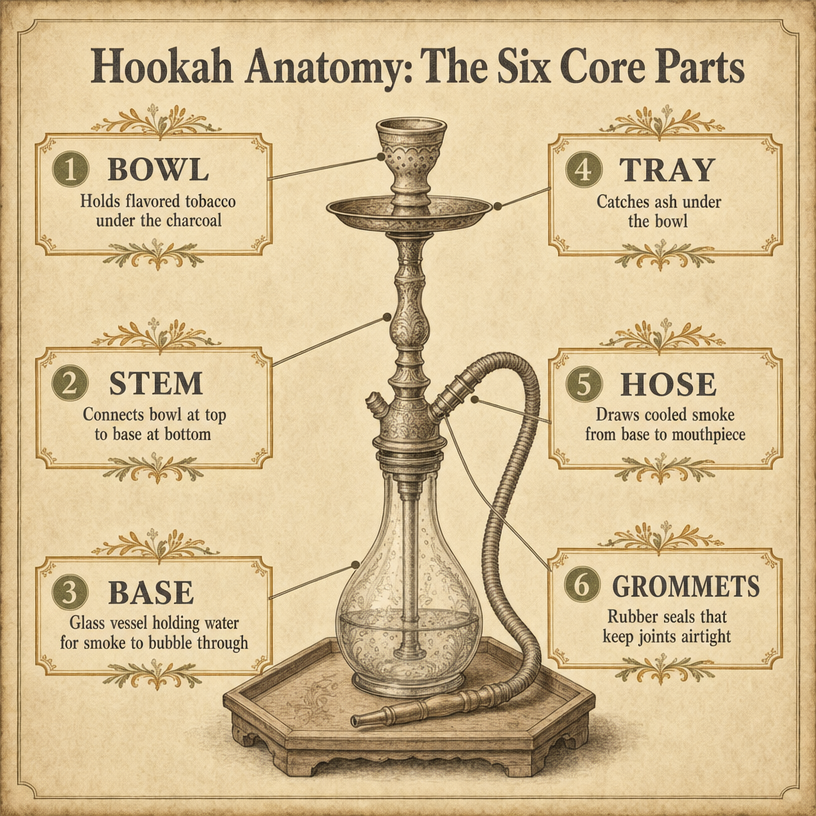
A typical modern hookah is built from six primary components, plus a few small but important extras that make the system work. Sources sometimes split the parts list differently — some count thirteen pieces, others count six, and the names of the smaller pieces shift between retailers — but every version of the anatomy describes the same airflow path. The numbered, six-piece list below is the simplest way to picture the device before getting into the smaller details [2] [3] [5] [7].
Two extra pieces you’ll see on better-made hookahs are a purge (or blow-off) valve and an optional diffuser. The purge valve lets you blow stale smoke out of the base between draws, and a diffuser is a small tip on the bottom of the downstem that breaks the bubbles up for a quieter draw. If you’re curious how water pipes compare across the wider accessory world, the What Is a Percolator Bong and How Does It Work? guide to percolator bongs walks through a related internal structure you may recognize.
Together, the parts sit on top of each other in a stack: bowl on top of stem, stem on top of base, hose ports branching off the side, and a tray under the bowl to catch ash. Grommets — small rubber or silicone rings — sit at every joint where two parts meet.
- Bowl — the cup at the very top that holds the flavored tobacco and sits under the charcoal.
- Stem — the metal shaft that connects the bowl at the top to the base at the bottom; the lower section that dips into the water is sometimes called the downstem.
- Base — the glass vessel at the bottom that holds the water and gives the hookah its weight.
- Tray — the plate that sits under the bowl to catch ash and falling charcoal.
- Hose — the long flexible tube with a mouthpiece on the end that you actually draw through.
- Grommets — rubber or silicone rings that seal the bowl-stem, stem-base, and hose-port joints so the suction does not leak.
- Purge valve — a small valve on the side of the stem that lets you blow stale smoke out of the base.
- Diffuser (optional) — a small attachable tip at the bottom of the downstem that breaks bubbles up for a quieter draw [2] [3] [7].
How Does a Hookah Work Step by Step?
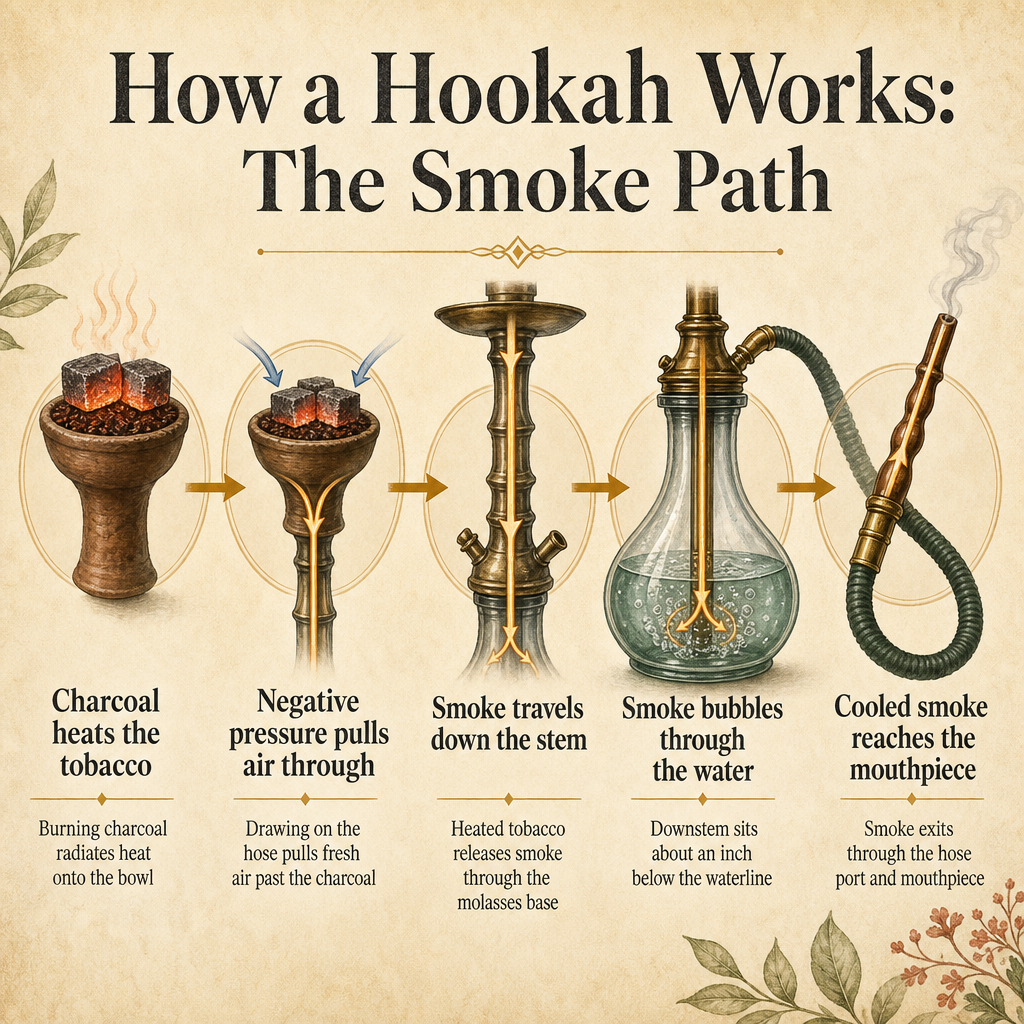
A hookah looks complex, but the operating principle is the same one that powers every pipe: heat, airflow, and negative pressure. When you draw on the mouthpiece, you create a small vacuum inside the hose and stem. That vacuum pulls fresh air in through the top of the bowl, past the lit charcoal, and down through the tobacco. The heated tobacco releases smoke from its molasses base, and the smoke then travels down the stem, bubbles up through the water in the base, and reaches you through the hose and mouthpiece. If you want a deeper walk-through of hookah mechanics from setup to draw, the What Is a Hookah and How Does It Work? guide to complete hookah setups covers the same airflow path in more detail [2] [8].
The water step does two visible things. First, it cools the smoke by dropping its temperature as it bubbles through the liquid, which is why a hookah draw feels cooler than a dry-pipe draw. Second, it makes the device bubble audibly when you purge — that gurgling sound is a useful cue that the system is sealed and the water level is right. The downstem should sit roughly one inch below the waterline; too shallow and the smoke skips the water, too deep and the draw becomes hard.
Because the entire system depends on airtight seals, grommets do the quiet but essential work of keeping suction where it belongs. A single missing or cracked grommet at the bowl or the hose port will collapse the draw and the hookah simply will not pull correctly [3] [5].
- Charcoal heats the tobacco — burning charcoal sits on top of the bowl and radiates heat down into the flavored tobacco below.
- Negative pressure pulls fresh air — drawing on the mouthpiece creates suction that pulls new air down through the charcoal and the tobacco.
- Smoke travels down the stem — the heated tobacco releases smoke, which flows down through the stem toward the base.
- Smoke bubbles up through the water — the downstem sits about one inch below the waterline, so smoke has to bubble up through the liquid.
- Cooled smoke reaches the mouthpiece — smoke exits the base, enters the hose port, and travels through the hose to the mouthpiece.
- Purge valve clears stale smoke — blowing gently into the hose lifts a small ball inside the purge valve and pushes old smoke out of the base [2] [3] [5] [8].
What Kinds of Hookahs Are There and How Do They Differ?
Three broad shapes cover most of what you’ll see on the market: traditional single-hose hookahs, multi-hose hookahs designed for sharing, and modern hybrid designs that try to combine the best of both. They all work on the same airflow principle, but the differences in internal airway diameter, diffuser design, and hose count change how the hookah feels to draw from. If you already browse the broader water-pipe family, this is the same kind of choice tree you see when picking between single- and multi-perc setups or between straight-tube and beaker shapes — the Straight Tube Bongs shop category for straight-tube bongs is a useful reference point for how airflow differences translate to feel [4] [8].
Traditional single-hose hookahs are the most common starter design. They have one hose port and one draw path, which makes the suction simple to manage. Multi-hose hookahs add two or more hose ports to the same base, so several people can draw at the same time. The catch is that older multi-hose designs share the same internal airway, which means the draw resistance shifts depending on how many people are pulling at once. Modern hybrid designs fix that by keeping a single internal airway while adding extra exterior hose ports, so each person gets the same consistent draw regardless of how many hoses are attached.
Materials also matter. Stainless steel and brass stems are heavier, more durable, and resist corrosion; aluminum and acrylic stems weigh less and cost less. Glass bases are universal because glass is easy to clean and does not interact with any residue from the water. Tray materials range from simple plastic to metal and even wood, and the choice usually comes down to aesthetics rather than performance.
- Traditional single-hose — one hose port and one draw path; the simplest design and the easiest to seal.
- Multi-hose traditional — two or more hose ports sharing one internal airway; great for groups but draw resistance shifts as more people pull.
- Multi-hose hybrid — multiple exterior hose ports with one shared internal airway behind them, so each person gets a consistent draw.
- Stem materials — stainless steel and brass for durability; aluminum and acrylic for reduced weight and lower cost.
- Base materials — glass is the standard because it is easy to clean and non-reactive with water residues [4] [8].
What Heat Sources Can You Use in a Hookah?
The charcoal you choose has a bigger effect on a hookah session than almost any other single decision. There are two main camps: natural charcoal, most often compressed coconut shell, and quick-light charcoal, which is impregnated with an ignition accelerant to make it light from a regular flame source or stove. Natural charcoal leaves a faint ash and lasts longer, making it the preferred option for longer sessions, while quick-light charcoal is more convenient for a fast setup and is often the first thing a new owner reaches for. If you want to pick up a starter pack of natural coconut coals alongside your setup, the Edie Parker Cones listing is a common starting point in the Treehouse catalog [3] [4] [7].
Heat management is the second decision you’ll make. Traditional setups use perforated foil stretched over the bowl with the charcoal placed on top of the foil; this is the simplest option and works fine for casual use. Heat management devices, or HMDs, are metal accessories that sit directly on top of the bowl and replace foil. They regulate how much heat reaches the tobacco, which makes sessions more consistent and longer-lasting. HMDs are optional, not required — a foil-and-natural-charcoal setup will still work — but they are a popular upgrade.
Whatever you choose, the underlying rule is the same: the goal is to heat the tobacco enough to release smoke from its molasses base without scorching it. With foil or an HMD, the tobacco dries out and releases smoke steadily; without enough indirect heat, the bowl goes out; with too much direct heat, the tobacco chars and the flavor turns harsh.
- Natural coconut charcoal — produces a faint ash, lasts longer, and is the go-to for longer sessions.
- Quick-light charcoal — impregnated with ignition accelerant, ignites fast from a regular flame source, burns hotter and shorter.
- Foil heat management — perforated foil stretched over the bowl with charcoal placed on top; the simplest traditional method.
- Heat management device (HMD) — an optional metal accessory that replaces foil and regulates heat more precisely.
- Tobacco heat range — aim for steady smoke release from the molasses base; too little heat and the bowl goes out, too much and the tobacco scorches [3] [4] [7].
Where Did the Hookah Come From?
The recognizable hookah most likely developed during the 16th century, as tobacco use spread through Mughal India and Safavid Persia. The widely repeated origin story credits Hakim Abul-Fath Gilani, a Persian healer at the court of the Mughal Emperor Akbar, with inventing a water-based smoking system, possibly inspired by a marble that fell into a cup and made the liquid bubble. No surviving record confirms a single inventor, exact location, or precise date, so this story is best treated as a popular tradition rather than a verified historical fact [1] [6] [8].
From the Indian subcontinent and Persia the device spread through the Ottoman Empire and into the Middle East and North Africa, where regional vocabularies diverged over time. A device called a qalyan or huqqa in India became a nargile in Turkey, a shisha in Egypt, and a hookah (from the Arabic huqqa) elsewhere. By the 17th century the basic form was already recognizable as the instrument we know today, with a bowl, stem, water base, and flexible tube for drawing.
The modern commercial hookah industry took off in the late 20th century as the device spread into Western markets. Today’s market includes both traditional hand-built designs and modern machined-construction models with stainless steel stems, anodized finishes, and replaceable parts — but the basic airflow path, and the bubbling water in the base, have not changed in roughly 400 years.
- 16th-century origins — most likely developed in Mughal India and Safavid Persia as tobacco use spread across the region.
- Popular origin story — Hakim Abul-Fath Gilani, a Persian healer at the court of Emperor Akbar, is credited with inventing the water-based system.
- Ottoman spread — the device moved through the Ottoman Empire and into the Middle East and North Africa over the following centuries.
- Regional vocabulary — qalyan, huqqa, nargile, shisha, hookah, goza, and hubble-bubble all describe closely related devices.
- Modern commercial era — late-20th-century Western demand led to machine-made hookahs with stainless steel stems and replaceable parts [1] [6] [8].
Frequently Asked Questions
Is a hookah the same thing as a shisha or a waterpipe?
How much water should I put in a hookah base?
What is a heat management device (HMD) and is it required?
What’s the difference between a single-hose and a multi-hose hookah?
Single-hose hookahs have one hose port and one draw path; multi-hose versions add extra hose ports so several people can draw from the same base at the same time. Modern hybrid designs combine the internal airflow of a single-hose with multiple exterior hose ports, so the draw resistance stays consistent regardless of how many people are sharing [4] [8].
What kinds of bowls can a hookah have?
So What Should You Remember About How a Hookah Works?
A hookah is a water pipe, and the water pipe has been doing the same thing for centuries: heat flavored tobacco with charcoal, bubble the smoke through water, and deliver it through a hose. The six core parts — bowl, stem, base, tray, hose, and grommets — handle that job in every modern design, and the only meaningful differences between hookahs are how many hoses they have, what the stem and base are made of, and how the heat is managed on top of the bowl.
When you shop, the practical decisions are simple: pick a stem material you like, decide between single-hose and multi-hose based on whether you usually smoke alone or share, choose natural or quick-light charcoal based on how often you want to set up, and decide whether an HMD is worth adding to your setup. Everything else is finish and aesthetics.
Treehouse ships hookah gear, charcoal, and accessories with free shipping on orders $150+, so it is easy to put together a full starter setup — bowl, stem, base, hose, charcoal, and a basic HMD — in a single order.
Sources
- Wikipedia (citing peer-reviewed and academic sources): Hookah
- HOOB Hookahs: What Is a Hookah Made Of? Parts, Anatomy & How It Works
- Fumari Inc.: How To Use A Hookah
- Kaloud Inc.: How Does A Hookah Work? A Beginner’s Guide
- Moze Shisha: How does a hookah work? Everything you need to know!
- Centers for Disease Control and Prevention (U.S. government): Hookahs | Smoking and Tobacco Use
- ShishaFreak: Hookah Parts: A Quick Rundown of Each Major Component and Its Function
- The Hookah Lab: When Was Hookah Invented? Origins and History Explained