

A complete guide to hookah pipes, tobacco and tobacco-free alternatives, setup, and maintenance
This hookah guide covers everything you need to know about setting up a hookah, choosing between tobacco and tobacco-free shisha, picking the right charcoal, and keeping your hookah in good working order for years of use. A hookah (also called a shisha pipe or waterpipe) vaporizes flavored tobacco called mu’assel or tobacco-free molasses and passes the smoke through water before inhalation. The hookah originated in 16th-century India and spread through Persia to the Ottoman Empire. Modern versions use stainless steel, aluminium, and silicone — materials that resist corrosion and odors better than traditional brass or copper. This guide walks you through every step from unboxing to your first session.
What Are the Main Parts of a Hookah and What Does Each Do?
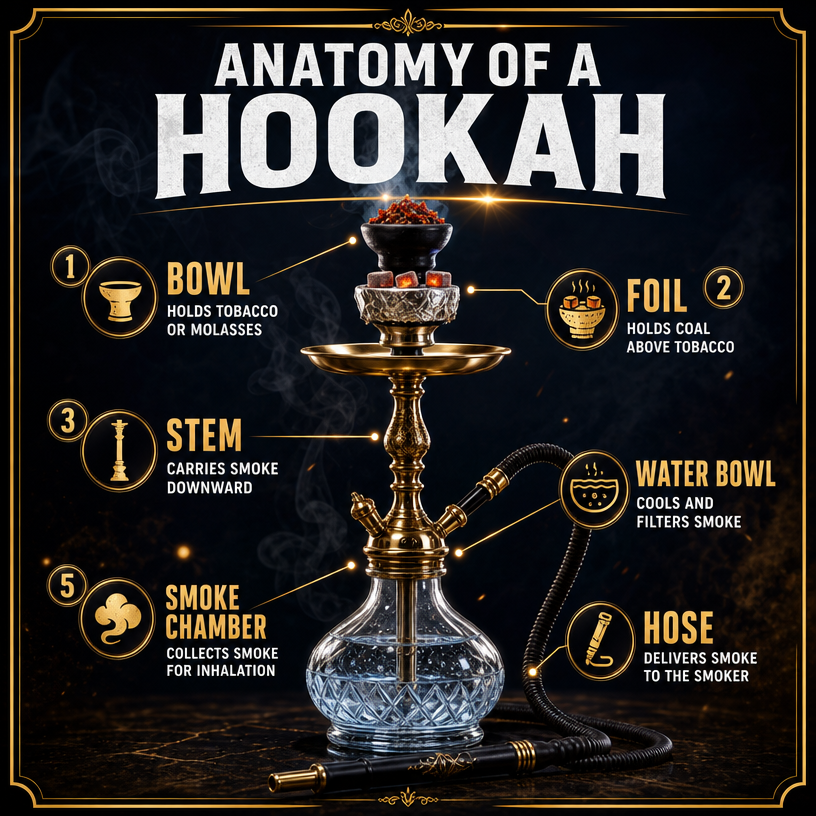
Every hookah shares the same basic components regardless of size or material. Knowing what each part does makes setup, use, and cleaning much simpler.
- **Bowl** — holds tobacco or molasses at the top of the unit
- **Foil or screen** — holds coal above the tobacco
- **Stem** — carries smoke from bowl to water
- **Diffuser** — breaks smoke into bubbles for a quieter draw
- **Water bowl (base)** — holds water that cools the smoke
- **Smoke chamber** — collects cooled smoke for inhalation
- **Hose** — delivers smoke to the smoker
The bowl sits at the very top and holds the tobacco or molasses. It is covered with perforated tin foil or a metal screen, with coal placed on top. The bowl is the hottest part during a session, reaching around 130°C on the tobacco surface. [3] Shop <a href="https://wordpress-production-3a6d.up.railway.app/shop/hookahs/hookah-hoses">Hookah Hoses</a> and <a href="https://wordpress-production-3a6d.up.railway.app/shop/hookahs/hookah-bowls">Hookah Bowls</a> at Treehouse Lifestyle.
The foil or screen holds coal above the tobacco and prevents ash from falling into the bowl below. Perforated foil is the traditional choice, while metal screens have become popular for their convenience and reusability.
The stem is the vertical pipe that carries smoke downward from the bowl to the water. Modern stainless steel stems are designed for durability and easy cleaning. Many include a diffuser at the bottom, which breaks smoke into smaller bubbles for a quieter, smoother draw. [3]
The water bowl (or glass base) holds water that cools and filters smoke. Most hold 400–700 milliliters of water. Enough water should submerge the bottom 1–2 inches of the stem without splashing up into the hose. [1]
The smoke chamber is the middle section between the base and the hose port. This is where smoke collects after passing through the water, waiting to be drawn up through the hose.
The hose delivers smoke from the smoke chamber to the smoker. Modern hookahs use silicone rubber hoses, which are washable and do not retain odors the way traditional leather and wire hoses do. [4]
The tray sits below the bowl and catches ash that falls from the coal during heating.
Browse Hookah Accessories to explore related options.
Browse Hookah Bases to explore related options.
How Does a Hookah Actually Work?
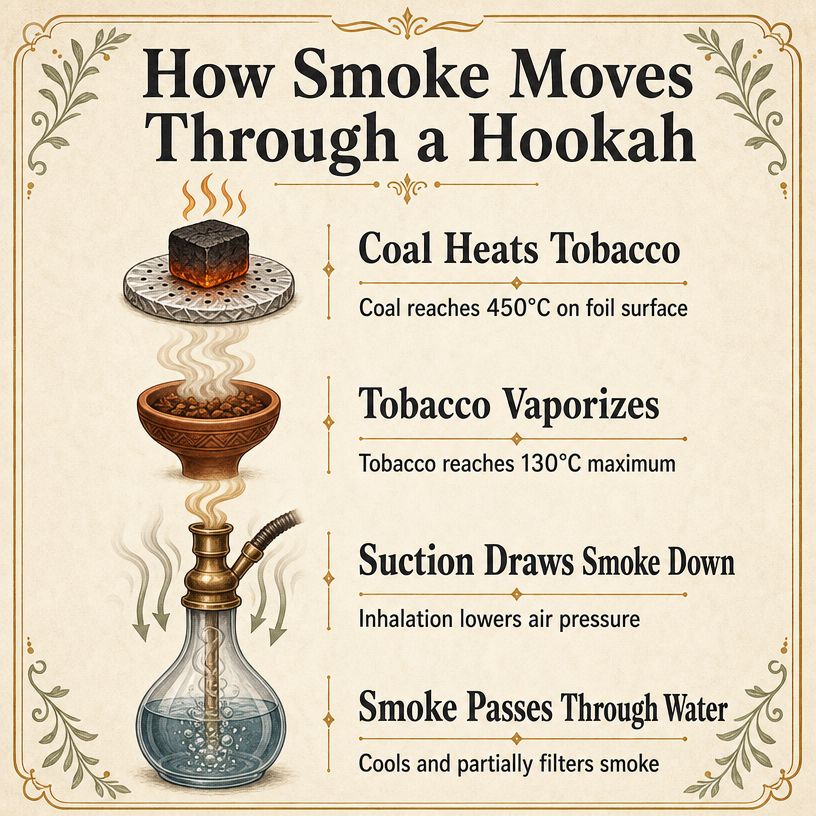
The hookah works by using air pressure differences to pull smoke through water before it reaches the smoker. Understanding this mechanism helps you get better results from every session.
- Coal placed on foil reaches 450°C and heats the tobacco to 130°C
- Tobacco releases smoke through distillation, not combustion
- Inhaling through the hose reduces pressure in the water bowl
- Suction draws smoke down through the stem into the water
- Smoke bubbles through the water, cooling as it rises
- Cooled smoke collects in the smoke chamber and is inhaled
Coal placed on the foil above the bowl reaches approximately 450°C, while the tobacco or molasses below heats to around 130°C — far below the 900°C produced by burning cigarettes. [3] This lower temperature means the tobacco heats rather than burns, releasing smoke through distillation rather than combustion. [3] Compare this to <a href="https://wordpress-production-3a6d.up.railway.app/blog/complete-guide-bongs-water-pipes">What Is a Bong and How Does It Work?</a> for a similar mechanism in bongs.
When you inhale through the hose, you reduce air pressure inside the water bowl’s headspace. This pressure difference pulls smoke down through the stem, where it bubbles through the water. [3]
The bubbling serves a real purpose. Each bubble exposes fresh smoke to the water, allowing heat to dissipate and some water-soluble compounds to be absorbed. The smoke that rises into the smoke chamber is noticeably cooler than it was leaving the bowl. [1]
From the smoke chamber, cooled vapor travels up through the hose and into your mouth. Longer, slower inhalations produce a steadier smoke flow than short, rapid puffs.
If your hookah is not producing much smoke, the issue is usually not enough water, a clogged stem, or a hose that needs cleaning. Regular maintenance — covered in the section on <a href="https://wordpress-production-3a6d.up.railway.app/blog/complete-guide-cleaning-smoking-accessories">The Complete Guide to Cleaning Smoking Accessories</a> — prevents most of these problems.
Read What Is a Bong and How Does It Work? for more detail.
What Types of Hookahs Are Available?
Hookahs come in a wide range of sizes, materials, and configurations. The right choice depends on how you plan to use it, how much space you have, and how often you need to move it. Browse our full selection of <a href="https://wordpress-production-3a6d.up.railway.app/shop/hookahs">Hookahs</a> at Treehouse Lifestyle.
- **Stainless steel hookahs** — durable, rust-resistant, easy to clean
- **Brass and copper hookahs** — traditional look, heavier, require more maintenance
- **Portable hookahs** — compact, travel-friendly, solo or small-group use
- **Medium home hookahs** — most common size, good balance of capacity and usability
- **Large performance hookahs** — maximum smoke volume for group sessions
Material is one of the most important distinctions. Traditional hookahs were made from brass, copper, and other handworked metals. Modern hookahs increasingly use stainless steel and aluminium, which resist corrosion, eliminate lingering odors, and last longer without the patina buildup that affects copper and brass. Silicone rubber has replaced leather and wire in hose construction, making hoses far easier to clean. [4]
| Material | Durability | Maintenance | Best For |
|---|---|---|---|
| Stainless steel | High | Low | Everyday home use |
| Aluminium | Medium | Low | Portable and travel |
| Brass / Copper | Medium | High | Traditional aesthetic |
| Silicone hose | High | Very low | Easy cleaning, no odor retention |
What Are the Steps to Set Up a Hookah Correctly?
A properly set up hookah produces better smoke, requires less attention during the session, and is easier to clean afterward. Follow these steps in order every time you set up.
- Choose a flat, stable surface with enough clearance above for the hose and enough room around the base to access all sides.
- Fill the water bowl with enough cool water (or ice water for a cooler smoke) to submerge the bottom 1 to 2 inches of the stem. Cold water produces a noticeably cooler smoke. [1]
- Assemble the hookah by inserting the stem into the water bowl and tightening any seal. Make sure the connection is snug but not over-tightened.
- Attach the hose to the hose port on the smoke chamber. Plug any unused hose ports with the provided stoppers so air does not leak during inhalation.
- Place the bowl on top of the stem, ensuring it sits securely. Leave a small gap between the tobacco surface and the foil so the coal has room to sit without touching the tobacco directly.
- Add your tobacco or molasses to the bowl, filling it to the top without packing it down. Fluffier tobacco heats more evenly.
- Cover the bowl with perforated foil (or place a metal screen on a screen-style bowl). Stretch the foil tight and make small holes throughout using a poker or tobacco poking tool.
- Place your charcoal on the foil and light it, or use a charcoal burner to pre-heat it. Start with two small pieces on opposite sides of the bowl to promote even heating. Allow the coal to ash over fully before you begin inhaling — this usually takes 3 to 5 minutes. [3]
- Begin inhaling slowly to draw heat through the bowl. Watch for smoke to start flowing within the first minute. If smoke is thin or absent, tap the coal gently or add another piece.
What Is the Difference Between Tobacco Shisha and Tobacco-Free Alternatives?
The two main categories of hookah smoking products are tobacco-based mu’assel and tobacco-free herbal molasses. They differ in ingredients, burn characteristics, smoke profile, and regulatory status.
- **Mu’assel (tobacco shisha)** — contains tobacco leaf, produces nicotine, traditional flavor and throat hit
- **Tumbak** — pure unflavored tobacco burned with charcoal, stronger tobacco presence, traditional South Asian style
- **Herbal tobacco-free shisha** — molasses and glycerin base with flavorings, no tobacco or nicotine
- **Burn behavior** — tobacco mu’assel heats at lower temperatures than burning cigarettes; herbal alternatives vaporize at similarly low temperatures
| Feature | Tobacco Mu’assel | Tobacco-Free Herbal |
|---|---|---|
| Contains tobacco | Yes | No |
| Contains nicotine | Yes | No |
| Burn method | Distillation at ~130°C | Vaporization at low heat |
| Traditional use | Mu’assel flavors (fruit, mint, spice) | Settings with tobacco restrictions |
| Flavor profile | Throat hit + tobacco base | Flavor-focused, no tobacco taste |
What Types of Hookah Charcoal Should I Use?
Charcoal choice affects flavor, burn time, and overall session quality. The three main types are coconut charcoal, quick-light charcoal, and wood charcoal — each with distinct characteristics. Explore <a href="https://wordpress-production-3a6d.up.railway.app/shop/hookahs/hookah-charcoal">Hookah Charcoal</a> at Treehouse Lifestyle.
- **Coconut charcoal** — longest burn, cleanest flavor, no odor, additive-free, requires dedicated burner
- **Quick-light charcoal** — lights instantly with flame, contains chemical accelerant, shorter burn, possible taste issues
- **Wood (lumpwood) charcoal** — natural hardwood, hot fast burn, quality varies, more ash
| Charcoal Type | Burn Time | Flavor Impact | Lighting Method | Additives |
|---|---|---|---|---|
| Coconut charcoal | Longest | Cleanest, no taste | Requires burner | None |
| Quick-light charcoal | Short | Possible chemical taste | Instant with flame | Chemical accelerant |
| Wood (lumpwood) | Medium to short | Varies by wood quality | Requires burner | None |
How Do I Clean and Maintain a Hookah?
Regular cleaning is the single most important thing you can do to keep your hookah producing good-tasting smoke. Residue buildup affects flavor, and organic material left in the stem or hose can become a source of odor and bacteria. For more detail, see our guide to <a href="https://wordpress-production-3a6d.up.railway.app/blog/complete-guide-cleaning-smoking-accessories">The Complete Guide to Cleaning Smoking Accessories</a>.
- Disassemble all components — remove the bowl, stem, hose, and any diffuser or accessories.
- Soak removable parts in warm water with a dedicated hookah cleaning solution, lemon juice, or white vinegar for 15 to 30 minutes.
- Scrub the stem using a long brush. Run warm water through it several times until the water runs clear.
- Clean the hose by running warm soapy water through the entire length, then rinse thoroughly and hang to dry completely. Silicone hoses are far easier to clean than traditional leather hoses. [4]
- Scrub the water bowl inside and out with a non-abrasive scrubber. Rinse until no residue remains, then dry the exterior with a clean cloth.
- Reassemble only when completely dry — moisture left in the stem or hose will dilute the flavor of your next session.
Rinse the bowl, stem, and hose with warm water after every session. This removes the bulk of residual tobacco or molasses before it can dry and harden. Do not let the bowl sit overnight with wet tobacco in it. [1]
For the water bowl, rinse thoroughly with warm water after each use. A light residue film can build up over time from smoke condensation. A paste of baking soda and water removes this film without scratching the glass.
Deep cleaning every 3 to 5 sessions (or when switching between very different flavor profiles) involves disassembling the hookah completely and cleaning each component more thoroughly.
What Are Common Questions About Smoking Accessories?
What is a hookah and how does it work?
A hookah is a waterpipe that vaporizes flavored tobacco (mu’assel) or tobacco-free molasses and passes the smoke through water before inhalation. When you inhale through the hose, suction reduces pressure in the water bowl’s headspace, pulling smoke down through a stem and into the water, where it bubbles up and fills the glass jar for you to inhale.
Does a hookah filter out harmful chemicals?
Traditional water filtration cools smoke and removes some water-soluble compounds, but it does relatively little to reduce VOCs, PAHs, and carbonyl compounds. Active carbon filtration combined with a heat management device has been shown in laboratory testing to reduce carbonyl compounds by 83.2%, PAHs by 90.5%, and VOCs by 91.2% compared to traditional charcoal-on-foil setups. No filtration method eliminates all harmful substances in hookah smoke.
How often should I clean my hookah?
Rinse the bowl, stem, and hose with warm water after every session to prevent flavor ghosting between sessions. Perform a deep clean with lemon water or a dedicated hookah cleaning solution every 3 to 5 sessions, or whenever you switch between substantially different flavor profiles.
Can you use a hookah indoors?
Yes, but adequate ventilation is important. The smoke produced by a hookah is denser than cigarette smoke and carries more moisture, which can affect indoor air quality and leave residue on surfaces over time. Many hookah enthusiasts prefer outdoor or well-ventilated indoor spaces.
What is the difference between quick-light charcoal and coconut charcoal?
Quick-light charcoal is impregnated with a chemical accelerant that lets it ignite with a match or lighter in seconds. Coconut charcoal burns longer, produces less odor and no chemical taste, and reaches a more consistent temperature. Most experienced hookah smokers prefer coconut or wood-based charcoal for flavor purity.
Ready to Set Up Your First Hookah?
Setting up and maintaining a hookah is straightforward once you understand the basics. Start with quality components — a stainless steel or aluminium hookah with a silicone hose will serve you well for years with minimal maintenance. Practice your setup routine a few times before adding friends to the session, and clean your hookah after every use to keep the smoke tasting fresh. Whether you prefer traditional tobacco mu’assel or a tobacco-free alternative, the right charcoal and heat management make a measurable difference in flavor and session quality. Treehouse Lifestyle carries a full range of hookahs, bowls, hoses, and charcoal to stock everything you need to get started, with free shipping on orders over $150.
Where Does This Smoking Accessory Information Come From?
- Wikipedia: Hookah
- Wikipedia (citing Rousselet 1875 / Chapman & Hall 2005): Hookah — History (citing Rousselet, Louis. India and Its Native Princes)
- Wikipedia (citing Shihadeh 2002, Shihadeh 2004): Hookah — Operation (citing Shihadeh, A. Food and Chemical Toxicology 2002; Shihadeh et al. Pharmacology Biochemistry and Behavior 2004)
- Wikipedia: Hookah — Modern development
- Wikipedia: Hookah — Filtration
- Wikipedia (citing Shihadeh et al. 2015, Tobacco Control): Hookah — Health effects / Toxicant content, physical properties and biological activity of waterpipe tobacco smoke and its tobacco-free alternatives
- Wikipedia (citing Akl et al. 2010, International Journal of Epidemiology; Martinasek et al. 2014, Nicotine & Tobacco Research): Hookah — Exposure to toxic chemicals (citing Akl et al. 2010; Martinasek et al. 2014)