
Hookah vs vape is a choice between two very different devices. A hookah is a water pipe that uses charcoal to heat flavored tobacco (shisha) and pulls the smoke through water to a shared hose. A vape is a small battery-powered device that heats a flavored liquid into an aerosol you inhale through your own mouthpiece. See our What Is a Hookah and How Does It Work? for a deeper intro to the hookah side.
Hookahs are built around a long, social, group session with lots of flavor variety and ritual. Vapes are built for short, private puffs with much less setup and much less cleanup. The two products also use different heat sources — burning charcoal versus a battery-powered heating element — and that single difference drives most of what you will notice as a user.
Neither device is a risk-free option, because both can deliver nicotine when the product contains it, and both produce smoke or aerosol that contains chemicals you do not want in your lungs. The right choice comes down to which setup, session style, flavor variety, and maintenance routine actually fit your habits. This guide walks through how each device works, what it heats, how long a session lasts, and what kind of upkeep each one needs so you can make a clear-eyed pick.
What Is a Hookah and How Does a Vape Work?
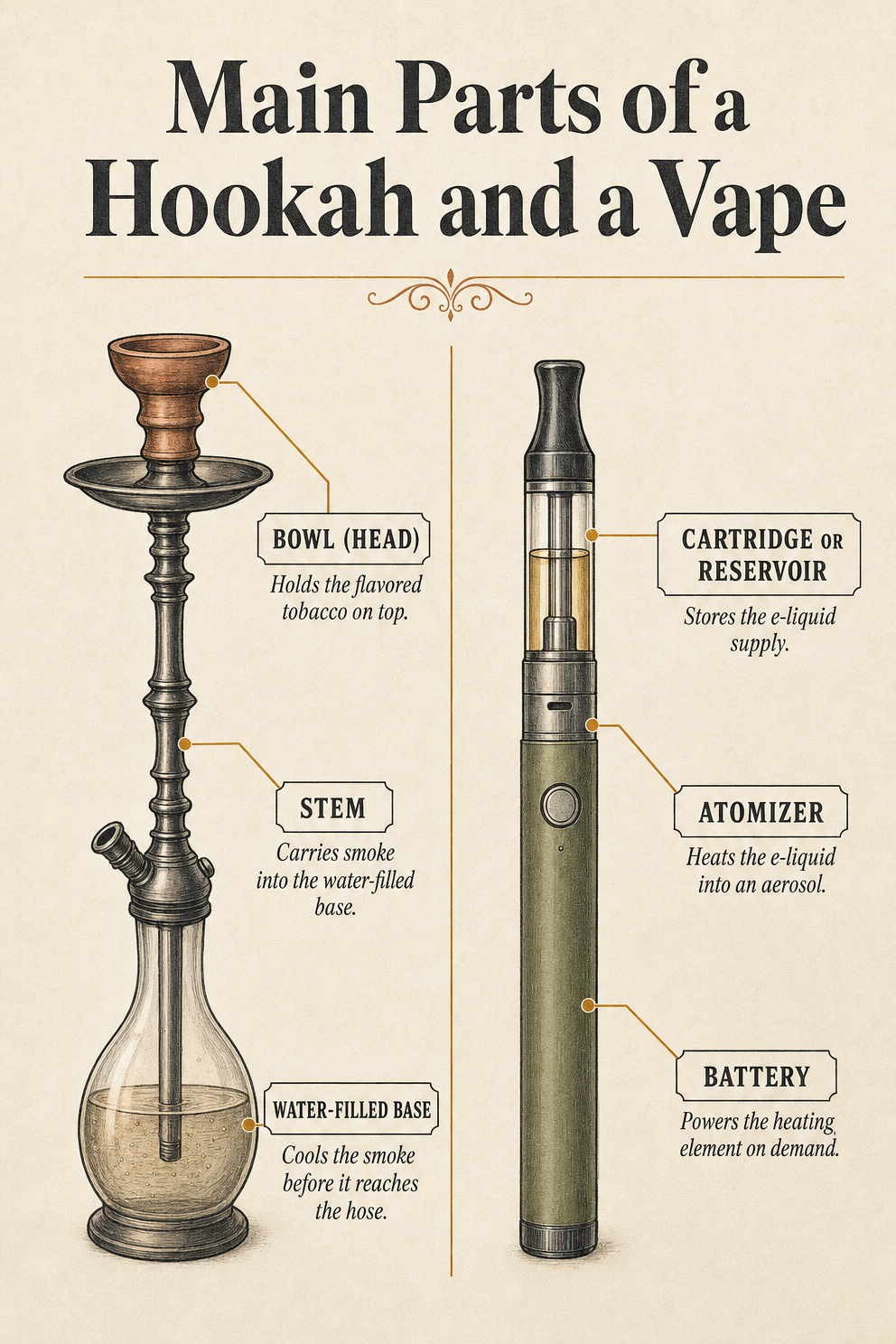
A hookah is a single, multi-part water pipe. You load flavored tobacco into a bowl on top, light charcoal above it, and pull on a hose. The smoke travels down through a stem, bubbles through a water-filled base, and rises into a flexible hose with a mouthpiece. The whole device is meant to be shared and used while sitting down. [1] [6]
A vape (also called an e-cigarette, vape pen, or ENDS device) is a much smaller, battery-powered tool. You press a button or simply draw on it, and a small heating element — called an atomizer — turns a flavored liquid into an aerosol. You inhale that aerosol through your own mouthpiece, then exhale it. [3] [5]
The two devices look nothing alike and feel nothing alike. A hookah is a tabletop setup you assemble, fill with water, and pass around. A vape fits in a pocket and is used one puff at a time, usually standing up or walking around. The mechanics under the hood are also different, which is why the sessions end up so different.
- Hookah parts: bowl (head) on top, metal stem down the middle, water-filled base, tray for ash, hose, and mouthpiece.
- Hookah parts: grommets create airtight seals between sections so the smoke travels cleanly through the water.
- Hookah parts: a hose port on the side of the stem connects the flexible hose to the cooled smoke in the base.
- Vape parts: a rechargeable battery powers the device and lasts through the day for most users.
- Vape parts: an atomizer heats the e-liquid on demand and turns it into an inhalable aerosol.
- Vape parts: a cartridge, tank, or pod holds the e-liquid and feeds it to the atomizer.
- Vape parts: a mouthpiece at the top is the only piece your lips touch, and each user has their own.
How Does a Hookah Heat Tobacco Compared to a Vape Heating E-Liquid?
Hookah heat comes from burning charcoal. You place a piece of natural coconut charcoal or a quick-light disc on top of foil or a heat management device, and the burning coals heat the tobacco below them. Combustion is the heat source, and smoke is the result. That smoke then travels down the stem and bubbles through the water in the base before reaching the hose. [1] [2] [8]
Vape heat comes from electricity. When you activate the device — either by pressing a button or by drawing — the battery sends power to the atomizer. The atomizer heats a small wick or coil that is soaked in e-liquid, and the liquid turns into a fine aerosol. There is no charcoal, no flame, and no water step. [3] [5]
Because the heat sources are so different, the rest of the experience changes with them. Charcoal stays hot for a long time and keeps a hookah bowl warm across a full sitting. A vape only heats when the user activates it, so each puff is short and the device cools down between draws. If you want a refresher on the bowl-style variations that change how hookah heat is delivered, the What Is a Percolator Bong and How Does It Work? guide on percolator-style airflow is a useful contrast piece.
It also helps to understand what is actually being heated. A hookah heats moist, sweetened, flavored tobacco on top of the bowl. A vape heats a much simpler mixture of propylene glycol, vegetable glycerin, flavorings, and (usually) nicotine dissolved in liquid form. The end products — smoke versus aerosol — are chemically different even though both look cloudy when they leave the device.
- Charcoal sits above the hookah bowl and heats the tobacco by contact and radiant heat.
- Smoke travels down the stem and bubbles through the water in the base before rising into the hose.
- Cooled smoke reaches the mouthpiece, where the user draws it in by pulling on the hose.
- A vape activates only when the user presses a button or draws on the device.
- The battery sends current to the atomizer, which heats a small wick or coil soaked in e-liquid.
- The e-liquid turns into a fine aerosol that travels a short distance to the mouthpiece and is inhaled directly.
- There is no charcoal, no flame, no water step, and no waiting for the device to cool between puffs.
Hookah vs Vape: What Are the Main Differences Side by Side?
Once you have seen how each device works, the side-by-side comparison comes into focus quickly. The biggest practical differences are device type, heat source, what gets heated, how long a session runs, who shares the device, and how much cleanup each one needs. Those six points cover most of what a beginner actually feels day to day. [1] [3] [6]
If you want a quick visual breakdown of the parts that change between devices, the Which Hookah Bowl Type Is Best for Your Smoke? post on hookah bowl types lays out how each piece of a hookah changes the session — it pairs well with the comparison below.
Here is the comparison in plain language. Each point tells you which device is on the left and which is on the right, so you can scan it quickly without flipping back to the rest of the article.
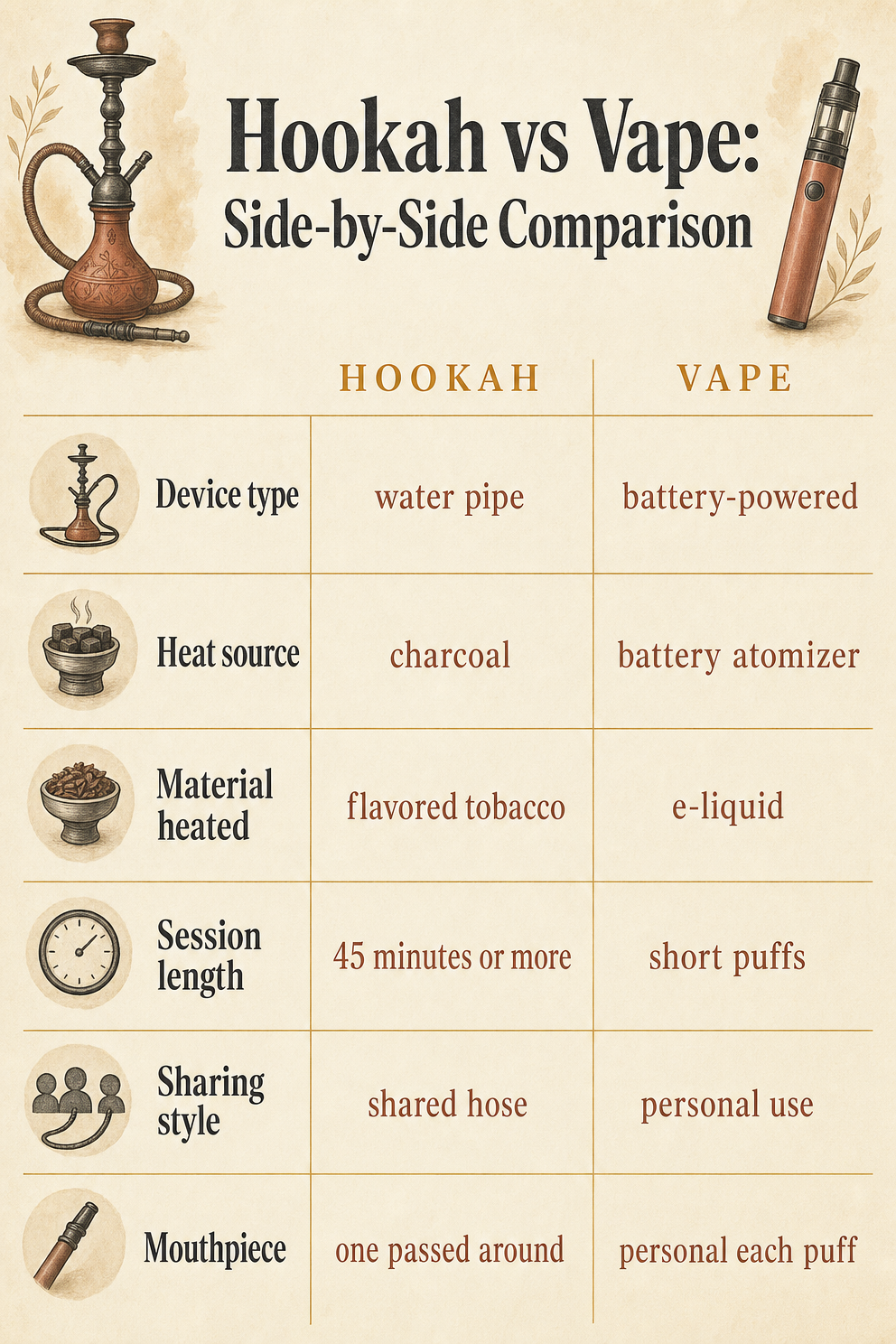
- Device type: a hookah is a water pipe with multiple parts; a vape is a small battery-powered device.
- Heat source: a hookah uses burning charcoal; a vape uses an electric atomizer.
- Material heated: a hookah heats flavored tobacco (shisha); a vape heats flavored e-liquid.
- Session length: a hookah session runs 45 minutes or more; a vape session is built around short individual puffs.
- Sharing: a hookah uses one shared hose and mouthpiece; a vape is used one person at a time.
- Mouthpiece: a hookah mouthpiece is passed between users; a vape mouthpiece is personal to each user.
- Setup: a hookah needs assembly, water, charcoal, and tobacco before each session; a vape is grab-and-go.
- Cleanup: a hookah needs stem, base, and hose cleaning after use; a vape needs the occasional coil or pod swap.
| Point | Hookah | Vape |
|---|---|---|
| Device type | Multi-part water pipe | Single battery-powered device |
| Heat source | Burning charcoal | Electric atomizer |
| Material heated | Flavored tobacco (shisha) | Flavored e-liquid |
| Session length | 45 minutes or more | Short individual puffs |
| Sharing | Shared hose and mouthpiece | Personal device and mouthpiece |
| Cleanup | Wash stem, base, and hose | Swap coil or pod as needed |
What Types of Vapes Are There and What Materials Do They Heat?
The word "vape" covers a wide range of devices. The simplest way to sort them is by what they are designed to heat. Most vapes on the market today heat e-liquid, while a smaller group of dry-herb vaporizers is built to heat plant material without combustion. Knowing which kind you are looking at changes how you shop and how you maintain the device. [3] [4] [5]
Disposable vapes are single-use devices that come pre-filled with e-liquid. Once the liquid or battery runs out, the whole device is tossed. They are the easiest entry point because there are no buttons, no settings, and nothing to refill. Refillable tank devices are larger, let you swap in your own e-liquid, and have replaceable coils. They cost more up front but are cheaper per puff over time.
Pod systems fall in between. They use small plastic pods that snap into a rechargeable battery. Some pods come pre-filled and are tossed when empty; others are refillable. The Dry Herb Vaporizers subcategory covers dry-herb vaporizers specifically — these are designed to heat dry plant material rather than e-liquid, using either conduction (direct contact with a hot surface) or convection (hot air passing through the material), and some hybrids use both. [9]
Wax and oil vaporizers are a smaller niche. They are built to handle concentrates rather than loose material, and they usually need a different atomizer style than e-liquid devices. Recognizing the category before you buy saves a lot of guessing at the register.
- Disposable vapes: single-use, pre-filled with e-liquid, tossed when empty.
- Refillable tank devices: larger, with a replaceable coil and a tank you fill with your own e-liquid.
- Pod systems: small rechargeable battery plus snap-in pods that can be pre-filled or refillable.
- Dry-herb vaporizers: designed to heat dry plant material using conduction, convection, or both.
- Wax and oil vaporizers: built for concentrates and usually use a different atomizer style than e-liquid devices.
- Hookah pens: pen-shaped, single-use flavored devices that mimic hookah flavor but do not use water or charcoal.
What Materials and Flavors Can You Use in a Hookah?
Hookah tobacco is called shisha, and it is a mixture of tobacco leaf, sweeteners or molasses, and flavoring. That mix is what gives shisha its dense, often sweet smoke and its broad flavor range. If you want to see how a flavored bowl looks in a smaller, glass-bodied design, the Flowering Spirals Glass Water Pipe – 5.5" / 10mm F / Colors Vary listing on the Treehouse Lifestyle shop shows how a compact water pipe uses similar flavor principles.
Flavor names are a big part of hookah culture. You will see familiar names on jars and tins at any hookah shop, and the same names tend to come up across brands. Common shisha flavors include apple, mint, cherry, chocolate, coconut, licorice, cappuccino, and watermelon, along with blends that mix two or more of these. Sweetened, flavored non-tobacco (often called "herbal") shisha is also sold for users who do not want tobacco leaf. [1] [2]
The charcoal that heats the bowl comes in two main types. Natural coconut charcoal is denser, lights with a bit more patience, and burns cleanly once it gets going. Quick-light charcoal comes in foil-wrapped discs, lights fast because of a chemical accelerant on the surface, and is the most common choice for casual home sessions. The two types produce slightly different flavor profiles and slightly different smoke density. [8]
- Shisha base: tobacco leaf mixed with sweeteners, molasses, and flavoring.
- Common flavors: apple, mint, cherry, chocolate, coconut, licorice, cappuccino, and watermelon.
- Blends: many brands mix two or more of these flavors into named blends like "double apple" or "fruit mix."
- Herbal shisha: sweetened, flavored non-tobacco options are sold for users who want flavor without tobacco leaf.
- Natural coconut charcoal: denser, takes longer to light, burns cleanly once going.
- Quick-light charcoal: foil-wrapped discs, lights fast with a chemical accelerant, common for casual home use.
- Heat management devices: metal lids that sit on top of the bowl and control how the charcoal heats the tobacco.
How Long Does a Hookah Session Last Compared to a Vape Session?
Session length is one of the easiest differences to feel. A typical hookah session lasts 45 minutes to an hour or more — long enough that the chair, the tray, and the company all become part of the routine. A typical vape session is built around individual puffs that take seconds, not a continuous block of time. The two formats reward different kinds of attention. [1] [6]
The reason comes back to the heat source. Charcoal keeps a hookah bowl hot across the entire sitting, so the bowl is ready whenever someone reaches for the hose. A vape only heats when the user activates it, so each puff is short and the device cools between draws. A hookah essentially runs on its own; a vape only works when you ask it to.
Long sessions also change the way cleanup works. A one-hour hookah session means a stem and base that need washing afterward, plus ash, used charcoal, and spent tobacco to dispose of. A short vape session means much less to clean up at the end. If you prefer a short session and quick wrap-up, a vape is the easier fit. If you want a long, sit-down ritual, a hookah matches the format. If you are curious about shorter, single-piece smoking formats, the Chillums chillum subcategory shows how compact pipes condense the session into something closer to vape-length puffs.
- Hookah session: typically 45 minutes to an hour or more, with the bowl staying hot the whole time.
- Vape session: built around short individual puffs that last seconds, with the device cooling between hits.
- Hookah cleanup: wash the stem, base, and hose after the session; dispose of ash and spent charcoal.
- Vape cleanup: swap the coil or pod when flavor drops, and charge the battery when it runs low.
- Hookah social fit: long enough to host a small group and pass the hose around the table.
- Vape social fit: better for solo use or short breaks where you step away and come back.
- Planning tip: a hookah session needs 60–90 minutes of free time; a vape session can be slotted into any spare minute.
How Much Setup and Cleaning Does Each Device Need?
Setup and cleanup are where the two devices really separate. A hookah asks for real setup time before each session and a real cleanup routine afterward. A vape asks for almost nothing before a puff and only occasional maintenance as the coil or pod wears down. If you do not want much fuss, the difference is large enough to make the decision on its own. [1] [5] [6]
Hookah setup runs through a reliable checklist: assemble the stem and base, fill the base with water to the right level, attach the hose, load the bowl with shisha, place the foil or heat management device on top, light the charcoal, and wait a few minutes for the bowl to heat up. Each step is small, but together they take 10–15 minutes from bag to first draw.
Hookah cleanup is the longer end of the routine. After the session, you let the base cool, pour out the water, rinse the stem and base with warm water, and run a brush through the downstem to clear residue. The hose gets a quick air-out, and the bowl is emptied of spent tobacco and ash. Doing this after every session keeps the flavor clean and the device working the way it should.
Vape upkeep is much shorter. Most disposable vapes need nothing until they are empty. Refillable tank vapes need a coil swap every week or two — the user unscrews the old coil, screws in a new one, primes the wick with a few drops of e-liquid, and refills the tank. Pod systems fall in between: you snap in a fresh pod when the old one is empty or the flavor goes off. If you want a side-by-side example of how an easy-to-clean smoking device handles routine maintenance, the Silicone Bongs silicone bongs subcategory shows a material designed to keep cleanup fast.
- Hookah setup: assemble the stem, fill the base with water to the right level, attach the hose.
- Hookah setup: load the bowl with shisha, place foil or a heat management device on top, light the charcoal.
- Hookah setup: wait a few minutes for the bowl to heat before the first draw.
- Hookah cleanup: let the base cool, pour out the water, rinse the base and stem with warm water.
- Hookah cleanup: brush the downstem, air out the hose, empty the bowl of spent tobacco and ash.
- Vape upkeep: swap the coil or pod when flavor drops; prime a new coil with a few drops of e-liquid.
- Vape upkeep: charge the battery when it runs low; refill the tank or pod as the e-liquid level drops.
How Do You Choose Between a Hookah and a Vape?
The cleanest way to pick a device is to match your habits to what each one is good at. There is no universal winner — the right answer depends on whether you want a long shared session, a short private puff, lots of flavor variety, or minimal cleanup. Use the checklist below to see which device each priority points toward. [1] [3] [6]
If you regularly host friends and want the session to be a centerpiece of the evening, a hookah is the more natural fit. If you mostly want a quick personal puff between other things, a vape is the simpler choice. If you care most about exploring flavor names like apple, mint, cherry, or chocolate, both devices have you covered — but the flavor range is broader and more obvious on the hookah side. If your priority is the smallest possible cleanup routine, the vape is the easier device to live with.
Cost and materials matter too. A basic hookah setup is a larger up-front buy, and you will keep buying shisha and charcoal over time. A basic vape kit is cheaper up front, and the ongoing cost depends on whether you buy disposable devices or refill with e-liquid. Both product categories ship nicotine and non-nicotine options, so you can match either device to your preference there. [4]
One last point: whichever device you pick, set it up in a place with good airflow, keep the parts clean, and replace the consumables (charcoal, shisha, coils, pods) on a regular schedule. A well-maintained hookah produces more consistent flavor; a well-maintained vape produces more consistent puffs. If you want a starting point on the vape side, the Vape Pens vape pens subcategory at Treehouse Lifestyle is a useful place to browse device shapes and sizes.
- Priority: hosting friends and a long shared session — a hookah matches the format.
- Priority: short private puffs with no setup — a vape matches the format.
- Priority: broad flavor variety (apple, mint, cherry, chocolate, and more) — both devices offer it, with hookah having the deeper flavor catalog.
- Priority: minimal cleanup — a vape is the easier device to live with day to day.
- Priority: lower up-front cost — a basic vape kit is cheaper to start with.
- Priority: nicotine-free option — both product categories sell nicotine-free shisha and e-liquid.
- Priority: a ritual that runs an hour or more — a hookah is built around exactly that pace.
Frequently Asked Questions
Is a hookah the same thing as a vape?
No. A hookah is a water pipe that uses charcoal to heat flavored tobacco and pulls the smoke through water before it reaches a shared hose. A vape is a small battery-powered device that heats a flavored liquid into an aerosol you inhale through your own mouthpiece. The heat source, the material being heated, and the way the smoke or aerosol is delivered are all different.
Do hookahs and vapes both contain nicotine?
Often, but not always. Hookah tobacco (shisha) is typically made from tobacco mixed with sweeteners and flavoring, so it usually contains nicotine. E-liquids usually contain nicotine derived from tobacco along with flavorings, propylene glycol, and vegetable glycerin, but nicotine-free e-liquids and nicotine-free herbal shisha products are also sold.
Which one is better for sharing with friends?
Hookahs are built around group sessions. The hose and mouthpiece are passed from person to person during a typical session, which is part of the social ritual. Vapes are designed for individual use — each person uses their own device and their own mouthpiece. If you regularly host a group, a hookah matches the format. If you mostly want a private puff, a vape is the simpler fit.
Does the water in a hookah filter out harmful chemicals?
No. The water in the base of a hookah cools the smoke and catches some larger particles, but it does not remove the harmful chemicals. Smoke that has passed through the water still contains nicotine, tar, heavy metals, carbon monoxide from the burning charcoal, and other toxic agents.
Is vape aerosol just water vapor?
No. E-cigarette aerosol is not the same as plain water vapor. It can contain nicotine, chemicals linked to long-term health risks, heavy metals such as nickel, tin, and lead, tiny particles that reach deep into the lungs, volatile organic compounds, and flavorings such as diacetyl.
How long does a hookah session last compared to a vape session?
A single hookah session typically lasts 45 minutes to an hour or more, while a vape session is built around short individual puffs that take only seconds. The difference comes from the heat source — charcoal keeps a hookah bowl hot across a long sitting, while a vape only heats while the user activates it.
So, Hookah or Vape — Which One Is the Better Choice for You?
The honest answer is that hookahs and vapes are built for two different rituals. A hookah is a long, social, group session with a charcoal-heated bowl, water-cooled smoke, and a hose that gets passed around the table. A vape is a short, personal puff from a small battery-powered device that heats e-liquid into an aerosol. Both can deliver nicotine when the product contains it, and both produce smoke or aerosol that contains chemicals you do not want in your lungs. Pick the device that fits your habits, not the one that sounds like the better choice on paper.
If you regularly host a small group, want flavor variety, and enjoy a 45-minute-plus ritual, a hookah is the more natural fit. If you want a quick personal puff, minimal setup, and minimal cleanup, a vape is the simpler device to live with. Most people who try both end up using them for different moments rather than choosing one over the other — a hookah for slow evenings and a vape for everything else. Browse the Treehouse Lifestyle hookah shop to start building your hookah setup, or check the vaporizers section if you want to explore the vape side first.
Sources
- Centers for Disease Control and Prevention (CDC): Hookahs | Smoking and Tobacco Use
- U.S. Food and Drug Administration (FDA): Hookah Tobacco (Shisha or Waterpipe Tobacco)
- Centers for Disease Control and Prevention (CDC): About E-Cigarettes (Vapes)
- U.S. Food and Drug Administration (FDA): E-Cigarettes, Vapes, and other Electronic Nicotine Delivery Systems (ENDS)
- National Institute on Drug Abuse (NIDA), National Institutes of Health: Vaping Devices (Electronic Cigarettes) DrugFacts
- HOOB (hookah manufacturer): What Is a Hookah Made Of? Parts, Anatomy & How It Works
- American Lung Association: Facts About Hookah
- Hookah.com (hookah retailer): Natural vs. Quick Light Hookah Charcoal: Which Is Best?
- TVape USA (vaporizer retailer and guide): Conduction vs Convection Vaporizers – Learn the Difference