

To clean a hookah, rinse the stem and base with warm water after every session, deep-clean washable parts weekly with brushes and a mild acidic solution, dry-store traditional hoses between uses, and swap worn grommets or a sticking purge ball before they ruin airflow. A small kit — stem brush, base brush, lemon juice or vinegar, mild dish soap, soft cloths — covers the whole routine.
How Often Should You Clean a Hookah?
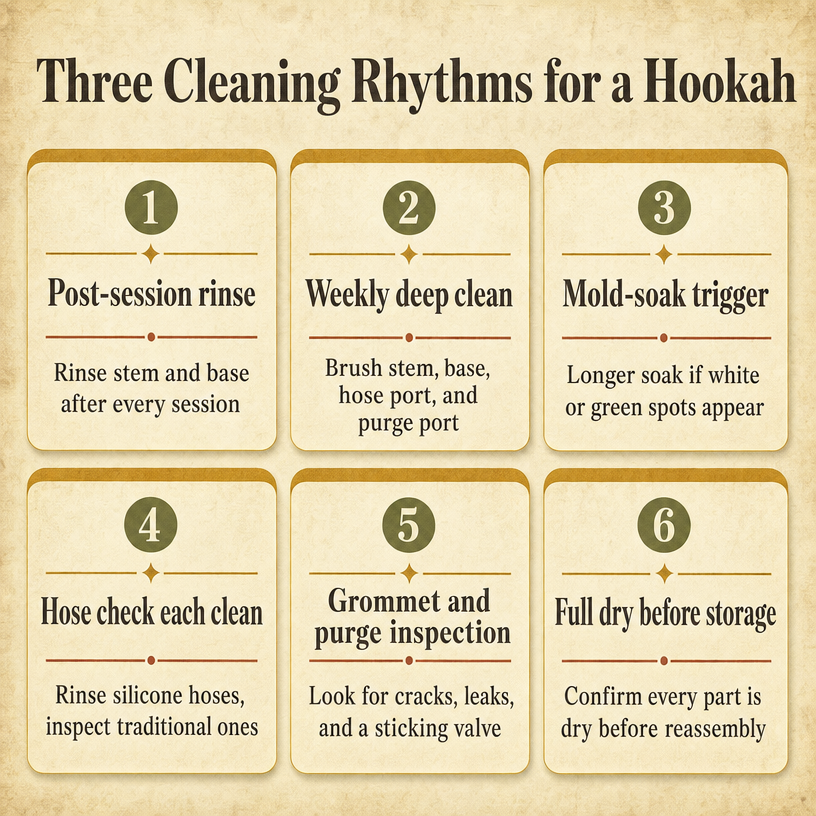
Maintenance guides split hookah cleaning into three rhythms rather than one rigid schedule, and each rhythm covers a different layer of the hookah [1].
The first rhythm is the post-session rinse. After the bowl is empty and the heat management device has cooled, the stem and base get a quick flush with warm water to wash out loose residue before it dries onto the metal or glass.
The second rhythm is the weekly deep clean. For regular smokers — anyone setting up a hookah a few times a week — that means a full disassembly, a brush run through the stem, a base scrub, and a check on the hose and purge valve. Occasional smokers can stretch this rhythm to every two or three weeks without trouble, since residue has less time to harden between sessions [2].
The third rhythm is the pre-storage dry. Before a hookah goes back on the shelf for more than a week, every washable component should be disassembled, cleaned, and confirmed dry. Trapped moisture is what produces musty odors, water spots, and mold at the base of the stem.
If you’d like a comparable cadence for the rest of your kit, our guide on How Often Should You Clean Smoking Accessories? walks through the same kind of rhythm for other smoking accessories.
- Post-session rinse: flush the stem and base with warm water after every session to clear loose residue before it dries.
- Weekly deep clean: full disassembly, brush the stem, scrub the base, and inspect the hose, grommets, and purge valve — relaxed to every two or three weeks for occasional smokers.
- Pre-storage dry: disassemble, clean, and fully dry every part before the hookah goes on the shelf for more than a week.
- Grommet and purge check: look for cracks, leaks, and a sticking valve at every weekly clean so worn parts get swapped before they ruin a session.
- Hose inspection: rinse washable silicone hoses at each weekly clean, and inspect traditional hoses for flavor ghosting or wear that signals replacement.
What Supplies Do You Need to Clean a Hookah?
A small kit covers most hookah maintenance, and almost every item is something you already have at home or can pick up at the grocery store.
The brushes do the heavy lifting: a long stem brush sized to the interior channel of your stem, a flexible base brush that bends around the curve of a glass base, and a smaller bottle brush or pipe cleaner for the hose port and purge port [1].
The cleaning solutions that work on every part of a traditional hookah are warm water, lemon juice, white vinegar, baking soda, and mild dish soap. None of these are harsh enough to pit metal finishes or etch glass, and each one handles a different kind of residue — dish soap cuts oily film, lemon juice and vinegar dissolve mineral buildup, and baking soda scrubs off organic film without scratching [2].
For the small parts, keep a few spare grommets on hand that match the bowl, hose, and base of your setup, since a wrong-sized grommet is the most common cause of weak airflow [3].
Abrasive scrubbers and steel wool should stay out of the kit entirely, because they scratch glass and metal finishes that are difficult or impossible to polish back out. The same goes for mixing bleach with vinegar or any acid cleaner — the combination produces fumes and should never happen at a hookah station.
If you want to compare this kit against what you’d use on a different accessory, our guide on How Do You Clean a Bong the Right Way? runs through the same kind of supply list for a bong.
- Long stem brush — sized to the interior channel of the stem for a full scrub on every deep clean.
- Flexible base brush — bends around the curve of a glass base to reach the walls and corners.
- Smaller brush or pipe cleaner — cleans the hose port and purge port where residue collects fast.
- Lemon juice or white vinegar — mild acidic solution that dissolves mineral and water-line buildup.
- Baking soda — gentle abrasive for organic film and lingering odors.
- Mild dish soap — cuts oily residue on metal stems and the exterior of glass bases.
- Soft cloths and spare grommets — for drying, polishing, and replacing worn seals.
How Do You Clean a Hookah Stem and Downstem Step by Step?
The stem and downstem carry smoke from the bowl down into the base, so they collect residue faster than any other part of the hookah. A repeatable step-by-step routine keeps that residue from hardening into a film that affects airflow.
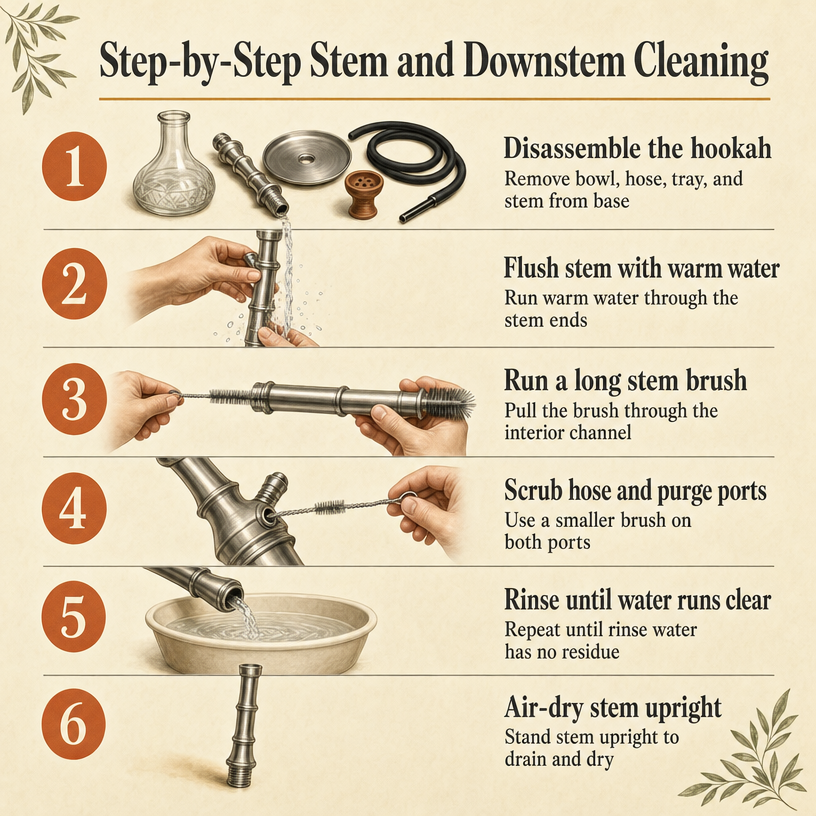
Start by fully disassembling the hookah: remove the bowl, take the heat management device off the bowl port, lift the tray, pull the hose out of the hose port, and separate the stem from the base. Set each piece on a clean towel so nothing gets scratched during cleaning.
Once the stem is off, flush the interior with warm water from both ends so loose residue loosens up before brushing. Then run a long stem brush through the channel, pushing all the way through so the bristles exit the other end. Repeat the brush pass until the brush comes out clean.
Move on to the hose port and the purge port. Both ports have small openings that collect tar and residue. Use a smaller brush or pipe cleaner to scrub the inside of each port, and rinse the stem with warm water again so loosened bits wash out.
The final step is air-drying the stem upright — standing it on a towel with the channel pointing up so any remaining moisture drains out instead of pooling in a bend of the metal. The stem is ready for reassembly once no water beads inside the channel [1] [2].
If you’d like a refresher on how the parts fit back together after a clean, our How Do You Set Up a Hookah Step by Step? walks through the full setup from base to bowl.
- Disassemble the hookah — remove the bowl, heat management device, tray, hose, and stem from the base.
- Flush the stem with warm water from both ends to loosen residue before brushing.
- Run a long stem brush through the interior channel, repeating until the brush comes out clean.
- Scrub the hose port and purge port with a smaller brush or pipe cleaner, then rinse again.
- Rinse the stem with warm water until the rinse water runs clear with no residue.
- Air-dry the stem upright on a towel so moisture drains out before reassembly.
How Do You Clean a Hookah Base and Remove Stains or Mold?
The glass base holds the water that cools the smoke as it travels up the stem, and because water sits in the base for an entire session, the base shows water-line stains and residue faster than any other part of the hookah.
The standard base routine starts with a partial fill of warm water and a mild acidic solution — a tablespoon of lemon juice or white vinegar is enough for most bases. Let the solution sit for a few minutes to soften any film, then scrub the interior walls with a flexible base brush, working the brush around the curve of the glass.
For stubborn residue that the brush can’t shift, a coarse salt or rice shake can stand in. Add a handful of coarse salt or uncooked rice to the warm solution, cover the top of the base with your palm, and shake the base gently for thirty seconds. The abrasive grains work the walls without scratching the glass [1].
Rinse the base thoroughly with warm water until the rinse water runs clear and shows no bubbles or film. Soap residue left in the base produces a stale taste in the next session.
Mold is the one issue a normal base clean will not solve. White spots, green spots, or a persistent musty odor inside a glass base are signs of mold growth, and a longer soak is required before the base is used again [1]. A diluted bleach soak — about one part bleach to nine parts water — handles mold, but the bleach should never be mixed with vinegar or any other acid cleaner at any point in the routine.
For the cleaning supplies themselves, our Cleaning Supplies rounds up brushes, solutions, and replacement parts worth keeping on hand.
- Fill the base partway with warm water and a tablespoon of lemon juice or white vinegar.
- Scrub the interior walls with a flexible base brush, working around the curve of the glass.
- Use a coarse salt or rice shake for stubborn residue the brush can’t shift.
- Rinse thoroughly with warm water until the rinse water runs clear.
- Trigger a longer mold-soak if you see white or green spots or smell a musty odor before reusing the base.
- Skip abrasive scrubbers and never mix bleach with vinegar or any acid cleaner.
How Do You Maintain a Hookah Hose Based on Its Type?
Hose maintenance depends entirely on how the hose is constructed. Washable silicone hoses and traditional coil hoses look similar from the outside, but the interior materials are completely different, and the cleaning routine for one will ruin the other if you mix them up [4].
Washable silicone hoses are built so the entire hose can be flushed with water. After every session, run warm water through the hose from the mouthpiece end, let it drain, and hang the hose vertically to air-dry. A flexible bottle brush can be run through the hose on a weekly cadence to clear buildup that water alone leaves behind [1].
Traditional coil hoses — the kind with a spring-shaped metal exterior — should not be submerged in water at any point. Water trapped inside a traditional hose leads to rust on the interior, musty odors, and a hose that pulls heavy. The right routine for a traditional hose is to dry-store it between sessions by hanging it vertically so any residual moisture drains out, and to plan on periodic replacement when flavor ghosting shows up or the interior lining starts to break down [5].
Flavor ghosting is the tell that a traditional hose has reached the end of its useful life. Once the previous session’s flavor keeps coming through no matter what you load into the bowl, no cleaning routine will fix the interior lining, and a replacement hose is the right answer.
Storing hoses the right way matters as much as cleaning them. Both silicone and traditional hoses benefit from being hung vertically between sessions so any moisture drains out instead of pooling in the curve. Our Storage collects storage solutions that work for hoses and other accessories alike.
- Washable silicone hoses — flush with warm water after every session, hang vertically to air-dry, and run a flexible brush through weekly.
- Traditional coil hoses — never submerge; dry-store vertically between sessions and replace when flavor ghosting appears.
- Mouthpiece and tip — wipe down both hose types with a soft cloth at every clean to clear residue that collects at the end.
- Flavor ghosting — the signal that a traditional hose has reached the end of its life and needs replacement rather than another cleaning attempt.
- Vertical storage — hangs both hose types so any residual moisture drains out instead of pooling in the curve of the hose.
| Step | Washable Silicone Hose | Traditional Coil Hose |
|---|---|---|
| Routine cleaning | Flush with warm water after every session | Never submerge; wipe the exterior only |
| Deep cleaning | Run a flexible bottle brush through weekly | Dry-store vertically; no internal brushing |
| Drying | Hang vertically to air-dry after rinsing | Hang vertically between sessions |
| When to replace | Replace when the silicone cracks or tears | Replace when flavor ghosting or wear appears |
How Do You Replace Hookah Grommets and Unstick a Purge Valve?
Grommets and the purge valve are the small parts that decide whether a hookah pulls properly. A worn, cracked, or wrong-sized grommet is the most common cause of weak airflow, loose parts, and a hose that falls out mid-session [3].
Most traditional hookahs use three grommets, and each one has a different size and shape. The bowl grommet seats in the bowl port on top of the stem, the hose grommet seats in the hose port on the side of the stem, and the base grommet seals the stem to the top of the base. Modern hookahs may swap one or more of these for threaded bases, click-lock systems, magnetic hose adapters, or built-in silicone seals, so the right replacement depends on the specific design.
The replacement routine itself is straightforward: pull out the old grommet, drop the new one into the seat, and confirm it sits flush. For bowl grommets, the gasket should be installed on the bowl port before the bowl is seated — placing the bowl first and forcing it down can dislodge or tear the gasket and produce a leaky seal.
A sticking purge valve is a different problem with a similar cause: buildup around the ball bearing or the seat. The fix is to remove the ball, soak the valve in a mild acidic solution like vinegar or citric acid, dry every part, and reassemble. If the original ball still sticks after cleaning, a plastic replacement bearing drops in without tools [1] [6].
If your kit uses silicone parts on other pieces as well, our Silicone Bongs shows how silicone construction changes the way you maintain it.
- Bowl grommet — seals the bowl to the bowl port; install the gasket before seating the bowl to avoid dislodging it.
- Hose grommet — seals the hose to the hose port; a worn or cracked version lets the hose slip out mid-session.
- Base grommet — seals the stem to the top of the base; the right size keeps the stem from rocking or leaking air.
- Modern alternatives — threaded bases, click-lock systems, magnetic adapters, or built-in silicone seals may replace one or more grommets.
- Purge valve clearing — remove the ball, soak in vinegar or citric acid, dry, and reassemble; swap in a plastic ball if the original still sticks.
How Should You Store a Hookah Between Sessions or Long-Term?
Storage is the part of hookah maintenance that owners most often skip, and it’s the part that decides whether the hookah is ready to use the next time you reach for it.
The base routine is to disassemble the hookah fully, clean every washable component with the steps above, and confirm every part — including the grommets and the purge ball — is completely dry before reassembly or boxing up. Trapping moisture between components is what produces musty odors, mold in the base, and grommets that never seat right [1] [2].
The correct water level matters too, both during a session and before storage. When you set up for a session, fill the base with cold water up to the diffuser holes or about one finger’s width above them. Too much water makes the draw heavy and can splash up into the stem, while too little means smoke is not cooled by passing through the base [7]. Before storage, pour out any leftover water and dry the inside of the base.
For hoses, hang them vertically so any residual moisture drains out, and store traditional hoses in a dry spot away from heat. For bowls and heat management devices, dry them on a towel before stacking them in a storage bag.
Finally, reassemble the hookah in reverse order — base grommet first, then stem, hose, tray, bowl grommet, and bowl — and confirm each seal sits flush before you put the hookah away. Our Chillums rounds up smaller accessories that benefit from the same kind of dry-store routine.
- Fully disassemble the hookah — stem, base, hose, tray, bowl, and grommets separated for cleaning and drying.
- Clean every washable component using the steps from the earlier sections.
- Confirm a complete dry — grommets, purge ball, stem channel, and base interior all free of moisture.
- Set the correct base water level at the diffuser holes (about one finger’s width above them) before each session.
- Hang hoses vertically to drain and store traditional hoses in a dry spot away from heat.
- Reassemble in reverse order — base grommet, stem, hose, tray, bowl grommet, then bowl — and confirm each seal sits flush.
Frequently Asked Questions
How often should I clean my hookah?
Maintenance guides break it into three rhythms: rinse the stem and base with warm water after every session, do a brush-and-solution deep clean roughly weekly for regular smokers (less often for occasional smokers), and do a full disassembly and dry before long-term storage.
What is the best way to clean a hookah stem and downstem?
Disassemble the hookah, flush the stem with warm water, run a long stem brush through the interior, scrub the hose port and purge port with a smaller brush, rinse until the water runs clear, and air-dry the stem upright before reassembly so no moisture is trapped in the channel.
What cleaning solutions are safe to use on a hookah?
Warm water, lemon juice, white vinegar, baking soda, and mild dish soap are the safe household cleaners for routine hookah maintenance. Abrasive scrubbers and steel wool should be avoided because they can scratch glass and metal finishes.
Can I wash a hookah hose with water?
It depends on the hose. Washable silicone hoses can be flushed with warm water between sessions and left to air-dry; traditional coil hoses should not be submerged and are maintained by dry storage between uses and periodic replacement when flavor ghosting or wear appears.
How do I get mold or water-line stains out of a hookah base?
White spots, green spots, or persistent odors inside a glass base can indicate mold and call for a longer soak before the base is used again. For water-line stains, fill the base partway with warm water and a mild acidic solution (lemon juice or vinegar), scrub with a flexible base brush or shake with coarse salt or rice, and rinse thoroughly.
How do I fix a sticking hookah purge valve?
A sticking purge valve is usually caused by buildup around the ball bearing or seat. Remove the ball, soak the valve in a mild acidic solution like vinegar or citric acid, dry all parts, and reassemble — replacing the bearing with a plastic one if the original still sticks.
How Can You Keep a Hookah in Good Shape for the Long Run?
A hookah that is rinsed after every session, deep-cleaned on a weekly cadence, and fully dried before storage will keep pulling cleanly for years.
The three rhythms — post-session rinse, weekly deep clean, and pre-storage dry — cover the routine part of ownership, and the small-part checks for grommets, the purge valve, and the hose type handle the rest.
Stick with warm water, lemon juice or vinegar, baking soda, and mild dish soap as your cleaning solutions, leave the abrasive scrubbers in the drawer, and the hookah will be ready whenever you are.
Sources
- Hookah Vault: How to Clean a Hookah: Step-by-Step Guide for Stem, Base & Hose
- The Hookah Lab: How to Clean a Hookah Properly for Better Sessions
- HookahSet: Hookah Grommets Explained: Types, Sizes and How to Fix Air Leaks
- HookahSet: Hookah Hose Types: Silicone vs. Traditional
- Mob Hookah: The Best Way To Clean Your Hookah Hose
- Hookah.com: What is a Hookah Purge Valve and Hose Port?
- Oduman: How to Set Up a Hookah: A Step-by-Step Guide