

A great hookah session comes down to more than the hookah itself. Beyond the pipe, you need a bowl that holds the shisha, a hose for drawing smoke, grommets to seal every joint, a tray to catch ash, and the right consumables — natural coconut or quick-light charcoal, plus either aluminum foil or a heat management device to control heat. A coal burner or electric coil heater is required to light natural coals, and metal tongs are needed to handle them safely. Standard support accessories include disposable mouth tips for sharing a hose, a wind cover for outdoor sessions, and a small cleaning kit (stem brush, base brush, and port brushes) for routine maintenance.
This guide walks through every accessory you need to set up, run, and maintain a hookah — from the six core parts of the pipe, to bowl types, foil versus heat management, charcoal choices, hose styles, and the cleaning tools that keep flavor consistent across sessions. If you are shopping for a first setup, you can read this top to bottom and end with a parts list. If you already own a hookah, jump to the section that matches the accessory you are about to buy.
What Are the Main Parts of a Hookah and What Does Each One Do?
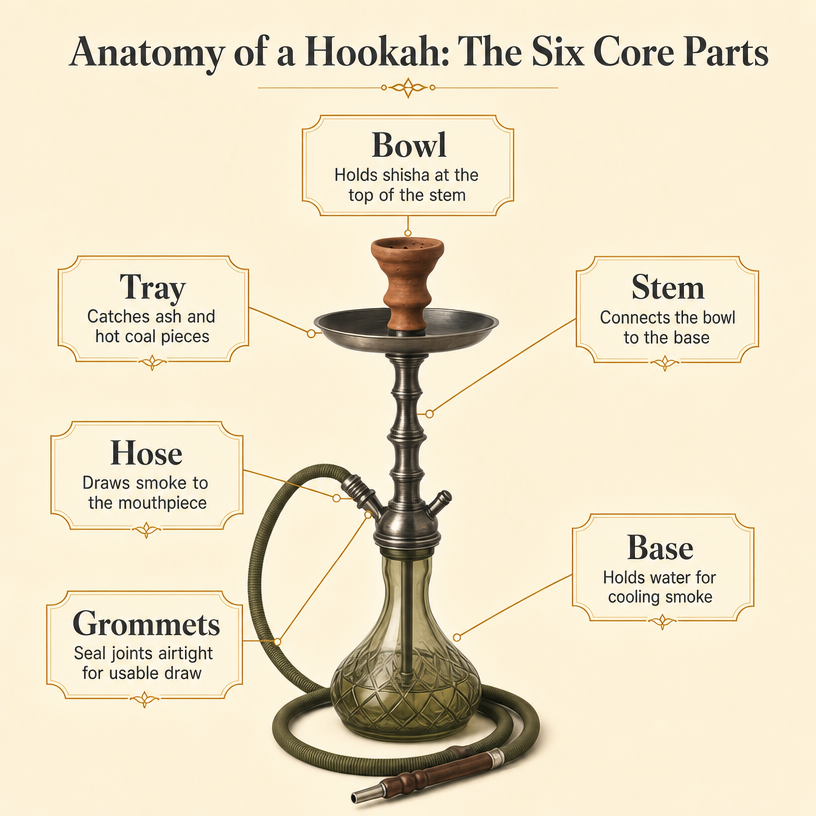
Before you buy anything else, it helps to know what a hookah is actually made of. A traditional hookah has six primary components that work together to move smoke from the bowl to your mouth, and three common add-ons that make the setup easier to run. Naming every part makes the rest of this guide far easier to follow, because almost every accessory on the market is shaped to fit one of these pieces [1].
The bowl sits at the very top of the hookah and holds the shisha. The stem runs down from the bowl into the base. The base is the glass or acrylic vessel at the bottom that you fill with water. The hose attaches to a port on the side of the stem and ends in a mouthpiece. The tray fits around the stem just below the bowl, and grommets are the rubber or silicone seals at every connection point — bowl to stem, stem to base, and hose to stem [2].
Three accessories are common enough to count as standard kit. A wind cover is a stainless steel dome that fits over the bowl on the tray; it shields coals from wind outdoors. Disposable mouth tips slip onto the hose end so multiple people can share one hose. A diffuser is a small piece that screws onto the bottom of the stem inside the base; it breaks the smoke into finer bubbles, which can change the sound and feel of a draw [1] [2].
The bowl is the only part you change based on what you are smoking. The stem and base are usually sold together as the hookah itself. The tray, hose, and grommets are sometimes bundled into a starter kit and sometimes sold separately. If you are picking a first hookah, a complete kit is the fastest way to make sure none of the seals are missing. If you want a flexible starter setup that grows with you, you can start with a basic pipe and add accessories one at a time — for example, a sturdy starter piece like the SILICONE BEAKER BONG WITH REMOVABLE GLASS BOWL pairs with a standard hookah setup if you ever want to compare glass construction across categories.
One more note on trays: the tray is not optional. It is the part that catches hot ash and any coal pieces that fall while you are managing the bowl. Even experienced hookah smokers rely on the tray every session [3].
- Bowl — the small clay or ceramic chamber at the top that holds shisha.
- Stem — the long metal shaft that connects the bowl to the base.
- Base — the glass or acrylic vessel that holds water for cooling.
- Tray — the dish that fits around the stem and catches ash and coals.
- Hose — the flexible tube with a mouthpiece that you draw through.
- Grommets — rubber or silicone seals at every joint that keep airflow tight.
Which Hookah Bowl Type Should You Use?
Two bowl styles dominate the market: traditional Egyptian bowls and phunnel bowls. Both work, but they are tuned to different shisha textures and different heat sources. The right pick depends on what you are smoking and how you plan to manage heat.
Egyptian bowls are the classic option. They have four to six small holes at the base of the bowl, just above where the bowl meets the stem. The holes drain juices down into the stem and base, which means they work best with drier shisha. The open base also encourages airflow, which suits aluminum foil as a heat source because heat travels up through the shisha via direct contact and air movement. If you like traditional foil setups and stick with drier tobacco styles, an Egyptian bowl is a comfortable fit [7].
Phunnel bowls have a single raised center post that sits in the middle of the bowl, with no holes at the base. The raised center traps molasses and glycerin inside the shisha instead of letting them drain. That trapped juice extends flavor life and produces thicker clouds, especially with juicier shisha. The trapped liquid also makes foil harder to manage, which is why phunnel bowls are most often paired with heat management devices — the HMD controls temperature from above so the juice does not scorch [2] [7].
One practical note: bowl size matters as much as bowl style. A small bowl (about 8 oz) holds less shisha and runs cooler, which is friendlier to beginners. A large bowl (about 14 oz) holds more shisha per session but needs more heat and more attention to airflow. If you are picking a first bowl, a medium Egyptian bowl in clay or standard ceramic is the most forgiving choice.
If you are comparing parts across categories or just want a second vessel on hand for swaps and cleanup, keep in mind that bowl measurements and stem threading vary by brand. A standard Egyptian or phunnel fits most mid-size hookahs, but always confirm the bowl stem diameter (often 14mm or 17mm) matches your stem before buying a replacement. A product like the SeshGear 2-Step Glass Beaker Water Pipe – 11.75" / 14mm F / Colors Vary shows how common 14mm threading shows up in the wider glassware world.
- Egyptian bowls — 4–6 base holes, best with foil, suited to drier shisha.
- Phunnel bowls — raised center, no base holes, retain juice, pair well with HMDs.
- Small bowls (around 8 oz) — run cooler, friendlier to beginners.
- Large bowls (around 14 oz) — hold more shisha per session, need more heat.
- Stem fit — confirm the bowl stem diameter (14mm or 17mm) matches your hookah.
Should You Use Foil or a Heat Management Device?
Foil and heat management devices do the same job — they sit between your charcoal and the bowl and deliver heat to the shisha — but they do it in completely different ways. Picking one is mostly a question of how much control you want and how much effort you want to spend on bowl prep.
Aluminum foil is the classic option. You wrap a square of heavy-duty foil tightly over the top of the bowl, poke a pattern of small holes through it with a pin or foil poker, and place two or three lit coals on top. Heat travels down through the foil and into the shisha by direct conduction. Foil is cheap, easy to find, and lets you adjust the draw by repoking or rotating coals. The downsides are that foil requires more attention during a session — you may need to swap out coals, rotate them, or adjust how far they sit from the center to keep flavor steady [3].
Heat management devices, usually called HMDs, replace the foil entirely. The most well-known example is the Kaloud Lotus, which is a small chamber that sits directly on the bowl. Lit coals go inside the chamber, and the chamber has adjustable vents on the sides and top. You control heat by rotating the lid to open or close the vents. HMDs use a mix of convection and radiation rather than direct conduction, which is widely cited as producing longer sessions, easier heat management for beginners, and less babysitting mid-session [5] [8].
There is no wrong answer here — it is a preference choice. Foil keeps cost and gear count low. An HMD costs more upfront but lasts for many sessions and reduces how often you tend the bowl. The cleanest decision rule: buy foil first, and add an HMD later if you find yourself managing coals more than enjoying the session. For a step-by-step walkthrough of either setup, our guide on How Do You Set Up a Hookah Step by Step? covers the full flow from filling the base to lighting the first coal.
One small thing to keep in mind: not every HMD fits every bowl. Some HMDs are sized for specific bowl diameters. If you already own a bowl, measure its top rim before picking an HMD; the Lotus and similar devices list compatible rim sizes in the product description.
- Foil — cheap, easy to find, requires more attention during sessions.
- Heat management devices — sit on the bowl, control heat via adjustable vents.
- Foil heat transfer — direct conduction from coals through foil into shisha.
- HMD heat transfer — convection and radiation through a closed chamber.
- Beginner experience — HMDs are widely cited as easier than foil.
- Cost — foil is the budget option; HMDs cost more up front but last across sessions.
What Is the Difference Between Natural Coconut and Quick-Light Charcoal?
Charcoal is what heats the bowl. There are two families of hookah charcoal, and the difference between them is large enough to change how you set up and run every session. Most hookah shops carry both, and most first-time buyers wonder which one to start with.
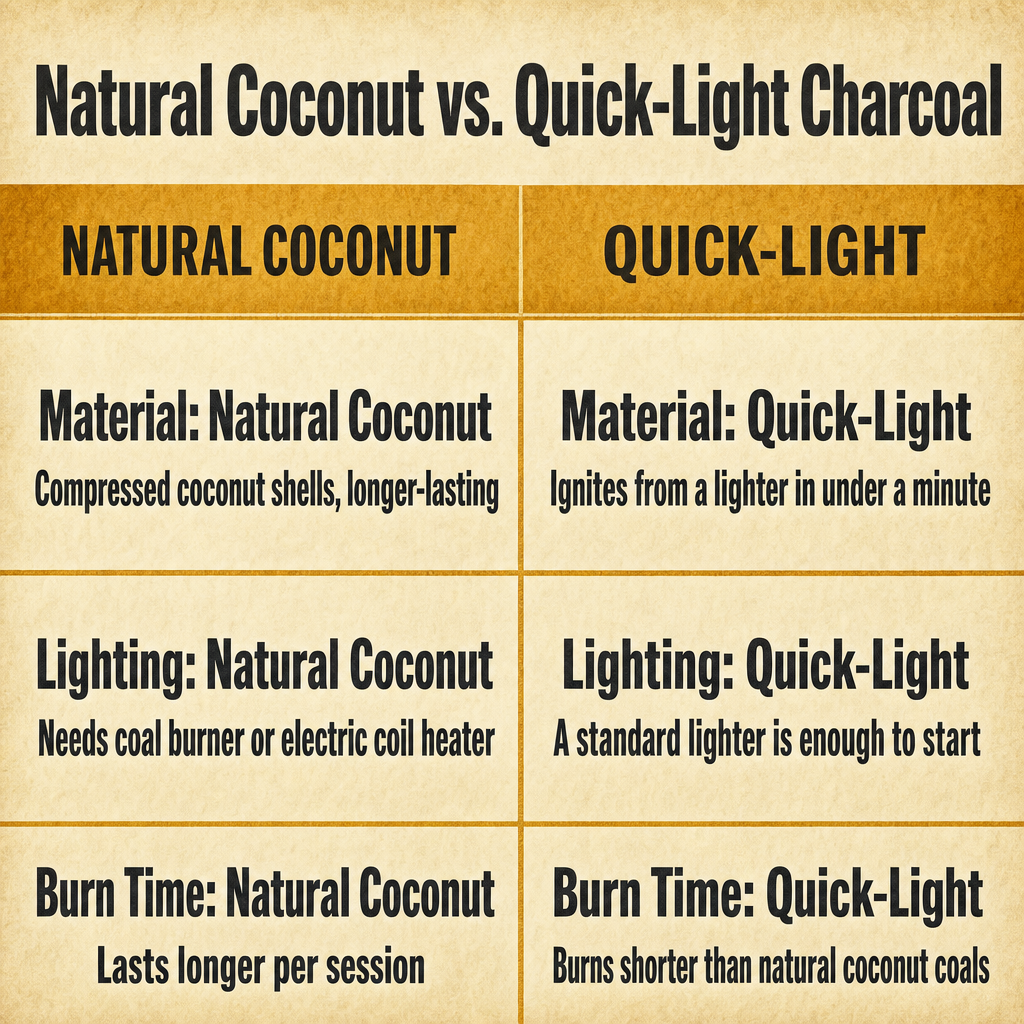
Natural coconut charcoal is made from compressed coconut shells, formed into cubes or flat shapes with no chemical accelerant. Because there is no accelerant, a regular lighter is not enough to light it. You need a coal burner — either a stove-top burner or an electric coil heater — to get the coals glowing red on all sides. Once lit, natural coconut coals burn for a long time per piece and are widely described as producing a more neutral flavor profile because there is no lighter fluid taste in the mix [4].
Quick-light charcoal is pre-soaked with an accelerant so it ignites from a standard lighter or match in under a minute. The trade-off is that quick-light coals burn out faster, are widely reported to add a faint chemical taste to the shisha, and produce more ash per session. Quick-light is convenient when you want to skip the prep step, but most hookah enthusiasts who smoke regularly move to natural coconut coals over time [4] [8].
If you want a way to bridge both worlds, you can start with quick-light coals while you are still learning, then add a coal burner to your kit when you are ready to switch to natural coconut. Either way, you should never use self-lighting charcoal near flammable seating, keep coals on the tray while they are hot, and let spent coals cool fully in a metal dish before you throw them away. For readers curious about how heat transfer works in a different vessel — like a desktop vaporizer — our breakdown of What Is the Difference Between Conduction and Convection Vaporizers? explains conduction and convection in a similar way.
Safety note: hookah smoke still contains nicotine and other components shared with cigarette smoke, and water in the base does not remove those components. Tools and accessories can make a session more convenient, but they do not make hookah smoking risk-free [11] [12].
- Natural coconut charcoal — compressed coconut shells, no chemical accelerant.
- Quick-light charcoal — pre-soaked with accelerant, ignites from a lighter in under a minute.
- Lighting method — natural needs a coal burner or electric coil heater; quick-light needs a lighter.
- Burn time — natural coals last longer per piece; quick-light burns shorter.
- Flavor note — natural is widely described as producing a more neutral flavor profile; quick-light can add a chemical taste.
- Best starter choice — quick-light is fine while learning; natural is the upgrade most smokers make.
What Type of Hookah Hose Should You Buy?
The hose is the part you handle the most, and picking the right one matters more than most first-time buyers expect. There are two main hose styles on the market, and they differ in how they feel, how they last, and how easy they are to clean.
Traditional non-washable hoses are the classic look — leather, vinyl, or plastic wrapped around an internal metal coil. They are flexible, comfortable to hold, and they produce a draw that many long-time hookah smokers prefer. The trade-off is that you cannot rinse the inside. Flavor carries over from one session to the next, which is fine if you always smoke the same shisha, but it gets in the way if you like to switch flavors. Non-washable hoses also tend to wear out faster because the wrapping breaks down with use [6].
Modern washable hoses use a silicone inner tube instead of a metal coil. The silicone can be rinsed with warm water between sessions, which makes flavor switching much easier and lets a single hose last longer. The look is more modern, and the draw is usually a little easier than a traditional hose. If you only want to own one hose, a washable hose is the more practical choice for most setups [6].
For group sessions, the standard accessory is disposable mouth tips. They slip onto the end of the hose so multiple people can share one hose without swapping parts. If you want a reusable option, a silicone mouthpiece like the Silicone Filter MouthPiece fits standard hose ends and rinses clean between users.
As for how many hoses you need: most hookahs have one hose port, but some models have two or three ports on the side of the stem. Multi-port hookahs let you attach multiple hoses at once so several people can draw at the same time. Each additional port needs its own hose and its own set of grommets to stay airtight.
- Traditional non-washable hose — leather or vinyl wrap over a metal coil; cannot be rinsed.
- Washable hose — silicone inner tube; can be rinsed between sessions.
- Flavor carryover — non-washable hoses carry flavor; washable hoses do not.
- Disposable mouth tips — slip-on tips for sharing one hose with a group.
- Reusable mouthpieces — silicone mouthpieces that fit standard hose ends and rinse clean.
- Multi-port hookahs — hookahs with two or three hose ports let several people draw at once.
What Tools and Maintenance Accessories Keep a Hookah Working Well?
Once you have the main kit together, a handful of tools and cleaning supplies make every session easier to manage and help keep flavor consistent over time. The good news is that none of these accessories are expensive, and most of them last for years.
For handling hot coals, you need metal tongs. Do not move coals with your fingers — even quick-light coals stay hot enough to burn. A coal burner (electric coil heater) or a stove-top burner is what you need to fully ignite natural coconut coals. A foil poker or a small pin makes poking the foil pattern fast and consistent, and a coal screen is a small metal mesh that some hookah smokers lay over the shisha before adding coals for extra airflow [3] [4].
For outdoor sessions, a wind cover is the single most useful add-on. It is a stainless steel dome that sits on the tray over the bowl and shields the coals from gusts of wind. Without a wind cover, you can lose coals or end up with uneven heat when you smoke outside [2].
For cleaning, you need a small kit of brushes. The standard set is a stem brush (long, narrow brush for the inside of the stem), a base brush (wider brush for the inside of the base), and small brushes for the hose port and the purge port on the side of the stem. A routine that most hookah smokers follow: rinse the base and stem with warm water after every session, then do a deeper clean with brushes and a mild cleaning solution every three to four sessions. Washable hoses can be rinsed between sessions; non-washable hoses cannot [9].
Finally, think about how you want to buy. Starter kits bundle a hookah, bowl, hose, tongs, and mouth tips together, which is convenient and cheaper than buying parts one at a time. Buying individual parts lets you pick exactly the bowl and hose you want, which matters if you already know you want a phunnel bowl or a washable hose. Starter kits are a good fit for first-time buyers; individual parts are a good fit once you know what you like [10]. For a more detailed look at cleaning routines and how often to break them down, our guide on How Often Should You Clean Smoking Accessories? walks through cleaning schedules for common smoking accessories. With the right combination of tools, consumables, and cleaning supplies, your setup is ready for its first session — and your second, and your hundredth.
Note on shopping: retailers like Treehouse Lifestyle carry hookah parts, hoses, charcoal, and a range of glass accessories, so you can fill out a full kit in one order. Standard hookah orders ship with free shipping on orders $150+.
- Metal tongs — the standard tool for moving hot coals.
- Coal burner or electric coil heater — needed to light natural coconut coals.
- Foil poker or pin — for poking airflow holes in aluminum foil.
- Wind cover — stainless steel dome for outdoor sessions.
- Cleaning brushes — stem brush, base brush, and small port brushes.
- Routine cadence — rinse after every session, deeper clean with brushes every 3–4 sessions.
Frequently Asked Questions
What hookah accessories do I need for a complete setup?
A complete setup includes the hookah itself (bowl, stem, base, tray, hose, and grommets), a bowl that matches your shisha and heat source, either foil or a heat management device, natural coconut or quick-light charcoal, a coal burner for natural coals, metal tongs, disposable mouth tips for sharing, and a small cleaning kit with a stem brush, base brush, and port brushes. All-in-one starter kits bundle most of these together for first-time buyers.
What is the difference between Egyptian and phunnel hookah bowls?
Egyptian bowls have four to six holes at the base, work best with foil, and suit drier shisha because juices drain through the holes. Phunnel bowls have a raised center with no base holes, retain molasses and glycerin, and pair naturally with heat management devices and juicier flavors.
Should I use foil or a heat management device on my hookah bowl?
Foil is the classic budget option: wrap it over the bowl, poke holes for airflow, and place coals on top. A heat management device like the Kaloud Lotus sits between the coals and the bowl, uses a chamber with adjustable vents, and is widely cited as easier for beginners, with longer sessions and more consistent flavor.
What is the difference between natural coconut and quick-light charcoal?
Natural coconut charcoal is made from compressed coconut shells, requires a coal burner or electric coil heater to light, lasts longer per piece, and is widely described as producing a more neutral flavor profile. Quick-light charcoal ignites from a lighter in under a minute, burns shorter, and is reported to interfere with shisha flavor more than natural coals.
How often should I clean my hookah and what do I use?
Rinse the base after every session and do a deeper clean every three to four sessions with a stem brush, base brush, and small brushes for the hose port and purge port. Washable hoses with a silicone inner tube can be rinsed between sessions; non-washable traditional hoses cannot.
What tools do I need to handle hot hookah charcoal safely?
Metal tongs are the standard tool for moving hot coals. To light natural coconut charcoal, you also need a coal burner (electric coil heater) or a stove-top burner — a regular lighter is not enough. Foil pokers or a coal screen help you prep the bowl before you set the coals in place.
How Do You Pick the Right Hookah Accessories for Your Setup?
Putting together a complete hookah setup is mostly a matter of pairing the right parts. Match the bowl to your shisha style — Egyptian for drier tobacco, phunnel for juicier flavors. Match the heat source to the bowl — foil for Egyptian bowls and bowl prep veterans, an HMD for phunnel bowls and beginners who want less babysitting. Match the charcoal to your patience level — quick-light for fast sessions, natural coconut for longer ones with a coal burner. Match the hose to how you clean — washable silicone for variety, traditional for the classic feel. And keep a small cleaning kit on hand so every session starts fresh.
Once you have those pieces, the remaining accessories fall into place quickly. Metal tongs and a coal burner keep charcoal handling safe. Disposable mouth tips or a reusable silicone mouthpiece make group sessions easy. A wind cover makes outdoor sessions less of a hassle. The tray, grommets, and brushes are the unglamorous parts that quietly hold the whole setup together. If you buy a starter kit first, you will have a working setup on day one. If you buy individual parts, you will have exactly the setup you want — the same six core parts either way. Either path gets you to a working session, and either path rewards you with better flavor as you learn which accessories matter most to you.
If you are ready to start, a starter kit is the easiest way to fill out the basics, and you can always upgrade specific parts later. For a quick refresher on the actual flow of setting up a pipe and lighting the first coal, our guide on How Do You Set Up a Hookah Step by Step? walks through the steps from filling the base to your first draw.
Sources
- HOOB (specialist hookah retailer and publisher): What Is a Hookah Made Of? Parts, Anatomy & How It Works
- ShishaFreak (specialist hookah publication): Hookah Parts: A Quick Rundown of Each Major Component and Its Function
- Fumari (hookah manufacturer and retailer): How To Use A Hookah
- Hookah.com (specialist hookah retailer): Natural vs. Quick Light Hookah Charcoal: Which Is Best?
- Kaloud Inc. (heat management device manufacturer): Lotus vs. Foil: Which Heat Management Method Actually Protects Flavor?
- Hookah.com (specialist hookah retailer): Hookah Hoses 101: A Definitive Guide
- Khalil Mamoon (hookah manufacturer): A Comparative Guide to Egyptian vs. Phunnel Bowls
- The Hookah Lab (specialist hookah retailer): Best Hookah Accessories in 2026: Must-Have Gear for the Perfect Setup
- Hookah Vault (specialist hookah retailer): How to Clean a Hookah: Step-by-Step Guide for Stem, Base, and Hose
- Amazon (retailer product listing): Hookah Set with Silicone Hose Bowl Tongs Mouth Tips Everything Included
- U.S. Centers for Disease Control and Prevention (CDC): Hookahs | Smoking and Tobacco Use
- Mayo Clinic: Hookah Smoking: Is It Safer Than Cigarette Smoking?