

Hookah charcoal is the heat source for the bowl. It sits on top of the packed tobacco, either on foil or inside a heat management device, and heats the tobacco instead of burning it. Two kinds are sold: quick-light charcoal, which carries an accelerant and lights from a lighter, and natural coconut charcoal, which has no coating and needs a coil burner, gas stove, or torch. [1] [2]
You will also see the same products listed as "hookah coals," "shisha charcoal," or just "coals," and natural coconut charcoal often shows up as "coco coals." This guide covers what each type does, how the two compare, and which cube size fits your bowl. It also walks through lighting either kind, how many pieces to use, and how to store charcoal so it still lights properly.
What Does Hookah Charcoal Actually Do in a Session?
The coal does three jobs at once. It gets the tobacco warming, it holds the heat steady once the bowl is going, and it decides when the session is finished. Change the coal and you change everything else about the bowl. [1]
The coal also sets the pace. A coal that is still climbing in temperature gives you a bowl that keeps shifting under you. A coal that has settled into a steady glow gives you a bowl that stays put. Read the coal and you can predict the bowl.
If you are comparing heat sources, Bongs work differently: those setups draw heat from a flame or a coil, not from a burning block resting on top of the material. Charcoal is a consumable you restock every few sessions, and most shops file it under Accessories rather than with the tobacco. For the full picture of how the parts fit together, start with What Is a Hookah and How Does It Work?.
- The coal is the heat source. It sits above the tobacco, never mixed into it, and passes heat through the foil or the device.
- "Hookah charcoal," "hookah coals," "shisha charcoal," and plain "coals" all describe the same product.
- "Quick light," "quick lighting," "fast lighting," "instant light," and "self-lighting" all describe charcoal with an accelerant built in.
- "Coconut charcoal," "coco coals," and "natural coals" all describe pressed coconut shell charcoal with no accelerant coating.
- Because the coal drives the heat, it is the first thing you adjust when a bowl runs hot or cool. Add a piece, take one away, or move them inward or outward. [2]
What Are the Main Types of Hookah Charcoal Available?
Quick-light charcoal is charcoal with an oxidizer pressed into it so the piece catches from a flame. A patent describing this kind of product names the oxidizer as "nitre, i.e., potassium nitrate or sodium nitrate or potassium permanganate," and manufacturers of hookah charcoal describe the quick-light accelerant as typically nitrate-based. Brands do not publish their exact formulations. [12] [2]
Natural charcoal is the other branch. The most common version is coconut shell powder pressed with a food-grade starch binder into cubes, with no accelerant anywhere in the mix. Because there is nothing in the coal to catch from a lighter, it needs an outside heat source that stays hot for several minutes. [13]
The two branches also ship in different formats. Quick-light is usually sold as discs in foil-wrapped rolls of ten, in 33mm and 40mm sizes. Natural charcoal ships as cubes, flats, fingers, and hexagonal pieces, plus Japanese-style scored tabs that sit somewhere between the two categories. [10] [5]
If the vocabulary here went past you, What Is a Hookah and How Does It Work? walks the parts in order, and What Hookah Accessories Do You Need for a Great Session? covers the extras that make a session easier to run.
- Quick-light charcoal: charcoal plus an oxidizer, lights from a lighter, ships as discs on a roll. [10]
- Natural coconut charcoal: coconut shell powder plus a starch binder, no accelerant, needs a burner or torch. [13]
- Quick-light discs are ready in about a minute, which makes them the travel and patio option.
- Natural charcoal takes 8 to 12 minutes to light but holds its heat for much longer, which is the trade you are making.
- Japanese-style silver tabs are a scored wood format, lit on a coil stove or with a torch, and they sit between the two main types. [5]
- Not every quick-light disc is built for a hookah. Some cheap brands were made for incense cones and oil burners and repackaged, and retailers warn that these can leave a chemical taste. [10]
Is Natural Coconut Charcoal Better Than Quick-Light Charcoal?
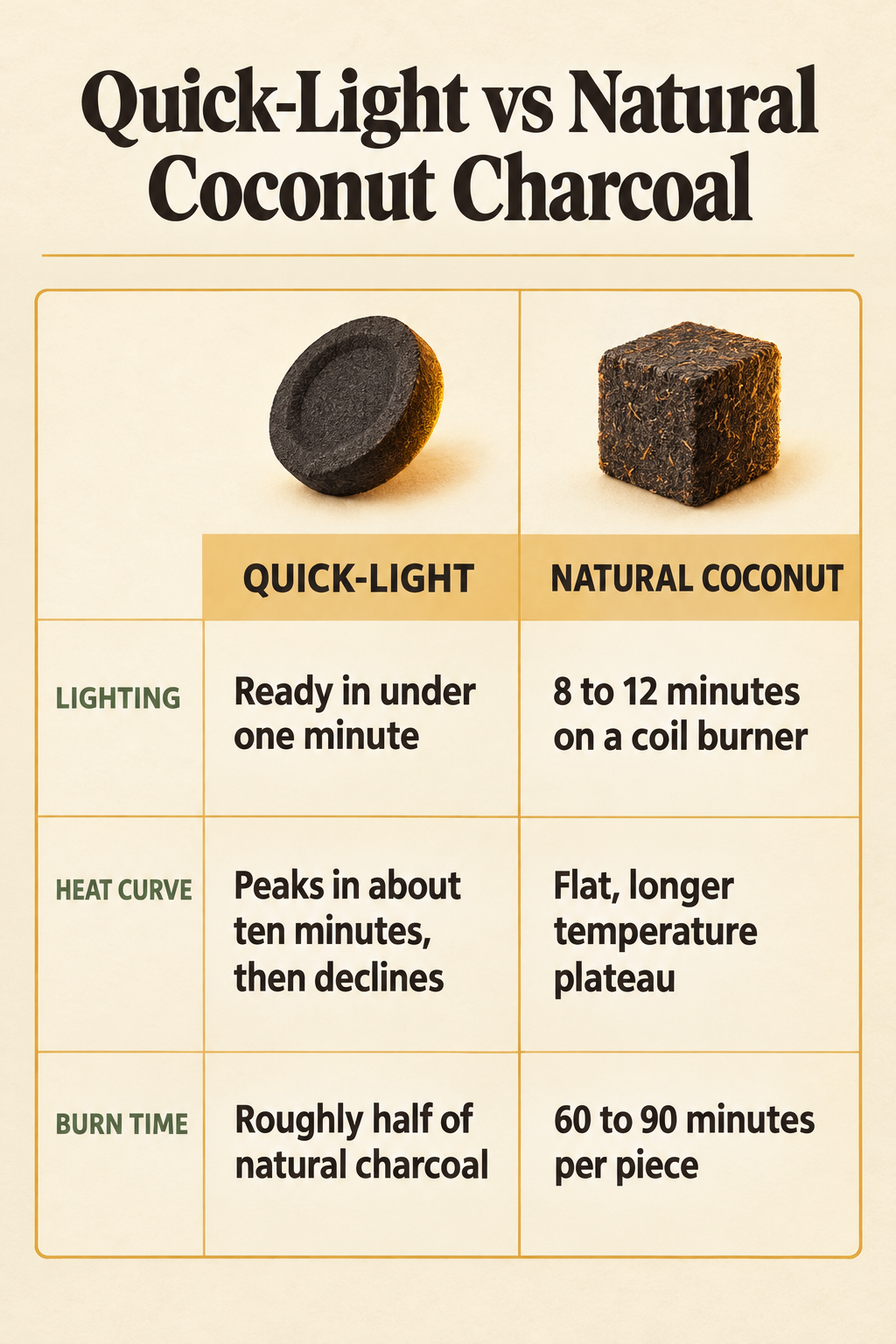
For most home setups, natural coconut charcoal is the better buy, and the reason is the heat curve rather than the price tag. Quick-light charcoal typically reaches peak temperature within about ten minutes and then declines. Natural coconut charcoal lights more slowly but holds a flatter, longer plateau, which is exactly what a 45-minute session needs. [2]
Burn time is where the gap shows up. Published figures for natural coconut charcoal range from 45 to 90 minutes, 60 to 90 minutes, and 90 to 120 minutes for 25mm cubes, depending on the brand and piece size. Quick-light discs are consistently quoted at roughly half the burn time of natural charcoal of similar size. [3] [4]
On the other side of the ledger, quick-light wins on convenience and on setup cost. You do not need a burner, you do not need a free wall socket, and the coal is ready before you have finished packing the bowl. If you smoke on a balcony, at a friend’s place, or twice a year, that matters more than a longer plateau. If you already own a coil burner and you smoke most weekends, natural coconut charcoal is the one to keep stocked. If you are still deciding between formats, Hookah vs Vape: Which Is the Better Choice for You? lays out the trade-offs.
- Lighting: quick-light is ready in under a minute; natural coconut takes about 8 to 12 minutes on a coil burner. [10] [3]
- Heat curve: quick-light peaks around ten minutes and then declines; natural coconut holds a flatter plateau. [2]
- Burn time: natural coconut runs 60 to 90 minutes per piece in most published figures, and quick-light runs roughly half that. [3]
- Cost per session: natural charcoal usually costs less once you are past the one-time burner purchase, because each piece lasts longer.
- Ash: coconut cubes are pressed to leave 1.6 to 3 percent ash, against 5 to 18 percent for barbecue briquettes. [13]
- Effort: quick-light needs no equipment; natural charcoal needs a burner, tongs, and ten minutes of attention. [1]
What Size and Shape of Hookah Charcoal Should You Buy?
Cube size is sold in a small set of standard formats, and each one carries a different mass. A 22mm cube weighs roughly 11 to 13 grams and gives you about 96 pieces per kilogram. A 25mm cube weighs roughly 16 to 18 grams and gives about 72 pieces per kilogram. A 26mm cube holds roughly 15 to 20 percent more mass than a 25mm cube. [4]
25mm is the size most bowls and heat management devices are designed around, which makes it the most reliable default if you are buying your first box. 26mm is the fit for devices such as the Kaloud Lotus, and 27mm is what dense dark leaf in a large bowl tends to want. If your device came with a recommended size, follow the device. [3] [4]
Shape changes behavior as much as size does. Flats are short rectangles, usually no more than about 18mm tall and 22 to 25mm long. They rest higher on the foil and are easy to nudge one piece at a time, but they tend to spike early in a session and then fade. Cubes carry more mass and give steadier output. Fingers and hexagonal pieces trade burn duration for faster ignition and more airflow. [5]
- 22mm cubes: about 11 to 13 grams each, about 96 pieces per kilogram, shorter burn. [4]
- 25mm cubes: about 16 to 18 grams each, about 72 pieces per kilogram, the size most bowls and devices are built for. [4]
- 26mm cubes: roughly 15 to 20 percent more mass than 25mm, the fit for the Lotus and similar devices. [4]
- Flats: short rectangles, sit high on the foil, easy to adjust, but they spike early and then dwindle. [5]
- Cubes: more mass, steadier heat, better for a long session than a short one.
- Fingers and hexagonal shapes: faster to light and more airflow, with a shorter burn as the trade-off. [4]
| Size | Weight per piece | Pieces per kilogram | Where it fits |
|---|---|---|---|
| 22mm cube | 11 to 13 grams | About 96 | Smaller bowls and shorter sessions |
| 25mm cube | 16 to 18 grams | About 72 | Most bowls and heat management devices |
| 26mm cube | 15 to 20 percent more mass than 25mm | Fewer per kilogram | Devices built around 26mm, such as the Kaloud Lotus |
How Do You Light Hookah Charcoal Without a Coil Burner?
A coil burner is the tool the whole method is built around. It feeds oxygen to the underside of the coal and lights the whole piece evenly, while a flat-top burner does a poorer job on the bottom face. If you use your kitchen stove, expect to replace damaged coils over time. [1] [10]
No coil burner? You still have workable options. A gas stove will light cubes if you set them on a metal screen over a low flame instead of resting them on the bare grate, and a kitchen torch will take a single cube to full glow in a few minutes if you keep it moving across each face. Japanese-style scored tabs are built for exactly this: they light on a coil stove or with a torch and burn down in steps as you work through the roll. [1] [10] [5]
Whichever tool you use, work outdoors or near an open door, because burning charcoal gives off carbon monoxide and the risk climbs in small spaces with poor airflow. Never leave a burner or a torch running unattended, and never light coals on a flat electric stovetop, because the glass can crack. The sequence below is the same either way. [1] [7]
- Set a coil burner on a heat-safe surface outdoors or in a well-ventilated spot, and put the screen on top so the cubes cannot fall through. [1]
- Lay the cubes flat on the coil with a little space between them, so each one gets air on all sides.
- Wait about 4 to 5 minutes, then flip every cube with tongs so the cold face goes down. [3]
- Wait another 3 to 5 minutes. Larger 26mm and 27mm cubes can need 12 to 15 minutes in total. [3]
- Check the readiness test: every side should glow red or orange under a thin layer of gray ash. Black spots mean the piece goes back on the burner. [1]
- Lift the cubes with tongs, never fingers, and set them on the bowl or in the device.
- Pull them off as soon as they are fully lit. Leaving natural coals on the burner too long shrinks them, and a smaller coal means a shorter session. [1]
- Using a gas stove or a torch instead of a burner: screen the cubes over a low flame, or keep the torch moving until one face glows, then turn the piece and repeat. The readiness test does not change. [1] [10]
How Many Coals Should You Put on a Hookah Bowl?
There is no single number, because coal count follows the bowl and the device rather than a universal rule. A wide bowl with a lot of surface area spreads three coals differently than a small phunnel does, and a heat management device holds heat in a way that foil does not. Start from the published starting point for your setup, then adjust. [3]
The pattern that works for almost everyone is to start one coal light and add as the bowl warms. A bowl that starts with too much heat is hard to rescue: you end up moving coals to the rim and waiting. A bowl that starts cool tells you exactly when it needs the next piece, and you learn your setup instead of fighting it. [4]
Ash handling belongs here too, because it affects how the coals behave on the bowl. Knock the ash off every 20 to 30 minutes so the pieces keep breathing, and use tongs rather than hands. Keep lit coals off floors, rugs, and furniture, since a lit coal is hot enough to scorch a surface. [3]
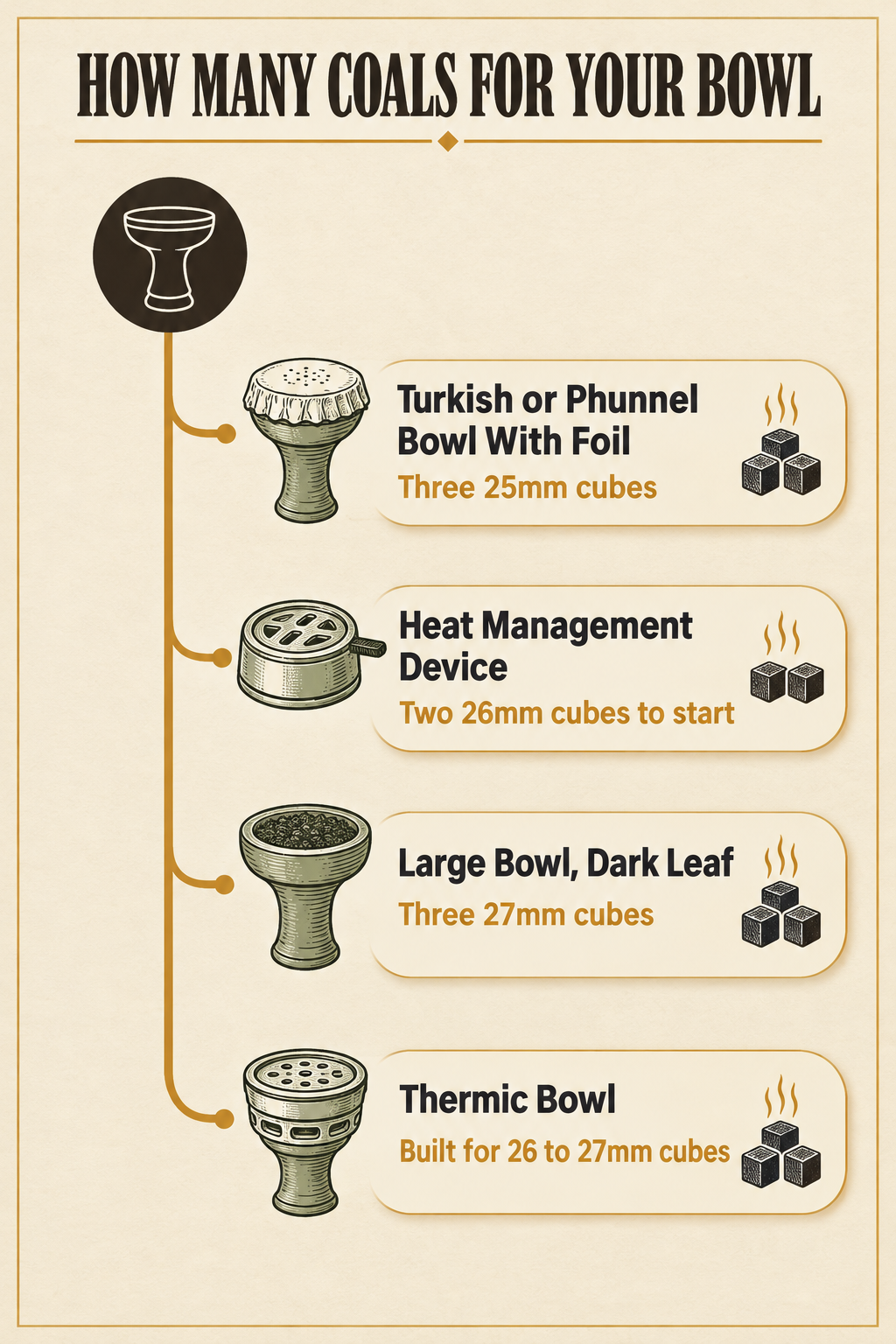
- Turkish or phunnel bowl with foil: three 25mm cubes, or three to four flats. [3]
- Heat management device such as the Kaloud Lotus: two 26mm cubes to start, adding the third as the bowl warms. [3]
- Large bowl packed with dense dark leaf: three 27mm cubes. [3]
- Thermic bowls such as the Quasar RAAS: built for 26mm to 27mm cubes. [4]
- Bowl size sets the count: a wide bowl spreads three coals differently than a small phunnel does, so use every figure here as a starting point. [3]
- Any setup: knock ash every 20 to 30 minutes and rotate coal positions rather than adding heat you cannot take back. [3]
How Is Hookah Charcoal Different From Barbecue Charcoal?
They are built for different jobs, and the recipe shows it. Hookah cubes are coconut shell powder pressed with a food-grade starch binder into 25mm to 35mm cubes, with ash content around 1.6 to 3 percent and fixed carbon around 75 to 85 percent. Barbecue briquettes are charcoal fines or sawdust held together with binder, and they commonly run 5 to 18 percent ash. [13]
Ash is the difference that matters most in practice. On a grill, ash falls away from the food. In a hookah, the coal sits directly above the bowl, so whatever the coal leaves behind ends up on top of your tobacco. More ash means more residue between the heat and the bowl, and more cleaning afterward. [13]
Burn profile is the second difference. A good hookah cube is pressed dense enough to hold a steady heat for 90 to 120 minutes, and it is designed to burn without sparks or added scent. A barbecue briquette is shaped to sit in a pile and burn hot and fast for a grill, which is a different set of priorities entirely. [13]
- Binders: hookah cubes use a food-grade starch binder; barbecue briquettes use charcoal fines or sawdust with binder. [13]
- Ash: 1.6 to 3 percent for hookah cubes versus 5 to 18 percent for barbecue briquettes. [13]
- Fixed carbon: 75 to 85 percent in hookah cubes, pressed for a long steady burn. [13]
- Shape: 25mm to 35mm cubes sized for a bowl or a device, not for a grill grate. [13]
- Burn time: 90 to 120 minutes per cube in published hookah figures. [13]
- Where the ash goes: onto your bowl in a hookah, away from the food on a grill. [13]
How Do You Store Hookah Charcoal So It Still Lights?
Charcoal pulls humidity out of the air, and wet charcoal is the most common reason a fresh box behaves badly. Coals that have taken on moisture take longer to light, give uneven heat, and sometimes force you to light extra pieces just to reach the same temperature. Retailers recommend keeping coals as dry as possible and resealing them after every session. [11]
The storage problem is usually a location problem. A garage or a shed is a poor choice for dryness, and a shelf next to the burner is worse. The kitchen cupboard or a closet in a conditioned room will keep a box in better shape than either one. [11]
A few habits cover most of it. Keep the box closed, keep it dry, and use the oldest box first so nothing sits through a humid summer. If a batch still lights slowly, add a piece rather than leaving the burner on longer. [4]
- Keep the coals in their original resealable bag, or move them to an airtight container once the bag is open. [11]
- Store them in a dry, conditioned room, not a garage, shed, basement, or next to the burner. [11]
- Squeeze the air out of the bag before you seal it, so the coals are not sitting in humid air between sessions.
- Rotate stock: finish the open box before starting a new one, and check dates on bulk buys.
- Buy the size you will finish in a season. A box of 96 cubes that sits for a year will light worse than a fresh 72-count box. [4]
- If a batch lights slowly or unevenly, light one extra piece instead of over-lighting the ones you have. [1]
Frequently Asked Questions
How long does hookah charcoal take to light?
Quick-light charcoal is ready in roughly one minute. Natural coconut charcoal takes about 8 to 12 minutes on a coil burner: roughly 4 to 5 minutes, then flip with tongs, then another 3 to 5 minutes. Larger 26mm and 27mm cubes can need 12 to 15 minutes. Either way, the coal is ready when every side glows red or orange under a thin layer of gray ash, and any black spots mean it goes back on the burner. [1] [3]
How long does a hookah coal last?
Published burn times for natural coconut charcoal vary by brand and piece size, so no single figure is universal. Ranges include 45 to 90 minutes, 60 to 90 minutes, and 90 to 120 minutes for 25mm cubes. Quick-light discs are consistently quoted at roughly half the burn time of natural charcoal of similar size. [2] [4]
What size hookah charcoal is standard?
25mm is the size most bowls and heat management devices are designed around. 22mm cubes weigh roughly 11 to 13 grams and give about 96 pieces per kilogram, while 25mm cubes weigh roughly 16 to 18 grams and give about 72 pieces per kilogram. 26mm cubes hold roughly 15 to 20 percent more mass than 25mm and are the fit for devices such as the Kaloud Lotus. [4] [3]
Can I use regular barbecue charcoal in a hookah?
They are built differently. Hookah cubes are coconut shell powder pressed with a food-grade starch binder into 25mm to 35mm cubes with about 1.6 to 3 percent ash and 75 to 85 percent fixed carbon, while barbecue briquettes are charcoal fines or sawdust with binder and commonly 5 to 18 percent ash. Ash matters more in a hookah because residue falls onto the bowl instead of dropping away from the food. [13]
Why do my hookah coals keep going out or lighting unevenly?
Two common causes are moisture and a partial light. Coals that have absorbed humidity take longer to light and give uneven heat, which is why charcoal should be stored sealed rather than in a garage, shed, or next to the burner. A coal with black spots is not fully lit, and putting it on the bowl moves the lighting phase into the airflow being drawn through the bowl. [11] [1]
What Is the Short Version on Hookah Charcoal?
If you smoke at home and own a coil burner, buy 25mm natural coconut cubes and keep two boxes on hand. They take ten minutes to light, they hold a flat plateau for most of a session, and 25mm fits the widest range of bowls and devices. Add a heat management device later if you want to stop replacing foil. [4] [3]
If your sessions happen away from an outlet, keep a roll of quick-light discs in the bag. Light them fully before they go on the bowl, and accept the shorter burn as the price of not carrying a burner. If you split the difference, scored Japanese-style tabs light from a torch and pack small. [10] [5]
Whichever you buy, the routine is the same. Light outdoors or in a ventilated space, and always use tongs. Wait for a full glow under a thin gray ash, start with one coal fewer than you think you need, and store the box sealed in a dry room. Stack that with a bowl that fits your device and you have solved the part of a hookah session most people never diagnose. Free shipping on orders $150+ covers most of a starter setup, so it is worth filling every gap in one order instead of three.
Sources
- Fumari: How To Light Your Hookah Coals (With Video!)
- Kaloud: Best Hookah Charcoal in 2026: Coconut vs. Quick-Light Compared
- Regal Hookah: Hookah Coals Guide: Sizes, Brands & How to Light Them
- Omnico (coconut charcoal manufacturer): How to Choose the Right Size and Shape of Shisha Charcoal
- Mason Shishaware: The Many Shapes and Applications of Hookah Charcoal
- Undersea and Hyperbaric Medicine (PubMed 26403022): Charcoal type used for hookah smoking influences CO production
- Rutgers University / New Jersey Poison Control Center: Poison Control Warns of Carbon Monoxide Risk from Hookah Smoking
- Centers for Disease Control and Prevention: Carbon Monoxide Poisoning Basics
- Michigan Poison & Drug Information Center, Wayne State University: Michigan Poison & Drug Information Center warns carbon monoxide exposure related to hookah use
- Hookah.com: Natural vs. Quick Light Hookah Charcoal: Which Is Best?
- Hookah.com: How To: Store Shisha Tobacco & Charcoal
- US Patent Office (US3955937A, via Google Patents): Ignitor charcoal and method of manufacture thereof
- BBQ on Charcoal (charcoal industry supplier): Hookah Charcoal vs BBQ Charcoal: The Burn Profile Decides