
A clear breakdown of how each heating method works, plus what it means for flavor, efficiency, and your buying decision.
Conduction vaporizers heat your material through direct contact with a hot surface, similar to a frying pan. Convection vaporizers pass hot air through the material without touching it, like a convection oven. Both methods produce vapor, but they affect flavor clarity, extraction efficiency, device size, and price differently. Understanding these differences helps you choose the right vaporizer for your priorities.
How Does Conduction Heating Work in a Vaporizer?
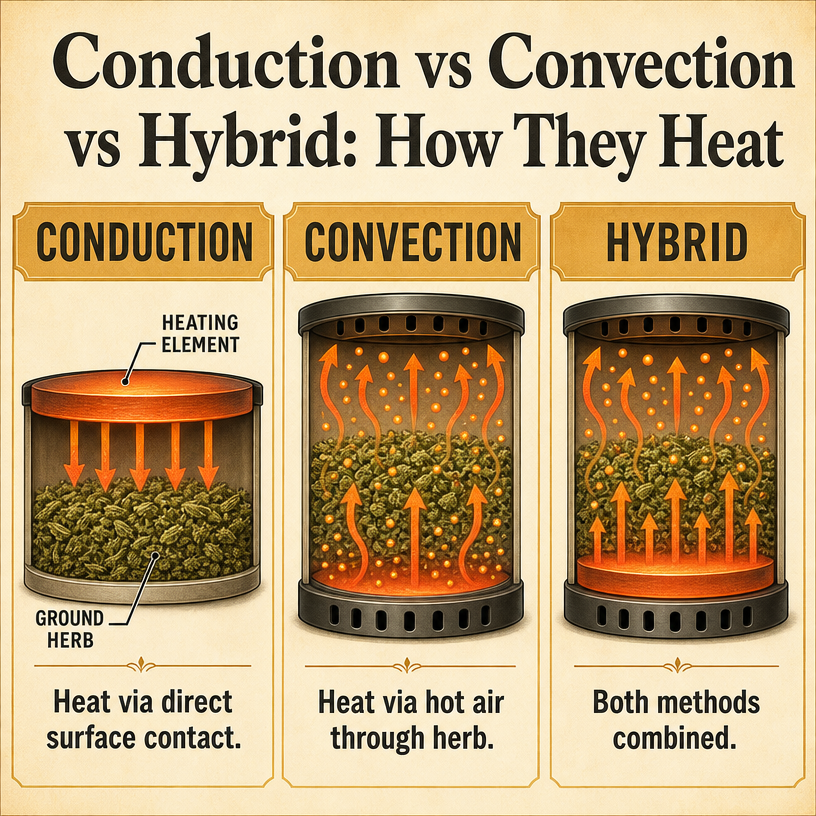
Conduction heating works the same way a frying pan cooks food. The heating element — usually a metal plate, chamber wall, or coil — gets hot first. When your herbal material sits directly against that surface, heat transfers through physical contact. The herb nearest the metal warms up fastest, and that heat gradually spreads inward. [1]
- Heat transfers through direct physical contact between the herbal material and a hot surface inside the device
- The heating element — typically a metal plate, chamber wall, or coil — warms first, then conductively heats whatever touches it
- Heat spreads from the hottest contact points outward, which means the herb closest to the element heats fastest
- Hot spots can develop if material sits packed tightly against the hottest surface for an extended period
- Grind consistency and packing density have a significant effect on how evenly the herb warms during a session
This direct-contact approach means the heating is almost instant. The metal heats up, and whatever touches it begins to warm immediately. That speed is a real advantage when you want to take a draw without waiting around. [2]
The trade-off is that heat does not distribute perfectly on its own. The herb touching the hottest part of the surface can reach higher temperatures than the herb in the center of the chamber. This creates what users sometimes call hot spots. If the material sits packed tightly against a very hot surface for too long between draws, it can darken or dry out more than you might expect. [3]
Grind size and packing density play a bigger role in conduction devices than in convection ones. A loose, evenly ground pack tends to perform more consistently because air can still flow between the pieces. A densely packed chamber in a conduction vaporizer can trap heat and lead to uneven warming. Taking the time to grind consistently and pack lightly usually improves the experience noticeably. [3]
How Does Convection Heating Work in a Vaporizer?
Convection heating works more like a convection oven than a frying pan. A heating element warms air first. That hot air then flows through the herbal material, carrying heat into every part of the chamber without any part of the herb needing to touch a hot surface. [1]
- A heating element warms air first, and that hot air passes through the herbal material without any part of it touching the heating surface directly
- Air flowing through the chamber carries heat evenly into every particle of herb, reducing the risk of localized hot spots
- Forced-air or fan systems help move hot air consistently through the chamber, which requires more power than simple conduction heating
- The multi-step heating process — warm the element, then the air, then the herb — typically results in longer heat-up times compared to conduction
- Because no herb contacts a hot surface directly, there is less risk of material scorching or developing hot spots between draws
Because the air spreads through the entire chamber, the herb heats much more evenly than it does in a conduction device. Each particle of herb gets exposed to hot air moving past it, so temperature differences within the chamber stay minimal. This is one of the main reasons many users prefer convection heating for flavor. [4]
Moving that air takes more energy than simply conducting heat through direct contact. Most convection vaporizers use a fan or forced-air system to push hot air through the chamber. That fan, plus the higher temperatures needed to heat all that air, draws more battery power than a simple conduction element. [2]
Convection vaporizers often have longer heat-up times as a result. The device needs to heat the element, then heat the air, then wait for that air to flow through the full chamber before you get usable vapor. This can take anywhere from 30 seconds to over a minute depending on the model, compared to the near-instant warm-up of many conduction devices. [5]
If you want to understand the full picture of how these devices work, our guide What Is a Vaporizer and How Does It Work? covers the core mechanics in detail. You can also compare vaporizers to other methods in Bong vs Pipe vs Vaporizer: Which Is Right for You?
Read What Is a Vaporizer and How Does It Work? for more detail.
Read Bong vs Pipe vs Vaporizer: Which Is Right for You? for more detail.
Which Heating Method Produces Better Flavor?
If flavor is your top priority, convection heating is generally the stronger choice. Because hot air surrounds the herb evenly without any part touching a scalding metal surface, delicate aromatic compounds called terpenes tend to survive the heating process in better condition. [1]
- Convection heating generally preserves terpene compounds better because the herb never contacts a hot surface directly
- Hot air surrounds the herb evenly, reducing the chance that any portion gets overheated and develops a burnt or roasted taste
- Conduction devices can produce bright, clean flavor in early draws, but later draws may shift toward a more cooked profile as the session progresses
- Convection units tend to maintain a more consistent flavor profile from the first draw to the last
- Regular cleaning of the chamber, airway, and screens helps preserve flavor quality in any vaporizer, regardless of heating method
Terpenes are the compounds that give different strains their distinct smells and flavor notes. They are fragile. Exposing them to direct high-heat contact can cause them to break down faster than when they are gently warmed by surrounding air. This is why convection vaporizers often produce a more nuanced and flavorful experience, especially at lower temperature settings. [4]
Conduction heating does not automatically ruin flavor. Many users are perfectly happy with the taste from a well-packed conduction device, particularly at medium temperatures. But the direct-contact heating means some part of the herb is always adjacent to the hottest surface. That proximity can push certain compounds past their flavor peak before the rest of the chamber has fully vaporized. [3]
Over the course of a full session, this difference tends to become more noticeable. Early draws in a conduction device often taste bright and clean, but later draws can shift toward a more cooked or roasted character. A convection device tends to hold a consistent flavor profile throughout because the herb warms uniformly with each draw. [4]
Proper device maintenance matters for flavor in both types. Residue buildup on heating surfaces or inside chambers affects taste regardless of the heating method. Cleaning your vaporizer regularly — especially the chamber, airway, and any screens — keeps the flavor true. Our guide on How Do You Clean a Bong the Right Way? covers general pipe cleaning principles that apply to vaporizer maintenance as well.
Read How Do You Clean a Bong the Right Way? for more detail.
| Heating Method | Flavor Profile | Terpene Preservation | Consistency Across Session |
|---|---|---|---|
| Conduction | Bright early, roasted later | Moderate — direct heat can degrade some terpenes | Inconsistent — flavor shifts as session progresses |
| Convection | Clean and nuanced throughout | High — no direct surface contact | Consistent — flavor holds from first draw to last |
What Are the Efficiency Differences Between Conduction and Convection?
Efficiency in a vaporizer is about how completely the device extracts the compounds you want from your herb, and how much material you need to use per session to get satisfying results. The two heating methods approach this differently. [1]
- Convection heats all the herb in the chamber more uniformly with each draw, extracting a higher percentage of available compounds in a single session
- Conduction heating tends to extract herb closest to the heating surface first, which can leave some portions under-extracted if the chamber is not agitated between draws
- Convection vaporizers typically leave less visibly unused material at the end of a session compared to conduction devices
- Convection units generally require a medium-to-full chamber to function efficiently, which can mean slightly higher herb consumption per session than conduction
- Using a consistent grind size improves packing uniformity and heat distribution, which benefits both heating methods
Convection heats the herb more completely with each draw. Because hot air passes through the entire chamber, nearly every particle gets exposed to heat during inhalation. This means you typically extract a higher percentage of available compounds in a single session compared to conduction. The herb tends to change color evenly, from green to brown, indicating that extraction is happening uniformly. [4]
Conduction heating is less consistent by comparison. The herb closest to the heating surface extracts first, while herb farther from the element may stay relatively untouched until later in the session. If you do not stir or agitate the chamber between draws, some material can remain under-extracted while other portions get over-extracted. [3]
The practical result is that convection vaporizers often feel like they get more out of each bowl, even though they may use a similar amount of herb to start. You end up with less visibly darkened, partially extracted material left behind at the end of a session. [1]
That said, convection units tend to use slightly more herb per session in absolute terms because the hot air system needs a certain volume of material to function efficiently. A very small, loosely packed chamber in a convection device may not allow enough air contact to work well. Most users find that a medium-full pack works best. [3]
Using a quality grinder to achieve a consistent particle size helps both heating methods perform at their best. Even, well-broken herb packs more uniformly and allows for more predictable heat distribution. Investing in a good grinder is one of the simplest upgrades you can make to improve session efficiency regardless of which vaporizer type you use. You can explore our selection of Grinders to find one that suits your setup.
| Heating Method | Extraction Evenness | Herb Used Per Session | Waste Left Behind |
|---|---|---|---|
| Conduction | Uneven — hot spots near heating surface | Lower — works well with smaller packs | More — portions may stay under-extracted |
| Convection | Even — hot air reaches all herb | Slightly higher — needs medium-to-full chamber | Less — more complete extraction overall |
What Are the Practical Differences in Size, Speed, and Cost?
Beyond how they heat, conduction and convection vaporizers differ in ways that affect everyday use. These practical factors often matter more than the underlying physics when you are deciding what to buy. [2]
- Conduction vaporizers typically heat up in under 5 seconds, while convection units usually require 30 seconds to over a minute before producing quality vapor
- Conduction devices can be built small and pocket-friendly; convection units tend to be larger and are often desktop designs intended for home use
- Battery life per charge is generally longer in conduction vaporizers because heating a metal surface requires less energy than heating and moving air through a chamber
- Conduction vaporizers are generally less expensive, with quality options starting around $30–$150; convection models typically start around $150 and can exceed $500
- Treehouse Lifestyle offers free shipping on orders $150+, making it more affordable to explore mid-range and premium vaporizer options
Heat-up time is one of the most noticeable differences. Conduction devices typically reach their working temperature within a few seconds. The heating element is in direct contact with the herb, so as soon as the metal is hot, vapor production begins. Many small conduction vaporizers are ready to use in under five seconds. Convection devices need more time because they have to heat air and push it through the chamber before you get good vapor. Most require 30 seconds to over a minute to reach operating temperature. [5]
Size and portability follow a similar pattern. Conduction heating does not require fans or large air chambers, so devices can be built compact and pocket-friendly. Many popular portable vaporizers use conduction or hybrid heating precisely because it allows for a small form factor. Convection devices tend to be larger, and many high-quality convection units are desktop models designed for home use rather than travel. [3]
Battery life also favors conduction in most cases. Heating a metal surface takes less energy than heating air and pushing it through a chamber. A conduction vaporizer of a given size will typically run longer on a single charge than a convection model with comparable battery capacity. If battery life matters for your use case, this is worth factoring in. [5]
Cost is often the entry point for new users. Conduction vaporizers tend to be less expensive to manufacture because their design is simpler. You can find solid conduction units ranging from around $30 to $150. Convection models usually start higher, with most quality options falling between $150 and $500 or more. Hybrid devices, which use both heating methods, typically fall in the middle to upper range. [2]
Treehouse Lifestyle carries vaporizers across all three categories, and free shipping on orders $150+ makes it easier to explore higher-end options without unexpected added costs. Whether you are looking for a budget-friendly conduction device for occasional use or a premium convection unit for flavor-focused home sessions, there are viable choices at every price point.
Browse Vape Bar Batteries to explore related options.
| Factor | Conduction | Convection |
|---|---|---|
| Heat-up time | Under 5 seconds | 30 seconds to over 1 minute |
| Size / Portability | Compact, pocket-friendly | Larger, often desktop |
| Battery life | Longer per charge | Shorter — more power needed for air flow |
| Price range | $30–$150 | $150–$500+ |
Are Convection Vaporizers Safer Than Conduction Vaporizers?
Safety questions around Vaporizers usually focus on combustion risk — the chance that the herb will actually burn rather than just vaporize. Both heating methods stay well below the temperature at which combustion becomes a concern when used as intended. [6]
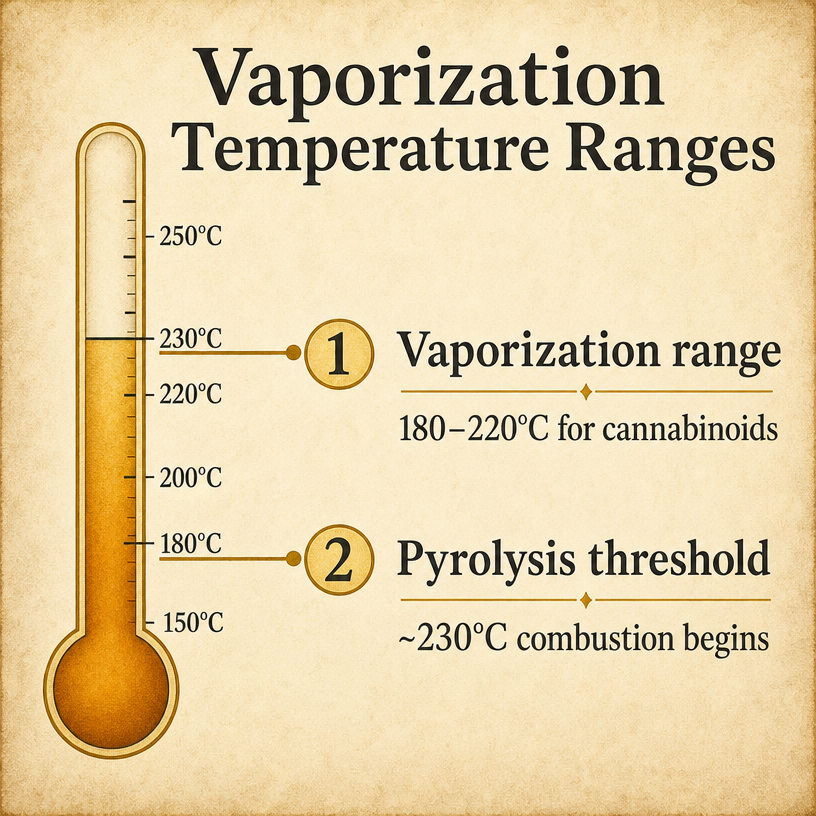
- Both heating methods operate well below the approximately 230°C threshold at which combustion begins when used as intended
- Convection heating carries a lower theoretical combustion risk because the herb never contacts a hot surface directly
- Conduction heating involves direct herb-to-hot-surface contact, which requires more careful temperature management to avoid scorching
- Research measuring tar content found notably lower tar per puff from vaporizers compared to cigarette smoking, regardless of heating method
- Proper device maintenance, following manufacturer temperature guidelines, and using the device as intended all support a safer experience with either vaporizer type
Pyrolysis, which is the scientific term for the thermal breakdown of plant material leading to combustion, begins around 230°C. The active compounds in herb vaporize at much lower temperatures, typically between 180 and 220°C. Reputable vaporizers are designed to operate comfortably within that vaporization range and below the pyrolysis threshold. [6]
Convection heating carries a lower theoretical risk of combustion because the herb never touches a heating surface. There is no hot metal in direct contact with the material, so the only way combustion could occur is if the airflow failed and heat built up significantly. Most modern convection devices have safety features that prevent that scenario. [4]
Conduction heating involves direct contact between the herb and a hot surface. Used properly, this does not cause combustion because the surface temperature is controlled and the herb does not stay pressed against it long enough to reach 230°C. But if a conduction device is left running unattended or set to an unusually high temperature, the risk of scorching or combustion increases compared to convection. [2]
Research measuring tar content per puff found that vaporizers produced 4.76–11.3 milligrams of tar per puff, compared to 140–310 milligrams per puff from cigarette smoking. [6]
Following manufacturer temperature guidelines, cleaning your device regularly, and using it as intended all contribute to a safer experience with either vaporizer type. You can explore the full range of Vaporizers at Treehouse Lifestyle to find a device that fits your needs.
| Factor | Conduction | Convection |
|---|---|---|
| Combustion risk | Low if used as intended; higher if left unattended at high temps | Lower — no direct herb-to-surface contact |
| Temperature control | Relies on controlled surface temperature | Air temperature is regulated, with safety shutoffs in modern units |
| Tar comparison | Significantly lower than smoking | Significantly lower than smoking |
What Is a Hybrid Vaporizer and How Does It Work?
A hybrid vaporizer combines conduction and convection heating in a single device. Rather than relying on one method exclusively, a hybrid uses both at the same time. The goal is to capture the strengths of each approach while offsetting their individual weaknesses. [1]
- A hybrid vaporizer uses both conduction and convection heating simultaneously in a single device to combine the speed of conduction with the even extraction of convection
- Most hybrid designs heat the herb through direct surface contact while also pushing hot air through the chamber at the same time
- Hybrids can offer faster heat-up times than pure convection units while delivering more consistent flavor than pure conduction devices
- The trade-off is added complexity — two heating systems mean more components, more maintenance, and a higher chance of calibration issues compared to single-method devices
- A well-designed hybrid can be an excellent choice for users who want versatility, but poorly designed hybrids may deliver the drawbacks of both methods without the benefits
In most hybrid designs, a conduction-heated chamber warms the herb through direct contact while a separate system pushes hot air through the material at the same time. The conduction element gets you to vaporization temperature quickly. The convection airflow helps distribute that heat more evenly throughout the chamber than conduction alone would achieve. [3]
Hybrids became popular as manufacturers looked for ways to offer the speed and compact size of conduction devices with the flavor and even extraction of convection. A well-designed hybrid can deliver fast heat-up times while still producing more consistent flavor across a full session compared to a pure conduction device. [2]
The trade-off is added complexity. Having two heating systems means more components that can potentially fail, more parts to clean, and more tuning required to get the balance right. A poorly designed hybrid can end up performing worse than a pure conduction or pure convection unit, with the drawbacks of both and the benefits of neither. [3]
For users who want the versatility of both heating methods in one device, a hybrid can be a good choice. Just make sure to research how a specific model implements the hybrid approach before buying. Not all hybrid designs are created equal. You can browse Portable Vaporizers to see options that include hybrid models alongside pure conduction and convection designs.
How Do I Choose the Right Heating Method for My Needs?
Choosing between conduction, convection, and hybrid heating comes down to matching your priorities to what each method does well. Here is a practical framework to work through as you evaluate options. [1]
- Set your budget first — conduction devices are the most affordable entry point, while convection and hybrid models typically cost more and offer meaningful advantages at higher price ranges
- Evaluate portability needs — conduction and hybrid models work well for on-the-go use, while most convection units are larger desktop designs better suited for home sessions
- Weigh flavor priority against convenience — convection produces more consistent flavor, but conduction devices offer speed and simplicity that many users prefer
- Consider preferred session length — convection supports longer, more consistent sessions while conduction works well for quick, fast draws
- Factor in experience level — beginners often find conduction more forgiving and intuitive, while experienced users may prefer the greater control offered by convection heating
First, set your budget. This is often the fastest way to narrow the field. Conduction vaporizers are generally the most affordable entry point, with many solid options in the $30–$150 range. Convection units typically start higher and can run to $500 or more. Hybrids usually fall in the middle to upper range. If budget is the primary constraint, conduction is the most accessible path. If you are willing to spend more for a premium experience, convection or hybrid models offer meaningful advantages. [2]
Second, consider how portability matters to you. If you want something you can carry in a pocket and use on the go, conduction or hybrid portable models are well-suited to that. Many convection units are desktop devices meant to stay on a countertop. Think about where you will use it most before deciding what type to pursue. [5]
Third, weigh flavor priority against convenience. Convection heating genuinely does produce better, more consistent flavor in most cases. But if you value speed and simplicity over nuanced taste, a conduction device may satisfy you perfectly well. Many experienced users start with conduction and eventually try convection before settling on a preference. [3]
Fourth, think about session length. Do you want a couple of quick draws and done, or do you prefer longer 10- to 15-minute sessions? Convection tends to support longer, more consistent sessions. Conduction can work well for short, fast hits. Knowing your preferred session style helps point you toward the right heating method.
Fifth, consider your experience level. Beginners often find conduction devices more intuitive to use — they heat fast, require no special technique, and tend to be more forgiving of inconsistent packing. As you learn how your herb responds to different temperatures and draw styles, you may find convection gives you more control over the experience. [5]
E-rigs and electric rigs, which are designed for concentrate use, operate on similar heating principles and are worth exploring if you also use dabs or concentrates alongside dry herb. Evaluating your full usage pattern helps ensure you pick a device that covers all your needs.
Browse E-rigs / Electric Rigs to explore related options.
What Are Common Questions About Smoking Accessories?
What is the difference between conduction and convection heating in vaporizers?
Conduction heats your material through direct contact with a hot surface. Convection heats it by passing hot air through the material with no direct contact. Both produce vapor, but convection generally preserves flavor better while conduction typically means faster heat-up and smaller devices.
Which type of vaporizer heats up faster?
Conduction vaporizers generally heat up faster because the heating element is in direct contact with the herb. Many conduction devices are ready to use within seconds, while convection devices may take longer because they need to heat air before it flows through the chamber.
Do convection vaporizers produce better flavor?
Convection vaporizers typically produce better flavor because the herb is heated evenly by hot air without touching a hot surface. This preserves delicate terpenes that direct-contact conduction heating can burn off, resulting in a clearer and more flavorful vapor.
What is a hybrid vaporizer?
A hybrid vaporizer combines both conduction and convection heating in a single device. A conduction-heated chamber preheats the herb while hot air (convection) flows through, aiming to capture the speed and efficiency of conduction with the flavor and even extraction of convection.
Are vaporizers safer than smoking?
Vaporizers operate at temperatures well below the approximately 230°C at which combustion begins, so they produce vapor without the smoke and tar associated with combustion. Studies have found vaporizers produce significantly less tar per puff compared to cigarette smoking.
Which Heating Method Should You Choose?
Conduction and convection heating each have real strengths, and neither is automatically the better choice for everyone. Conduction vaporizers offer speed, portability, battery efficiency, and a lower price of entry. Convection vaporizers deliver superior flavor consistency, more even extraction, and a lower theoretical combustion risk. Hybrid devices attempt to give you both, though the quality of that combination varies by model.
If you are new to vaporizers and want something affordable and easy to use, a conduction device is a reasonable starting point. If flavor is your main concern and you do not mind spending more or waiting a bit longer for heat-up, convection is worth exploring. If you want the flexibility of both methods in one device, look for a well-reviewed hybrid model.
The right choice ultimately depends on how you weigh factors like budget, portability, session style, and flavor priority. Think through each of those dimensions for yourself, and you will find it easier to narrow down the options. Use this guide as a reference when comparing devices, and you will be in a better position to pick a vaporizer that actually fits the way you want to use it.
Where Does This Smoking Accessory Information Come From?
- DynaVap: Conduction vs Convection Vaporizers: What’s the Real Difference?
- Vaping360: Convection vs Conduction: Is it a Heated Debate?
- Planet of the Vapes: Conduction vs Convection vs Hybrid: What’s the Difference?
- Healthy Rips: What Is A Convection Vaporizer And How Is It Different?
- TVape: Conduction vs Convection Vaporizers
- Fundación CANNA: Vaporizer Usage: Safety and Toxicology
- Canadian Journal of Public Health / NCBI PMC: Are vaporizers a lower-risk alternative to smoking cannabis?