

A DynaVap is a battery-free vaporizer you heat from the outside instead of plugging in. You load ground material into a small metal tip, put the cap back on, and heat the cap with a butane torch or an induction heater. Two discs inside the cap snap together at a set temperature and click, and that click is the only signal the device gives you: it means start drawing.
What Is a DynaVap, and How Does It Work Without a Battery?
Start with the names, because they trip people up. DynaVap is the company and VapCap is the device family. DynaVap calls its products Thermal Extraction Devices, while independent reviewers and most retailers still say butane vaporizer, battery-free vaporizer or manual vaporizer. None of those terms is wrong, so read them as synonyms and check the spec sheet instead of the label. [6] [19]
The physical idea is simple. A metal tip holds the ground material, a cap fits over the tip, and the heat comes from outside rather than from a coil or a battery. You are holding five parts: the tip and its chamber, the cap, the condenser that runs inside the stem, the stem itself, and the CCD screen at the bottom of the tip. Everything else is a variation on those five pieces. [2]
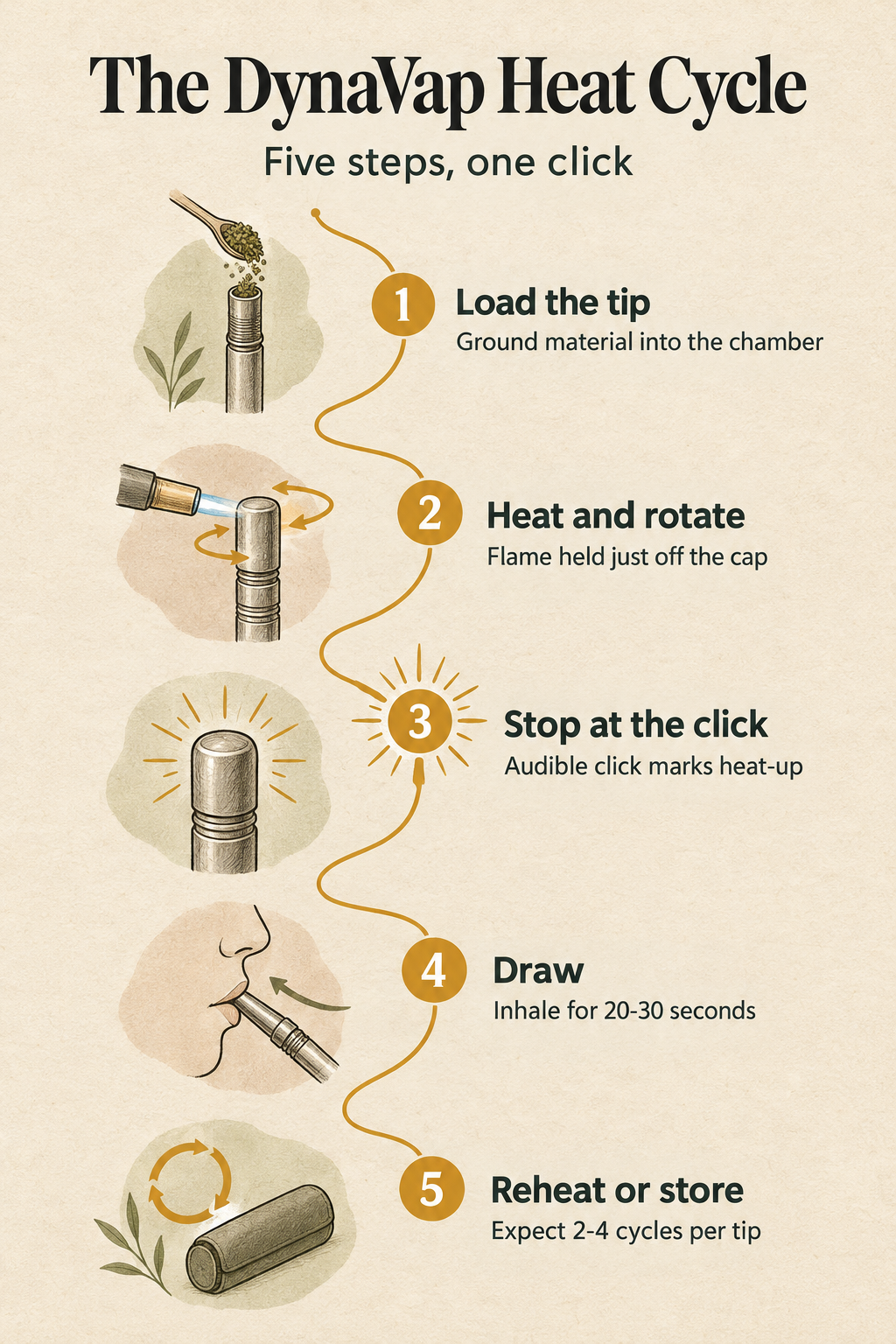
Before you load anything, run the loop once in your head. DynaVap’s own instructions break it into a short sequence, and the order matters more than the speed.
That is one heat cycle. A loaded tip usually gives roughly two to four of them, and each cycle has the same shape: heat to the click, draw, wait for the cool-down click, then decide whether to go again. [1] [6]
The click is mechanical, not electronic, and it is worth hearing once before you trust it. Some caps click once during heat-up and some click twice, with a soft click followed by a clearer one; DynaVap says both patterns are normal. The next section covers what is actually moving inside the cap. [4]
If what you actually want is a device you switch on and forget, a battery portable works differently. Something like the Pax Four Vaporizer starts with a button and a number on a screen, and the device holds that temperature for you. Everything in the current Vaporizers category on our shop falls into one of those two camps, so it helps to know which one you are shopping for before you compare prices.
One practical note for a new owner: the click is quiet in a noisy room. Do not wear headphones while you learn the device, and heat it somewhere you can hear a small metallic snap. That one habit explains a lot of first sessions that seem to go sideways.
- Slide the cap off the tip and set it down somewhere it will not roll away.
- Load ground material into the tip chamber and leave a little room at the top rather than packing it tight.
- Check that the CCD screen is seated in the tip, then press the cap back on until it sits snug.
- Hold the torch about an inch from the cap, aim at the N in the DynaVap logo, and turn the device slowly as you heat.
- Pull the flame away the moment you hear the click.
- Draw for roughly 20 to 30 seconds.
- Stop when the cool-down click arrives, so the cap can reset.
- Reheat for another cycle, or set the device down to store it.
What Does the DynaVap Click Mean, and What Temperature Does It Click At?
The click is a mechanical signal, not a readout. Two bimetal discs inside the crimped end of the cap snap together when they reach a set temperature, and the snap is what you hear and feel through your fingers. Nothing measures the chamber for you. The cap is the thermostat, and the click is the only way it can tell you anything. [4] [6]
DynaVap publishes the click temperatures as design specifications, and its own pages give slightly different figures. Its support article lists the standard cap at 230 to 250 degrees Celsius and the low-temperature cap at 205 to 220 degrees Celsius; its cap comparison page instead says roughly 240 degrees Celsius plus or minus 10 for the standard cap and roughly 215 degrees Celsius plus or minus 10 for the low-temperature version. [3] [4] Report the range rather than a single number, because the cap is a mechanical part built to a tolerance and DynaVap’s two pages describe that same tolerance differently. Those figures are manufacturing specs, not guidance on what a session will feel like.
Caps are not one product either. DynaVap sells several, and the differences are worth knowing before you assume your device is faulty because it behaves unlike a friend’s.
The rule that matters most is short: stop at the click. DynaVap says going one to two seconds past the click is a user-preference option, and that more than three seconds past the click permanently damages the cap. Heating the very end of the cap causes a premature click, which means the device tells you it is ready long before the chamber is. You also have to wait for the cool-down click before reheating, because a cap that never resets cannot click again. [3] [5]
If no click comes within about four seconds of steady heating, stop and let the cap cool. That is DynaVap’s own troubleshooting advice, and it usually means the flame is in the wrong place, the cap is already warm, or the torch is struggling. Caps also darken with use, which is cosmetic and expected, though a dented or deformed cap is a different story and should be replaced. [3]
If you want the wider picture before going deeper, What Is a Vaporizer and How Does It Work? covers the basics of what a vaporizer is doing in the first place, and What Is a Dry Herb Vaporizer and How Does It Work? explains the same mechanics for battery devices. Still narrowing the field? How Do You Choose the Right Portable Vaporizer? walks through the buying questions, and Portable vs Desktop Vaporizer: Which Fits Your Routine? covers the desktop side of that decision. Concentrate hardware is a separate conversation: a device like the Dr Dabber XS e-Rig Portable Vaporizer uses a different chamber design entirely, which is why the click rules above are specific to dry material in a DynaVap tip.
- Captive Cap: the standard cap on every current device, with captive indents that grip the tip and a click near DynaVap’s roughly 240 degree Celsius specification.
- Low Temp Captive Cap: the same captive design built to click lower, around 215 degrees Celsius plus or minus 10, and marked with its own logo so you can tell it apart.
- Standard Cap: the original cap with no captive indents, the same click range as the Captive Cap, and a looser fit that some long-time owners still prefer.
- Armored Cap: a Captive Cap inside a stainless steel shell, with extra mass that changes how long a heat cycle runs and how the cap behaves on an induction heater.
- Rule for all of them: stop at the click, wait for the cool-down click before reheating, and never heat past three seconds after the click.
How Long Should You Heat It, and Does Heat Placement Change the Result?
Heat-up time depends on two things you control and one you do not: the heat source, the tip material, and the cap itself. DynaVap’s own pages disagree slightly, which is a useful reminder that these are typical ranges rather than guarantees. Its support article gives three to six seconds for a torch on a titanium tip and about fifteen seconds for a soft flame. Its blog timing table is a little more generous, and it also covers stainless steel and induction heating. [5] [7]
Hold both sets of numbers loosely. The signal to stop is the click, not a stopwatch. A titanium tip moves heat into the chamber faster than a stainless tip, a single-flame torch adds heat more slowly than a triple-flame torch, and a warm device clicks sooner than a cold one on the second cycle. Time is what you notice while you learn. The click is what you trust.
Placement is the other half of the technique, and it changes more than timing does. DynaVap advises heating the middle and back of the cap rather than the very end, rotating steadily so no single spot takes all the heat, and holding the flame just off the metal instead of burying the cap in it. Heat the tip end and you get the premature click described above, which reads as a device that stopped working when it is really just being heated in the wrong place. [3] [5]
DynaVap also publishes guidance that heating higher on the cap produces a different vapor density than heating lower down, describing the higher position as lighter and the lower position as thicker. Read that as manufacturer technique guidance about where the heat lands, not as a promise about what a session will feel like. The honest version is that position changes how quickly the chamber comes up to temperature and how long a cycle lasts. [7]
After the draw, the cap needs to cool before it can click again. DynaVap puts the cool-down wait at roughly half a minute, which means a full heat-to-cool cycle runs about thirty seconds end to end, and a loaded tip with two to four cycles is a several-minute process rather than a thirty-second one. [1] [7]
Heat placement is not a DynaVap-only idea, either. Why Do Dabbers Prefer Quartz Pipes and Bangers? looks at how quartz responds to a torch, and the same principle applies: where the heat goes matters as much as how much of it there is.
- Jet torch with a titanium tip: DynaVap’s blog lists 5 to 7 seconds, and its support article says 3 to 6 seconds.
- Jet torch with a stainless steel tip: 6 to 10 seconds, because stainless takes longer to come up to temperature.
- Soft flame lighter: about 15 seconds on both of DynaVap’s pages, with soot on the cap as the trade-off.
- Induction heater: 10 to 15 seconds, with no rotation needed.
- Placement: aim at the middle and back of the cap, rotate steadily, and keep the flame just off the metal.
Torch, Soft Flame, or Induction Heater: Which Heat Source Should You Choose?
You have three realistic ways to heat the cap, and they are a genuine choice rather than a hierarchy. A torch is the fastest and the most portable, but you have to rotate the device steadily for the whole heat-up and keep refillable fuel on hand. A soft flame is slower, and Planet of the Vapes notes that it leaves soot on the tip. An induction heater heats the cap without any spinning and gives more repeatable timing, because the coil does the work instead of your wrist. [7] [18] [6]
Torch choice changes control more than most people expect. A single-flame torch heats slowly enough that you can react, which is why it is the usual recommendation for learning. A multi-flame torch gets to the click faster and gives you less room to correct a mistake. Planet of the Vapes covers both patterns, along with bleeding and refilling a torch before the first use. [18]
The most common induction heater in this world is The Wand, and one detail is worth stating plainly: it is made by Ispire, not by DynaVap. DynaVap sells it with a DynaVap adaptor, borosilicate glass cups, a USB-C charging cable and a one-year warranty. Manual mode uses five presses of the fire button with the adaptor installed. Automatic mode uses a double press of the power button without the adaptor, and either way the device heats a DynaVap without spinning it. [15]
Torch handling deserves a factual answer rather than a vibe. Butane torch lighters are regulated consumer products. On July 16, 2026 the Consumer Product Safety Commission announced recall 26-626 covering about 13,200 Jobon butane torch lighters, sold on Amazon and Alibaba from April 2021 through September 2025 for roughly $5 to $20, because they lacked the child-resistant mechanism required under the mandatory safety standard for multipurpose lighters. Consumers were told to stop using them immediately. [20]
The practical translation is not complicated. Buy a torch that meets the standard, follow the torch maker’s instructions for refilling and storage, and keep fuel and lighters away from children. A DynaVap holds no fuel of its own, so the torch is the part of the setup that needs the most attention, and it is also the part people handle casually because it cost twelve dollars.
- Torch: fastest heat-up, works anywhere, needs steady rotation and a refillable butane supply.
- Single-flame torch: slower heat-up with finer control, which makes it the easier one to learn on.
- Multi-flame torch: faster heat-up with less precision, and less time to react before the click.
- Soft flame: slowest of the flame options, leaves soot on the cap, and is the least fussy about technique.
- Induction heater: no rotation, more repeatable timing, but it is another battery device to charge and carry.
Which DynaVap Model Fits How You Actually Use It?
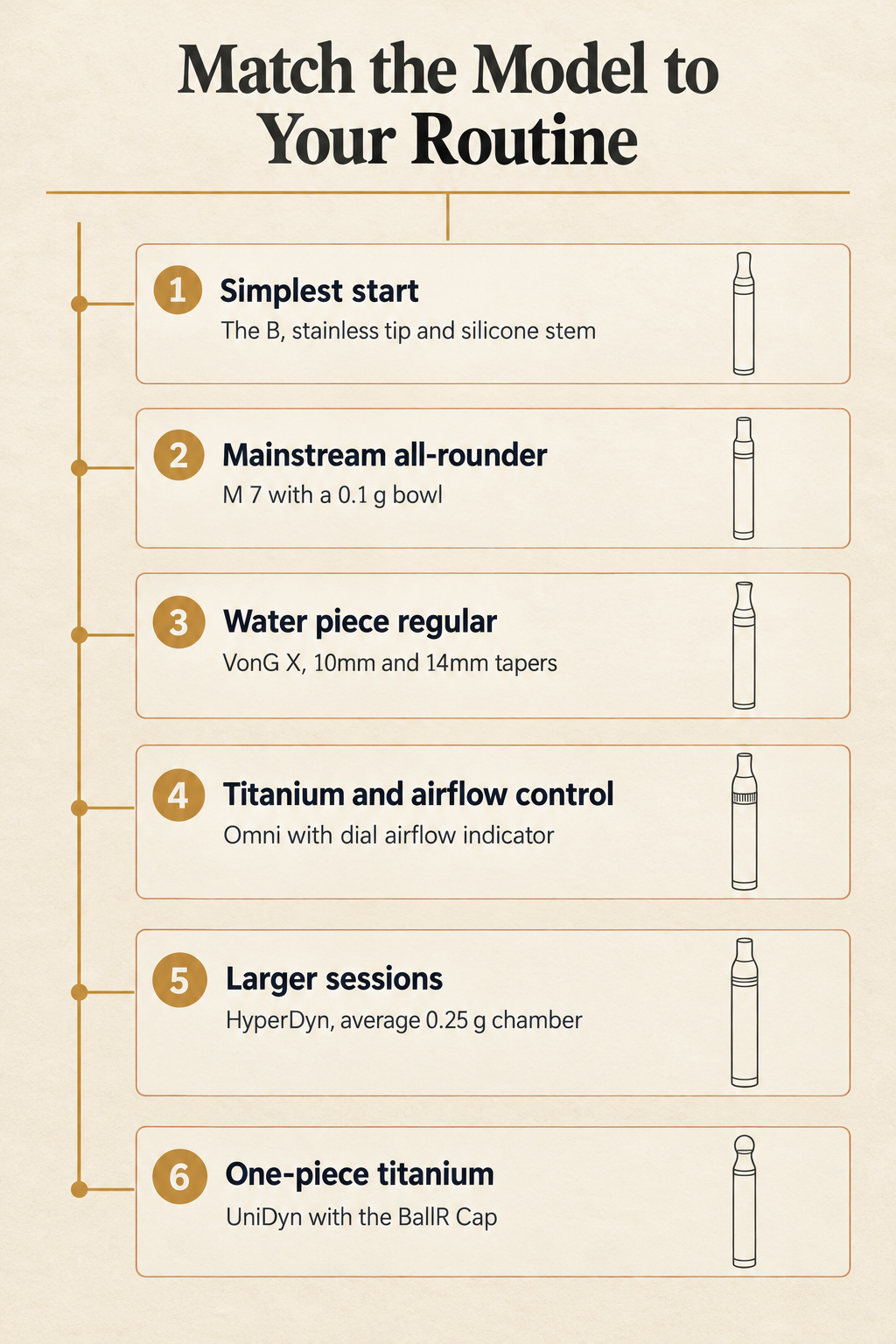
Think of the lineup as a set of trade-offs rather than a ladder, because the expensive model is not automatically the right one. Each device answers a different question: how much material you want to load, whether you use a water piece, how much you care about airflow adjustment, and whether you want titanium or stainless steel in your hand. There is no universally best butane vaporizer, and any guide that names one winner is selling something. [8] [9] [10]
Two of the newer models get confused constantly, so separate them here. The HyperDyn is the big-bowl device, with an average 0.25 gram chamber, titanium construction with a DuraDyn finish, built-in 10mm and 14mm tapers, and seven airflow settings set by condenser depth. Its Hyper Cap fits only the Hyper Tip. The UniDyn is a different animal: a one-piece titanium UniBody that integrates tip and stem, a 0.1 gram bowl, the BallR Cap, a HypoTherm heat break between chamber and stem, and only two o-rings in the whole device. [13] [14]
Chamber size is where most buying decisions actually get made, and adjust-a-bowl is the feature that solves it. On the M 7, the Omni, the VonG X, the WoodWynd and the UniDyn, adjust-a-bowl halves the chamber, which is how microdosing works on these devices without buying a second tip. Standard tips are listed at 0.1 grams, older M chambers were adjustable from 0.05 to 0.1 grams, the HyperDyn averages 0.25 grams, and the Hyper dosing capsule holds about 0.125 grams. [9] [13] [19]
Then there is availability, which a manufacturer lineup page will never tell you. The Treehouse Lifestyle catalog currently lists three DynaVap pieces in the Vaporizers category: the HyperDyn at $229.00 in stock, the DynaVap UniDyn Ball Vape at $129.00 in stock, and the WoodWynd Blackwood at $179.00, which was listed as out of stock at the most recent catalog sync. Check the live product page before you order, since stock moves faster than any snapshot. [21] [22] [23] [24] Shipping is free shipping on orders $150+, which the HyperDyn and the WoodWynd both clear on their own.
One buying note that saves a return: decide about water pieces early. If you already own a bong and plan to use the device with it, a model with built-in tapers saves you an adaptor and a wobble. If you never use water, paying for tapers buys you nothing.
- Simplest possible start: the B, with a stainless steel tip and a silicone stem, and a 10mm tapered mouthpiece.
- Mainstream all-rounder: the M 7, the stainless model with a 0.1 gram bowl and a pivot-style rocker airport for airflow.
- Battery-free flagship in titanium: the Omni, with a dial airflow indicator and a spiraled condenser, plus a notched chamber that doubles as a built-in grinder.
- Regular water-piece user: the VonG X, with 10mm and 14mm tapered mouthpiece ends and a mouthpiece-based airport you twist to open or close.
- Wood with a titanium tip: the WoodWynd, an hourglass wood stem with stainless crowns, a Helix titanium tip, and a fit with 10mm openings even without a taper.
- Fewer reloads per session: the HyperDyn, with an average 0.25 gram chamber, built-in 10mm and 14mm tapers and seven condenser airflow settings.
- One-piece titanium: the UniDyn, with the BallR Cap, a HypoTherm heat break and two o-rings, in XL length.
Which Parts Wear Out, and What Is Actually Interchangeable?
These are small mechanical parts, so some of them are consumables by design. Caps, CCD screens, high-temperature o-rings and condensers are the four replacement parts to budget for. DynaVap notes that caps darken with use and can be permanently damaged by overheating, which is another reason the click discipline matters. Read these as normal wear items rather than defects, and expect to replace a screen or an o-ring long before you replace anything expensive. [2] [3] [8]
Interchangeability is mostly true, with specific exceptions that people discover the hard way. DynaVap says its devices are modular and that parts can be mixed and matched across tips, stems and condensers. The exceptions: the Hyper Cap fits only the Hyper Tip, the Armored Cap fits any tip except the Hyper Tip, and the VonG X mouthpiece airflow control will not adjust airflow on other devices. Never assume blanket cross-compatibility without checking those three. [2] [13] [16] [11]
The Armored Cap deserves an honest description, including its status. It is a Captive Cap enclosed in a stainless steel shell, and the extra mass means DynaVap says you can reach full extraction in one to two heat cycles with no spinning needed during torch heating. Its 12mm diameter makes induction heater compatibility vary, though it does work with The Wand without the adaptor. DynaVap’s own product page labels it discontinued, so read it as a legacy part rather than a mainstream upgrade. [16] [3]
Before the first session, run an inspection. The parts are small enough that a missing piece is easy to miss until the device behaves strangely, and the checks take under a minute.
- Check that the cap is undamaged and free of dents.
- Confirm the CCD screen is seated at the bottom of the tip.
- Check that the high-temperature o-rings are intact, remembering that the B needs none on its tip.
- Confirm the condenser is inside the stem where it belongs.
- Do an empty dry run, with no material loaded, to confirm the cap clicks.
- Do a shake test to confirm the cap does not slide off before you load anything.
How Do You Clean and Maintain a DynaVap?
Cleaning is straightforward, but the cap has hard limits that are easy to break by accident. The rest of the device can go through hot water and dish soap, an isopropyl alcohol bath followed by a rinse, or the dishwasher. The cap cannot: it is not dishwasher safe and must never be soaked or submerged. Clean the inside of the cap with a q-tip dipped in isopropyl alcohol or water, and keep the liquid out of the discs. [2]
Drying matters as much as cleaning. Let every part dry completely before you reassemble and use it, because trapped moisture in a condenser or a tip is the usual cause of a first draw that tastes wrong. If parts feel stiff when you put them back together, DynaVap suggests DynaWax or a food-grade, non-flammable lubricant on the o-rings. [2]
Then there is the guarantee question, which is where two separate policies get blended into one in a lot of conversations. DynaVap offers a 90-day money-back guarantee on DynaVap-manufactured devices bought directly from DynaVap. It names the M, B, VonG, Omni, WoodWynd and Hyper devices plus tips, caps, condensers, spinning mouthpieces, the Armored Cap, DynaCoil and SlingStash, and it excludes misuse, extreme wear, missing parts, contaminated products, multi-packs returned individually and color imperfections on colored devices. [17]
That guarantee is DynaVap’s, and it applies to purchases made directly from DynaVap. Treehouse Lifestyle’s own return terms are a separate policy, and the two are not the same thing. If you bought from us, our terms govern your purchase, and DynaVap’s guarantee is not a promise we made or one we are obligated to honor. Check the retailer’s terms where you actually bought the device, and keep your receipt.
Maintenance is also where the earlier parts list pays off. A quick look at the o-rings and the screen every few cleanings catches most problems before they turn into a device that will not seal, and a cap that has lost its click is a replacement item rather than a repair project.
- Disassemble the device and set the cap aside, well away from water.
- Clean the tip, condenser and stem in hot water with dish soap, an isopropyl bath followed by a rinse, or the dishwasher.
- Clean the inside of the cap with a q-tip dipped in isopropyl alcohol or water, without soaking it.
- Rinse everything thoroughly, then let every part dry completely before reassembly.
- Apply DynaWax or a food-grade, non-flammable lubricant to stiff o-rings.
- Reassemble, then do a dry run to confirm the cap still clicks.
DynaVap vs a Battery Vaporizer: Which One Fits Your Routine?
The comparison is operational, and it comes down to what you are willing to carry and how much you want the device to decide for you. A DynaVap has no battery and no charging, so there is no runtime limit and fewer electronics that can fail. The trade is that every session needs a torch or an induction heater, there is no digital setpoint, and the click is the only feedback you get. [6] [7]
A battery portable gives you push-button startup and digital temperature control, with steadier results from session to session. You pay for that in charging, battery aging, and more parts that can fail. Neither list is a criticism of the other device. They are different answers to the same question about how much of the work you want to do yourself.
Be honest about the learning curve, because it is real. Vaping360 calls the heating process the most challenging part of using a DynaVap and says results are less consistent than push-button devices, while Planet of the Vapes notes that torch choice affects control and heat-up speed. Expect the first few sessions to be practice. Technique improves with repetition, and the people who like these devices usually like them because of that, not in spite of it. [19] [18]
One thing this guide will not do is repeat manufacturer marketing as fact. DynaVap’s product copy describes devices that eliminate combustion, reduce the byproducts associated with it, and use less than half your material. Those are manufacturer marketing statements, not independently verified findings, and this article makes no health, emissions or efficiency guarantee of any kind. If those claims matter to your decision, read the primary material and decide for yourself. [8] [10]
What is left is a fair summary. If you want a device that works in the cold, never needs a charge, and rewards attention, a DynaVap is a reasonable answer. If you want to press a button in the dark and get the same result every time, a battery portable is the better fit. Both are legitimate, and the wrong choice is usually the one you made without thinking about which of those two people you are.
- Power: no battery and no charging on a DynaVap, versus a battery you charge and eventually replace.
- Feedback: an audible click on a DynaVap, versus a screen with a set temperature on a battery device.
- Consistency: more repeatable session to session on a battery device, more dependent on your hands on a DynaVap.
- Kit: a DynaVap needs a torch or an induction heater, while a battery portable needs a cable.
- Failure points: fewer electronics on a DynaVap, but caps, screens and o-rings are wear items.
- Learning curve: a few practice sessions on a DynaVap, and almost none on a battery portable.
| Aspect | DynaVap device | Battery vaporizer |
|---|---|---|
| Power | No battery; heated by torch or induction heater | Rechargeable battery you charge and replace |
| Feedback | Audible click from the cap | Screen showing a set temperature |
| Consistency | Depends on your heating technique | Push-button startup, steadier session to session |
| Kit | Torch or induction heater, plus fuel or charging | Device and a charging cable |
| Wear items | Caps, CCD screens, o-rings, condensers | Battery, chamber parts, electronics |
Frequently Asked Questions
Do I have to use a butane torch, or can I use an induction heater?
Either works. A torch is the fastest option and the most portable, but you have to rotate the device steadily while you heat it. An induction heater heats the cap without any spinning and gives more repeatable timing, which is why people who do not want to fuss with technique tend to prefer one. The Wand is made by Ispire rather than DynaVap and ships with a DynaVap adaptor, glass cups, a USB-C cable and a one-year warranty.
Can the cap get wet when I clean the device?
No. The cap is not dishwasher safe and must never be soaked or submerged, even though the rest of the device can go in a dishwasher, through an isopropyl bath, or into hot water with dish soap. Clean the inside of the cap with a q-tip dipped in isopropyl alcohol or water, then let every part dry completely before you use it again.
Why does my DynaVap taste harsh or burnt?
The usual cause is heat past the click. Going more than three seconds beyond the click permanently damages the cap, and heating the very end of the cap gives you a premature click and uneven results. Stop at the click, wait for the cool-down click before reheating, and aim the flame at the middle and back of the cap rather than the tip end.
How many heat cycles should one loaded bowl give me?
DynaVap suggests expecting roughly two to four heat-up cycles per loaded tip, with a cool-down click between each one. If you want more sessions from the same chamber rather than a bigger one, adjust-a-bowl halves the chamber on the M 7, Omni, VonG X, WoodWynd and UniDyn, and chamber sizes run from a 0.1 gram standard tip up to an average 0.25 grams on the HyperDyn.
Are DynaVap parts interchangeable between models?
Mostly, but not universally. DynaVap describes its devices as modular and parts can be mixed and matched across tips, stems and condensers, with named exceptions: the Hyper Cap fits only the Hyper Tip, the Armored Cap fits any tip except the Hyper Tip, and the VonG X mouthpiece airflow control will not adjust airflow on other devices.
Which DynaVap models does Treehouse Lifestyle carry right now?
The current catalog lists three DynaVap pieces in the Vaporizers category: the HyperDyn at $229.00 in stock, the UniDyn Ball Vape at $129.00 in stock, and the WoodWynd Blackwood at $179.00, which was listed as out of stock at the latest catalog sync. Check the live product page before you order, since stock moves. We also offer free shipping on orders $150+.
So Which DynaVap Should You Actually Buy?
Buy the device that matches your routine, not the one at the top of the range. If you want the cheapest way to find out whether you enjoy heating a device by hand, the B is the entry point, with its stainless tip and silicone stem and its 10mm tapered mouthpiece. If you want the mainstream all-rounder that most people end up with, that is the M 7 and its 0.1 gram bowl. Neither is a compromise, and neither requires you to learn anything the other does not. [8] [9]
Past that, the questions get specific. Do you use a water piece most sessions? The VonG X has 10mm and 14mm tapered ends built for it. Do you want titanium with airflow you can dial in? That is the Omni. Do you want fewer reloads? The HyperDyn averages 0.25 grams and carries seven condenser airflow settings. Do you want one-piece titanium with the BallR Cap? That is the UniDyn. If wood is the appeal, the WoodWynd pairs a wood stem with a titanium Helix tip, though it was out of stock at the last catalog sync, so confirm availability first. [10] [11] [12] [13] [14]
Whatever you pick, three habits do most of the work. Stop at the click, aim at the middle and back of the cap rather than the end, and wait for the cool-down click before you reheat. Those three rules cover the overwhelming majority of the problems new owners run into, and the rest is practice with a device that tells you when it is ready. [3] [5]
Shop our Vaporizers category to see current pricing and stock, and remember that the device is the cheap part of the habit to learn. A compliant torch and a spare screen or two will do more for your first month than any upgrade will.
Sources
- DynaVap: How to Use a DynaVap (official step-by-step page)
- DynaVap: DynaVap FAQ (getting started, inspection, cleaning, cap fitment)
- DynaVap Support: Everything about Caps!
- DynaVap Support: What is the difference between the caps?
- DynaVap Support: How to heat a DynaVap Vaporizer
- DynaVap: Respect the Click: The DynaVap Rule New Owners Need
- DynaVap: How Long Should You Heat a DynaVap? Mastering DynaVap Click Timing
- DynaVap: The "B" product page
- DynaVap: The M 7: TwoToniuM product page
- DynaVap: The Omni collection page
- DynaVap: The VonG X product page
- DynaVap: WoodWynd product page
- DynaVap: The HyperDyn product page
- DynaVap: The UniDyn – Ball Vape product page
- DynaVap (product made by Ispire): The Wand with Adaptor
- DynaVap: The Armored Cap product page
- DynaVap: 90-Day 100% Satisfaction Guarantee
- Planet of the Vapes: How to Use a DynaVap Vaporizer (quickstart guide)
- Vaping360: DynaVap VapCap M 2020: A Journey Into the Dynaverse
- U.S. Consumer Product Safety Commission: Jobon Torch Lighters Recalled Due to Risk of Serious Injury or Death from Fire and Burn Hazards
- Treehouse Lifestyle: Vaporizers category page
- Treehouse Lifestyle: The HyperDyn – Treehouse Lifestyle product page
- Treehouse Lifestyle: Dynavap UniDyn – Ball Vape – Treehouse Lifestyle product page
- Treehouse Lifestyle: Dynavap WoodWynd: Blackwood – Treehouse Lifestyle product page