
A complete guide to understanding, choosing, and using dry herb vaporizers
A dry herb vaporizer is an electrical device that heats cannabis flower to a temperature below the point of combustion, producing vapor instead of smoke. The flower is ground and placed in a sealed chamber where electrical heat — either from a heated surface (conduction) or flowing hot air (convection) — turns plant material into inhalable vapor. Portable Vaporizers run on rechargeable batteries for on-the-go use, while desktop units plug into a wall outlet and deliver higher output for home sessions. Combustion burns at roughly 230–315 °C (445–600 °F), while vaporizers operate within a target temperature range that sits below that threshold. [1]
What Is a Dry Herb Vaporizer and How Does It Work?
A dry herb vaporizer is a device that uses electrical heat to vaporize cannabis flower in a sealed chamber, producing vapor for inhalation without the flame or smoke associated with combustion. [1] The key difference from smoking is temperature: combustion occurs at roughly 230–315 °C (445–600 °F), while a vaporizer stays within a target range below that threshold. The result is a mist that carries plant material in vapor form, delivered through a mouthpiece attached to the heated chamber.
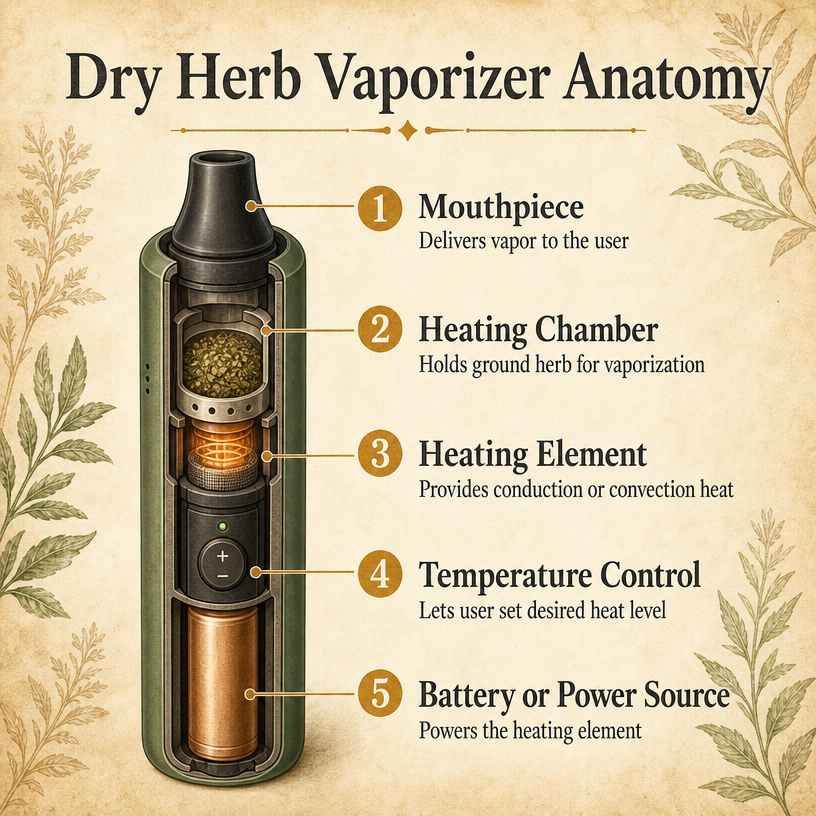
- Heating chamber: the sealed compartment that holds ground cannabis flower during vaporization
- Heating element: a surface heater (conduction) or hot-air source (convection) that brings the chamber to the target temperature
- Temperature control system: a dial, button, or app interface that lets the user set and hold the desired heat level
- Power source: a rechargeable battery for portable units or a fixed power connection for desktop models
- Mouthpiece: the opening through which vapor travels from the chamber to the user
The basic anatomy of a dry herb vaporizer includes several core components that work together. A heating chamber holds the ground cannabis flower. A heating element — either a heated surface or a hot-air source — brings the material to the target temperature. Temperature controls let the user adjust and maintain the heat level. A battery or power cord supplies energy. And a mouthpiece delivers the vapor from the chamber to the user. [1]
It is worth distinguishing a dry herb vaporizer from other vaporization devices on the market. The broad colloquial term "vape" can refer to e-cigarettes, dry herb vaporizers, or concentrate pens depending on context. [1] A dry herb vaporizer specifically heats ground cannabis flower in a chamber. Concentrate pens vaporize oils and waxy extracts, and e-cigarettes heat e-liquid containing nicotine. Each device type has a different form factor, maintenance routine, and consumable. Understanding this distinction helps first-time buyers avoid confusion when shopping.
What Are the Main Types of Dry Herb Vaporizers?
Dry Herb Vaporizers fall into two broad categories based on how they are powered and where they are designed to be used. Portable vaporizers are battery-powered and built for on-the-go use. Desktop Vaporizers require a wall outlet and are built for higher output in a home setting. [2] The choice between them comes down to lifestyle: frequent travelers and commuters generally prefer portable units, while home users who want maximum vapor production and precise temperature control tend to favor desktop models.
- Portable vaporizers: battery-powered, designed for on-the-go use, compact enough to carry in a bag or pocket
- Desktop vaporizers: require a power outlet, larger heating elements, more precise temperature control, better suited to home sessions
- Straight bore chambers: direct airpath through the heating zone, simple design and straightforward to clean
- Venturi chambers: narrowed tube accelerates airflow, which affects vapor density and draw feel
- Sequential venturi chambers: two-stage design that adds another layer of pressure and flow control for more managed extraction
Within these two categories, vaporizers also differ by the internal design of their extraction chamber. The three most common chamber geometries are straight bore, venturi, and sequential venturi. [1] Straight bore chambers are the simplest design — a direct path for air to pass through the heating zone. Venturi chambers use a narrowing tube to accelerate airflow as it passes the heat source. Sequential venturi chambers add a second stage that further controls pressure and vapor density. These designs affect how smoothly air draws through the device and how efficiently vapor is produced.
Some notable manufacturers shape their entire product lineup around specific form factors. Storz & Bickel, for example, produces both precision-grade and consumer vaporizers across desktop and portable lines — including the Volcano series (desktop), Mighty and Crafty (portable), and the newer Venty series. [3] Other brands focus primarily on one category, such as ultra-compact pens designed for discretion or high-powered units built for dense vapor clouds. Understanding the form factor that fits your routine is a practical first step in narrowing down the market.
Read What Is a Vaporizer and How Does It Work? for more detail.
What Is the Difference Between Conduction and Convection Heating?
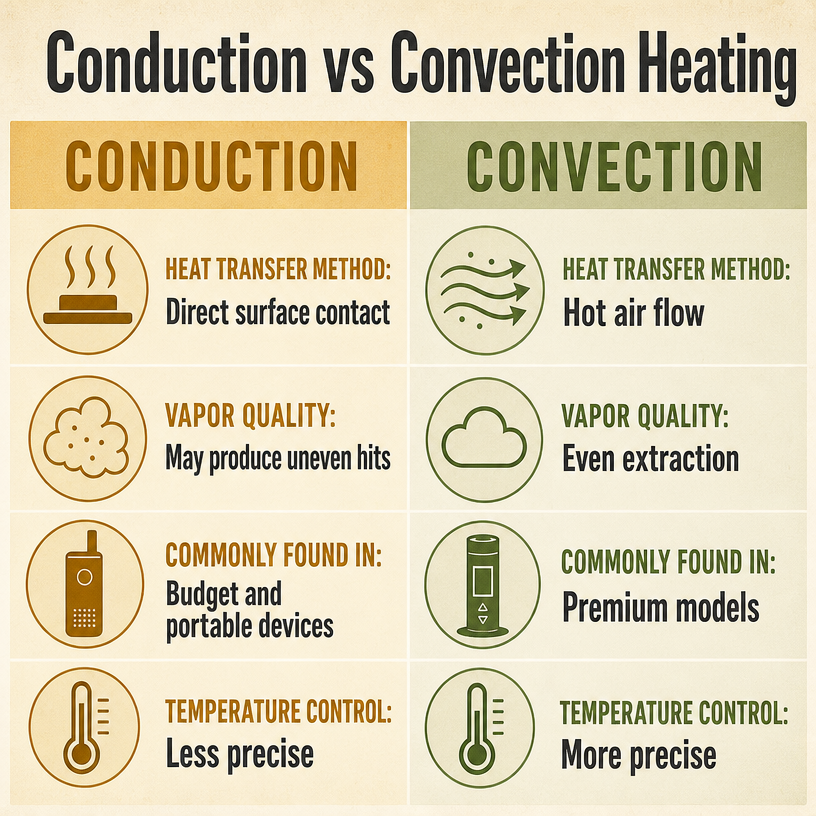
The heating method inside a dry herb vaporizer is one of the most important technical distinctions between devices. Conduction heating works by direct contact — the ground herb sits against a heated surface, typically a metal chamber wall or a ceramic plate. [1] Heat transfers from the surface directly into the material. This method is straightforward and common in more affordable and compact devices.
- Conduction: herb contacts a heated surface — simple and efficient, but prone to uneven heating where the herb touches the hot surface first
- Convection: hot air flows through the herb — more even vaporization and precise temperature control, but typically requires more power and appears mainly in higher-end devices
- Hybrid: combines both methods — aims for the efficiency of conduction with the consistency of convection
Convection heating works differently. Instead of the herb touching a hot surface, hot air is forced or drawn through the herb, carrying heat with it. [1] The air itself is heated by an element located away from the herb, then guided through the chamber so the material is heated by the passing air rather than by contact. [3] This method typically produces more even vaporization across the entire load and gives the user more precise control over the temperature of each draw.
Here is a side-by-side breakdown of how the two methods compare across the factors that matter most to users.
Many mid-range and premium devices combine both conduction and convection in a hybrid approach. The hybrid method attempts to capture the efficiency of conduction heating while using convection airflow to reduce hot spots and improve the consistency of each draw. This is worth knowing because the distinction is not always clear-cut in product marketing — reading the technical specifications or reviews helps confirm which method a device actually uses.
Read What Are the Different Types of Bongs? for more detail.
What Temperature Does a Dry Herb Vaporizer Operate At?
Dry herb vaporizers operate in a temperature range that sits below the combustion threshold of cannabis flower. Combustion — the point at which open flame touches the material and creates smoke — begins around 230–315 °C (445–600 °F). [1] Vaporizers are designed to stay below this range, generally between 155 °C and 230 °C (311–446 °F), though many users spend most of their time between 180 °C and 210 °C (356–410 °F).
- Below 180 °C (356 °F): lighter vapor, more aromatic profile, less visible output
- 180 °C to 210 °C (356–410 °F): the most commonly used range for most users, producing a balance of vapor density and temperature
- Above 210 °C (410 °F): denser vapor and more visible output, at the upper end of the typical vaporization range
- Combustion threshold: 230–315 °C (445–600 °F) — temperatures above this range produce smoke rather than vapor
Temperature settings affect what the vapor looks and feels like. Lower temperatures tend to produce a lighter, more aromatic vapor with less visible output. Warmer settings generate denser vapor with more visible clouds. The exact results vary with the moisture content of the herb, the grind consistency, and the specific device. This is a subjective and personal tradeoff — there is no universally correct temperature, and finding what works best involves some experimentation.
Most modern vaporizers give users adjustable temperature control with a stated minimum and maximum. A typical portable device might offer 160 °C to 220 °C, while some desktop units stretch up to 240 °C. The practical range for most people falls between 180 °C and 210 °C, and most first-time users find a workable starting point in the middle of that band and adjust from there based on the vapor they see and feel. Factors like the moisture content of the herb and the grind consistency also influence what temperature works best in practice.
Read Bong vs Pipe vs Vaporizer: Which Is Right for You? for more detail.
What Should I Look for When Buying a Dry Herb Vaporizer?
Choosing a dry herb vaporizer involves weighing several practical factors that affect day-to-day use. The list below covers the criteria that matter most for first-time buyers. Think through each one based on how and where you plan to use the device.
- Heating method: conduction (direct contact, more affordable), convection (hot air flow, more even vaporization), or hybrid (combination of both)
- Battery capacity: for portable units, higher mAh means more sessions per charge; factor in your typical usage frequency
- Temperature range and control: adjustable in small increments is more useful than a few fixed presets; wider range offers more flexibility to experiment
- Chamber material: stainless steel (durable and common), ceramic (even heating, favored for flavor), or glass (premium taste but more fragile)
- Ease of cleaning: removable chambers and accessible airways make routine maintenance simpler and extend device life
- Warranty: one to three years of coverage is typical for reputable brands; lack of a clear warranty is a red flag
Heating method is the foundational choice. Conduction heats through direct contact, is generally more affordable, and appears in more compact designs. Convection heats through hot air and typically delivers more even vaporization, but devices using this method tend to cost more. Many devices use a hybrid of both. Knowing this distinction helps cut through marketing language and understand what you are actually getting. [1] [3]
Battery life matters most for portable units. Capacity is measured in milliamp-hours (mAh) — higher numbers mean more sessions between charges. Real-world battery performance depends on the set temperature and how long each session runs. For occasional use, a compact device with a moderate mAh rating may be sufficient. For all-day or multi-session use, prioritize a higher capacity battery or carry a spare.
Temperature range and control also deserve attention. Look for a device that lets you adjust the heat in small increments, not just a handful of fixed presets. A wider range — ideally starting around 160 °C and going up to at least 220 °C — gives more flexibility to experiment. Digital temperature displays are more precise than colored lights or vague Low/Medium/High settings.
Chamber material affects heat distribution and vapor flavor. Stainless steel is common and durable. Ceramic chambers tend to heat more evenly and are favored by users who prioritize flavor. Glass chambers are used in some higher-end designs. Each material has different cleaning and maintenance needs.
Ease of cleaning is often overlooked until the first deep clean is needed. Devices with removable, accessible chambers are simpler to maintain than those requiring tools or partial disassembly. Regular cleaning extends the life of the heating element and maintains consistent vapor flavor over time.
Warranty coverage signals how much confidence the manufacturer has in the product and gives you recourse if something goes wrong. Reputable brands typically offer one to three years of coverage. Budget models with no stated warranty or unclear return policies are worth approaching with caution.
How Do I Use a Dry Herb Vaporizer Step by Step?
Using a dry herb vaporizer for the first time involves a straightforward sequence of steps. Once you have done it a few times, the process becomes quick and routine. The following steps cover a complete session from preparation through post-session cleanup. [2]
- Charge the device fully and grind the cannabis flower to a medium-fine consistency
- Load the chamber evenly without overpacking, then seal the chamber with the mouthpiece
- Set the target temperature (start around 180 °C for first sessions), power on, and wait for the ready signal
- Draw slowly for 3–5 seconds, hold briefly, then exhale; check chamber packing and adjust temperature if vapor production seems low
- Allow the device to cool after the session, then empty the chamber and brush away residue
- Perform a deeper monthly cleaning with isopropyl alcohol on the chamber and airway when regular use is frequent
Start with a fully charged device and freshly ground herb. Remove the cannabis flower from its storage container and break it down using a grinder. A medium-fine grind works best for most vaporizers — too coarse and the air may pass around the herb without producing much vapor; too fine and it can clog the airflow path. The herb should be dry to the touch but not so desiccated that it turns to dust. Load the ground material into the chamber, spreading it evenly without overpacking. Overpacking restricts airflow through the chamber, which limits vapor production. Leave a small gap above the chamber so the mouthpiece can seal properly.
Set your desired temperature. If you are new to the device, begin around 180 °C (356 °F). This is a workable middle ground that produces visible vapor without being at the extreme end of the range. Power on the device and wait for it to reach the set temperature. Most vaporizers signal readiness through a light, a vibration, or a notification on a digital display. This warm-up period varies by device, typically between 20 and 60 seconds.
Position the mouthpiece and begin inhaling. Draw slowly and steadily — a 3 to 5 second draw is a good starting point. Hold the vapor in your lungs for a moment before exhaling. You should see a small amount of visible vapor on the exhale, though the density varies with temperature, draw speed, and the condition of the herb. If little to no vapor is produced, try a slightly higher temperature or check that the chamber is not overpacked.
After the session, let the device cool down before opening the chamber or attempting to clean it. Open the chamber and tap or brush out the spent herb. Use a small brush — a soft-bristle toothbrush or the cleaning brush that comes with many devices — to remove residue from the chamber walls and the airway. Wipe the chamber with a clean cloth or alcohol wipe if needed. Store the device in a clean, dry place.
Cleaning frequency depends on how often you use the device and the type of material in the chamber. Weekly cleaning for regular users keeps residue from building up and affecting vapor flavor and airflow. A deeper clean — disassembling the airway and cleaning components with isopropyl alcohol — is recommended monthly or whenever you notice a noticeable decline in performance.
What Are Common Questions About Smoking Accessories?
Is a dry herb vaporizer the same as a vape pen?
No. The term ‘vape’ is a broad colloquial term that may refer to e-cigarettes, dry herb vaporizers, or concentrate pens depending on context. A dry herb vaporizer specifically heats ground cannabis flower in a chamber, while a vape pen typically vaporizes oil or concentrate.
What is the combustion temperature of cannabis flower?
Cannabis flower combusts at approximately 230–315 °C (445–600 °F). Dry herb vaporizers are designed to stay below this range, heating the material to a point where plant compounds become vapor without reaching open flame.
Do all dry herb vaporizers use the same heating method?
No. Some devices use conduction heating where the herb contacts a heated surface. Others use convection heating where hot air passes through the herb. Many devices combine both methods for more even heating across the chamber.
What is the difference between a portable and a desktop vaporizer?
Portable vaporizers are battery-powered and designed for on-the-go use, making them practical for commuting, travel, or discreet sessions. Desktop vaporizers require a power outlet and typically deliver higher output and more precise temperature control, suited for home use.
How do I know when my vaporizer is working properly?
Most vaporizers have a visual or vibration indicator when they reach the set temperature. You should see or feel vapor begin to produce as you draw air through the device. If little to no vapor is visible, try adjusting the temperature upward slightly or checking that the chamber is properly packed.
What Is the Best Dry Herb Vaporizer for You?
Choosing the right dry herb vaporizer comes down to matching the device to how and where you plan to use it. Portable vaporizers work well for on-the-go sessions and travel. Desktop units are better suited for home use where maximum vapor output and precise temperature control are priorities. If you are new to vaporization, a device with adjustable temperature control and a hybrid heating system offers a flexible starting point that lets you explore a wide range without committing to a single heating style.
Pay attention to battery life, temperature range, and ease of cleaning before making a purchase. These practical factors have more impact on day-to-day satisfaction than raw specifications. Whether you choose a compact portable unit or a full-powered desktop setup, the core process is the same: grind, load, set your temperature, and draw. Experiment within your device’s range to find what works for your preferences, and clean the chamber regularly to maintain consistent vapor quality over time.
Treehouse Lifestyle carries a selection of dry herb vaporizers across both portable and desktop categories, with free shipping on orders over $150. Browse the full collection to compare features and find a device that fits your routine.
Where Does This Smoking Accessory Information Come From?
- Wikipedia: Vaporizer (inhalation device)
- Weedmaps: What is a Vaporizer? Vaporizer Definition
- Storz & Bickel: STORZ & BICKEL – Premium Vaporizers Made in Germany